TECHNO HELP
How the latest transport systems are leading to better road safety
FEMALES TO THE FORE
Promoting gender diversity in Britain’s transport sector
WELFARE WORRY
Truckers are kicking back at the lack of facilities on offer

TECHNO HELP
How the latest transport systems are leading to better road safety
FEMALES TO THE FORE
Promoting gender diversity in Britain’s transport sector
WELFARE WORRY
Truckers are kicking back at the lack of facilities on offer
KEEPING YOUR FLEET SAFE, LEGAL AND ON THE ROAD







14
Fixing flawed finances
Help is at hand from a rather surprising source when transport firms find themselves with temporary financial problems
22 Females to the fore
The UK transport sector has long been viewed as a male-dominated one. But increasingly women are taking their places in the industry’s upper echelons
38 Stress busters
Many van and truck drivers suffer from stress in their working lives. But using technology to plan their routes more efficiently is a great way to alleviate this problem
18

Publisher: Matthew Eisenegger
Editorial: John Charles
Art Editor: Leo Gehlcken
Email: design@cvdriver.com
Contributors Steve Banner, Richard Simpson
Advertising Sales: David Johns Mobile: 07590 547343
Email: sales@thestandardmagazine.co.uk
Editorial Address: Commercial Vehicle Media & Publishing Ltd, 4th Floor 19 Capesthorne Drive, Eaves Green, Chorley, Lancashire. PR7 3QQ Telephone: 01257 231521
Email: matthew@cvdriver.com
Note: The publisher makes every effort to ensure the magazine’s contents are correct. All material published in The Standards & Compliance Magazine is copyright and unauthorised reproduction is forbidden. The Editor and publisher of this magazine give no warranties, guarantees or assurances and make no representations regarding any goods or services advertised in this edition. The Standards & Compliance Magazine is published under a licence from Commercial Vehicle Media & Publishing Ltd. All rights in the licensed material belong to Matthew Eisenegger or Commercial Vehicle Media and Publishing Ltd and may not be reproduced whether in whole or in part, without their prior written consent.
The Standards & Compliance Magazine is a registered trademark. If you are not going to keep this magazine for future reference please pass it on or recycle it.

Ian Jones Editor at Large
Backhouse Jones Solicitors
Allow me to return to the waterfront – not Liverpool, but New Jersey in the 1950s. Our protagonist is not Marlon Brando, but Malcolm McLean, a haulier whose idea would transform global trade.
On 26 April 1956, 56 containers were lifted from lorry trailers in New Jersey and loaded onto a ship, the Ideal X, bound for Houston. There, 56 waiting trucks received them directly. The process was simple, but its implications were profound.
McLean did more than invent a steel box. He made the world smaller. His frustration at watching cargo manually transferred from truck to ship sparked a radical thought: why not lift the entire trailer body onto the vessel? That moment of practical insight helped ignite modern globalisation.
By the late 1950s, containers were the talk of the transport world. Trucks hauled them, railways carried them, and ships moved them across oceans. Yet ‘container’ meant very different things to different operators. In Europe, many were wooden crates with steel reinforcement, typically about five feet tall. Some designs were lifted by crane hooks, others were built for forklifts. The Marine Steel Corporation alone advertised around 30 models.
A 1959 survey found roughly 58,000 privately owned containers in the United States — most under eight feet square, others longer. This lack of standardisation threatened to derail the entire concept. If one company’s containers did not fit another’s ships or rail wagons, each operator would need its own closed system, destroying the economics.
Recognising the risk, the United States Maritime Administration intervened in 1958 to drive common standards. Backed by subsidy power and supported by the Navy, it pushed the industry through years of technical wrangling over sizes, lifting points, and locking mechanisms.
By 1970, standard container dimensions were finally agreed. Confidence surged. Leasing companies invested heavily, interoperability became reality and goods could move seamlessly across truck, rail and ship worldwide. Containerisation – and modern globalisation –had arrived.
The lesson for today’s climate challenge is clear. Transformation at scale requires innovation, commercial pragmatism, supportive policy and regulatory alignment. To decarbonise commercial transport, the industry must once again combine technological ingenuity with coordinated action to power the next era of global trade. ●
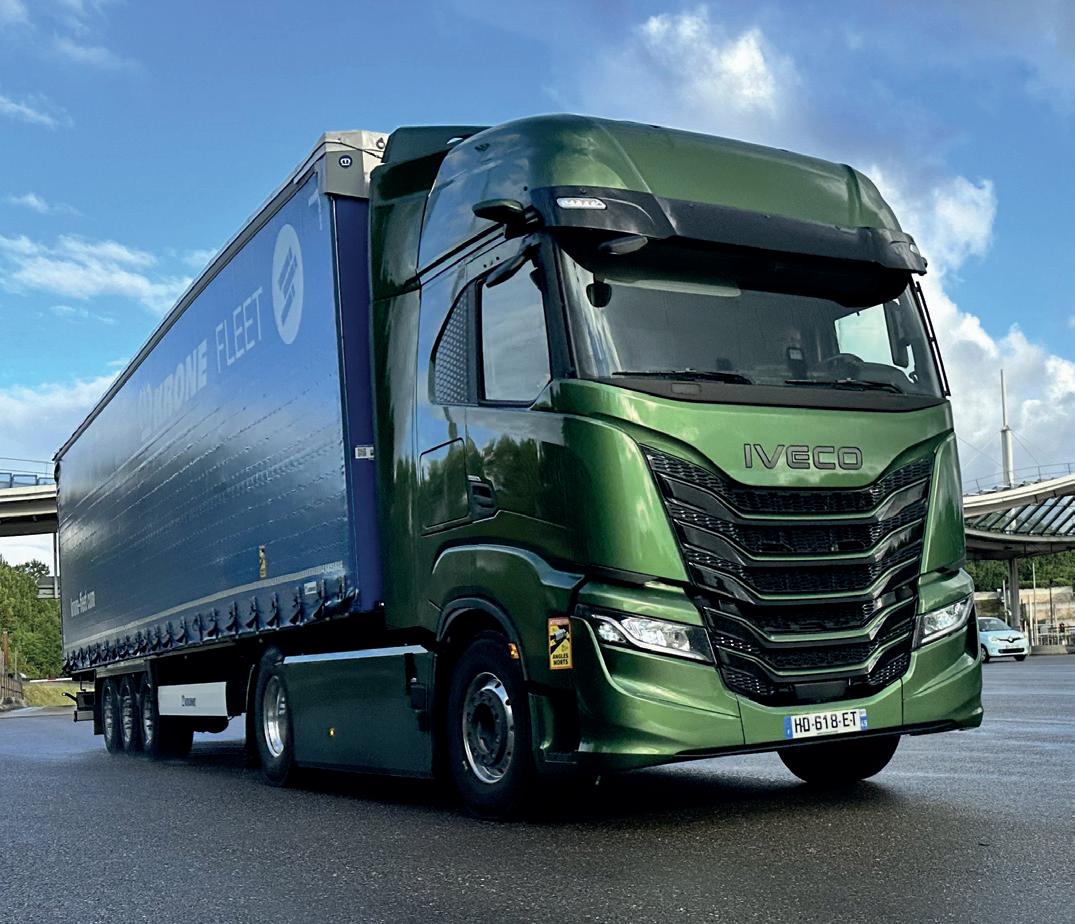
Iveco has demonstrated the outstanding performance of its gas-powered heavy-duty vehicles. Last summer, an Iveco S-Way CNG travelled over 1,000 kilometres on a single refill of compressed natural gas (CNG). The vehicles driven by the French journalists Fabien Calvet and Loïc Fieux took place between the Belgian and Spanish borders, under real-world operating conditions. The tractor towed a loaded Krone curtain-sided semitrailer with a gross combination weight of 30 tonnes, showcasing the S-Way CNG’s efficiency, endurance, and everyday practicality.
This milestone perfectly embodies our commitment to sustainable transport
The journalists highlighted the exceptional handling and driving comfort of the S-Way CNG. The vehicle’s High-Performance Engine Brake and Intarder hydraulic retarder delivered powerful endurance braking, while its full air suspension and new steering column enhanced driving precision and comfort.
The gas engine impressed with its smooth, responsive, and remarkably quiet performance. On-road handling was comparable
to that of a diesel model – but significantly quieter.
The result was an average consumption below 21 kg/100 km over more than 1,000 kilometres, combined with rapid refuelling, confirming the technological maturity and everyday viability of Iveco’s CNG solutions.
The tested model was powered by the xCursor 13 engine by FPT Industrial, delivering 500hp and 2,200Nm of torque. This latestgeneration gas engine is designed to meet the upcoming Euro VII standards and delivers optimal performance between 1,000rpm and 1,500rpm.
“This milestone perfectly embodies our commitment to sustainable transport that delivers both performance and profitability to our customers,” said Giandomenico Fioretti, head of alternative propulsion business development at Iveco. “With over 1,000km on a single refill, the Iveco S-Way CNG sets a new benchmark for range, efficiency and comfort, proving once again that natural gas is a real alternative to diesel for long-haul transport, driving the decarbonisation of road freight.” ❚
BELOW: The Iveco S-Way CNG proved its worth on a long distance test
The London Lorry Control Scheme (LLCS) is being boosted by a series of automatic number plate recognition (ANPR) cameras.
The LLCS is designed to manage the environmental impact of journeys made by heavy goods vehicles (HGVs) in London by restricting access to residential roads at certain times to minimise traffic and noise pollution. The scheme has been in place since 1985.
ANPR cameras will be deployed on specific routes where enforcement is required to support compliance with the LLCS. These locations have been selected based on traffic patterns, known issues with non-compliance and operational priorities. ANPR cameras automatically detect and record the number plates of HGVs using specific roads during restricted hours.
The change aims to deliver a more consistent, efficient and fair level of enforcement, as well
as provide London Councils with a better understanding of night time movement of HGVs during restricted hours.
London Councils is providing warning notices to hauliers for each location where cameras will be installed to help them manage the transition. Warning notices will be given for a period of two weeks at each new camera location.
Mayor Brenda Dacres, London Councils’ executive member for transport and environment, said: “The introduction of ANPR cameras will help the London Lorry Control Scheme make use of modern technology, supporting the work of enforcement officers on our streets and increasing compliance with the scheme across London.
“This change will allow enforcement to be applied more consistently, efficiently and fairly, as well as minimise overnight disruption to London’s communities, allowing Londoners to live in a cleaner, quieter city.” ❚
RHA freight platform offers host of benefits for Britain’s hauliers
A new digital freight platform that connects hauliers, logistics providers and freight customers across the UK has been launched by The Road Haulage Association (RHA) in partnership with Haulage Hub Technologies.
RHA Exchange is designed to help RHA members share capacity, post and find loads and manage work in a secure and transparent environment.
Members can post loads in real time, match them with verified hauliers, negotiate terms and manage bookings, all through one interface, helping them to reduce empty running.
“This partnership is about giving our members access to modern tools that make their businesses more efficient and competitive,” said Richard Smith, RHA managing
director. “We’ve listened to what our members need – more work, more visibility, less empty running and a trusted environment to trade loads. The RHA Exchange delivers on that.”
Security and compliance are central. All participants on the platform are verified RHA members, and transactions take place within a closed network. Smith believes this gives members the confidence that every load and partner meets the association’s standards for professionalism and safety.
Scott Robertson, co-founder at Haulage Hub Technologies, added: “The RHA Exchange has been designed around the everyday challenges of hauliers. We’ve focused on usability, reliability and trust, enabling members to find work quickly. ❚
Anew best-practice compliance guide, designed to support van operators navigating an increasingly complex regulatory environment, has been launched the Road Haulage Association (RHA).
The RHA Van Standard is aimed at businesses operating goods vehicles up to 3.5 tonnes gross vehicle weight, including operators who primarily run HGV fleets but rely on vans to support local, timecritical or specialist work.
In recent years, van operators have faced growing regulatory pressure, increased DVSA enforcement activity and confusion over how rules apply – particularly around drivers’ hours, working time, international operations and employment responsibilities, says the RHA.
The RHA Van Standard brings together the key areas operators need to manage effectively,
including driver requirements, vehicle maintenance, employment contracts, health and safety, working time and tachographs.
The guidance sets out some industry best practice and what would reasonably be expected of a professional van operator.
Richard Smith, managing director at the RHA, said: “Van operators are doing more than ever, often with tighter margins and greater scrutiny.
“We hear consistently that the rules can feel unclear, fragmented and difficult to navigate –especially for operators running mixed fleets or working across borders.
“The RHA Van Standard is designed to show what good looks like in practice, reduce uncertainty and help operators protect their businesses.” ❚
The RHA Van Standard is free to download at rha.uk.net
Road Angel is developing a new early warning system to help truck drivers avoid low-bridge strikes.
The road safety technology company has secured six-figure funding through Innovate UK for the new solution, which is expected to be deployed at known bridge strike locations and scaled nationally from Q3 2026.
The project will see warning technology installed directly on bridges at risk of being struck, triggering alerts to drivers inside the cab via a dedicated and free new Road Angel app, purely for trucks, providing a last-line warning.
Bridge strikes remain one of the most common and disruptive incidents involving HGVs and high-sided vehicles, often caused by incorrect routing, reliance on unsuitable sat-navs or unfamiliar roads.
Alongside vehicle damage and driver injury, consequences for
It seems as though every time a useful new innovation appears for vehicles, thieves find a way to exploit it. Keyless entry is a classic example. While it is a useful tool for drivers, it is now used by crooks to steal nine out of every 10 vehicles that go missing.
Now vehicle security specialist Tracker says new laws to clamp down on keyless thefts must be fast-tracked and enforced to end soaring levels of crime
Following a BBC report highlighting the growing trend of keyless vehicle theft, Tracker has released new data showing the company recovered over £35m worth of vehicles between January and October 2025, hitting a 15-year high.
More than nine in 10 (93%) of the vehicles recovered by the company were taken without the keys, underlining the scale of keyless car theft across the UK.
The Home Office is introducing new legislation to clamp down on this, but a date for the legislation is yet to be announced.
relay attacks and steal keyless vehicles are readily available online, and although the price is high, organised crime groups know the profit potential makes the upfront cost worthwhile.
fleets can also include insurance claims, missed deliveries and reputational harm.
Road Angel’s system uses low-power Bluetooth beacon technology mounted on bridges, paired with in-cab alerts delivered through dashcams and mobile technology. Crucially, it does not rely on GPS accuracy, mobile data connectivity, gantries, grid power or specialist in-cab hardware, making it a scalable solution for widespread deployment.
The project is being delivered within the wider Road Angel group, with the Innovate UK funding awarded to a group technology entity supporting development of the bridge-mounted alert system that will integrate with Road Angel’s in-cab safety technology.
Road Angel’s Gary Digva said: “Every bridge strike is preventable but only if the driver gets the warning at the right moment.” ❚
Mark Rose, managing director of Tracker, said: “As the BBC report confirmed, devices used to conduct
Without meaningful action, such thefts will continue
“Previously, prosecution for handling these devices was only possible if it could be proved by police that they had been used to commit a specific crime. Under the new laws proposed, anyone who is found in possession of one, or to have imported, made, adapted or distributed them, will bear the consequences and rightly so. Without meaningful action in the shape of robust legislation, such thefts will continue to rise unchecked, with more drivers becoming victims of these crimes and suffering the emotional and financial impact of that. The time for that action is now.” ❚
BELOW: Nine in ten stolen vehicles are taken by thieves bypassing keyless entry systems

Retread tyres can cut costs, emissions and waste, according to new research commissioned by Continental – but most truck fleets ignore this and fit new ones.
A survey of more than 700 UK-based fleets commissioned by Continental found that two thirds of respondents (66.9%) exclusively fit new tyres, even though more than half said mileage performance (56.7%) and purchase price (56.3%) were their top priorities when selecting tyres.
Concerns about quality and durability remain the main barriers, with 62.5% of respondents citing worries about retread quality and 46% questioning longevity. Only 2.1% said they use retreads exclusively.
Pete Robb, marketing director at Continental Tyres, said: “Retread tyres are a sweet spot for so many businesses. They can provide a
lower upfront purchase price and like-for-like mileage capabilities matching that of an equivalent new tyre.
“However, a historic reluctance to embrace retreads is pushing operators to use cheaper, sometimes single-use new tyres that will likely not offer the same operational benefits.”
Continental’s ContiLifeCycle facility in Devon produces up to 4,000 retreads a week, reusing casings to reduce raw material use and waste.
Michelin said its Remix retreads require only 20kg of new material compared with 70kg for a new tyre, saving up to six tonnes of CO2 emissions per 100 retreads.
Goodyear has reported a 56% reduction in crude oil use compared with new tyre production, while Giti Tire estimates each retread saves 68 litres of oil and 44kg of rubber. ❚
Firms are being urged to consider using rtetread tyres

The Government-backed HyHaul project, which was set to deploy up to 30 hydrogen fuel cell electric trucks, supported by dedicated fleet hydrogen transport systems and three refuelling stations, has been axed.
Announcing the project’s closure, HyHaul Mobility MD Kyle Arnold said it had been ‘unable to secure sufficient customer commitments for fuel cell heavy goods vehicles’. As a result, Arnold said that Innovate UK and the Department for Transport (DfT) have ‘ended a key grant, bringing
the programme to an end’.
The grant included five work packages: programme management, customer and fleet leasing, hydrogen refuelling infrastructure, data and digital and exploitation.
Arnold explained: “HyHaul Mobility successfully met expectations on all, except the customer and fleet leasing work package. Despite considerable effort from the consortium, Novuna was unable to obtain the required number of signed customer agreements needed to progress with fuel cell HGV orders.” ❚
Thermo King, a leader in transport temperature control solutions, has launched TK OneView, a new all-in-one fleet management platform for operators managing mixed fleets. Designed to simplify how managers monitor and oversee their fleet operations, TK OneView enables them to access and view consolidated data from vehicle usage, driver info, trailer EBS and TPMS systems, as well as tractor and refrigeration units data, regardless of the brand. The service gives fleet operators a holistic view of their refrigerated truck and trailer assets in real time.
Raluca Radu, portfolio leader for digital solutions at Thermo King Europe, said: “With TK OneView, we aim to simplify fleet management for our mixed fleet customers by offering consolidated, easy-toaccess insights across tractors, trailers and refrigeration units. By leveraging advancements in digital, connected technologies, we provide expert support and actionable intelligence to improve fleet efficiency, safety and decision-making.”
TK OneView acts as a single point of contact for streamlined services and personalised support from Thermo King’s dealer network. Fleet operators no longer need to rely on third-party integrators to aggregate and interpret data from their tractors, trailers, drivers and refrigeration units.
With TK OneView, operators gain real time access and visibility of:
• Tractor and refrigeration units
data – delivering unified access to critical operational information across all tractors and reefers in the fleet.
• Electronic Braking Systems (EBS), axle loads and Tyre Pressure Monitoring System (TPMS) data – supporting insightful fleet performance optimisation.
Driver Behaviour – enabling insights to improve safety and efficiency.
The launch of TK OneView reflects the increasing importance of digital integration in the fleet management sector. The platform was created in partnership with idem telematics, a leading provider of telematic solutions for fleet logistics and a subsidiary of the BPW Group.
“Maintaining a customercentric approach, Thermo King
We continue to meet evolving fleet needs and strengthen our role as a dependable partner
remains committed to simplifying fleet management processes and enhancing operational effectiveness by turning data into actionable insight,” added Radu. “We continue to innovate and to meet evolving fleet needs and strengthen our role as a dependable partner in advancing fleet management practices.” ❚
BELOW: TK OneView is a new fleet management platform for mixed fleets


The Big Logistics Diversity Challenge 2026 promises its most exciting edition yet, headlined by the debut of five all-new challenges that will test teamwork, strategy and creativity like never before. These fresh additions will sit alongside a host of returning favourites, offering a dynamic and engaging day that continues to champion the power of inclusive, diverse teams.
Now in its seventh year, The Big Logistics Diversity Challenge has grown into one of the most important events on the industry calendar. In 2025, more than 40 companies took part, including DHL Supply Chain, GXO, Kuehne + Nagel, Yusen Logistics, and the RAF Officer Training Academy. Organised by Nimble Media, the event is designed to promote equality, diversity, and inclusion (EDI) across the logistics sector through a series of team-based challenges that are physical, mental and practical in nature.
The 2026 event will introduce five new challenges, each offering a test of collaboration and problem-solving. In Bridging the Gap, teams must design and build a functioning bridge using only basic materials, race a vehicle across it and then bring it down in spectacular fashion. Memory Market puts observational skills under pressure, with teams asked to memorise and replicate a table of items without the chance to confer. Goggle Boules turns a simple precision game into a test of co-ordination and communication,
with participants wearing visiondistorting goggles. In Revenge of the Space Hoppers, teams bounce through a frantic relay to collect stars, combining chaos with camaraderie. Finally, The Great Diversity Bake Off sees blindfolded team members decorating gingerbread people with the help of a sighted partner - blending creativity with communication
More than 400 logistics and warehousing professionals are expected to attend this year
under pressure.
These new challenges will join returning favourites, including It’s a Knockout, Silent Disco, Catwalk Challenge and Bring on the Beans, delivered by Supporting Organisation RTITB. Together, they form the core of a day designed to celebrate the strength of diversity through shared experience and high-spirited competition.
Supported by Headline Sponsor UPS, more than 400 logistics and warehousing professionals are expected to attend this year. As well as delivering a memorable day of fun and team building, the event also supports industry charity Transaid, raising awareness and funds for life-saving work across sub-Saharan Africa.
Further details about this year’s challenges can be found at: https://biglogisticsdiversity.co.uk/ challenges ❚
BELOW: Flashback to last year

Paul Hollick, chief executive officer at driver coaching and engagement specialist Lightfoot, has welcomed the Government proposal to pilot a National Work-Related Safety Charter.
Hollick said: “Employers are uniquely positioned to influence safer outcomes, particularly with additional training, as most drivers have not had any further training since passing their tests. We applaud the Government in recognising that driving for work is stressful and demanding.
“For example, in the everexpanding last mile delivery sector, we see that safety is often being compromised to ensure deadlines and targets are hit. But there are many other examples like this when it comes to driving for work.
“Lightfoot’s experience across UK fleets has proved that engaging drivers must be at the heart of any effective road safety strategy and that policies and technology deliver the greatest impact when drivers understand and actively participate in initiatives.
“That’s why we support the Work-Related Safety Charter’s emphasis on good practice, accountability and culture change,
and the Government’s holistic approach to all aspects of road safety is the right strategy.
“We also believe the charter should place explicit emphasis on driver engagement, behavioural change and real-world outcomes, as these are the factors most closely linked to sustained reductions in work-related road risk. Every employer’s objective, as it is at Lightfoot, should be to get every driver home safely at night, and this aligns with the charter’s principles.” ❚
Engaging drivers must be at the heart of any effective road safety strategy
BELOW: Paul Hollick

A new one-day course designed to enhance people management skills is being launched by the Association of Fleet Professionals (AFP).
Part of the AFP Fleet Academy programme for 2026, ‘Accelerate – Navigating People Challenges’ consists of two modules. ‘Develop Knowledge’ focuses on increasing self-awareness as a leader while ‘Activate Knowledge’ provides practical tools to manage a team more effectively.
Ronnie Gillman, AFP training manager, said: “Fleet managers frequently tell us that managing teams can be a challenge. It consumes much of their time and
they find issues that arise often difficult to resolve.
“This course helps develop their skills to create better outcomes. Whether managing people is a new responsibility or something they’ve been doing for many years, it explores a range of different tools and approaches in a safe and supportive environment.
“Together, we will discuss how to find balance in the workplace by offering the level of support employees should expect from their manager while still ensuring people are performing effectively in the role for which they were employed.” ❚



Using driver training to deliver the Road Safety Strategy
The Government’s updated Road Safety Strategy sets a clear direction – fewer deaths and serious injuries on Britain’s roads. In 2024, an average of four people lost their lives each day. One in six road deaths in 2023 involved drink driving. Drivers aged 17–24 were involved in 24% of fatal and serious collisions, while motorcyclists accounted for 21% of road deaths.
The aim is to reduce deaths and serious injuries by 65% by 2035 through targeted action on speeding, drink and drug driving, seat belt use and mobile phone offences. For commercial operators, this demands more than policy awareness – it requires demonstrable competence and consistent standards.
Michelle Scott, director at compliance specialist, Total
Compliance, said: “A compliant workforce is essential, but risk management must extend beyond individual behaviour.
“Professional drivers of HGVs and PSVs operate vehicles capable of causing significant harm. Training must address hazard perception, defensive
Risk management must extend beyond individual behaviour
driving and safe interaction with vulnerable road users.
“That is why we have integrated immersive VR into our Driver CPC FORS VR Safe Driver and Lo-City course to strengthen judgement in practical scenarios. High-quality, experienceled training underpins safer, compliant transport operations nationwide.” ❚

• 96% advance for your invoices
• 4% gives your customers 60 days credit
• Improve your cash flow in 3 working days
•
•
•
•
•
•
• Selective factoring


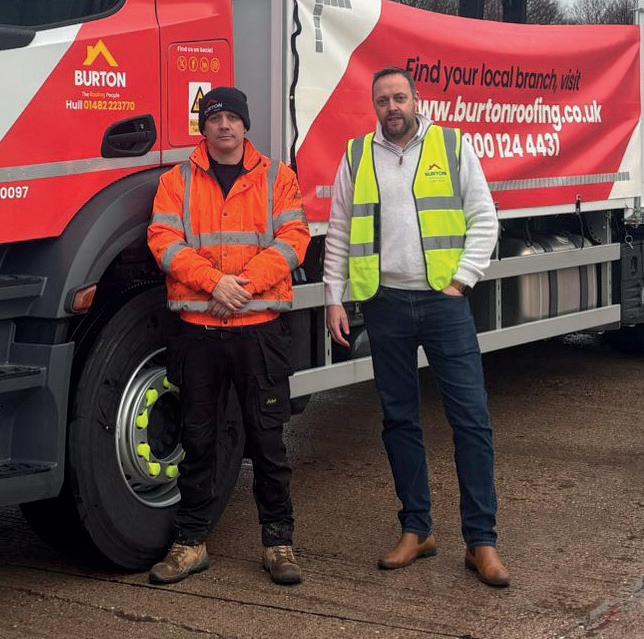
Motormax and Geotab partner with Burton Roofing Merchants
Burton Roofing Merchants, one of the UK’s largest independent roofing distributors, has strengthened fleet safety, compliance and operational efficiency across its national transport network through a major partnership with Motormax and Geotab.
Operating over 100 HGVs and LCVs across 37 branches, Burton needed a unified, single platform solution to enhance visibility, streamline compliance and support drivers following a period of network expansion and acquisitions. The company chose Motormax and Geotab to deliver a fully integrated package of camera technology, AI-based monitoring, driver alerts, and telematics.
Motormax provided a customised Safetymax system featuring multi-camera setups, AI driver-monitoring technology, sidedetection sensors, and left-turn alarms. The company also created specialised applications for crane, boom, and stabiliser-leg monitoring to ensure safe loading operations across the HGV fleet.
Geotab’s telematics platform offers near real-time access to
vehicle diagnostics, tachograph data, driver behaviour insights, and incident footage, enabling quicker reporting and more proactive fleet management. All data is consolidated on a single platform, replacing multiple legacy systems.
Martin Pollard, fleet and facilities manager at Burton Roofing Merchants, said:
“We needed a robust, scalable solution to improve visibility across our fleet and ensure compliance
We needed a robust, scalable solution to improve visibility across our fleet
with evolving regulations. The integrated solution with Geotab and Motormax has transformed how we manage safety and performance. We now have instant access to footage, data and analytics, helping us respond faster, support our drivers and strengthen operational control across the business.” ❚
BELOW: Martin Pollard, fleet and facilities manager at Burton Roofing Merchants

Insurance claims that should be simple often drag on for months, driving up costs through inflated hire charges, storage fees, repair bills, and legal disputes.
In the UK, defence costs can hit six figures, while vehicle hire and storage add hundreds more each day. With repair costs climbing over 40% in the past five years, every extra day a claim stays open makes the problem worse.






MANTIS Collision Insights accelerates claims with AI-driven reconstructions, helping you cut investigation costs, dispute false claims, and protect your bottom line.

Faster claims mean fewer disputes, lower legal spend, and reduced third-party charges.
By keeping claim costs under control, fleets improve their loss ratio and strengthen renewal negotiations, often securing better premiums.
With MANTIS Collision Insights, insurers get clarity, fleets get savings, and everyone benefits from quicker resolutions. See MANTIS Collision Insights in action today.



In today’s harsh trading environment, tax arrears have become a defining pressure point for UK businesses. Rising labour and utility costs, restricted credit, intense competition and slow paying customers have combined to stretch cash flow well beyond historic norms. For many otherwise viable firms, HMRC has quietly become the lender of last resort.
Against this backdrop, HMRC’s Time to Pay (TTP) facility has taken on renewed significance. Following the launch of PKF’s national Tax Arrears Solutions service in late 2025, the firm has already supported 22 businesses with combined HMRC liabilities exceeding £16.8m, safeguarding around 1,500 jobs in the process. The cases span construction, recruitment, healthcare and logistics and range geographically from London and the Midlands to the North West and South Wales – clear evidence that tax arrears are not confined to any one sector or region.
A pragmatic tool, not a tax holiday
Time to Pay is often misunderstood. It is not a loophole, a tax holiday or a friendly overdraft from the state. It is a structured concession that recognises a basic economic truth: cash-flow problems can be temporary, while tax liabilities are not.
Used properly, TTP can preserve businesses, protect employment and prevent the cascade of insolvencies that turns a manageable downturn into an economic loss. Used badly –or approached too late – it simply adds interest, penalties and stress to an already fragile situation.
At its simplest, TTP allows a business that cannot meet a tax bill on the due date to agree an instalment plan with HMRC. It most commonly applies to VAT, PAYE and Corporation Tax, though every case is assessed on its individual facts. The logic is straightforward: HMRC would rather recover tax over a sensible period than force insolvency and recover only pennies in the pound.
ABOVE: In the current climate, survival often depends less on optimism and more on action
However, the default expectation remains full and timely payment. Time to Pay is a concession, not an entitlement – and the process reflects that.
Experience shows that HMRC focuses on three fundamentals. First, evidence that the difficulty is genuine and temporary. One-off cash squeezes, delayed receipts, lost contracts or short-term cost spikes are credible explanations. Repeated requests supported only by vague assertions that ‘things are tough’ are not. Second, a realistic and deliverable plan. Instalments must be affordable and sustainable. HMRC has little interest in agreements that collapse within months and will often expect tax to be prioritised over discretionary spending. Businesses should also be prepared to explain what they are doing to improve cash flow,

If there is one recurring mistake, it is delay. Businesses often engage with HMRC only after missing deadlines, ignoring correspondence and allowing liabilities to snowball with interest and penalties. By then, trust has eroded, options are narrower and the total bill is higher. Early engagement is not just good practice – it is financially rational.
There is also a tendency to underestimate cost. Even where penalties are mitigated, interest continues to accrue. Time is not free, which is why early, informed advice can make a decisive difference.
whether through tighter credit control, cost reductions, supplier negotiations or additional funding.
Third, compliance going forward. Filing returns on time and keeping up with current liabilities materially increases the chances of HMRC agreeing to a TTP arrangement.
This is where specialist advice matters. Preparing credible financial information and presenting a proposal that HMRC can accept is very different from simply asking for more time.
One of the most consistent lessons from PKF’s work is that Time to Pay is rarely effective in isolation. Where margins are structurally weak, customers pay habitually late or costs are out of control, spreading tax debt over six or 12 months merely postpones a reckoning. In those cases, TTP risks becoming a crutch rather than a bridge.
The firm’s approach is therefore deliberately challenging as well as supportive – testing viability and, where necessary, pushing management to reshape the business model. That may involve improving operational efficiency, strengthening credit control, reducing overheads or raising additional working capital.
A case in point
One recent example involved a profitable construction subcontractor with HMRC arrears exceeding £1.6m. The debt arose from a combination of hardened market conditions, delayed projects, weather disruption and an ambitious diversification strategy that delivered
rapid growth but insufficient early returns. Cash flow was further strained by management capacity issues, overspending and inefficiencies. Matters were compounded when VAT repayments – common in the sector due to the reverse charge – were subjected to enhanced scrutiny following a sharp increase in refund values. More than £700,000 of VAT repayments were held by HMRC, while overdrawn directors’ loan accounts triggered additional Corporation Tax liabilities. With compliance already poor, the case was transferred to HMRC’s Debt Management and Insolvency Service and a winding-up petition loomed.
Following PKF’s intervention, management addressed the underlying operational and governance issues and presented a credible recovery plan. A six-month Time to Pay arrangement was agreed, safeguarding around 200 jobs and avoiding an insolvency that would have damaged the wider supply chain.
From HMRC’s perspective, Time to Pay is a pragmatic policy that recognises not all late payments are wilful and that forcing viable businesses into insolvency can be economically self-defeating. But pragmatism is paired with discipline. HMRC will work with businesses where difficulties are genuine and plans are credible. It will not underwrite poor management.
The message for business leaders is clear. If a tax payment issue is foreseeable, act early. Gather accurate numbers. Be realistic about what can be paid. Use Time to Pay as a tool to relieve short-term pressure while fixing the underlying problem – not as a way of avoiding it.
In the current climate, survival often depends less on optimism and more on action. Fixing the problem, rather than assigning the blame, may be the difference between recovery and collapse. ●
BELOW: There is clear evidence that tax issues are not confined to the transport industry

But all EV batteries should last the lifetime of the vehicle
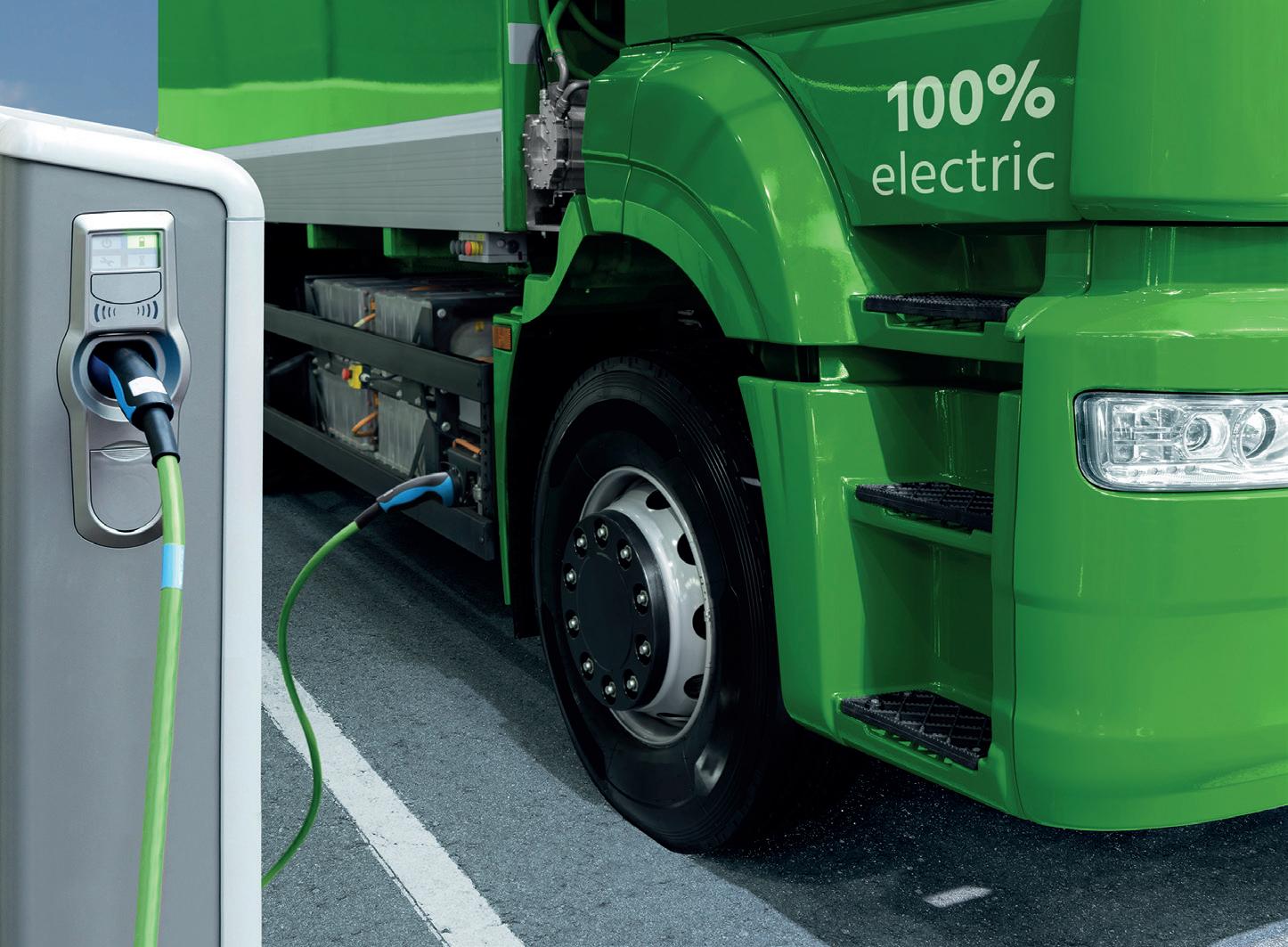
The batteries on electric vehicles that predominantly use ultra-fast charging to top up degrade at twice the speed of those that use ordinary chargers. That’s the finding from new analysis of 22,700 electric vehicles across 21 makes and models by Geotab.
However, the survey also concluded that whatever method of charging is chosen, vehicle batteries should last during normal fleet cycles without having to be replaced.
In its updated EV battery health study, the company analysed real-world battery health data from more than 22,700 electric vehicles across 21 makes and models, drawing on several years of aggregated telematics information. The updated analysis shows an average annual battery degradation rate of 2.3%, compared to 1.8% in Geotab’s 2024 findings.
EV lifespan can be a concern for both
individual drivers and fleet operators, particularly as adoption accelerates across commercial and public-sector fleets. By understanding how batteries age under different charging, climate and utilisation conditions, operators can better manage EV performance, protect battery health and make more informed decisions about vehicle deployment and charging strategy over the life of the vehicle.
Charlotte Argue, senior manager, sustainable mobility at Geotab, said: “EV battery health remains strong, even as vehicles are charged faster and deployed more intensively. Our latest data shows that batteries are still lasting well beyond the replacement cycles most fleets plan for. What has changed is that charging behaviour now plays a much bigger role in
EV battery health remains strong, even as vehicles are charged faster
how quickly batteries age, giving operators an opportunity to manage long-term risk through smart charging strategies.”
The analysis shows that charging power is now the strongest operational influence on EV battery health. Vehicles that relied heavily on DC fast charging above 100kW experienced faster degradation, averaging up to 3.0% per year, compared with around 1.5% for vehicles that primarily used AC or lower-power charging.
Other factors, such as climate, showed a smaller independent effect. Vehicles operating in hotter regions degraded around 0.4% faster per year than those in mild climates.
The data also challenges the need for strict day-to-day charging constraints. Vehicles that regularly used a wider state-of-charge range did not show meaningfully higher degradation unless they spent prolonged, habitual periods near full or near empty charge levels.
Higher-use vehicles showed slightly faster degradation, increasing by around 0.8% per year compared to the lowest-use group, but this is an acceptable trade-off relative to the operational and cost benefits gained from keeping vehicles in service. For many fleets, these productivity gains directly translate into a lower cost per mile over the vehicle’s life.
“For fleets, the focus should be balance,” Argue added. “Using the lowest charging power that still meets operational needs can make a measurable difference to long-term battery health without limiting vehicle availability.” ●













But

If technology and data are to deliver on their promise, fleets must be part of the system
The UK’s new Road Safety Strategy puts technology and data front and centre. That matters for fleets, because this is where the gap between policy ambition and realworld outcomes is widest.
The Government is right to focus on advanced safety systems, connected vehicles and better use of collision data. Human error plays a role in 95% of collisions. Technology already exists that can reduce that risk. For fleets, the question is how this technology is being adopted, and how quickly.
Fitting safety tech is not the same as using it
Mandating new safety features is a solid step. Automatic emergency braking, intelligent speed assistance and driver monitoring systems can reduce both the frequency and
The opportunity is there to turn everyday driving data into safer roads

severity of collisions.
The UK’s decision to align with the EU’s General Safety Regulation 2 (GSR2), requiring a new baseline of in-vehicle safety technologies, reflects that direction of travel. But fleets know that technology left unused, misunderstood or overridden delivers limited value.
There’s some work to do by OEMs and fleets as Advanced Driver Assist Systems (ADAS) only have value when drivers trust it, understand it and use it as intended.
In practice, that trust is uneven. We see a wide variation in how drivers interact with the same systems, even within identical vehicles. Some rely on them correctly. Others disable alerts, misread interventions, or compensate in ways that increase risk.
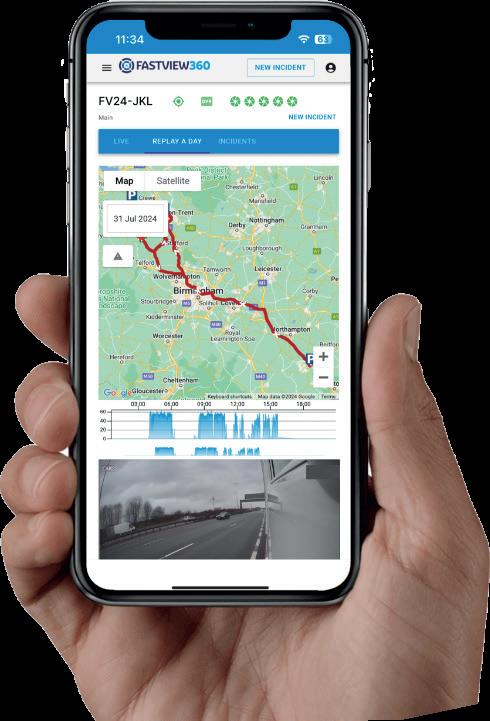
This is where visibility matters. Video and sensor data, including dash cams, give fleets and drivers a shared view of what actually happened. When used properly, they take subjectivity out of safety conversations. Drivers can see why a system intervened, or why it did not. Managers can focus on facts rather than blame.
As a result, safety performance now depends as much on data and training as hardware. Telematics shows how ADAS behaves in real conditions, where it intervenes and where gaps remain.
Combined with contextual video, that insight builds driver trust, supports targeted coaching and helps fleets close the gap between how safety systems are designed and how they are really used on the road.

Near misses matter more than collisions
The strategy proposes a Road Safety Investigation Branch and better linkage between police and health data. That is long overdue. But fleets already sit on a richer, faster-moving safety dataset.
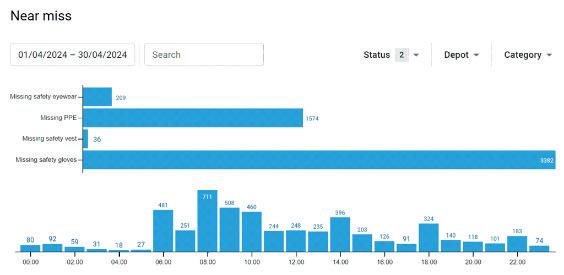
Harsh braking, speeding, fatigue indicators and repeated near misses happen thousands of times before a serious incident.
Fleets can see this today, across millions of miles, without waiting for formal investigations. Using near-miss data shifts safety from reactive to predictive. It allows operators to identify high-risk routes, times and behaviours early.
It also helps local authorities and road operators understand how roads perform in practice, not just how they were designed. If the
Government wants the Investigation Branch to succeed, fleet data has to be part of the picture from day one.
Linking vehicle data with health outcomes, as proposed, also improves how safety measures are judged. It moves the focus from damage to vehicles toward the impact on people, which is where it belongs.
Fleets can move faster than policy
The strategy sets targets for 2035. Road safety decisions happen every day.
But meanwhile, fleet control vehicle choice, technology configuration, driver standards and operating conditions. That makes them the fastest route to measurable safety gains.
It also makes them the test bed for what
ABOVE: Human error plays a role in 95% of collisions
works before regulation follows. Treating telematics and vehicle data as safety infrastructure is how safety stops being a compliance task but rather an operational discipline, with clear metrics and accountability.
If technology and data are to deliver on their promise, fleets must be part of the system, not subject to it. The opportunity is there to turn everyday driving data into safer roads, better policy and fewer families affected by preventable collisions.
Road safety progress stalled when the system stopped learning fast enough. Technology gives us the chance to fix that – and fleets can lead the way. ●
The recent Road Haulage Association Parliamentary Reception brought together parliamentarians, industry leaders and stakeholders to promote driver welfare and facilities across the UK.
The event showcased the RHA’s new ‘Guide to Maintaining Driver Health – Keeping Drivers Fit for the Road’, which supports operators to better help their driver colleagues with their health and wellbeing.
Moreton Cullimore, RHA chair, opened the reception and paid tribute to the lorry, coach and van drivers who move people and goods amid difficult conditions. He said they’re asked to do this in conditions that fall well short of what would be expected in other workplaces.
Recruitment and retention challenges and cost pressures are ongoing issues for transport operators working on paper thin margins, he said, and reflected on the work the RHA has done to improve understanding with decisionmakers.
“We have been persistent, evidence-led and constructive, and that approach has delivered
some quality results. We must be honest about the challenges that remain and the need for continued engagement to address them.”
Guests also heard from Keir Mather, Parliamentary UnderSecretary of State at DfT, who praised RHA members and the wider industry for their role in supporting the economy. Rachel
We must be honest about the challenges that remain and the need for continued engagement to address them
Taylor MP, Freight and Logistics
APPG chair, updated on industry and government efforts to tackle freight crime including a recent BBC One documentary involving the RHA.
MPs also signed an open letter to the Prime Minister which calls for improved welfare facilities for HGV and coach drivers ahead of the National Planning Policy Framework changes coming into place. ❚
BELOW: The RHA Parliamentary Reception (from left): Moreton Cullimore, Keir Mather MP and Rachel Taylor MP

The Road Safety Trust has released details of its forthcoming Large Grants round, with funding of up to £200,000 for innovative and high impact on the UK's roads.
The trust is an independent grant-giving organisation which supports projects and research that make UK roads and streets safer for all users.
It has now released details of the Spring 2026 Large Grant programme, which will open in early April. Applicants will be invited to bid for funding relating to one of two themes:
Preventing harm linked to drugimpaired driving and motorised riding, or • Safer vehicles
These themes align with priorities set out in the UK Government’s National Road Safety Strategy, which emphasises tackling the use of drink and drugs and also highlights the role of technology, innovation and data in improving vehicle safety.
Funding of between £50k-£200k per project will be available out of a total budget of around £750k and, with not long to go until the round opens, prospective applicants are encouraged to start thinking about their bids now.
Louise Palomino, grants
and impact director at The Road Safety Trust, said: “It’s important to us that any project or intervention that we fund can make a demonstrable difference to preventing harm on our roads and making them safer for all users –and the publication of the National Road Safety Strategy further strengthens the case of innovative and high impact approaches.
“I look forward to seeing the proposals that are submitted for consideration once the round opens in the spring.”
Following a successful pilot with its Autumn 2025 Small Grant round, the trust will once again adopt a two-stage application process which will offer prospective grantees early feedback on their proposal, and then additional guidance for those invited to submit full bids.
Applications are welcome from UK-based organisations only, with public sector bodies, professional associations, registered charities and university departments among those encouraged to apply. ❚
Further details about the themes and what they will be looking for in the proposals can be found at roadsafetytrust.org.uk
A massive number of vehicles are driving around in Britain with illegal number plates, according to a new report from the AllParty Parliamentary Group for Transport Safety (APPGTS), which blames an outdated and poorly regulated number plate system for widespread illegality.
It has created a rapidly growing crisis that enables criminals and organised crime groups to operate undetected on UK roads, lets dangerous drivers off the hook, poses serious safety concerns, and leads to a significant loss of public funds, it says.
The report follows a cross-party inquiry into vehicle registration plates, with new technology recently revealing that more than 4,000 non-compliant plates identified in a single location in Birmingham in just two weeks.
Ghost plates look normal to the naked eye but are rendered unreadable to ANPR cameras by a transparent film or raised digits made of non-compliant materials, or the careful altering of specific characters.
Cloned plates are also a growing worry, according to data from Transport for London (TfL). ❚

Eliminate the stressful and time-consuming job of manually chasing, collecting and downloading driver cards and vehicle unit tachograph data
Let the NEW Tachomaster DOT device remotely download your tacho data daily. Monitor driver availability, work, drive and rest periods live and massively reduce driver infringements.
With zero upfront costs, no additional sim card charges and pay as you go. What have you got to lose?
£14.95 PER VEHICLE PER MONTH REMOTE TACHO DEVICE
£5MORE PER VEHICLE PER MONTH(OPTIONAL) ADD VEHICLETRACKING FOR
It’s no secret that women are underrepresented, particularly in leadership roles

Areport from the Institute of the Motor Industry revealed that just 17.5% of the sector’s workforce was female – and this proportion has declined in recent years.
I’ve been in the automotive business for 24 years, working under the Auto Windscreen brand. Over the years, I’ve noticed our working environment changing from a very male-dominated space to one in which an increasing number of women are going into more senior roles.
Lack of female role models
Within the automotive sector, there’s been a lack of mentorship for women, which has limited
their ability to see ways to develop their careers and identify paths into senior leadership roles.
The industry has traditionally been seen as a male environment. But as time has gone by, more and more women have been prepared to get involved and take on every role available.
Automotive 30% Club
That’s why it’s important that companies in our sector join the Automotive 30% Club.
The club comprises more than 70 automotive CEOs and MDs who have committed to be inclusive leaders and build diverse, genderbalanced businesses.
It enables members to share inclusive
ABOVE: There is a need to change the perception of the automotive industry as male-dominated
The industry has traditionally been seen as a male environment

ABOVE: There’s a lot more work flexibility now, particularly in working patterns
leadership practices, values and policies to tackle the sector’s skills deficit and get its career paths on the radar of wider recruitment markets.
Members also learn about successful initiatives that their peers have implemented, so they can adopt similar recruitment and retention practices to support women in their career progression.
Instead of assuming that the automotive industry can cater for women by simply tweaking or adapting pre-existing initiatives designed for men, the club recognises that the sector needs to develop a plan to specifically increase diverse female representation.
Ways of realising this objective include ensuring that organisations no longer inadvertently exclude women through their use of language and imagery, working practices or culture.
When you look at the automotive sector overall, you find that there’s a lot more flexibility now, particularly in working patterns. We know that some parents can’t always work unsociable hours, so businesses have to adapt their processes accordingly. They need to offer shifts that go beyond nine-to-five, weekend or out-ofhours working.
To support flexible working, at Auto Windscreens we’ve introduced 84 different shift patterns and these are designed to accommodate individuals’ external commitments.
Hybrid working is another way to support gender diversity. Employers can ask their
employees to come into the office for a certain number of days a week, which gives them a greater ability to manage their family commitments outside of work.
Maternity leave and term-time working
Women returning from maternity leave, particularly in senior positions, are often reluctant to request switching to working parttime. The industry can support these mums by proactively giving them the option of part-time work or job shares.
Similarly, progressive employers can help their female colleagues even further by organising their shift patterns around school terms. Building a pattern of work for mums that allows them to be at their place of work during term time but away during the long summer
holidays means they don’t have to worry about finding alternative childcare or take time off work unpaid.
Addressing the challenges
One of the key issues to address is the lack of female technicians within the industry. The role of technician is often seen as purely manual – lifting heavy windscreens, for example – but we have the tools to support women with the physical nature of the work. More importantly, to be a successful technician you have to deliver great service and communicate efficiently with the customer.
This is dependent on soft skills, not gender, so there’s a big opportunity here for the sector to promote itself to anyone interested in a public-facing role.
Auto Windscreens is walking the walk here by currently employing four female technicians – including the first female apprentice in the industry to complete the Level 3 apprenticeship programme – and a female apprentice.
We’ve also been keen to demonstrate leadership in this area by employing women in senior roles such as head of sales, contact centre manager and service centre manager.
We currently have 12 service centre managers and eight supervisors who are female, while 80% of our sales team are women.
Ultimately, we need to actively work to change the perception of the automotive industry as male-dominated by developing communication campaigns that highlight the diverse range of careers available to women. ●
BELOW: One of the key issues to address is the lack of female technicians

Transport chiefs have long been aware of the dangers of their staff drinking and driving. But drugdriving is proving to be just as much of a menace – and harder to spot.
While it will probably be fairly obvious if a worker is under the influence of alcohol, someone who has taken amphetamines or cocaine is likely to dodge under the radar –until a crash or an accident in the workplace happens.
Now worrying new figures from the Ministry of Justice (MoJ) reveal a concerning rise in the rate of drug-driving reoffending, prompting calls for urgent reforms to the system. Instances of this have surged by more than 134% in the last four years according to road safety charity IAM RoadSmart.
In 2024 there were 3,193 instances of drug-driving reoffending, compared to 1,363 recorded offences in 2020.
Nearly half of drug-drive offences (44%) are committed by a reoffender, according to Government data. One person committed the offence when they had 18 previous drink and drug-driving convictions. IAM RoadSmart says the system is broken and in need of urgent reform.
When police suspect a person of drug-driving, they will conduct a roadside screening test such as a swab which can test on the spot for cannabis and cocaine.
They may also perform a Field Impairment Test (FIT) and ask the driver to perform physical tasks to assess co-ordination such as walking in a line or standing on one leg. A person will be arrested if they fail the FIT, or if the officer still suspects driving is impaired by drugs. The offender will then be taken to a police station and asked to provide a sample of blood or urine for laboratory analysis.
One of the reasons that reoffending is rife could be because of delays of up to six months to process blood tests, which means people who have failed a roadside test are allowed to continue to drive. Some of those drivers have
gone on to kill while their results are pending.
The backlog has been acknowledged in the Government’s new Road Safety Strategy, which proposes giving police powers to suspend the driving licences of those suspected of committing a drug-driving offence.
Exploring alternative methods for drug-driving evidence collection and sampling is also on the table. Australia has been using immediate roadside evidential saliva sampling for nearly two decades, combining this with laboratory testing for rapid case resolution.
William Porter, IAM RoadSmart’s policy, public affairs and communications manager, said: “The system for dealing with drug-drivers hasn’t kept pace with the huge increase in reoffending. The fact that those who have tested positive to a roadside test are allowed to get back into the driving seat pending a laboratory blood test shows that the system is broken. We welcome the proposed government shakeup and would like to see an immediate suspension when a driver has provided a positive roadside saliva drug test.
“We also need to see the introduction of a drug-drive rehabilitation course with better
screening for drug and mental health problems and with clear pathways to treatment. Drugdrivers often need support to break the pattern of reoffending by changing their mindset and habits, understanding how drugs impair driving, and the serious consequences for themselves and others.”
Research conducted by IAM RoadSmart in 2025, through a survey of 2,053 UK motorists, found that 82% support a proposal to give police powers to suspend driving licences immediately pending trial for those testing positive for drug-driving.
Separate figures show that drug-driving on the whole is increasing: 20,072 people in England and Wales were sentenced for drugdriving offences in 2024 – 143% higher than in 2017.
A conviction for drug-driving carries a minimum one-year driving ban, an unlimited fine and up to six months in prison.
While the drink-drive rehabilitation scheme has been in place for 25 years, no such national scheme exists for drug-drive offenders although trials are being been undertaken. ●
BELOW: When police suspect a person of drugdriving, they conduct a roadside screening test


• Outstanding mileage
• Even wear
• Excellent all-season performance
Anew truck survey at UK motorway service areas has revealed that some transport operators are lacking a systematic fleet management approach to tyres.
The study, organised by TyreSafe, revealed a divide in tyre compliance, with a low adoption rate of proactive technology and knowledge gaps among commercial drivers.
The data was gathered from tyre checks conducted by International Tyres and Trading, with assistance from Truck Tyre Solutions and BTMA members Goodyear, and Michelin, at Exeter and Lymm motorway service areas.
The research covered 186 vehicles and trailers and collected more than 1,320 individual tyre readings.
TyreSafe said the targeted checks exposed a contrast between policy-driven national fleets and smaller, owner-operated businesses. Only 11% of the 66 drivers surveyed confirmed they use an in-cab TPMS monitoring solution. Some 21% admitted to relying on visual checks to monitor tyre pressures.
The data showed a high level of training among drivers from large fleets, who quoted their total operating cost-driven (TOC) replacement policy rather than the 1mm legal minimum. While 100% of drivers were aware of their daily legal obligation to check their vehicle, the survey highlighted that 38% were unaware of their fleet’s formal tyre fitment policy. A further 38% did not know the legal minimum tread depth for an HGV tyre in the UK (1mm).
Rich Allen, commercial director at International Tyres and Trading, said: “What we saw on the ground at Lymm provided immediate, visible proof of the risk disparity. Where we saw policy in action, we saw quality fitment and trained drivers.
“But among the smaller fleets and owneroperators, we found a high degree of technical complacency – mixed brands, cheaper rubber and errors like using steer tyres on trailers.
“For these operators, their lack of policy is likely to lead to mismatching of tread depths or load ratings and an overall reduction in handling capability.
“It is likely that tyres are being purchased directly on price for immediate savings. However there is a growing correlation between that trend and an increase in Total Cost of Ownership with higher rolling resistance (increased fuel consumption) during a reduced lifespan (lower mileage capability).”
Darren Lindsey, CEO of the British Tyre Manufacturers Association (BTMA), added: “The data confirms that the industry is divided.
Without a robust retreading policy in place itmeans these fleets are effectively throwing money away
BELOW:
There is a low adoption rate of proactive technology and knowledge gaps among commercial drivers

Where strong policies exist – often driven by the need to preserve the valuable tyre casing for retreading – compliance is excellent, running to standards well above the law.
“We urge smaller operators to understand that without a robust retreading policy in place it means these fleets are effectively throwing money away, sacrificing future cost savings and compromising safety by running rubber down to the limit.”
Stuart Lovatt, chair of TyreSafe, said: “The 11% TPMS adoption rate is a significant red flag. For smaller, regional fleets operating in hazardous urban or construction environments, tyre damage is a daily reality, yet these operators are the least equipped to detect it early.
“Relying on a quick visual check is a high-stakes gamble; by the time a tyre looks under-inflated, the internal structure is often already compromised beyond repair. This is the definition of a false economy.”
He continued: “We urge operators to move beyond the ‘bare minimum’ mindset. Whether through digital tools or enhanced driver training, the goal must be to identify damage –like cuts to cords or incorrect load applications – before they become fatal failures or costly roadside prohibitions.”
Lisa Scott, regional road safety programme manager for the North West at National Highways, said: “Safety is our top priority. While it’s encouraging to see high average tread depths on vehicles on our roads, the knowledge gaps and the low adoption of in-cab monitoring are concerning.
“A vehicle that is prohibited at the roadside due to a defective tyre is not only a danger but is causing avoidable disruption to the network.
“Road safety is a shared responsibility and we fully support TyreSafe’s call for all operators to treat tyre maintenance as a critical, nonnegotiable part of their operational safety culture.”
To improve safety and reduce operating costs, TyreSafe recommends moving beyond just a quick look, ensuring fitness for purpose, prioritising damage prevention over replacement, bridging the knowledge gap and evaluating monitoring solutions.
Moving beyond a quick look entails drivers being trained to specifically look for cuts to cords and sidewall bulges.
Ensuring fitness for purpose means operators must ensure tyres are correctly matched for the vehicle’s specific load requirements and
Operators must ensure tyres are correctly matched for the vehicle’s specific load requirements

operating speeds to prevent premature fatigue and heat-related failure.
TyreSafe said drivers need to be aware that tyres marked ‘FRT’ are designed specifically for trailer or non-steering axles. Prioritising damage prevention over replacement means drivers understanding the difference between a minor repairable puncture and a major internal failure.
Bridging the knowledge gap ensures every driver understands that the 1mm legal limit is a minimum, not a safety target.
TyeSafe and its partners are urging operators to adopt a “safety margin”, replacing at a higher threshold than the legal minimum, to maintain handling and braking performance, particularly in wet or urban conditions.
Evaluating monitoring solutions encourages operators to explore how monitoring technology (like TPMS) can provide a “safety net” against slow punctures and overheating. ●
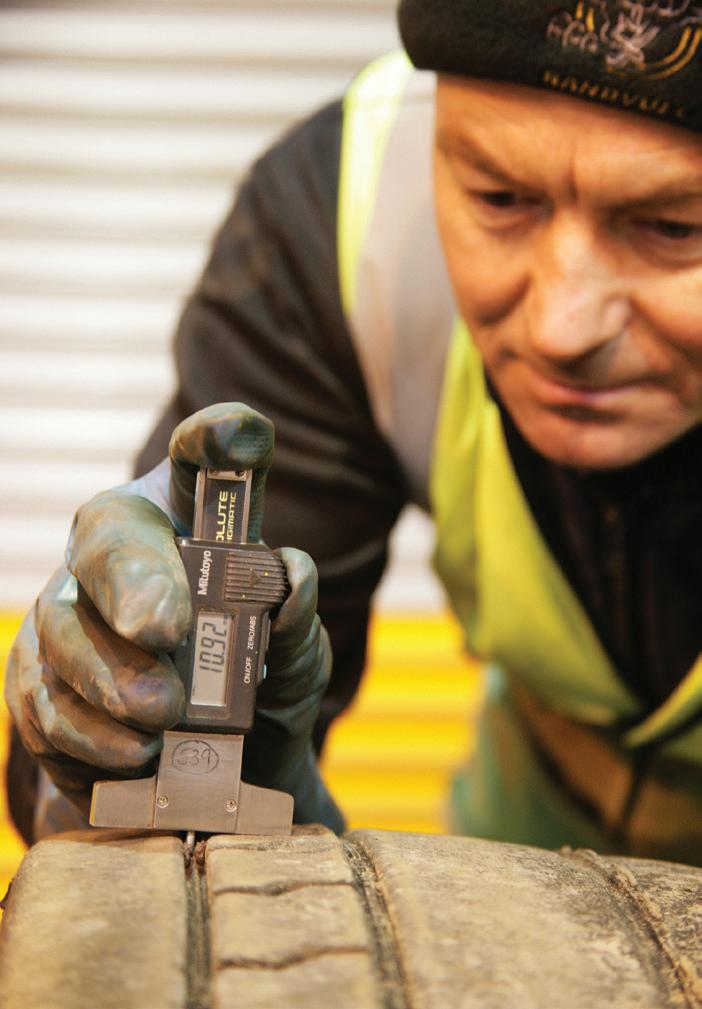

Lack of a systematic fleet management approach to tyres will lead to greater risks on the road
Governments and EU institutions still lack even a common definition of what constitutes a work-related road collision
Eurocrats in Brussels are being urged to take action on work-related road safety after warnings from The European Transport Safety Council (ETSC) about widespread failures to prevent road deaths.
Work-related road deaths account for between 30 and 40% of all road deaths in major European markets. Now, a major new report by the ETSC reveals that thousands are killed every year in collisions linked to work activities – yet it says that governments and EU institutions still lack even a basic common definition of what constitutes a work-related road collision.
The report, titled ‘Tapping the Potential for Reducing Work-Related Road Deaths and Injuries’, reveals that at least 2,922 people died in work-related incidents annually in the EU between 2020 and 2022 and 43% of all such deaths occurred in the transport sector, including road transport.
Data from 16 European countries shows that work-related road deaths account for between 30 and 40% of all road deaths – but the ETSC says official numbers are distorted by inconsistent reporting, missing data and incompatible national definitions. In France, work-related road deaths represent 42% of all road deaths; in Ireland 29%, Italy 16%, Germany 10% with one country reporting just 2%.
No definition
Despite this, 10 countries still have no national definition of a work-related road collision and fewer than half record the purpose of a journey in police crash reports. In most EU countries, police data, employer reporting and occupational safety systems remain completely disconnected and the ETSC said the ‘fragmented and underestimated picture obscures the true scale of the problem’.
Antonio Avenoso, executive director, warned that work-related road deaths represent a ‘systemic failure that Europe continues to ignore’. He said: “Professional drivers, riders, commuters and the public are dying because employers, national governments and the EU treat road risk
at work as someone else’s problem. It is time for political leadership.”
The report shows that work-related road deaths span professional drivers, workers on or near the road, professional travellers, commuters and third parties – meaning anyone can be a victim of their own, or someone else’s work-related risk. Professional drivers face pressure from long hours, fatigue and time constraints. Commuting remains one of the most dangerous parts of the working day in Europe. Yet employers’ responsibilities vary dramatically across countries, and legal obligations often do not explicitly cover driving for work.
The ETSC also reported that the lack of harmonised data makes meaningful prevention
It also warns that employer reporting obligations are inconsistent and often exclude self-employed workers and third parties.
And data sources – police, Occupational Safety and Health (OSH) authorities, insurers, coroners – are not linked, leaving large gaps in understanding causes and solutions.
Immediate action
ETSC is calling for immediate action from the European Commission, the European Parliament, member states and public authorities. It wants action at an EU level that includes the adoption of a common EU definition of work-related road collisions covering professional drivers, workers on the road, commuters and third parties.
Drivers are dying because employers treat road risk at work as someone else’s problem
much more difficult. Among the European countries covered by the report, 20 have a definition for a work-related road collision; 10 do not. Only 13 countries include journey purpose in police reports.
The ETSC also called for an extension to the EU’s Common Accident Data Set to cover journey purpose for all road users, including pedestrians and cyclists.
And it wants EU institutions mandated to implement work-related road safety management programmes and procure only Euro NCAP 5-star vehicles across all fleets.
Other calls include bans on the use of all mobile phones while driving, especially work-related use and the inclusion of ‘safe workers’ under the social clause of EU public procurement legislation, so that reducing road risk becomes a recognised requirement in public procurement in the 2026 review. ●



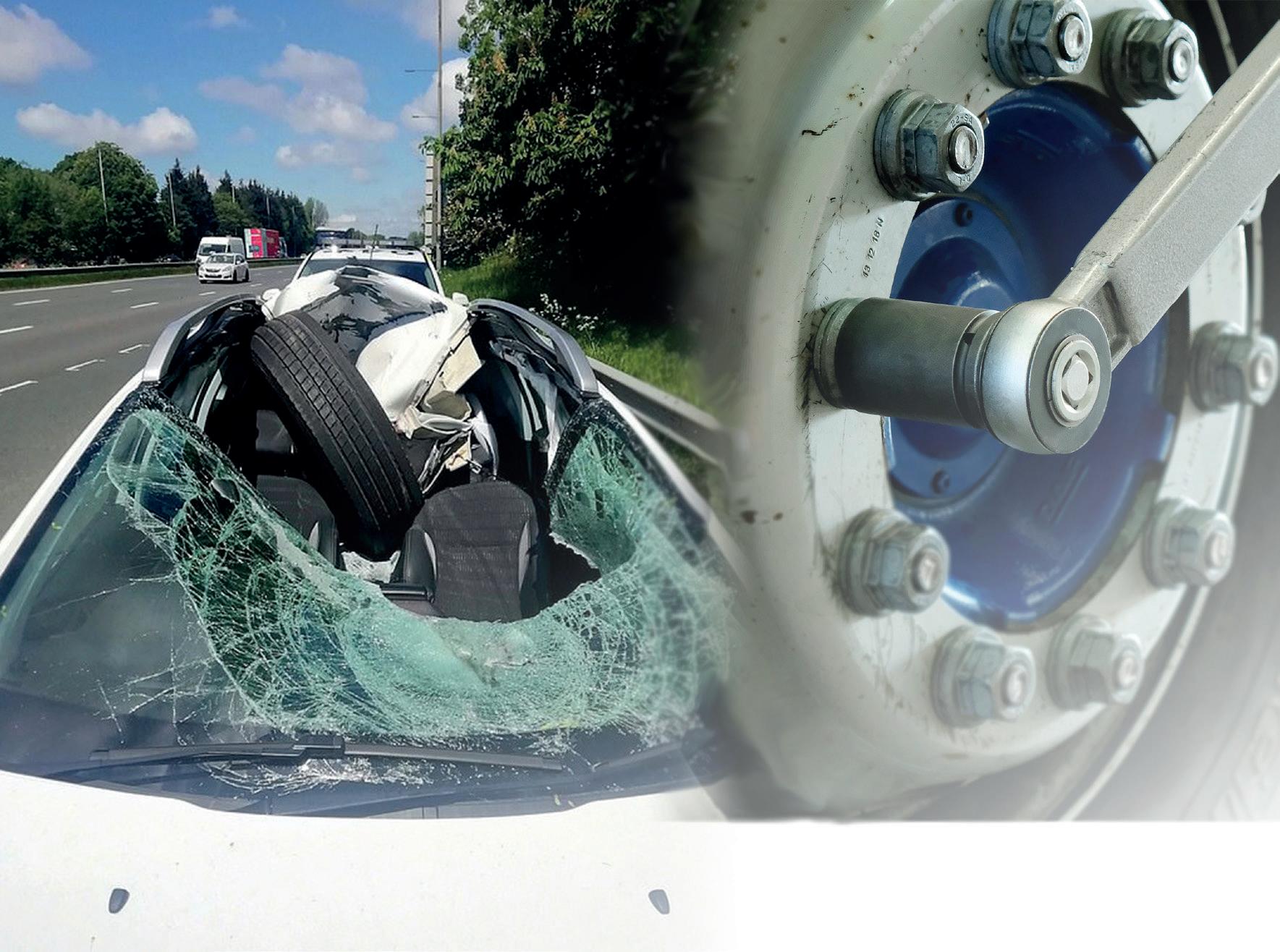
Truck drivers and their transport managers are being warned that they are about to be hit by a new wave of AI-powered scams.
Front Line Sales Consultancy (FLSC) has highlighted ‘red flags’ in fake HM Revenue & Customs and Driver & Vehicle Licensing Agency calls as scammers deploy voice cloning, fake numbers and urgent payment tactics.
According to FLSC, fraudsters are increasingly using AI-generated voice cloning, highly polished scripts and spoofed phone numbers to impersonate trusted organisations such as HMRC and the DVLA, making scam calls harder than ever to detect.
An FLSC spokesperson said: “Traditional scam calls were easy to spot – robotic voices, poor audio quality and obvious pressure tactics. In 2026, that’s no longer the case. We’re seeing calls that sound calm, professional and convincingly human, sometimes even mimicking official tones or familiar voices. That’s what makes these scams so dangerous.”
FLSC warned that AI voice cloning is changing the scam playbook. Fraudster now need only a short audio sample – often taken from social media videos, voicemail greetings or leaked data – to generate realistic voice clones. These calls may include natural pauses, emotional language and confident responses designed to disarm scepticism.
“In some cases, people are being told they owe tax, face licence suspension, or must act immediately to avoid penalties,” the spokesperson added. “The urgency is deliberate. Scammers rely on panic rather than logic.”
Tactics include:
• Fake HMRC calls claiming unpaid tax, missed filings or legal action unless immediate payment is made
• Bogus DVLA calls or messages threatening fines, licence suspension or vehicle seizure
• Caller ID spoofing, where the number appears to match a legitimate government helpline
• Follow-up texts or emails sent after a call to add credibility and push victims to click links or share details
FLSC stressed that HMRC and the DVLA do not demand payment, personal data or banking details via unsolicited phone calls.
Red flags include:
• Pressure to act immediately, especially around deadlines or penalties
• Requests for payment or personal information over the phone
• Threatening or fear-based language, including legal action or account suspension
• Resistance to verification, such as discouraging you from hanging up and calling back
• Over-polished or scripted responses that fail when challenged with unexpected questions
“Caller ID alone means nothing anymore,” the FLSC spokesperson said. “If a call feels urgent, emotional or pushy, that’s usually your cue to stop and verify independently.”
In case of scam calls, FLSC recommends the following steps:
Hang up and contact organisations directly using official numbers from trusted websites
• Never share bank details, passwords or onetime codes on unsolicited calls
Be cautious of follow-up messages that reference a recent phone conversation
• Speak to friends, family or advisors before taking action if you’re unsure. ●
The urgency is deliberate. Scammers rely on panic rather than logic

Many logistics firms say they are not confident that phase-out dates for diesel vans and heavy HGVs will be met
Anew report from Logistics UK has highlighted the growing gap between government decarbonisation targets and the logistics sector’s readiness for them.
It says there is low confidence across the logistics sector and insufficient support, particularly for smaller operators who form the backbone of the industry.
The report, ‘Powering Change: Building a Credible Plan for Decarbonising Road Logistics’, reveals that 80% of industry stakeholders are not confident the phase-out dates for diesel vans and heavy goods vehicles (HGVs) will be met.
Concerns are driven by a lack of confidence that there is sufficient support for the sector to switch to zero-emission vehicles. Over 85% of respondents express low confidence in the availability of suitable public charging, more than 80% disagree they can install chargers with sufficient capacity at their operating sites and around 60% feel there is insufficient guidance and funding.
In response, the report calls for a credible road map for logistics decarbonisation, planned through a co-owned industry and crossgovernment roadmap.
Lamech Solomon, head of decarbonisation policy at Logistics UK, said: “The date to end the sale of internal combustion engine vehicles is now less than 10 years away for the lightest road freight vehicles and under 15 for the heaviest. Road logistics stands at a critical juncture on the pathway to decarbonisation.
“The urgent need to reduce emissions and address climate change is not in question: the sector is committed to decarbonising and across the sector we see investment in infrastructure, adoption of battery electric vehicles, largescale trials of battery HGVs and greater use of low carbon fuel. Yet there is no avoiding

the reality that operators consider the current technology and policy landscape confusing and fragmented.”
The report highlights the resilience and determination of the industry to meet the need for low-emission logistics: diesel use is predicted to drop to 50% by 2030 from current use of 80% through increased use of low carbon fuel, as well as a rise in battery electric vehicles.
ABOVE: The government is driving the agenda towards net zero but many transport firms say they are not ready for the big changes ahead
freight and its associated activities account for 18.4% of the £170bn the logistics sector contributes each year to the UK economy and 80% of UK freight travels on roads at some point on its journey to the end-user.
For an industry that operates on slim margins, the cost of the transition
is currently considered prohibitive
“Road freight is critical to the UK’s way of life,” said Solomon. “Some 4.8 million light commercial vehicles and over half a million heavy goods vehicles operate on UK roads, delivering essential goods for consumers and businesses across the UK and beyond. Road
“Electrification will be central to decarbonising road freight but for an industry that operates on slim margins, the cost of the transition is currently considered prohibitive. We all have an incentive for the transition to be delivered economically: logistics costs are embedded in all products so how much it costs for the sector to decarbonise, and how it affects supply chains, will impact us all.”
The report identifies government policy mechanisms such as prioritising grid connections at logistics hubs and ports, extending the ZEHID programme, targeted financial support for logistics operators, clear national guidance for managing the connection process supported by distribution network operators (DNO) and scaling up use of low carbon fuel as key enablers to help the sector achieve its decarbonisation goals. ●
Mercedes-Benz calls for action after survey reveals the pressure of hours alone behind the wheel
Van and truck manufacturer
Mercedes-Benz is calling on transport operators to have a greater focus on staff wellbeing after its new survey found long distance driving to be one of the most lonely jobs of all.
The study of 2,000 UK workers found delivery and long-distance drivers reported spending the most time alone – up to 15 hours per week – but only 17% feel lonely at work, having built up a strong network in their profession.
Topping the list of loneliest jobs was farmers, who spend an average of 13.7 hours alone during a working week. More than one in four (27%) say they feel lonely at work.
Mercedes-Benz carried out the research to highlight the scale of driver loneliness and the toll on driver mental health and wellbeing.
The average driver spends 13.7 hours alone at the wheel during a typical week. Now the manufacturer is calling for more conversations in the workplace.
The research – carried out by Opinium –reveals that calling or checking in on a loved one and sharing a tea break with a teammate are among the biggest benefits of good mental wellbeing at work.
Yet fewer than half (43%) of drivers stop to have a chat during a break with a colleague. And the days of checking in on ones nearest and dearest and the traditional phone call home’ are over. Only 12% of UK workers call their partners once a day from work.
The average person last spoke to their partner on the phone 13 days ago, while one in five (21%) call home once a month or less.
More than half (53%) said they would only call them if they needed something urgently, or in an emergency.
Research also showed that loneliness affected employees working from home (20%) and those based in an office equally (20%), while workers on the move – such as van and delivery drivers –were slightly more affected (25%).
Time to Talk Day 2026 encourages people across the UK to start simple, open conversations about mental wellbeing to help break stigma. Led by organisations including Mind and Rethink Mental Illness, the day highlights how small actions, such as talking with a friend, colleague or family member, can make a real difference.
As the number of commercial drivers continues to increase amid the rise in e-commerce, the research shows many are feeling the impact of spending long hours at the wheel. Nearly half (49%) have fewer than five conversations a day, while 46% do not spend more than five minutes per day in one person’s company.
More than one in four (28%) said they experience more anxiety about speaking to
A single meaningful conversation can have a huge impact on someone’s mental wellbeing
other people at work than they did a year ago, as a result of having fewer social interactions.
Iain Forsyth, managing director of MercedesBenz Vans in the UK said: “A single meaningful conversation can have a huge impact on someone’s mental wellbeing, especially if they’re spending long hours at work alone.
“To support Time To Talk day, Mercedes-Benz Vans in the UK will be encouraging colleagues to take a break, a walk or reach out to a loved one, friend or colleague to check in.” ●
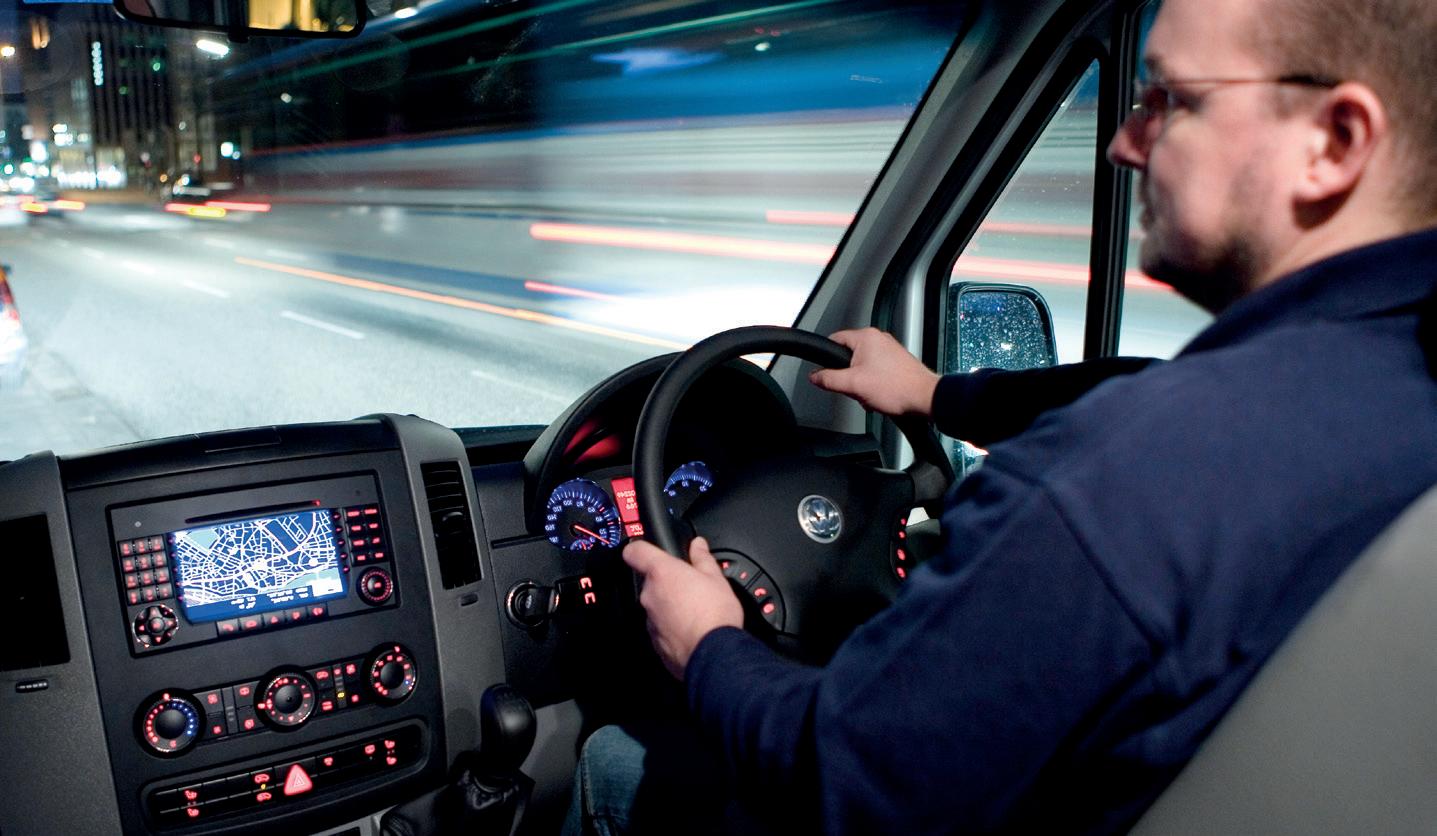

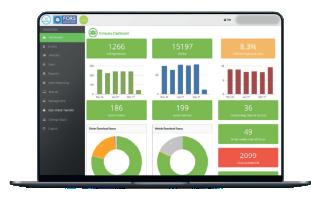
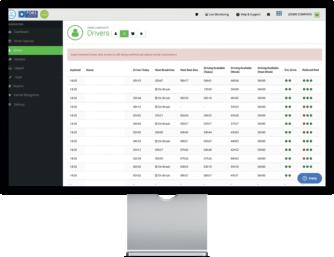

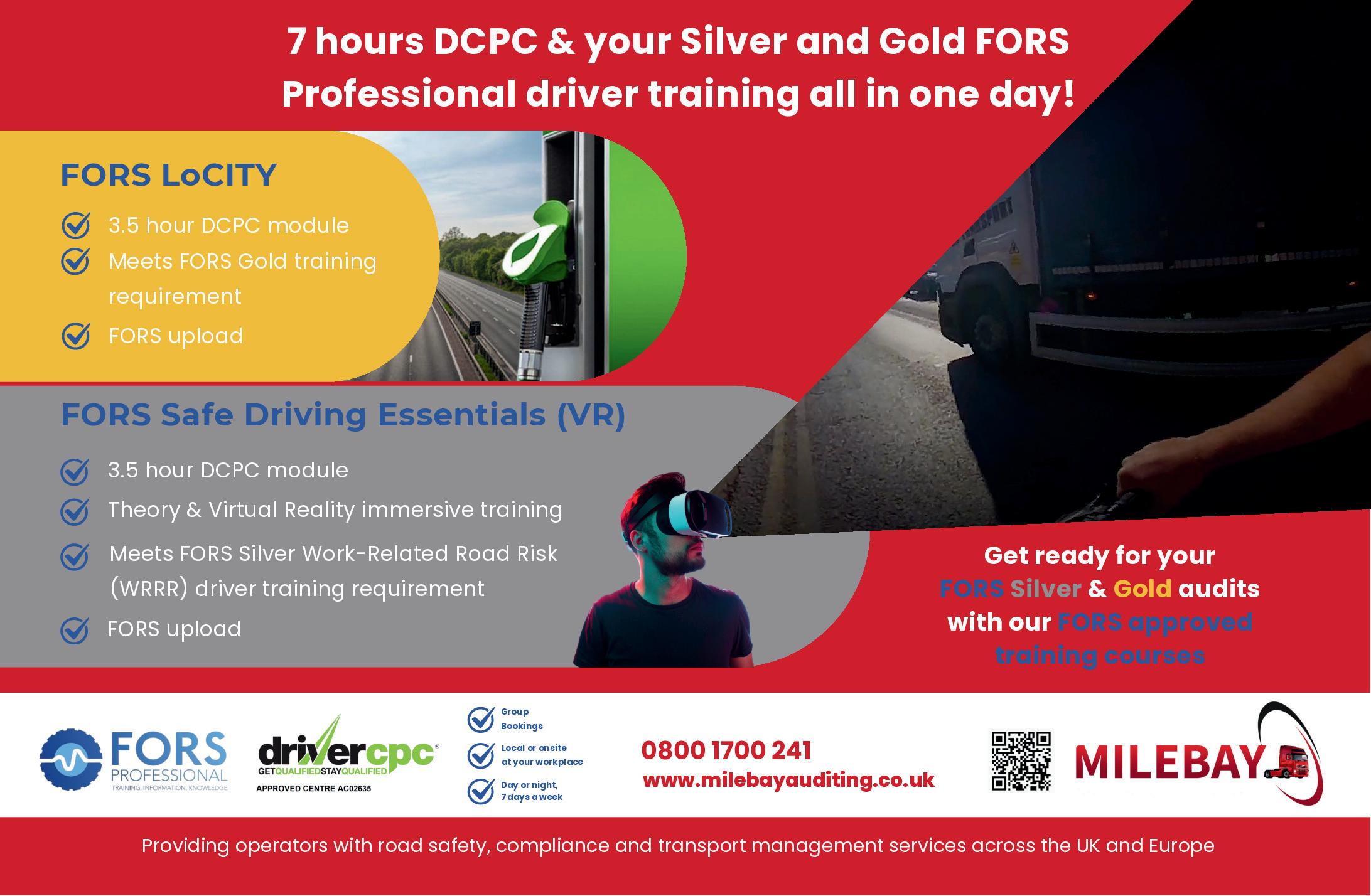
Canny operators are turning to the latest systems to ensure they are legally compliant

Digital transport management systems allow operators to eliminate paperwork, promote efficiencies as they expand and generally cut running costs across their businesses.
They also give greater visibility of daily transport operations, helping managers look into individual vehicle performance, eliminate recurring defects, control parts and labour costs, as well as make time savings.
For example, bulk earthworks contractor Wordsworth Excavations has become a more data-driven operation and has improved backoffice efficiencies since adopting a transportmanagement system (TMS) from HaulTech. Based in Barnsley, South Yorkshire, the company operates 45 tippers: mainly eightwheeler rigids plus some articulated vehicles and two all-electric trucks.
The company had always relied on a paper ticket system but that was not now ideal for its diverse and busy fleet.
It also faced issues such as being unable to read a driver’s handwriting, or tickets getting lost, as well as difficulties improving on time management because it had no visibility of data.
In addition, it had no idea how productive each wagon and driver were until the end of the day when the tickets came back to the office. Using software from HaulTech, Wordsworth has moved its operation from a paper-based jobmanagement system to a digitised one.
Jason Thorp, compliance manager at Wordsworth Excavations said: “On a big job, we can be managing 150 loads a day going in and out. In the past, the admin time to manually input all of those tickets might be 90 mins. HaulTech can do it in less than 10 mins and the results are more accurate. The simplicity of the
ABOVE: Digital transport management systems are making transport safer and more efficient
By identifying problems and likely causes, we can fix things quickly and ensure vehicle downtime is minimised
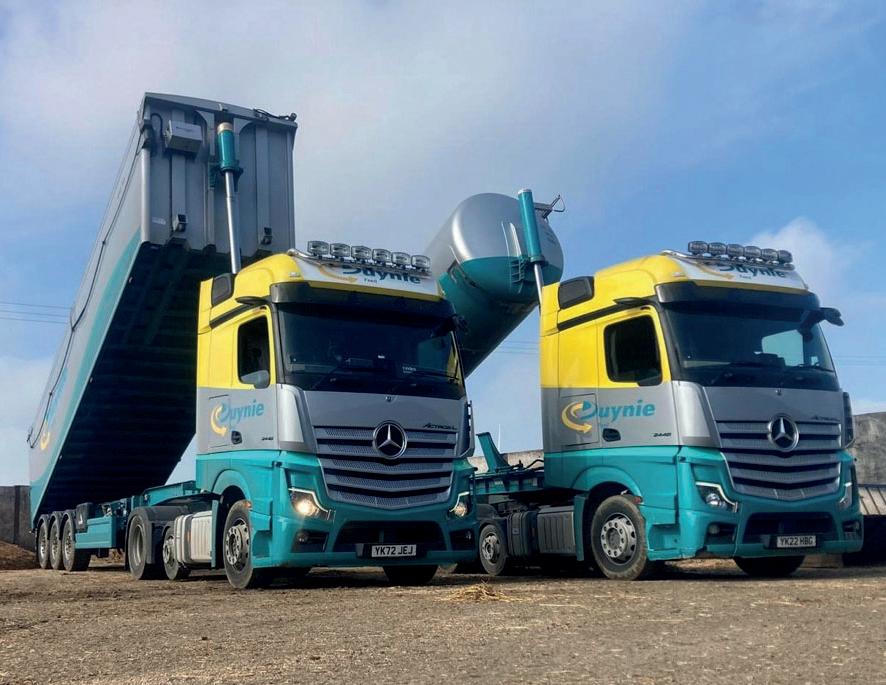
ABOVE: Duynie says consolidating all compliance functions has improved accuracy, reduced administration time and provided managers with instant access to information
BELOW: Heavy haulage specialist J.C. Gillespie has adopted logistics software from Podfather
system made it easy for our team to embrace.
“With clear instructions and real-time updates, the drivers were able to see the value right away – whether it was tracking their loads, optimising their routes, or receiving instant feedback.”
Also, the decision by Manchester-based heavy haulage specialist J.C. Gillespie to adopt logistics software from Podfather has helped it remove all paper from its operation.
This has involved hundreds of sheets every day being replaced with digital job lists, realtime updates, and automated invoicing.
At the start of each shift, drivers complete a comprehensive vehicle check, including the capture of pre-defined photographs, before they can access the day’s job details.
Incoming jobs are recorded up to a daily cut-off point and then allocated to drivers, with details automatically shared to the driver’s mobile device, via the Podfather app.
Once on-site, drivers record their arrival time on the digital job sheet and capture additional information including date-, time- and location-stamped photographs, and signatures – together with details such as on-site delays, differences between expected and actual outcomes, and damage reports. This information is shared with the back office in real time for customer reporting and billing.
Vehicle checks are also repeated at the end of the working day and recorded using Podfather.
In addition, J.C Gillespie is using the Podfather system to improve the health and safety of its workforce through compulsory vehicle checks, and to manage and report on its accreditation for fleet management schemes such as FORS.
Michael Gillespie, managing director of J.C. Gillespie said: “With our old system, it could literally take days, if not weeks, for job sheets to make it back to the office for pricing and invoicing. That is assuming the paperwork was filled in correctly and didn’t get lost in transit.
“Now, using Podfather, we can invoice within minutes of the delivery being made – this is good for the drivers, good for the business, and good for our customers.”
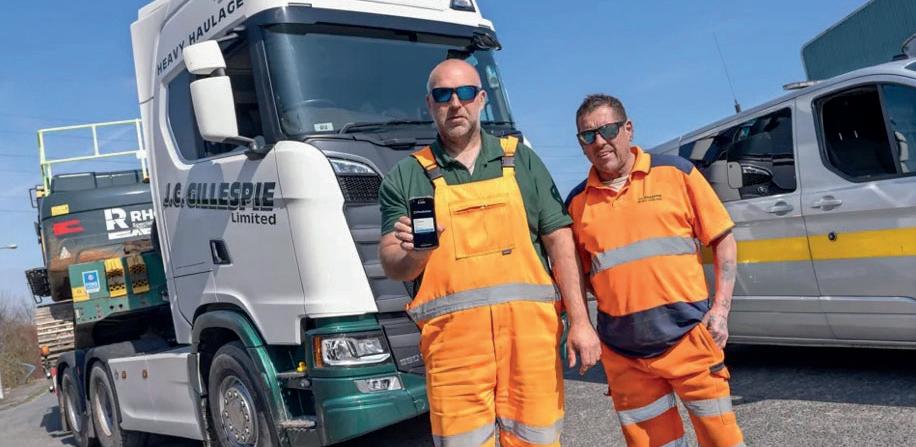

Meanwhile, the engineering department at Nottingham City Transport (NCT) has become fully digital, with a Freeway system managing the workshop, stores, and compliance.
NCT’s engineering staff are equipped with rugged tablet devices including an app that allows quick, easy entry of data to replace traditional job sheets, inspection reports, timesheets and other paperwork. The app also synchronises in real time with a central Freeway system that manages the maintenance of NCT’s fleet of 282 buses.
Backed with photographs, the digital reports allow engineers to quickly decide if a vehicle is safe to operate.
Also, when buses return to the depot, the cabin is inspected for lost property, cleanliness and damage such as vandalism, with details recorded digitally.
In addition, the system gives NCT a complete picture of each asset including servicing schedules, MoT dates and outstanding defects.
Huge savings
Sean O’Sullivan, Head of Engineering at NCT said the automation provided by Freeway is saving the organisation the work of about five people across its workshops – worth between £150,000 and £200,000 every year. He added: “With the mobile app, driver defect reports are sent directly to Freeway. That means we can quickly adjust workshop schedules and resources to minimise disruption to services. What’s really impressive with Freeway is that everyone can access the history of maintenance work – by whom and when, the parts used, and so on.
“That’s really useful for identifying recurring defects and parts performance issues.
“By quickly identifying problems and likely causes, we can fix things quickly and ensure vehicle downtime is minimised.”
Castleford-based Duynie Feed, a specialist in co-products from the food, beverage, and biofuel industries, has also adopted AssetGo’s digital fleet and driver compliance platform.
The operator now uses the full system covering daily vehicle checks, inspections, accident reporting, cost tracking and driver licence checks, which has tightened its driver compliance management and helped it control its fleet data better.
Duynie said that consolidating all compliance functions has improved accuracy, reduced administration time, and provided managers with instant access to information when required.
Anthony Price, UK logistics manager at Duynie, said: “AssetGo provide us with a system which allows the management of the vehicle and driver compliance to be kept in one place.
“Being digital cuts admin time, reduces errors and allows greater accuracy and immediate access to data for monitoring and if any Driver and Vehicle Standards Agency (DVSA) inspections are required.”
It is clear that over the coming years, transport operators looking to improve efficiency and reduce costs will increasingly switch to digital fleet management technology. ●
Article originally published in Transport Newsbrief from the Society of Motor Manufacturers and Traders.
By quickly identifying problems and likely causes, we can fix things quickly and ensure vehicle downtime is minimised








Our talking alarms are probably the safest type of warning system because of their unique directional qualities and the ability to say exactly what the danger is
These alarms are available as standalone alarms such as, “Stand well clear, vehicle reversing,” to complete systems where we provide the complete solution
• Dual voltage 12-24 volts
• Epoxy sealed
• Pressure washable - IP67
• Single bolt fixing
• CE & emc marked







With shipment volumes set to increase, delivery windows tightening and customer expectations rising, drivers could be placed under increasing pressure to meet the demand
Even a small delay early in the day can cascade into a backlog of missed ETAs, leading to customer frustration and longer working hours, all of which heighten an already significant stress burden on the workforce and test legal drivers’ hours limits.
Findings from Geotab's 2025 survey, ‘The Unseen Toll: Driver Stress and Road Safety’, reveal that 90% of European commercial vehicle drivers say work-related stress negatively impacts driving. Bad news for a sector already
grappling with a driver shortage and escalating levels of work-related stress among vehicle operators.
Here Andrew Tavener, head of fleet marketing EMEA, Descartes, gives his advice on how transport operators can reduce driver stress and ensure they continue to operate efficiently over the coming months.
The current state of play Geotab's survey of 3,501 commercial vehicle drivers across Europe, including 500 from the

UK, highlighted that 46% have considered quitting their jobs in the past year due to overwhelming stress. These findings demonstrate a workforce operating at its limits. And as demand grows through the final quarter of the year, these pressures are likely set to intensify.
Some of the contributing factors to driver stress include having unrealistic delivery schedules. For instance, half of the drivers feel compelled to regularly exceed speed limits to meet delivery deadlines. As well as this, 64% of
LEFT: Some 46% of truck drivers have considered quitting their jobs in the past year due to overwhelming stress
The onus is now on businesses to be proactive and use the integrated solutions available to tackle the factors contributing to driver stress

achievable delivery plans that eliminate the need to break speed limits or extend their working hours.
automatically. This not only helps to manage expectations by providing early visibility of any changes to arrival times but keeps the customer happy too. Ultimately, selecting to use modern routing and scheduling software will increase operational efficiency and contribute to a healthier work environment for drivers; which is a win-win for fleet operators, no matter the time of year.
As Geotab's survey shows, the pressure on UK drivers is a very real concern and will have far-reaching implications if allowed to reach a breaking point.
So, for fleet operators preparing for peak seasons, the best way to maintain performance is to prioritise those who make the deliveries possible – the drivers.
By using intelligent routing solutions, businesses don’t just get a technology upgrade. They get a strategic investment to aid their workforce’s wellbeing and retention rates.
drivers stated that excessive traffic or roadworks hinder their ability to complete jobs efficiently.
Perhaps the most shameful statistic though is that over half of drivers (55%) feel uncomfortable approaching their employer about stress or mental health concerns, and 37% report that their employer offers minimal or no support in managing these issues.
There’s no doubt that over the coming months, drivers will experience more fatigue from having to juggle more stops per shift. This, combined with the fact that drivers have less room for recovery between shift patterns, could lead to burnout. The result without intervention? The sector could be looking at a deeper crisis among its drivers in a sector that is already feeling the pinch.
How technology can reduce driver stress
Addressing the challenges at hand requires a multifaceted approach, with technology playing an important role. For example, modern routing and scheduling software enables organisations to relieve the pressure on fleets and drivers by introducing more structure to fleet operations, as well as visibility and control in managing daily delivery commitments.
This technology uses real-time data to allow for more efficient routing that takes into account traffic patterns and road conditions. It then uses an intelligent background optimisation engine to create realistic and
Integrated platforms also facilitate better communication between drivers and dispatchers, enabling timely updates and support. It is also recommended to find a function that comes with proactive notifications too.
This allows customers to be notified of any delays and changes to the delivery schedule
The onus is now on businesses to be proactive and use the integrated solutions available to tackle the factors contributing to driver stress. The rewards are clear. Better driver retention, enhanced safety, and improved customer service; something every business should be looking to achieve at this point in the year. ●
BELOW: Integrated platforms also facilitate better communication between drivers and dispatchers

New figures show a worrying slowdown in the number of people being trained to fix and

There is a worrying picture of slowing investment in training for zero emission vehicle repairs, with just one in four UK technicians qualified to work on electric vehicles.
Projected EV demand could exceed supply by more than 44,000 technicians by 2035.
The latest data from the Institute of the Motor Industry (IMI) shows that only 26% of the UK technician workforce was EV qualified at the end of quarter three 2025, equating to 71,942 technicians. At the same time, the number of technicians gaining an EV qualification in Q3 dropped nearly 13% compared to Q1.
And latest IMI analysis predicts even lower EV certifications for Q4, with around 2,580 new certifications expected.
Future EV uptake also looks set to outpace technician training, as OEMs push EV purchases in their rush to meet ZEV mandate targets in the run-up to the 2030 ICE ban and beyond.
Although IMI projections show the number of
ABOVE: Britain is facing a huge shortfall in the number of technicians who can work on electric vehicles
EV-qualified technicians will rise over the next decade to reach around 137,000 by 2032 and 193,000 by 2035, the gap between supply and demand is currently set to widen sharply in the early 2030s. Shortfalls are due to emerge from 2033 onwards and increasing year-onyear, reaching more than 44,000 technicians by 2035.
Such a skill shortage will mean the growing population of EV operators are likely to find it harder to get their vehicles serviced and repaired by qualified experts, especially in certain areas of the UK.
Emma Carrigy, head of research, policy and inclusion at the IMI said there was a strong risk of a ‘postcode lottery’ as the second-hand EV market grows.
“It is vital that EV owners and those who
It is vital that EV operators have confidence that their vehicle can be safely, affordably and conveniently serviced
aspire to become one, have confidence that their vehicle can be safely, affordably and conveniently serviced throughout their lifetime. A visible, qualified and geographically distributed service and repair workforce is therefore a critical enabler of sustained EV adoption. Employers need urgent support from government to ensure EV drivers don’t face a postcode lottery for servicing and repairs.”
Carrigy warned that it was now too late for even sustained growth in certification to fully close the gap. “The most acute pressure on technician capacity falls in the years leading up to 2030, when the ZEV mandate needs a rapid increase in electric vehicle sales. This creates a narrow window for employers to scale training and bring more technicians into EV repair roles. Delays during this period will be difficult to recover later, as the skills gap compounds alongside rising vehicle volumes.”
The industry group is calling for further action to explicitly recognise automotive servicing and repair skills as part of the EV transition infrastructure. This includes embedding workforce capability into EV policy design, supporting large-scale upskilling of the existing workforce, and ensuring clear, recognised competence and safety standards for work on safety-critical, high-risk and securitysensitive vehicle systems across the sector. ●





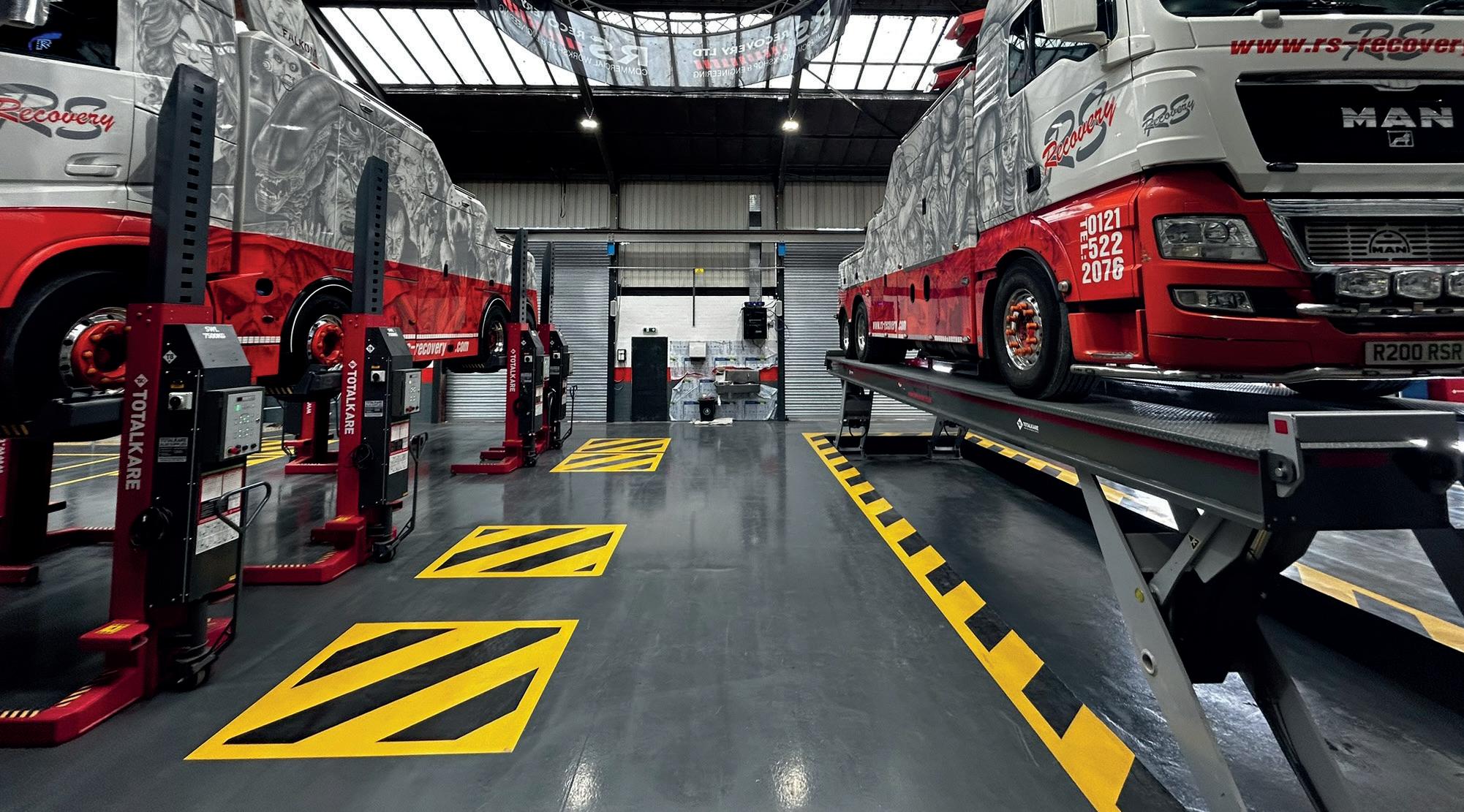

It marks a significant shift in how road risk will be addressed across policy, enforcement and industry
January 2026 saw the Department for Transport release a new Road Safety Strategy, setting out the Government’s vision for improving safety on Great Britain’s roads. This is the first comprehensive national strategy for over a decade and represents a significant shift in how road risk will be addressed across policy, enforcement and industry.
At its core, the strategy sets out ambitious long-term outcomes, aiming for a substantial reduction in fatal and serious road traffic collisions by 2035. Particular emphasis is placed on protecting younger road users, with enhanced targets for children and young people. The strategy built around four key priorities:
Supporting road users
Focusing on education, skills and behaviour, with proposals aimed at improving driver competence at both ends of the age spectrum. It includes measures to strengthen learning and training for new drivers, alongside proposals that consider vision and cognitive capability for older motorists.
Using technology, data and innovation
The Government intends to make greater use
of vehicle technology, data sharing and postcollision analysis to better understand why incidents occur and how they can be prevented. This includes improving how collision data is collected and analysed to inform future policy development and enforcement activity.
Safer road infrastructure
Renewed commitment to safer road design and management, with infrastructure improvements intended to reduce risk, particularly for vulnerable road users. This includes reviewing guidance, standards and the role of local authorities in delivering safer road environments.
Stronger and more effective enforcement
The strategy places enforcement at the centre of road safety, recognising its role in deterring dangerous behaviour and improving compliance. This includes reviewing how penalties are applied and ensuring enforcement approaches remain effective and proportionate.
What does the strategy mean for operators?
The Road Safety Strategy sets out several proposals with direct implications for commercial vehicle operators and fleet managers namely:
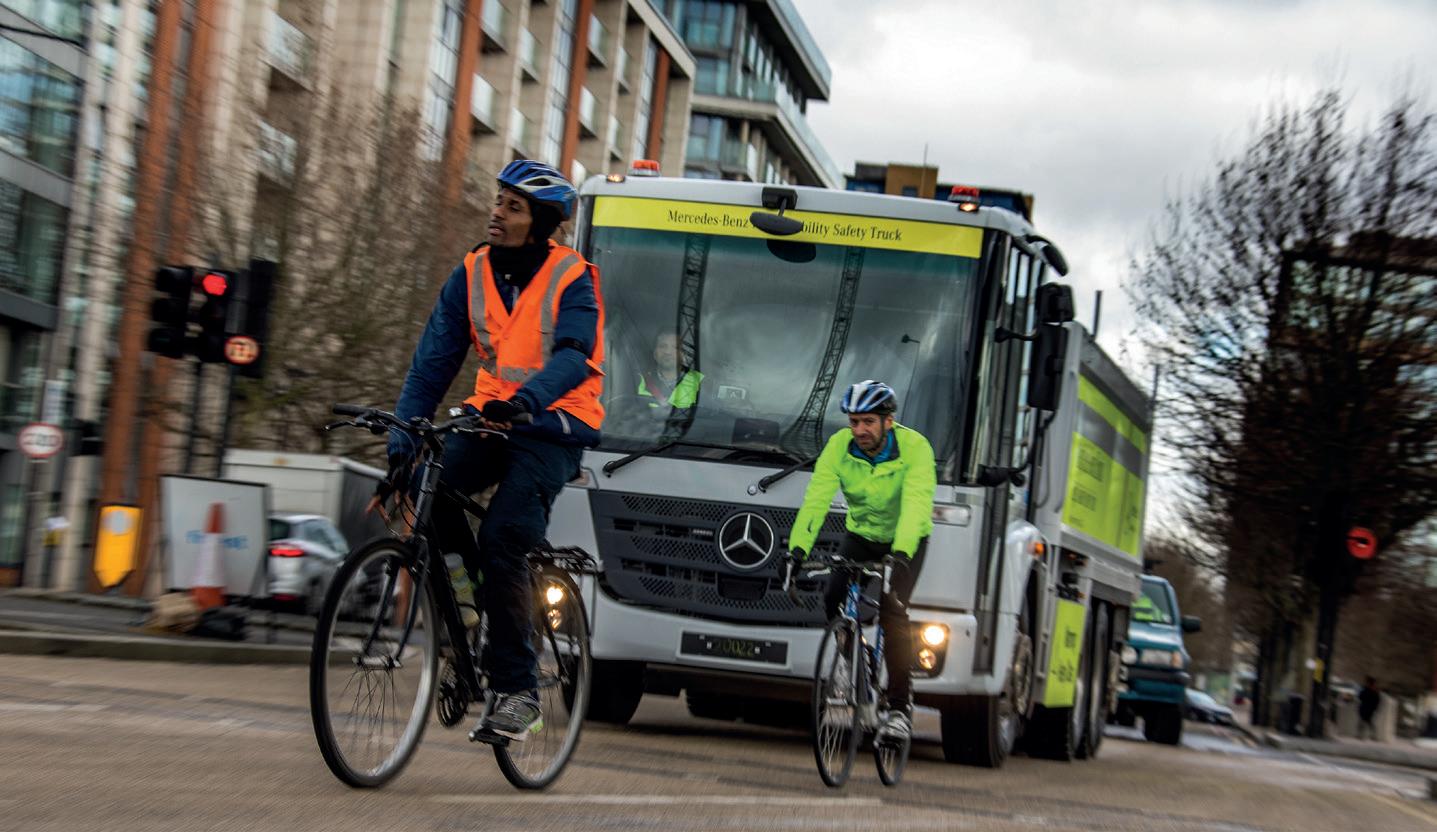
The direction of travel is clear: greater emphasis on compliance, data and accountability
Earned recognition
Ministers will review how the Earned Recognition scheme can be strengthened, reinforcing the role of compliance-led operators and potentially widening the benefits for those consistently meeting high standards.
Penalties and sanctions
The penalties regime for commercial vehicles will remain under review to ensure it acts as an effective deterrent. This includes closer consideration of enforcement against non-UK operators using Britain’s roads.
National Work-Related Road Safety Charter
A new National Work-Related Road Safety Charter will be piloted for organisations whose staff drive or ride for work. Developed with industry input, it aims to promote consistent, cross-sector safety standards and build on existing best practice.
Road Safety Investigation Branch
Plans to establish a Road Safety Investigation Branch for Great Britain are confirmed. Its dataled remit could include insights from DVSA postcollision examinations of commercial vehicles, feeding into wider systemic learning.
For operators, the direction of travel is clear: greater emphasis on compliance, data and accountability. Further guidance, consultation and potential regulatory change are likely, making it important for those managing fleets and occupational road risk to stay engaged with developments as the strategy progresses. ●
The Employment Rights Bill successfully completed its passage through Parliament and as of 18 December 2025, is now officially the Employment Rights Act 2025
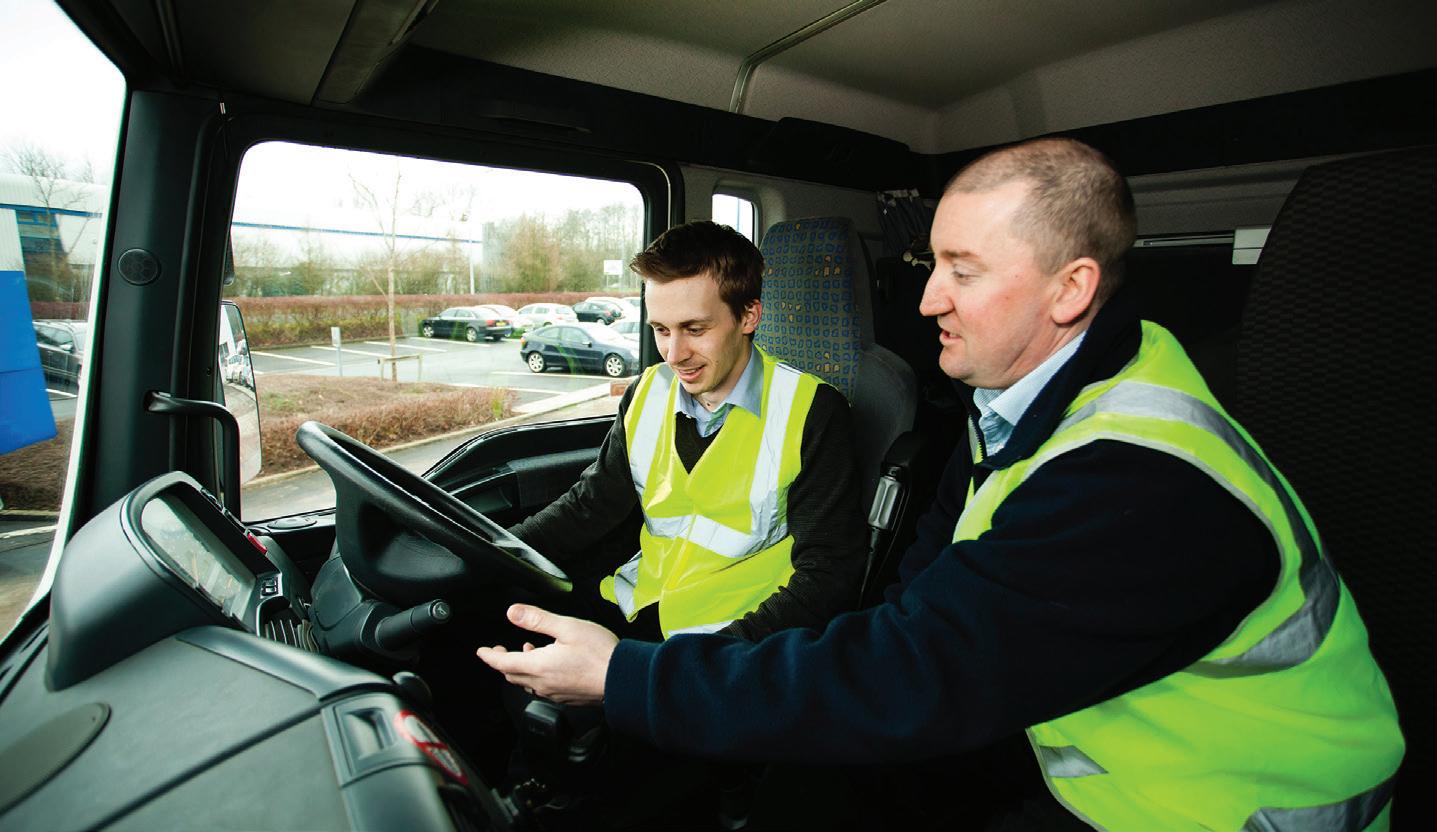

It’s no secret that the Act progressed through the legislative process with some difficulty, with the most recent concern raised regarding the removal of the statutory compensation cap for unfair dismissal claims. However, following assurances from the Government and requests from business organisations to conclude the legislative process, peers withdrew their final amendment, allowing the Bill to pass in its current form.
The removal of the cap on compensatory
awards for unfair dismissal is one of the most significant changes introduced by the Act. During Lords debates, the Government confirmed it will publish an impact assessment examining the consequences of removing the cap before the relevant provisions come into force.
David Pannick KC made a notable contribution to the debate, arguing that concerns around uncapped compensation are overstated. He highlighted that discrimination claims have long been uncapped without
the Act confirms that substantial reform is on the horizon with the removal of the compensation cap increasing potential financial exposure, particularly in cases involving higher earners
leading to excessive or disorderly awards, suggesting there is no reason to expect a different outcome for unfair dismissal claims.
For employers, the Act confirms that substantial reform is on the horizon with the removal of the compensation cap increasing potential financial exposure, particularly in cases involving higher earners.
However, assessments suggest there may be a lead-in period before the changes take effect, giving employers time to prepare, review policies and monitor developments around commencement and implementation. We now await further details of the expected consultations and impact assessment for the removal of the unfair dismissal compensation cap.
Do you need any advice on how the Employment Rights Act 2025 could affect your business? Backhouse Jones’ team of employment law specialists will help you understand the risks, review your dismissal procedures and help you prepare for the removal of the unfair dismissal compensation cap. ●
Britain faces huge job losses and economic turmoil in its push to lower noxious emissions from transport vehicles
In 2006 the former USA vice president Al Gore produced a documentary titled ‘An Inconvenient Truth’, to describe how he viewed the climate crisis. For him the actions necessary were more moral than political. He stressed that we didn’t have to wait for politicians and legislators to pass laws to regulate green house gas emissions, there was much every individual could do immediately. Now 20 years later we are facing the
inconvenient truth that it remains an act of faith in as yet unproven technological breakthroughs promoted in the shadow of military conflict in oil rich countries.
The world has depended on Middle East and Russian markets to satisfy energy demand and progress on decarbonisation has been complicated by the political madness threatening tariffs on global trade.
In addition, the battle for mineral rights vital
to the development of zero carbon energy solutions, that will reduce demand for fossil fuels and in the process lessen the impact of greenhouse gas emissions, has become a priority for the world’s leading economic powers.
The inconvenient truth about net zero is that we need to accept that currently the task of decarbonisation of the world we live in and the preservation of economic growth is currently an

unimaginable task to be delivered in less than two decades.
In the house of Lords recently, Lord Tony Woodley, a former Vauxhall worker and leader of the TGWU, raised the issue about the how the ZEV Mandate was putting unsustainable pressure on vehicle manufacturers, putting manufacturing operations such as Vauxhall’s Ellesmere Port plant at risk and the government should seriously reconsider the penalties that will be applied from 2025 for non-compliance with electric vehicle sales targets. Failure to do so would be political suicide.
At the same time in France at the Paris Motor Show, the head of BMW, Oliver Zipse told the assembled press that the 2035 cut-off for CO2 emitting vehicles was no longer realistic. It would, in his opinion, lead to a massive shrinking of the industry as a whole.
Volvo has also announced that it is reconsidering its 100% EV production plans from 2030 onwards and will continue to sell hybrid vehicles post 2030. It comes after the industry faces a severe slowdown in EV demand

in major markets and uncertainty due to the imposition of trade tariffs on EV’s made in China.
Both VW and Mercedes-Benz recognise that the industry is now facing a crisis of confidence and Mercedes-Benz CEO Ola Kallenius pledged that its ICE vehicles will exist as long as demand remained for them.
In the UK, since the introduction of the ZEV mandate, we have seen thousands of automotive jobs lost. Some 3,500 jobs in Swindon at the Honda plant, 1,700 jobs at the Bridgend Ford Engine factory have been lost to name just two – and there are potential job losses at a further six-to-eight locations.
In the UK, after the realisation we were no longer part of the EU, the British government hailed the adoption of net zero and it has rapidly become a growth strategy.
energy storage strategy and remains reliant on three of the pillars of modern civilisation.
Concrete for the foundations of wind turbines, steel for the turbine towers and plastic resin for the protection of the giant blades. There will be eight billion tonnes of CO2 generated every year by these vital commodities until alternative material or manufacturing methodologies are discovered.
The second truth is that four countries, USA, China, India and Russia, currently emit over 55% of the world’s CO2 emissions.
So, until these four countries and the four industrial commodities defined as the pillars of modern society are making serious efforts to decarbonise their economies then the inconvenient truth about net zero is that we need to think very carefully about how a modern civilisation operates.
Our commercial vehicle industry does not get the credit is deserves for the environmental progress it has made
The other inconvenient truth about the UK road transport industry is that while it represents 20% (c90 mt CO2) of the UK’s total CO2 (381mt CO2) emissions, the total emissions from vans and heavy trucks represents 0.005% of the planet’s total emissions. It is recognised that the UK has made serious progress in reducing emissions from the 1990 levels, yet our commercial vehicle industry does not get the credit is deserves for the environmental progress it has made.
Like it or not, we are in a world of extreme energy politics and the decarbonisation of our planet let alone our transport industry is unlikely to deliver on the aims of the 2015 Paris agreement in the next two decades.
What is true is that the continued support for wind and wave alternative energies, which is applauded but recognised as intermittent energy sources, are still reliant on a more robust
LEFT: Achieving net zero remains an act of faith in as yet unproven technological breakthroughs promoted in the shadow of military conflict in oil rich countries
The solutions lie with geo-political agreements that we currently have zero visibility of. The truth remains that until the military conflicts in Ukraine and the Middle East are resolved, the trade war tensions between the USA and China are concluded, the environment chaos inflicted by extreme weather will continue to cast doubt on our ability to restrict global warming to below two degrees centigrade.
The future of the automotive industry and the transport sector in particular in the UK, will depend on how quickly we embrace the transition to a zero carbon economy. The inconvenient truth I would like to end on, is that in order for the UK to retain about 250,000 jobs currently employed assembling over 1.5 million cars per year. we need to have invested in a minimum of 3x35gwh capacity Gigafactories. Sadly, China has won the battery arms race. China dominates both world production of batteries and the supply of rare earth materials necessary for their manufacture eg. Lithium Cobalt, Graphite.
To date the UK has zero investment in a battery manufacturing facility and the highly respected Faraday Institute, a govt battery technology research organisation, forecasts possibly up to 1,000,000 million jobs in today’s and future production and supply chain sectors will be lost unless this situation is rectified.
This, unfortunately is the inconvenient truth behind Net Zero ambitions in the UK Transport and automotive supply chains. ●
Des Evans is Honorary Professor at Aston Business School and a former CEO of MAN Truck & Bus UK
New survey finds at over two thirds of drivers are dissatisfied with the number and quality of facilities in the UK
In case transport firms are wonder why they are struggling to fill truck driving vacancies, a new survey from Transport Focus may help to solve the mystery.
According to its analysis, almost twothirds of drivers are dissatisfied with the number and quality of facilities in the UK. This marks an increase in dissatisfaction compared with the previous year.
The UK logistics industry contributes around £170 billion to the national economy, employs more than 8% of the workforce and plays a crucial role in supporting the Government’s growth objectives.
With freight crime estimated to cost around £700 million annually, ensuring drivers have consistent access to secure, high-quality facilities is essential for protecting this vital sector and sustaining economic growth, says Transport Focus.
Its ‘Lorry Drivers’ Facilities Survey’, which has quizzed more than 13,000 HGV drivers over the past two years, highlights the connection between drivers’ ability to rest and how safe they feel.
Louise Collins, director at Transport Focus, said: “Lorry drivers play a vital role delivering goods we all rely on right across the country.
They need access to high quality facilities to rest for their own wellbeing but also because of the safety critical nature of that role. These findings clearly show the link between feeling safe and secure and being able to rest properly.”
While welcoming recent investment in improving security at services, she explained that things can take time to make an impact.
She said: “It is important that the industry maintains focus and continues working together to introduce improvements which will help change driver perceptions.”
Junction 31 Secure Parking (M1 Sheffield) and Exelby Services, Coneygarth, were rated as the best truck stops, according to overall satisfactions scores, both scoring 100%.
Accelerated improvements
Rob Exelby, managing director at Exelby Services, said: “Matched funding from the Department for Transport has helped us accelerate improvements at Coneygarth, adding additional parking and upgraded security measures that drivers need.
“Collaboration between Government and industry makes a real difference, complementing the investments many operators
Ensuring drivers have consistent access to secure, high-quality facilities is essential
are already making to raise standards.”
Moto Heston (E) was the lowest rated, with a satisfaction score of 61%, followed by Welcome Break Newport Pagnell Southbound (63%).
The Road Haulage Association (RHA) suggests that the industry will need an average of 60,000 new drivers a year for the next five years to meet demand.
Meanwhile, 24% of HGV businesses reported driver vacancies in late 2024, with many drivers leaving the industry or retiring.
The union Unite says lack of adequate facilities results in drivers not being able to get good quality rest and makes it far more challenging for them to eat healthily, which creates problems for physical and mental health.
Unite general secretary Sharon Graham said: “Lorry drivers are all too aware of the problem, what they need to see is action in improving and expanding facilities, the hand wring needs to end. Investment and finding workable solutions needs to happen now.”
National Highways has been spending millions of pounds to improve facilities for drivers. Freda Rashdi, head of customer journeys, said: “We are committed to making changes to improve the experience of lorry drivers and boost business.
“Drivers need a safe place to stop to rest on their journeys. That’s why, along with industry, we have invested more than £25 million –creating more HGV parking spaces, boosting security, and upgrading lorry park facilities.
“These are improvements designed to give drivers the safe, comfortable places they need to rest and recharge.”
Rachel Taylor MP, and chair of the All-Party Parliamentary Group for Freight and Logistics, highlighted the impact of freight crime. She said: “These survey results from Transport Focus lay bare what they frequently tell me: that there is an urgent need to tackle crime and insecurity at rest stops.” ●
Transport firms must not be left alone to bear the costs of Government push to net zero
Words: Andy Maddock
We are constantly advised to eat our greens and focus on a minimum of a five-a-day diet for our personal health and sustainability. Similarly, business organisations looking to reduce their carbon intake in pursuit of their environmental, social and governance (ESG) goals are all looking to greener solutions.
Being one of just 9% of global organisations which form part of the circular economy, we understand the need to stress-test supply chain solutions that reduce business impact.
We refer to this as ECOnomics, where green solutions and profitability are not mutually exclusive. In fact, they form an essential part of the corporate drive towards commercial and environmental benefit.
For example, in supply chain businesses such as ours, we understand that electric vehicles (EVs) are an expensive and limited luxury for 24/7 operations.
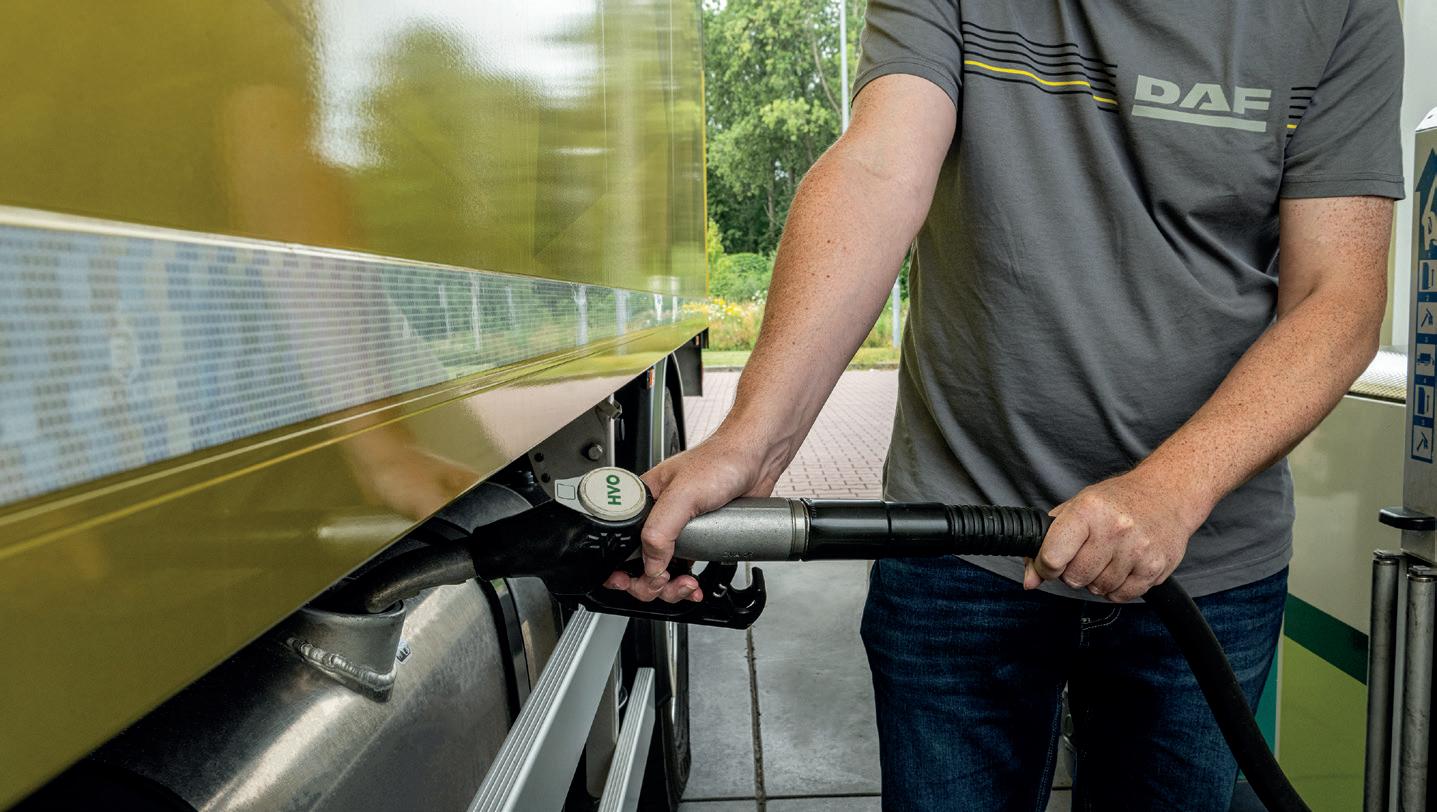
red and white diesel as it cuts up to 90% of net CO2 emissions. However, the obvious high demand has pushed up the price to prohibitive levels, as has shortage of supply following a recent fire at a leading HVO refinery in Rotterdam.
Fluctuating prices
It’s only fair to ask key policy makers to incentivise rather than penalise businesses
Sweating the assets of a fleet is the only way to sustain a business in an industry operating on wafer-thin margins and while shorter, local deliveries can be managed on EVs, longer highvolume hauls are currently off the menu.
While diesel has become a dirty word, the development and production of HVO100 – a biofuel refined from hydrotreated vegetable oil from renewable sources such as cooking oils and animal fats – is being seen as a potential gamechanger.
HVO is seen as a ready replacement for fossil
The fluctuating price of raw materials such as cooking oil is also a pinch point, along with other geopolitical issues that indirectly impact the price of this new sustainable alternative.
Businesses can – and do – keep a watching brief on the current market prices and negotiate with HVO suppliers for more competitive rates.
However, a more effective solution may be to focus on its overall benefit, such as reduced engine maintenance and lower emissions, which can help offset the initial expense. The other solution is lobbying for an industrywide incentive to switch to HVO by way of offering Government subsidies. After all, it is Government that is driving the net zero agenda by means of legislation.
In Europe, the EU’s key legislation requires companies to report on their ESG impacts, increase corporate accountability and guide investors toward more sustainable financial products. The EU also regulates ESG rating
providers to ensure their operations are transparent and reliable.
Message cuts both ways
As a European business that understands the ‘go lean and green’ message, we make the point that the message has to cut both ways. We already engage in many initiatives to cut our CO2 emissions and we understand that consumers also have a role to play in this transition, as the shift to low-carbon logistics is a shared responsibility.
However, we believe it’s only fair to ask key policy makers to incentivise rather than penalise businesses. As such, we believe companies should be subsidised to use this fuel and cut carbon emissions more generally.
Business can achieve a lot in terms of the growth and sustainability agenda, but it can’t do everything here on its own – the state has to help to some degree.
In terms of its five a day, there should be more carrot and less stick in the corporate diet. ●
Andy Maddock is regional managing director at IPP
The Association of Fleet Professionals (AFP) recently organised a series of round table events for members, which consistently see strong attendance and active participation.
A key factor behind the success of these discussions is that fleet managers are consulted about preferred topics and, while it is not possible to cover every suggestion, their proposals provide a fascinating snapshot of what is on fleet agendas right now. So, what are we seeing as we look ahead to 2026? These are five subjects that were among most requested.
Sales of electric light commercial vehicles are growing but remain slow. The core issues behind this sluggishness are simple – compared to their diesel equivalents, electric vans tend to suffer more operational downtime along with a range of charging and cost issues. Despite these concerns, many fleet managers are continuing to push ahead with adoption – partially for corporate environmental reasons and partially because of the ZEV mandate.
The AFP believes there is huge potential for shared charging – where fleets provide access to their depot and office chargers to others. It promises not just to exponentially increase the number of chargers available to operators but also to substantially reduce the cost of on-theroad power.
In May, we signed a deal with technology start-up Evata to provide the digital infrastructure that will deliver on this vision and are onboarding members and others who would like to take part. There is significant interest in this initiative and it is very much a current topic
Words: Paul Hollick, AFP chair

ABOVE: Sales of electric light commercial vehicles are growing but remain slow
When fleets talk about administration right now, they tend to be referring to parking and speeding tickets. This issue is becoming more and more troublesome, especially rising numbers of private parking fines. Processing them is escalating into a bigger and bigger issue and there is much dialogue between fleets about creating the best procedures for payment as well as the most effective methods of challenging unfair fines.
The Government recently held a consultation on this subject and the hope is that we will see a new and improved industry code of practice soon. Depending on where they operate, fleets are also experiencing issues with the Dartford and Blackwell tolls, as well as Low Emission Zones.
The fleet sector already makes widespread use of technology and has, in recent years, undergone an extensive process of digitalisation but, so far, there has been little sign of AI making a deep impact.
Some manufacturers of products such as fleet software are using it to introduce new features but any gains so far have tended to be incremental rather than radical.
Our view is that discussions about the potential for AI in fleet tend to flip between relatively prosaic improvements and far future blue sky thinking, with less attention paid to ideas in the middle ground that could provide major advances. It’s certainly an area that has huge potential. ●
The Road Haulage Association (RHS) has expanded its portfolio of member services with the launch of RHA Tacho & Asset, delivered in partnership with AssetGo and available to both members and non-members following its rollout in January.
The platform enables operators to manage drivers’ hours and tachograph data, manage and maintain their fleets compliance, carry out PMIs (periodic maintenance inspections) and daily walkaround checks, report defects and conduct driver licence checks while meeting regulatory requirements more efficiently, all within a single RHA-branded solution.
The service is being introduced alongside the RHA’s existing digital and technical services, broadening the range of tools available to members and giving operators greater choice when selecting compliance and fleet management solutions. RHA members can access the platform at an exclusive member rate, with non-member access also offered.
“This initiative reflects the RHA’s continued focus on supporting operators by providing
practical, digital and compliant technical solutions at a time when cost pressures, skills shortages and regulatory complexity continue to challenge the commercial vehicle sector,” said Joe Colasurdo, national technical services manager at the RHA.
“It’s early days, but the initial feedback has been positive,” added Joe. “Members value having another credible option endorsed by the association, particularly one that brings together tachograph analysis, fleet oversight and driver compliance within a single platform.”
Joe goes on to say that AssetGo has established a strong reputation for delivering practical, operator-focused compliance and fleet management solutions for businesses ranging from owner-drivers to large multi-depot fleets.
Matt Cotton, managing director of AssetGo, is equally upbeat about the new partnership. He said: “This exciting partnership with the RHA was a natural fit for both organisations.
The RHA team has a deep understanding of the challenges faced by operators across the sector and we’re delighted to be able to provide software solutions that support driver
compliance, improve fleet oversight and help operators meet their regulatory obligations with confidence.”
Further information on RHA Tacho & Asset is available through the RHA, with webinars and demonstrations planned as part of the ongoing rollout.
Find out more about the new service or book a demonstration at: shorturl.at/gj7ZZ
BELOW: Matt Cotton, managing director, AssetGo




Dr Air Brake’s active intervention systems represent a fundamental shift in safety approach:
• Park Brake Auto-Stop: Automatically applies brakes when a driver’s door opens without the parking brake engaged.
• Reverse Smart Auto Braking: Uses radar to monitor behind the vehicle, automatically braking when obstacles or pedestrians enter danger zones.
• Trailer Auto-Brake System: Prevents devastating trailer impacts through automatic brake application
“After installing these systems, we’ve seen near-misses virtually eliminated,” reports Transport Manager Sarah Williams. “The return on investment becomes incalculable.”
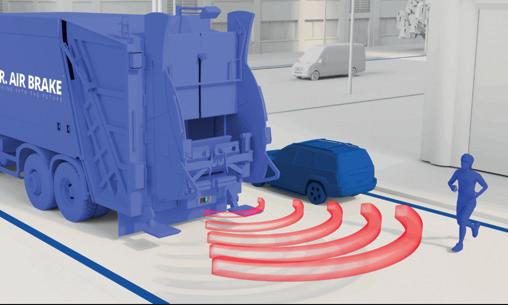



“We brought in the AssetGo system to digitise our daily walkaround checks and make them more efficient. We also use it for our scheduled PMI checks, MOT dates, LOLER inspections and tachograph calibration dates. We can see exactly what’s going on with the trucks and trailers, making sure we are compliant at all times.”
- Adrian Spencer-Hicks. Transport Training and Data Manager, Advanced Proteins.

Sapphire Vehicle Services, a leading provider of commercial vehicle maintenance and repair, is proud to announce the opening of its newest depot in Barnsley. The facility is strategically located just off the M1, providing a vital hub for fleet operators across South Yorkshire and beyond
The new Barnsley site is designed to accommodate the growing needs of the logistics and transport industry.
The facility features:
• A spacious yard with ample parking for large fleets
• High-clearance workshops specifically designed to handle double-deck trailers
at Sapphire, said: “The opening of our Barnsley depot is a significant milestone in Sapphire’s growth. By establishing ourselves at Wentworth Way, we aren’t just adding more space – we are providing a high-capacity, 24/7 strategic hub designed to meet the complex needs of modern fleets. With specialised infrastructure for double-deck trailers and a prime location
account customers who sign up at the Barnsley depot during the opening period. sapphirevs.com
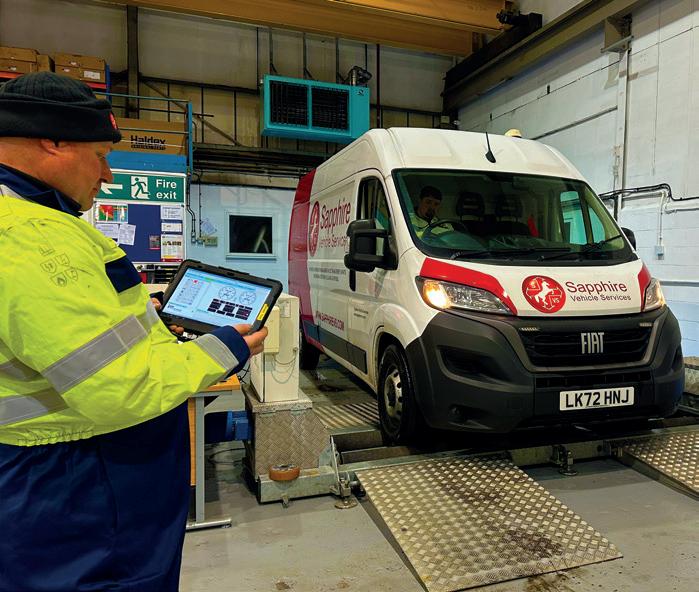
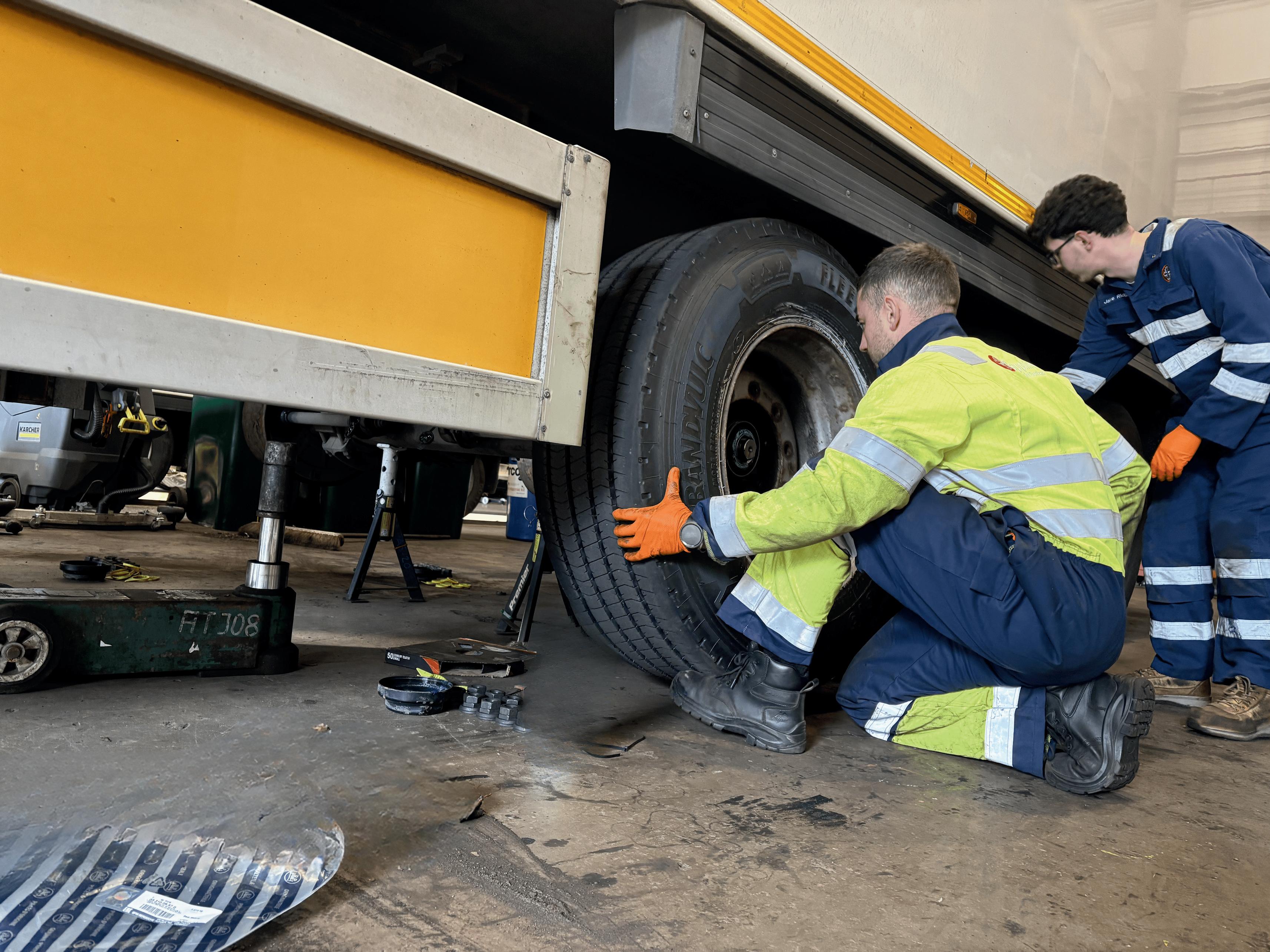


Richard Drinkwater at SVTech gives us the lowdown on this complicated subject
Downplating to 3,500kg is no longer a viable option in most cases, as they require around 1,000-1,200kg minimum payload – and unfortunately over 95% of 4,500kg/5,000kg vehicles will weigh more than 2,500kg empty.
Only panel vans are acceptable as they need a minimum one-tonne payload. You are not allowed to downrate a vehicle without a body, so that the customer cannot produce a weight ticket of 2,250kg for a chassis cab and say it’s under 2,500kg.
The unladen weight must be the full-bodied weight. It’s safe to say absolutely no downrates on recovery vehicles to 3,500kg as the minimum payload needs to be nearer 1,400kg due to hybrid and electric car weights. The DVLA is pulling these vehicles over daily for being overloaded.
However, the more important uprating has also undergone some tweaking.
Requirements from the DVSA for uprates are that they now need a copy of the Certificate of Conformity for each stage of the vehicle build.
If the vehicle has been subject to a multistage build, then you will need to find out who converted the vehicle and obtain their stage 2 CoC. If they no longer exist, which has happened, then you’ll need to have a DVSA voluntary IVA inspection.
This incurs a high fee (circ. £450) and then the vehicle may have issues that the converter overlooked. (ie. sharp edges, ramp struts protruding etc).
Time scales to the process have increased immensely, as the DVSA has experienced a reduction in staff numbers.
Add to this a reduced amount of test slots available at the testing stations, and timescales have risen by nearly three months.
More stringent checks on vehicles have seen
an increase in vehicle faults. Do check who you use to convert your vehicle and obtain feedback from other buyers to see if they’ve experienced problems. We can all accept things don’t always go to plan, but it is what gets done to resolve the issues that carries weight and confidence in using that converter/seller again.
Don’t trust a brochure!
It’s imperative to check the vehicle’s real unladen weights against a claimed brochure weight.
It may seem strange to have to say that, but it is shocking to see how many people will buy a vehicle and not check the information provided is correct, only to find the vehicle weighs 100-200kg heavier than advertised. This could be down to the extra weight of a partition, racking and fixed equipment etc. that may not have been included in the brochure/advertised figures, so please weigh before you buy. ●
For further information, visit: svtech.co.uk
More stringent checks on vehicles have seen an increase in faults
BELOW:
The DVLA is pulling vehicles over daily for being overloaded
With

Connect
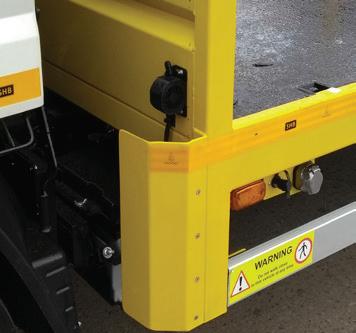
l
For
For

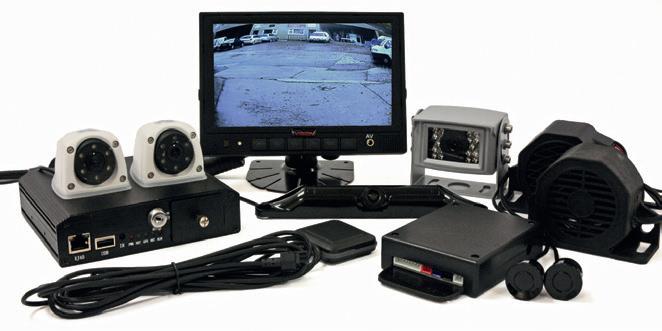
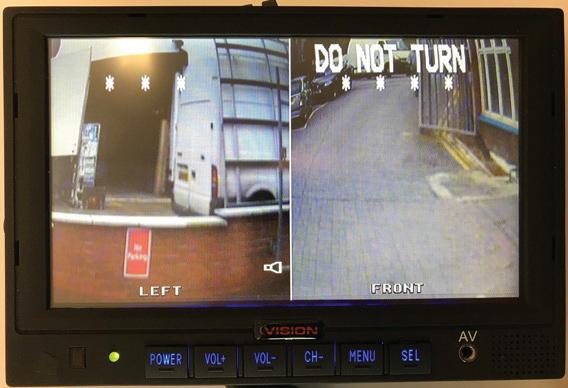

•


Protect your fleet from costly bridge strikes
Powered by AI, GPS precision, and the UK Low Bridge Database, it gives drivers instant, accurate alerts — because knowing the road ahead means knowing every bridge in your path.




checking height — can result in fines, legal action, or loss of an operator’s licence.
BRIDGE STRIKES ARE PREVENTABLE.

BRIDGE STRIKES CAN SERIOUSLY IMPACT FLEET SAFETY, OPERATIONS, AND COSTS.

SCAN TO LEARN MORE