Feb. 4, 2026

Page 1


VOLUME 69, ISSUE 4 FEB. 4, 2026

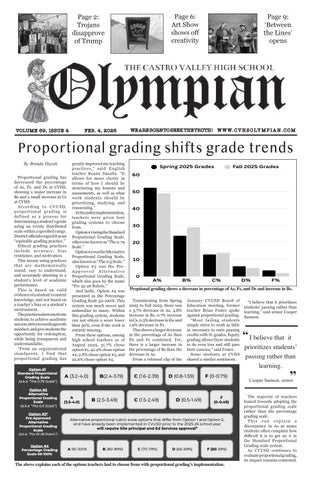
Proportional grading shifts grade trends

Proportional grading has decreased the percentage of As, Fs, and Ds at CVHS, showing a major increase in Bs and a small increase in Cs at CVHS.

According to CVUSD, proportional grading is defined as a process for determining a student’s grade using an evenly distributed scale within a specified range. District officials regard it as an “equitable grading practice.”

Ethical grading practices include accuracy, bias resistance, and motivation.

This means using practices that are mathematically sound, easy to understand, and accurately attesting to a student’s level of academic performance.

This is based on valid evidence of a student’s content knowledge, and not based on a teacher’s bias or a student’s environment.

The practices aim to motivate students to achieve academic success, strive towards a growth mindset, and give students the opportunity for redemption, while being transparent and understandable.

“From an organizational standpoint, I find that proportional grading has

greatly improved my teaching practices,” said English teacher Keanu Dasalla. “It allows for more clarity in terms of how I should be structuring my lessons and assessments, as well as what work students should be prioritizing, studying, and reassessing.”

In the policyimplementation, teachers were given four grading systems to choose from.

Option #1 being the Standard Proportional Grading Scale, otherwise known as “The 0.79 Scale.”

Option #2 was the Alternative Proportional Grading Scale, also known as “The 0.5 Scale.”

Option #3 was the PreApproved Alternative Proportional Grading Scale, which also goes by the name “Pre 25-26 Rubric.”

And lastly, Option #4 was presented as the Percentage Grading Scale 50-100%. This system was much newer and unfamiliar to many. Within this grading system, students can not obtain a score lower than 50%, even if the work is entirely missing.

From these options, among high school teachers as of August 2025, 31.7% chose option #1, 42.9% chose option #2, 2.8% chose option #3, and 22.6% chose option #4.

Transitioning from Spring 2025 to Fall 2025, there was a 3.7% decrease in As, 4.8% increase in Bs, 0.7% increase in Cs, 0.3% decrease in Ds, and 1.9% decrease in Fs.

This shows a larger decrease in the percentage of As than Ds and Fs combined. Yet, there is a larger increase in the percentage of Bs than the decrease in As.

From a released clip of the

January CVUSD Board of Education meeting, former teacher Brian Foster spoke against proportional grading.

“Most failing students simply strive to work as little as necessary to earn passing credits with D- grades. Equity grading allows these students to do even less and still pass their courses,” said Foster.

Some students at CVHS shared a similar sentiment.

“I

believe that it prioritizes students’ passing rather than learning,” said senior Cooper Samson.

I believe that it prioritizes students’ passing rather than learning. ” “
Cooper Samson, senior

The majority of teachers leaned towards adopting the proportional grading scale rather than the percentage grading scale.

This can explain a discrepancy in As as many students often complain how difficult it is to get an A in the Standard Proportional Grading scale system.

As CVUSD continues to evaluate proportional grading, its impact remains contested.

Proptional grading shows a decrease in percentage of As, Fs, and Ds and increase in Bs.

Trojans disapprove of Trump’s presidency Students share opinions on Trump’s first year back in office

A recent CVHS student survey conducted indicated a strong disapproval of President Donald Trump. Of 303 students who participated in this survey, 86.5% disapproved of Trump’s overall job performance while only 13.5% approved of it.

Overall disapproval of Trump’s presidency remained consistent across all categories taken into account.

Immigration policy received particularly high levels of criticism.

Approximately 88% of respondents disapproved of Trump’s approach to immigration, which included policies such as deportations, border wall expansion, travel bans, and efforts to challenge birthright citizenship. Only about 12% of students expressed approval of these policies.

“The fact that people that are legal in the USA are getting detained by ICE is a huge problem. [President Trump] said only illegals [get arrested and deported], but ICE goes after any Mexican they see,” said senior Nathan Hickey.

The overwhelming number of responses like these indicates strong opposition to these measures among the student body, but Trump does have supporters, also.

“I’ve researched DOJ and DHS laws with ICE and immigration policies. All of it is fully legal and has been done before 60 years ago,” said junior Roman Garcia.

Economic policy also faced widespread disapproval, with 81.8% of students opposed Trump’s handling of economic issues, including tariffs, tax decreases, employment, inflation, affordability, the budget deficit, and national debt. While 18.2% approved of his economic policies (the highest approval rate across all categories), it still represented a clear minority.

“He is destroying the economy as we speak and soon no one can buy any essential needs for ourselves,” said junior James Stein.

Similarly, Trump’s foreign policy decisions were viewed unfavorably by most

respondents.

“He is bringing us closer to another war,” claimed junior Ivan Han.

“We did not need that for America. No one besides the oil companies wanted that,” junior Ella Hull said.

About 82.5% disapproved of actions such as the abrupt invasion of Venezuela and the withdrawal from the Paris Climate Agreement, while 17.5% approved. These results suggest student concern regarding global stability and climate-related policy decisions.

Trump’s education policies generated the strongest negative response in the survey. An overwhelming 90.1% of respondents disapproved of Trump’s education-related policies, including changes to diversity, equality, transrelated policies, ethnic studies, financial aid programs, and proposals to shut down the Department of Education and shift power to state governments.

“We need this stuff. History is history—it doesn’t take sides, and learning about history doesn’t brain wash you,” senior Sky Johnson said. “It teaches you about the mistakes of the past and how to prevent them. By shutting down the department of education and removing so much from programs only serves to make people dumber and easier to control.”

Only 9.9% approved of these policies, making education the most heavily criticized area among students.

“I have no knowledge of these things but I haven’t heard any people complaining about it online or any major news headings of these sorts of things so it can’t be that bad,” said Jacob Heisick.

While a small percentage of respondents expressed approval of Trump’s numerous policies across different categories, the survey results immensely reflect student dissatisfaction. Overall, the findings suggest that students at CVHS hold critical views of Trump’s presidency, particularly regarding policies that directly impact their education, future opportunities, and social environment.

If felons can’t vote, a felon shouldn’t be able to run for president. ”
Elsa Madsen He is a liar, predator, abuser, and more. He is the worst president America has ever seen. “ ”
Josiah De La Vega Rules are rules and we can’t just allow people to break rules even if they help America. “ ” junior
Wee lee junior
junior
Nate Rico
Isaac Hulse
Wee lee
Wee lee
Trojans protest Trump’s presidency on Jan. 20.

The Olympian Feb. 4, 2026

Trojans like Trump’s Venezuela strike

President Donald Trump issued an unprecedented series of military strikes on Venezuela on Jan. 3, resulting in the capture of Venezuelan President Nicolás Maduro and First Lady Cilia Flores.

“I just want to say that to represent all Venezuelans, we’re glad that [Maduro is] out, and we’re glad that it’s done,” said Venezuelan student Lucia Alfonzo.

According to Trump, the motivation for the intervention termed Operation Absolute Resolve was mainly to bring to justice Maduro and Flores. The first Trump administration indicted them among many other officials in 2020 by unsealing United States v. Nicolás Maduro Moros et al, a criminal case initially filed in 2011 against Hugo “El Pollo” Carvajal, a senior intelligence official under Maduro’s predecessor Hugo Chávez.

”He personally oversaw the vicious cartel known as

Cartel de los Soles…which flooded our nation with lethal poison responsible for the deaths of countless Americans,” said Trump during a press conference held the same day.

Maduro and Flores are currently awaiting trial in the Metropolitan Detention Center in Brooklyn, having made their first court appearance on Jan 5. Their next court date will take place March 17.

Regardless of how much

the Trump administration celebrates, the attacks still remain the subject of legal debate. In an emergency Security Council meeting, UN Secretary General António Guterres expressed grave concern that “rules of international law have not been respected with regard to the 3 January military action.”

However, a newly released memo from the Department of Justice written on Dec. 23, 2025 states that the

entirety of the mission, from the strikes to the seizure, would be constitutionally legal without the need to notify Congress.

“I feel relieved that they are prosecuting Maduro because he was a terrible president who rigged his own elections…He’s a criminal,” said Venezuelan student Mario Campa.

Despite his support for Maduro’s trial, Campa still has doubts. “I don’t agree with taking over Venezuela

for a period of time…I don’t agree with anything other than the capture of Maduro.”

For the time being, Delcy Rodríguez will serve as the interim president of Venezuela and according to Trump has been “essentially willing to do what we think is necessary to make Venezuela great again.”

Rodríguez was Maduro’s vice president from 2018 to 2026,runningtheBolivarian National Intelligence Service (SEBIN), which has been accused of numerous human rights violations and being a secret police force accessory to the Maduro and Chávez regimes.

“Since this, the regime has been going on for 27 years, I didn’t expect it to just from night and day become a democracy again. But you know, baby steps?” said Alfonzo on the topic. “I think that just having Maduro out for now is a great step and we’ll just see how it goes from then…You know, we’re just waiting to see what happens next.”

MamaCare Ghana gives aid to women

CVHS and Olympian alum Ali Nosseir has taken his experiences from journalism to help raise an initiative known as MamaCare Ghana to bring quality maternal and child health care to rural villages in the Northern Volta Region of Ghana.

Nosseir’s parents immigrated from Egypt to the US in their 20s. Returning yearly to Egypt, he saw mothers struggling to provide for their children, and children having to work as street vendors. Maturing into understanding his privilege and the luck of being born in the U.S., he is now supporting MamaCare Ghana, an initiative for training and aiding breast cancer treatment in Ghana.

“So as I’ve matured, I’ve started realizing that I’m very grateful to be in the position that I have today,” Nosseir said. “We’re all humans. We’re all part of the same species. And I really think it’s really sad how many people live, not knowing when their next meal is, not having access to clean water.”

In northern Ghana, of every 1,000 kids born, 100 don’t make it past the age of 5. This

is absolutely unacceptable, yet still happens. This has raised the fertility rate to five to six kids per mother, on the premise that some won’t make it. The problem with this fertility rate is that there is no birth control, nor the resources to support that many kids effectively. Hygiene and good nutrition are unaffordable.

And it’s a cycle too. The children who survive grow to have children who die. Ten percent of these children die before being on Earth for more than about 1826.25 days. Imagine your five year old dying. You probably can’t even imagine them dying without hurting.

MamaCare Ghana is here to stop this cycle. The group provides education about birth and children as a whole; how to treat the patient with a fetus in the womb, how to handle STDs, how to give birth to the child, and how to raise the child. Every year, they educate 600 women, with 490 reporting significant improvements to their decision making and livelihood—clearly displaying the gap between being capable of learning and doing, yet not getting the education to do so.

Nosseir wants to add another 50 women with his work.

He joined MamaCare Ghana because the organization focuses on education, rather than raw funding. Teach a man to fish over feeding a man a fish.

“So rather than just sending someone over there, like a licensed medical professional, and help deliver a couple babies or something like that, help them raise the kids, I think it’s really important to teach the people there how to effectively raise these kids and deliver the babies,” Nosseir said. “Because that kind of knowledge can be passed down generations and generations, which could have a long-lasting impact on the people there.”

A big thing about Nosseir’s humanitarian work is his financial transparency. When donating to other nonprofits, you can find them donating to other nonprofits. Through Nosseir, he keeps his donors inthe-know; i.e., they donate $10, he tells them where that money goes; he’s buying this birth control, doing this, handling that—this is what is happening to your money.

Ultimately, Nosseir wants to establish his own nonprofit organization dedicated to generating funds for humanitarian efforts in other organizations, advocating for

financial transparency in the same way he informs his current donors about how their money is spent. In the meantime, he is supporting MamaCare Ghana for all they do in medical education in Ghana. To change the abominable statistics.

If you would like to donate, feel free to go to mamacareghana.org

alinosseir@ucla.edu

CVHS and Olympian alum Ali Nosseir supports MamaCare.
Kai atKinson

Editorial: Olympian stands against Trump

The Olympian unanimously stands against President Donald Trump. We at The Olympian believe that Trump’s behavior and actions have not met the standard of leadership that America needs.

Many supporters of Trump argue that he keeps American interests in mind, or that he challenges or understands the system in a way many traditional politicians don’t.

However, even if those concerns are valid, his method of action has caused more harm than progress.

One of the most prominent criticisms raised toward Trump was his immigration policy, which was seen with heavy disapproval across the board. Immigration is a complicated issue, involving both legal and humanitarian responsibilities. A strong policy takes into account both national security and compassion. We believe that his actions did not address the root causes of immigration, and instead caused fear and

division across the country.

Another condemned action by Trump was the second withdrawal from the Paris Climate Agreement, a choice that showed a deliberate lack of global cooperation on America’s

behalf, and hurt its credibility internationally. Trump’s reasoning for this decision was that it would undermine the American economy, but longterm environmental damage costs more than short-term

economic discomfort.

Additionally, Trump’s choice of rhetoric is one that many felt actively instigates and deepens political and social division. Leadership is about communication, and Trump’s

choice of words actively affects public behavior. When hostility is normalized, it discourages compromise and encourages the people of a country to see each other as enemies rather than citizens working towards a common goal.

We at The Olympian believe that in a time like this, the best course of action is to do everything in our power to help facilitate change in our country. Voting when you are eligible is a civic responsibility, and one of the most direct and powerful ways to make your voice heard.

Democracy is a system that only works when its citizens participate. Choosing inaction allows harmful systems to repeat their behavior. Students should stay informed, question political claims, and engage in respectful political discussion. Division today will shape the political climate in the future, and by supporting candidates who prioritize unity and cooperation, we can encourage a future built on understanding, rather than division.

Dogs outshine cats for man’s best friend

I love all the animals around my neighborhood, so much so that I’ve started to build a relationship with a few of them—especially the dogs. But the cats? Not so much. In the summer, I went on walks

with my parents after dinner. It was a great way to spend time with my family, watching the sky slowly turn dark and digesting the hearty meal we had eaten earlier.

We would usually discuss daily matters or listen to a podcast on our stroll, but I believed the main attraction were the animals. They always kept me entertained, and it motivated me to go on the walks every day so that I could see them. When they weren’t there, I was disappointed but told myself that they might be there tomorrow.

Every day at a specific spot, we would see a certain dog on our way up and down the road. He was

small, dark grey, and barked a lot. Whenever my parents and I came close to the fence, he would come running over as if he remembered our scent and barked loudly. It was these moments that I enjoyed most during the summer, when I could laugh and be with my family carefree.

When we came back, there were a total of five cats around my neighborhood, but I usually only see three of them from time to time. They would all roam around to other homes, so I found myself fortunate living in a neighborhood where all my neighbors were comfortable with each other.

I would try to greet the cats, but they would always look away or dismiss me. One time, the cat had even run away and went inside when it saw that I tried to come closer, which honestly hurt my feelings a little. Regardless, I have grown up with these cats on my street, but it wasn’t until this summer that I started to notice their behavior and habits.

My encounter with these animals showed a clear difference between dogs and cats. I didn’t expect them all to be friendly, but the dogs seemed more energetic and intrigued when they met strangers. This explains why most

people consider dogs as the better companion for humans.

Therefore, when you see animals around the street, just know that the dogs will always bark at you to show their playfulness while the cats probably won’t care too much. Although I love cats too, dogs are considered man’s best friend for a reason.

Even now when I go home from school, I look to see if the black and white cat is there on my neighbor’s front porch every day. It’s a reminder to me that no matter what hardships I have to go through that day, there are friends around that keep me going.

The model minority myth: a cage disguised as praise

Asian Americans are frequently portrayed as naturally successful, intelligent, “academic weapons.” This idea is known as the model minority myth. On the surface, it may appear positive. But, to crown one group as the “model,” means other groups have to be less than.

The term “model minority” was introduced by sociologist William Petersen in 1966. In The New York Times Magazine, in his article titled “Successful story: Japanese American style,” Peterson praised Japanese Americans for their work ethic and achievement despite discrimination.

In spite of this, nuance disappeared over time. Media narratives condensed Asians into a single narrative. For storylines, “Asian success story” was easier to parrot than having to acknowledge the histories of over 50 ethnic groups with vastly different barriers and levels of access to opportunity. What sounds like praise actually undermines people. In fact, the myth erases individual

effort as it suggests that success is automatic if you’re Asian.

As an Asian American, accomplishments I worked for were met with remarks like “typical [for your race]” or more modern phrases such as “well, well, well.” While these phrases are intended to be harmless jokes, they play into the misconception any and all accomplishments are to be expected of my race.

My identity swallowed my effort.

When success is seen as the product of being “Asian,” it dismisses the hard work and dedication taken to reach those achievements; it reduces millions of individuals into one stereotype instead of recognizing them as their own

people with personal challenges and stories. It marks them as symbols of what “should be.”

Those long hours of stress, studying, and human struggle become less about discipline and hard work and more about fulfilling a racial expectation. Rather than praise, the myth traps people into a box — you are no longer a person, but the mere product of a stereotype.

The myth doesn’t only harm Asian Americans; it harms other communities of color as well.

To stand at the top, that means others have to be below you.

The myth implies that other minority groups are lesser and that their failures are personal, rather than from systematic barriers. Inequality is framed as an issue of not

trying hard enough instead of a lack of access, opportunity, or discrimination.

The message that Asians are the “model” pits people of color against each other. In fact, it weaponizes Asian success to create a racial hierarchy instead of addressing the real roots of inequality.

In the end, the model minority myth doesn’t celebrate Asians — it confines them. It uses stereotypes as a tool to silence conversations about inequality.

Dismantling the myth has never been about rejecting success. Instead, it’s about reclaiming success as an individual effort and confronting shared systems of discrimination together, rather than being divided by them.

Social media is making misinformation believable

“There’s just no way Helen Keller could have been real.”

Shock filled my face like it never had before. The people around me? Unfazed.

These words weren’t from strangers online or conspiracy theorist Alex Jones, they were from my very own friends. Hearing them made a cut in my soul, not because I’ve never heard of it, but because I didn’t expect to hear something like this from the people I surround myself with.

Whether they know it or not, social media has not only exposed my friends to the conspiracy theory pipeline, but everyone in our digital society has too.

The days following the attempted shooting of President

Donald Trump, people and friends around me were spreading theories that it was all staged, despite the real people in the crowd who were actually murdered by the shooter. Even trying to correct people like this is difficult, considering that they fully believe the things they see and hear on the internet, and a whole digital world of people are willing to back their beliefs if they look hard enough.

This makes it clear that in

this new age of social media, conspiracy theories are no longer esoteric. They are being normalized, all to achieve the goal of shocking people into a like, comment, or follow. The worst part? It’s working.

As teenagers and even younger kids, we have shortened attention spans. That makes the appeal of things like TikTok and Instagram that have a platform full of instantaneous dopamine to be the first thing they use when

they eat, sleep, and wake up in the morning. This makes it easy to “doomscroll” and come across news media and other events. Yet, we forget social media is not as veracious as we would like it to be.

Fact checking takes too much time and energy, even though it’s just a simple search. It takes 20 seconds to fact check and make a Google search, but it takes less than a thought to scroll with ignorant bliss.

This begs the question: how can

we stop ourselves from becoming our own conspiracy theorists?

Yes, of course the answer is fact check. However, it’s unrealistic to expect the growing tech-dependent society to rip their melting faces away from something as captivating as a TikTok video.

Instead, considering the heavy amounts of media we consume in a day, it’s much easier to visualize the reality of making sure any news or shocking things we see online are from somewhere reliable, or with a blue check on a news source. This way, you know that it is already fact checked so you don’t have to do all of the heavy lifting. You may think that this doesn’t apply to you, or that you’ve just never really seen any conspiracies online, but I implore you to ask yourself, when was the last time you fact checked? Even if you think you have, the micromedia we consume will always have discrepancies, and your awareness is only step one.

Social polarization is pulling us apart

This may not be news to anyone, but the world is in a strange place right now. Thanks to the internet and globalization, we’re a lot more connected than ever. Yet paradoxically, many of us feel more alone. You’ve probably heard that we’re in a “loneliness epidemic,” a term that was popularized by Surgeon General Vivek Murthy, and it’s hard to ignore how real it actually feels. Ever since the pandemic, it seems like the trajectory of our world has shifted in a way that’s irreversible.

I also think social polarization plays a rather important role in this situation. Simply put, polarization is the division of people into opposing groups based on, oftentimes radical, opinions and beliefs. When you look around, it becomes clear just how polarized our world has become. Everything feels like a battle between who’s “right” and who’s “wrong,” the left versus the right, the “me” versus the “you.” Common ground in our social spaces feels almost nonexistent now. The more I look, the more I see people clinging steadfast to their beliefs, unwilling to even entertain another perspective. Honestly, it’s extremely unsettling to watch people choose to argue and fight rather than try to understand one another. After all, people are inherently different. No

Trojan Talk

Re: Editorial: Olympian supports social media restrictions

“I agree with most of this, but I also do believe that kids themselves have a bit of responsibility in this as well. I think that kids have to take part of their lives into accountability as they are the ones who control their social media in the end, not their parents.”

- Jacob Heisick

Re: Survey shows students suffer sleep shortage

“Sleep is very important, and it’s very sad to know that many students aren’t getting the sleep they need. Thank you for showing these stats!”

- Phoenix Tumlinson

Re: Sora AI: The Beginning of the End?

“I agree with the idea of this article. It shows how the use of AI is taking away jobs that are valuable to many people, in video production, animation, and the cartoon industry. It takes away the creativity of art itself, which many people enjoy doing.”

- Junior Domingo

I really like this article, I think the way it was written is very good. It is also very interesting.

- Hope Hudson

two people will ever share the exact same beliefs, so how did we reach a point where those differences are pushed to the extremes? I wish there were a simple answer, but it’s complicated. Politics is a pretty clear example of this. Even when we don’t notice it, politics is woven into our everyday lives. Political polarization is nothing new, though I’ve noticed the rise of the “radical left” versus the “radical right” has begun to dominate nearly all political discourse today. Civil debates feel like a thing of the past. Instead, we’ve seemed to normalize a culture of personal attacks, hostility, and constant back-and-forth accusations. Social media has only made things worse as well, with algorithms pushing people deeper into their own beliefs, effectively trapping them in

echo chambers that reinforce division.

Beyond mainstream politics, polarization shows up in our personal lives as well. Cultural differences that were once celebrated are now used as evidence of how “separate” we are, often portrayed in a negative way. We even see polarization through socioeconomic status, further widening the gap between people. So why does any of this matter? The bottom line is that social polarization weakens communities. It leads to declining social stability and makes it harder to make collective decisions that benefit everyone (or at least a majority of people). A divided community is a weak one destined for disaster. If we can’t come together over relatively small differences, how can we expect

to face larger global or internal challenges?

The greatest risk is reaching a point of no return, where even the shared interests that once connected us are no longer enough to bring us together. That’s why this is my call to action. We need to resist the polarization threatening to tear us apart. While some forces may seem beyond our control, we can still choose to build connections within our communities. Be open to meeting new people. Maybe even form a friendship with someone you normally wouldn’t approach. You don’t even have to go out of your way to do this, simply keeping an open mind to the experiences and perspectives of others can go a long way.

After all, we’re stronger together. Don’t let the world convince you otherwise.

Re: Largest dim sum restaurant opens in Castro Valley

“It was wild to see Castro Valley have the ‘largest’ anything! I bet there’s much more to come! We just have to hope our infrastructure can keep up!”

- Harper Kiely

Re: Senior Bruns skis the slopes of success

“Lucy’s talent is very impressive and inspiring! I can imagine how challenging it is to miss so much school but she has a lot of perseverance to keep on going, even while training out of season!”

- Miley Giang

Castro Valley High School’s journalism class publishes The Olympian, an award-winning newspaper and media empire, from our world headquarters at 19400 Santa Maria Ave., Castro Valley, California 94546. © 2026

Staff Writers: Nia Alton, Kai Atkinson, Elvis Carpenter, Franci Da Costa, Heldana Deme, Jackson Fabiani, Isaac Hulse, Valentina Huynh, Nathaniel Johanson, Wee Lee, Mikhaela Macabeo,Mason Mattox, Mairen McNeill, Ben Morlan, Pari Muni, Winnie Shen, Leila Tran, Alisa Wang Advisor...............................................................Matt Johanson

Nia altoN

CVHS alumni return as teachers and staff

As students of CVHS graduate, most leave looking back on fond memories and teary eyes as they leave campus for their last time. However, some students have been able to come back years after their graduation, this time, to teach a new generation of students.

Looking back on their years in high school, the CVHS alumni remembered fond memories and experiences that shaped them to become who they are today. Taking these experiences with them, they inspire their students now and help foster new memories.

Some alumni shared absurd stories from their time at CVHS, including senior pranks and crazy mishaps.

“There was a massive flood on campus and I had to leave school early. It was in the 500 hall in my freshman year and it was awesome,” social studies teacher and 2001 graduate Ian Rodriquez recalled.

Social studies teacher and CVHS graduate of 1997 Jackie Stone remembers a senior prank where many goats were put onto the roofs around

campus, as well as an incident where students cut the fence to the pool and drove a car into the pool.

Homecoming was a highlight for some of the alumni, recalling the time as exciting and competitive.

“As juniors, we won all categories and beat the seniors with our Fantasyland themed float, skit, and dance routine,” English teacher Kelsey Olson, CVHS graduate of 2001 said. “I also remember we had fireworks during the HOCO football game (launched from the baseball fields).”

Social studies teacher Angela Sigler, who graduated with the class of 2017, reflects a similar sentiment towards homecoming. For her homecoming in her senior year, she remembers everyone participated in going to the dance. “I was able to go out and dance with my friends and it was a lot of fun,” she said.

Alumni teachers also remember the impact of clubs and extracurricular activities in their high school years, and encourage students to join things they were interested in.

“I got involved in the Improv Club in either freshman or sophomore year and before,

I had been very awkward and unconfident, but that club really helped me get out of my shell,” physics teacher Mander Kraut, graduating class of 2004, said. English teacher Travis Olazabal, who graduated in 2013, looks back at his favorite memories of attending the ASL Disneyland Deaf Awareness Day field trip, as well as working on plays and musicals in the

drama and ASL departments.

Similarly, Olson reflects she had the most amount of fun as a senior in the school musical; she had a few speaking lines and was a member of the ensemble, the production being “South Pacific.”

Stone, who graduated with other CVHS alumni like physical education teacher John Edwards and German teacher

Barbara Andersen, said she kept many of her friends she had in high school and still runs cross country to this day, her experience dating back to her high school years.

With this rich background of the teachers at CVHS, new memories are able to be fostered here on campus for the new generations, many that will last a lifetime.

Art show shows Castro Valley’s creativity

Students and adults walked around the Adobe Art Gallery as they took in the personal, heartfelt art pieces filling the room, created by CVHS and other students for the “Origin Stories: The Story Within” art show on Dec. 4.

“This project gave the students the opportunity to choose a story that’s deeply resonant within themselves and portray it through storytelling,” said Jennifer Jervis, one of the advisers for the art show. Autobios and art boxes made by CVHS students enrolled in the Art and Self course, as well as students outside CVHS who contributed their own media, were on display at the Adobe Art Gallery.

Students used various materials to create their mixed media, such as fabric, acrylic paint, a clipboard, and many other pieces.

Different boxes consisted of creations that were either objects, animals, places, or plants. Although the individual boxes all had one thing in common. Each piece came from

a special place in their heart.

The art boxes showcased at the event represented student’s personal identities and experiences.

From ranging to ethnic experiences, family relationships, cultural traditions, and immigration, students turned a personal part of themselves into something beautiful.

“Bitter Yet Sweet” by Evelyn Yang, CVHS student, made a mixed media of two coffee cups, one with steam coming out and the other with creamer getting poured in. Surrounding the coffee cups were pills, scattered on top of a music sheet.

Yang’s piece represented the hardships with their father. In the writing that goes along with the art box, Yang described their dad and wrote about themself.

The music sheet was included because of their journey in the orchestra to where they are now.

The pills on the sheet were antidepressants that both Yang and their father took. This piece highlights how the two of them struggled to keep fighting. Yang did, their father did, until he could no longer.

This was just one of the

“Mahal Kita” by Anny Murphy expresses her culture and heritage.

many incredible art pieces where students expressed their personal lives.

Each art piece came with a written message to describe their work. Students’ messages further explained the depth of their work, also letting those who read their passage feel

emotionally connected.

“The Story Within” art show really helped give students a voice to share a special part of their lives that they might have not been able to comfortably convey before.

“I decided to make my piece on experiences of transformation,

regarding my mom, and I did a project on her heritage coming from the Philippines to America. She brought her heritage along and taught me about it and helped me embrace my Filipino culture,” said Anny Murphy, a CVHS student who created “Mahal Kita.”

CVHS alumni, now staff members, take a group photo in the quad on Nov. 5.
Natalie le
MadisoN lee

CVHS Adopt a Family Drive brings in thousands

CVHS leadership students came together during the holiday season to support local families in need through the schoolwide Adopt a Family drive, raising $7,251.04 overall. Classroom 122 collected $894.25, making it the highest earning class overall, with more than $450 raised on the final day alone. The drive provided students with an opportunity to make a meaningful difference in their community during the holiday season.

According to senior ASB Treasurer John Ryken, the donations were collected in

envelopes and delivered to the leadership room, where the students counted the money and reported the totals to leadership adviser Thomas Maloney. He entered the amounts into the school’s system to track which class raised the most.

After being counted, the envelopes were handed back to the students, where the amount was secured and verified by the school’s student treasury process to determine the daily and overall totals. The process required attention to detail, as leadership students carefully sorted and counted the money together to ensure accuracy.

Now that the drive is concluded, leadership students shopped for gifts at Target and returned to the school to wrap

the presents before families came to campus to pick them up, ensuring that each family received thoughtful and organized support. The experience allowed students to see firsthand how their efforts translated into real help for families in need.

Students shared their personal experiences with leadership, explaining that they joined the class to help people in the local community. “This is some stuff that I wanted to do when I got into high school,” said Ryken.

Others added that helping people is something they hope to carry into their future. Senior Olga Volynets added that it’s why she took leadership. “I love helping people,” she said.

When asked how her class was able to raise such a large amount of money, teacher

Jackie Stone cited a mix of persistence and early preparation.

“Begging, sad looks, constant

reminders, google classroom, collecting change,” Stone said. She added that her class began discussing and fundraising early on, which contributed to their overall success.

Fashion Club bedazzles members and more

At CVHS, the corner of campus is where creativity and clothes come together. The CVHS Fashion Club, led by our presidents Cassidy Berg and Ella Stahl-Rhodes, is a place for students to hang out, make art, and express who they are.

If you walk into a club meeting on a Wednesday in Room 407A, you’ll see people making

crafts. The club hosts weekly crafts to teach everyone new ways to create. The best part? You don’t need to be an artist to join. They show you the basics and then let you put your own twist on it.

This club is all about promoting diversity and letting people be creative through fashion and art. According to Loriannah Shah who talks about the club’s goals, the main idea is to give students a space where they feel comfort-

able being themselves.

“The reason behind this club is because it gives students a place to express themselves through their art and clothing,” Shah shared. “It’s a way to connect with others in a creative space.”

The sense of community extends beyond the weekly meetings. The club allows for deep connections to form through shared projects and a mutual love for style. For many, it’s a relief to find a group that

values original ideas over following the latest trends.

A highlight of the year is the club’s annual fashion show. This year the fashion show will be on April 17. It’s a huge production that acts as a bridge between the fashion students and the rest of the CVHS community. For the members, it’s a big deal because it’s finally their chance to show off all

the hard work they have put in and prove to the town what the next generation of designers can actually do.

Whether you’re obsessed with style or just want to learn how to make a cool pin, Fashion Club is open to everyone. It doesn’t matter if you have zero experience, it’s a fun place to talk about fashion and meet new people.

Elvis CarpEntEr
Kai atKinson
Leadership students count donations.
Vice President Cassidy Berg shows off a handmade pin.

‘And the River Drags Her Down’ reforges a new normal

In her new debut novel, “And the River Drags Her Down,” CVHS alumna Jihyun Yun, who graduated in 2009, explores the complex themes of grief, sisterhood, and friendship. Yun never saw herself as a writer; she dabbled in different hobbies, but didn’t have a clear direction or passion, describing herself as a “listless” person. That all changed when she discovered her love for poetry. Suddenly, Yun found herself consumed by writing, eager to finish daily tasks and write until the early morning hours.

The story begins with Soojin Han. Soojin’s older sister is found mysteriously drowned in the river that flows through Jade Acre, their town. As she grieves the loss of her sister and mother, Soojin defies every rule and uses her inherited magic to bring her sister,

Mirae, back from the dead, despite only being allowed to resuscitate small animals.

As happy as the sisters were at first, Mirae was driven by the desire to live her own life instead of hiding in the shadows from the public, secretly out for revenge. Suddenly, Soojin is forced to reconsider if this is really the sister she once grew up with.

Yun began writing the novel during the COVID-19 lockdown, initially drafted it thinking it would be part of a poetry collection. Fueled by her own personal grief, the feeling of uncertainty inspired her to explore what it truly means to bargain with loss.

“I soon realized that I wanted characters to live out my inquiries more fully than the contained space of a poem would allow. Like that, almost accidentally, the bones of the novel were formed,” said Yun.

The story is loosely based on a Joseon Dynasty-era ghost story called Janghwa Hongryeon Jeon, in which two sisters are drowned by their wicked stepmother and return as ghosts for revenge.

Once the grudge was resolved, the sisters were reborn and lived happily in their next life.

Beyond the story itself, Yun hopes readers take away a new way of thinking about healing.

“Things I hope readers take away are permission to

release themselves from the burden of perfect healing,”

Yun said. “I hope that those who read ‘River’ come away with the bracing affirmation that sometimes there is no return, and that is not a failure. Instead, rather than return,

perhaps what we have to think of is reforging a new normal.”

Her advice to young writers is simple, read widely, especially poetry and works in translation, to understand different storytelling forms and encourage empathy.

FNaF 2 doesn’t disappoint but doesn’t excite

Coming out two years after the first, the sequel in the “Five Nights at Freddy’s” (FNaF) series follows the same characters as the first, a year after the events of the first film, however there is a new antagonist. At the beginning of the film, we receive a glimpse of a tragedy that occurred in the past, which is the main fuel for said antagonist, the Marionette.

One of the main characters, Abby Schmidt, formed a deep connection with the animatronics from the first movie and tried to seek them out despite her older brother, Mike Schmidt, attempting to guard her from going back to the building. When she arrives, she finds an old toy on the floor, the “FazTalker,” that would let someone talk to

the animatronics, and takes it home in hopes to speak to her friends.

While this is happening, the original Freddy’s building is being explored by a group of ghost-hunting kids under the supervision of a different nightguard named Michael. We learn this was all a trap set by Michael. While exploring the basement, one of the kids would discover the Marionette’s toybox, and

as she does, she picks up and stops the music box in front of her, and the Marionette awakens.

Taking control of people and being the puppetmaster to the new animatronics, the Marionette would use the FazTalker to manipulate Abby into allowing the animatronics to roam out of the building so the Marionette can get revenge for the events that happened in that beginning flashback.

Mike and the other main character, Vanessa, would stop this from happening and reactivate a music box to put the Marionette back to sleep.

The original animatronics would also show up to defeat the new ones to save the main characters, and Michael would be stopped from escaping by one of the side characters.

For the review part, this movie was worse than the first FNaF movie, and that

movie was already not great. In terms of storytelling from the game, this film doesn’t accurately portray the events from the games that it is based on, and it seems more of a fan recreation, which is also how it felt watching the movie itself at times.

There was a moment where they switched it to seem like it was being filmed on a handheld during the ghost hunting, but instead of leaving it as normal handheld filming quality, they edited it to make it extremely apparent.

Aside from the nitpicking, I was also just not a fan of the actress who played Vanessa, Elizabeth Lail. I feel as though she was lackluster at times when she could’ve been more emotional or connected to the character.

There was also a random event that happened at the end, solely so Michael could disappear and possibly make the story for a third movie. Overall, I’d give the film at most 3 stars out of 5. It wasn’t the worst I’ve seen, but it wasn’t great.

4, 2026

‘Between the Lines:’ follow the fairy tale

Some days it feels like no one is really watching, like you could disappear and nobody would notice. For Deliliah McPhee, that feeling is all to real. In “Between the Lines,” she escapes into a fairy tail world where the character she meets starts to question the rules written for them, and she begins to realize that maybe she has the power to rewrite her own story too.

“Between the Lines” runs from Jan. 20 through Feb. 8. Performances will take place on Jan. 30, Feb. 1, 6, 7, and 8.

The musical follows Delilah, a teenage girl who often feels overlooked in her everyday life. When life becomes overwhelming, she turns to a fairy tale book to comfort. What starts as a quiet escape soon becomes something more, as the characters inside the book begin questioning their own roles. As the real world and the storybook start to blur, Delilah slowly discovers she may have more control over her life than she ever realized.

Sean Cooper, who is both a performer and a technical director of this show, plays

‘Zoo

topia 2’ zooms to adventure

two very different characters.

In the real world, he portrays Dr. Ducharme, a calm and supportive school psychiatrist.

Inside the fairy tale, he plays Repsculio, the villain of the story. Although Repsculio appears intimidating at first, Cooper explained there is more to the character than meets the eye.

“When the storybook is closed, he is secretly a very

“Zootopia 2” is a great followup for “Zootopia,” which hit theaters in 2016. It follows the characters Judy and Nick after their first case, showcasing the struggles of working with a new partner, especially one you might have feelings for.

Watching the two try to protect each other and acting out of character to do so was definitely funny at times, and was a great way to move the plot along, as Judy’s recklessness often led to someone getting away and created tensions between the two.

In one specific instance, Judy fails to pay attention to a warning and almost drowns underwater. Nick chooses to save her, rather than catch who they’re after, which angers Judy,

tender hearted character who loves butterflies,” Cooper said. He also shared what makes the show special to him. He described the production as fun, creative, and full of strong performances, adding that it is worth seeing for its music, cast, and visuals.

Representation plays a major role in “Between the Lines.”

Jazzy Maestro, who plays Jules in the real world and a

who is all for the case. Nick, unable to tell her that he saved her out of love, escalates the conflict and the two struggle to work together. This manifests itself many different times throughout the film, making it even more of a relief when they finally confess their feelings for each other.

I love how the new movie draws attention to marginalized groups that are being pushed out of their homes by wealthier communities; the reptilian/ water dwelling community is being taken over by the wealthy and prestigious lynxes.

It also addresses how a singular person (or animal) can persecute a community and weaponize fear in order to gain power and control.

bold mermaid in the fairy tale, spoke about how personal the role is to them. As a non-binary performer, Maestro believed playing Jules allows them to bring their real identity onto the stage.

“This is really my identity,” Maestro said. “I am really talking about things that I personally deal with.” At its core, the musical explores what it feels like to be different

and the desire to be seen and accepted.

Clarisee Nichole plays Grace, a single mother struggling with financial stress and heartbreak, as well as Queen Maureen, a sarcastic and comedic fairy tale queen. She described the show as an opportunity for audiences to step away from everyday stress and enjoy a meaningful story.

“I saw a lot of really relatable themes in that story,” Nichole said. “It’s nice to block out the rest of the noise and just come and see a story.”

At the center of the production is Delilah, played by Aniliza May. May described Deliliah as someone who struggles with self confidence and finding her place in the world. Having moved several times in her own life, May said she personally connects with Delilah’s experience of being new and trying to find where she belongs.

The musical tells a story about growing up, feeling lost, and learning to accept who you are. It offers audiences a thoughtful and entertaining experience that students and community members alike can relate to. Go check out “Between the Lines” with your friend and see the story come to life on stage!

On top of calling out political agendas in the real world, the show also had a fair amount of suspense, featuring multiple plot twists as well as one big

one that shocked me. I definitely feel that this movie is worth watching and gave me some reassurance in a dark political time.

‘Train Dreams’ tells a tale of grief and endurance

A man spends his life haunted, being orphaned at such a young age, he learned to live on his own and survive. “Train Dreams,” directed by Clint Bentley, is based on the 2011 novella by the late author Denis Johnson. The movie follows Robert Grainier, a logger in the Pacific Northwest, who helped build railroads in the West during the early 1900s. The movie begins with a young orphan, Robert Grainer, arriving at the Pacific Northwest

Railway, where he starts his work on the construction of a new railroad. As Grainer gets older, he witnesses the many changes in the early 20th century. That includes the tragedies and brutal treatments like the murder of a Chinese laborer, a reflection of the racism during that time, which haunts him throughout the story. Despite his life of loneliness, Grainer met Gladys at a church seminar where she was singing. Drawn by her, he starts to attend church regularly. The two connected easily, which led to a quick proposal and marriage.

For the first time, Grainier finds purpose and meaning and builds a life with her. However, the rapid modernization of America keeps him away from his family.

After being away for so long, the couple decided to build their own farm and work together; unfortunately, they were never able to finish, as he had to leave again for the logging season. Coming back home, Grainier was devastated to see his home in flames, his wife and daughter nowhere to be found. This moment marks the emotional core of the film. He felt as if his life had lost all meaning, sulking

and weeping on the ground of what once was their home.

Granier gets flashbacks of the people he once knew and loved. He couldn’t quite understand how and why his wife and daughter had to be taken from him. He could no longer find a reason to live and work, so he isolates himself, camping and sleeping in the same spot, through storms, freezing winds, and cold nights. The rest of the world kept moving, but Granier felt his stop. Soon later, his good friend Ignatius Jack helps him get back to his old self, bringing him food,

companionship, hunting with him, and keeping him company on some nights. Eventually, Granier rebuilds his old home, which felt empty and cold, but he got back to work. He saw how much the world had changed, railroads expanding, the cities growing, and how time moved forward so quickly without him.

In the end, “Train Dreams” is a film on grief, endurance, and the unnoticed lives that have shaped history. Robert Grainer’s story is a reminder to viewers that even the most ordinary lives carry a deeper meaning, shaped by love and time.

The cast of “Between the Lines” poses for a picture.
Sharlene Goduco

Trojans strive for winter success

Heldana deme
Sam JarviS
Pari muni
leila Tran
Mia Weinberger gets a pin.
Madilyn Koscinski wins her match.
The boys soccer team gathers together.
Hannah Sommerhalter goes for the goal.
Sarah Yang defends the ball.
Bernard Waldon-Hoes dribbles the ball down the court.
Trojans take control of the ball.
leila Tran
Winnie SHen
Sam JarviS

4, 2026

Super savvy sports stars

Freshman

Hayley Biasbas

Despite being a freshman, Hayley Biasbas is already making waves on the girls wrestling team. She wrestled when she was younger but quit to explore other options. She loves sports and didn’t want to limit herself to one thing. However, in eighth grade she decided to rejoin and has found a passion for wrestling. She enjoys the people and the challenge it provides.

At a tournament at Albany High School, she placed fifth in the 105-pound bracket. Now, Biabas has a lot of goals for this season and hopes to improve as a wrestler.

Audrey Marquez is a talented wrestler. As a freshman, she placed third at NCS and qualified for the CIF State Wrestling Championship where she advanced to round 32.

Now a sophomore, Marquez continues to work hard towards being the best wrestler she can be. Her goal for this season is to find her love for wrestling again and she finds motivation with her teammates. Wrestling can be a very tough sport mentally and her biggest obstacle has been being disciplined in what she eats. Despite this she pushes herself at every practice. Wrestling has helped her gain confidence and be bold.

Tristan Ayllon is a junior on the boys soccer team. He expressed his goal of making it to NCS this season and to grow alongside his teammates.

Ayllon started soccer after watching his sister play with her friends growing up. Now he has been playing for 11 years. He loves the thrill that comes with the sport; getting to stay active and also enjoys playing with his friends. He battled injuries throughout his journey but has pushed through and strived to be the best he can be. Ayllon’s advice for anyone trying a sport is to have fun and not take everything so seriously.

Desmond Sicat is a senior and point guard on the boys basketball team. He has accomplished a lot on the court and even played for the National Philippine American Association.

When Sicat was young, he used to watch his older brother and dad play basketball. What started as a younger sibling, is trying to copy his brother which became a genuine love for basketball. He intends to include basketball in his future and was recruited to play in college.

Sicat is very excited to see how the rest of the season goes and feels very positive about his team’s successes.

Keep going. It may seem hard at first but it’s all worth it in the end. Don’t cheat yourself. “ ”
Audrey Marquez
Sophomore
Audrey Marquez
Junior Tristan Ayllon
Senior Desmond Sicat

ACROSS

1. Neon sign staple

5. Use Letterboxd

9. Makes, as a meager living

13. Similar to submarines

21 Chick sound

15. Egyptian goddess

4. It can be true or magnetic

5. Implements similar to food mills

6. “___ in the dark”

7. Dad might teach you how to wear one

"Easier said ___ done" 24 A communist's favorite possessive, perhaps

16. “And ___ quick word from our sponsor...”

17. They can be tension, migraine, or cluster

25 Newport product

26 Half and half

19. Three, in Trier

8. What comes before tea?

9. Ad infinitum

10. With 4D, country with one of the worst human rights records

27 Joseph's gift

20. How the Beatles didn’t make their music

11. Like smartwatches or Google Glass

21. Good for radio

31 The founding fathers had 27 of them

12. Acutis, for one

14. Carnegie’s purview

32 Half-___ (coffee order)

22. How like-minded people see

33 Partner of one and the

25. Member of the “Squad”

28. Pts. of tons

35 They have to be in the upright and locked

29. Shades used by Basquiat and Warhol

36 Computer pro

30. French in London?

Architect Mies van

32. What one might do when they 30A

38 Elvis, in 1960

39 Sin over cos

34. 1967 medical achievement, or what happened to the phrases in 17, 22, 47, and 58 across 40. Have enough

43 It may take you to jail or the hospital

41. Song whose dance spells out its title

44 School grps.

45 19A plus 19A

47 Islamic veil

42. Per 43. Calculus or biology, to some

18. Ahab, according to Ray Stevens

21. Chick sound

23. “Easier said ___ done”

24. A communist’s favorite possessive, perhaps

25. Newport product

26. Half and half

27. Joseph’s gift

31. The founding fathers had 27 of them

32. Half-___ (coffee order)

33. Partner of one and the

35. They have to be in the upright and locked position

36. Computer pro

37. Architect Mies van der

48 Famously carried a Little Boy

46. A long, long time

47. Clumsy

52. Cusco natives

49 Yearned for 50 Expression whose meaning might be lost on a pirate

53. Like rotoscoped frames

57. Gospel writer

58. Gets humiliated

51 Succumb to

60. Knight Guinness who played one on film

54 Apple product discontinued in 2017

61. God whose homophone is ruled by its Roman counterpart

55 Cheeky smile

62. Justice Sotomayor

56 "ASAP!"

63. Said farewell

58 On the ___ (at large)

59 Crater Lake St.

64. Gaga dress material

65. Where babies go in the chapel

DOWN

1. “Didn’t expect to see you!”

2. Rounded end of a hammer

3. Highest-grossing musical tour of all time

38. Elvis, in 1960

39. Sin over cos

43. It may take you to jail or the hospital

44. School grps.

45. 19A plus 19A

47. Islamic veil

48. Famously carried a Little Boy

49. Yearned for

50. Expression whose meaning might be lost on a pirate

51. Succumb to

54. Apple product discontinued in 2017

55. Cheeky smile

56. “ASAP!”

58. On the ___ (at large)

59. Crater Lake St.

Turn static files into dynamic content formats.

Create a flipbook