Matilda Education Australia acknowledges all Aboriginal and Torres Strait Islander Traditional Custodians of Country and recognises their continuing connection to land, sea, culture, and community. We pay our respects to Elders past and present.
This edition published in 2024 by Matilda Education Australia , an imprint of Meanwhile Education Pty PO Box 118, Burwood, Victoria, Australia 3125
T: 1300 277 235
E: customersupport@matildaed.com.au
W: www.matildaeducation.com.au
First edition published in 2008 by Macmillan Science and Education Australia Pty Ltd
The moral rights of the author have been asserted.
All rights reserved. Except under the conditions described in the Copyright Act 1968 of Australia (the Act) and subsequent amendments, no part of this publication may be reproduced, in any form or by any means, without the prior written permission of the copyright owner.
Educational institutions copying any part of this book for educational purposes under the Act must be covered by a Copyright Agency Limited (CAL) licence for educational institutions and must have given a remuneration notice to CAL.
These limitations include: restricting the copying to a maximum of one chapter or 10% of this book, whichever is greater. For details of the CAL licence for educational institutions, please contact:
Copyright Agency Limited
Level 12, 66 Goulburn Street
Sydney, NSW 2000
Toll-free phone number (landlines only): 1800066844
Grammar Rules! comprehensively addresses the interrelated strands of Language, Literature and Literacy in the Australian Curriculum English V9, 2022. The Grammar Rules! series supports students’ development of knowledge, understanding and skills in reading, viewing, speaking, writing and creating texts.
The Australian Curriculum English recognises that learning in English is recursive and cumulative, so each book in the Grammar Rules! series is designed to build on concepts covered previously and for an expanding range of audiences and purposes.
Grammar Rules! provides a conceptually sound scope and sequence of context-based activities that support teaching and learning in English. Although the title for the series is Grammar Rules! , the series in not just about grammar. Each unit of work in the series begins at the level of the whole text by identifying purpose and audience for the model text, providing teaching opportunities to activate students’ background knowledge of the topic or the text type, and then supporting students in reading comprehension. The texts provided can be used for discussion of text forms and features and sentence structures, as well as for vocabulary expansion. The texts can also be used as models for students to use when creating their own written, spoken or multimodal texts. The texts included in Grammar Rules! cover a variety of informative, imaginative and persuasive texts and hybrid texts that use elements of different types of texts.
Grammar Rules! also teaches the conventions of punctuation and some aspects of spelling, such as prefixes, suffixes, apostrophes and homophones, and literary elements, such as onomatopoeia, simile and idiom, as well as character, setting and plot in narratives. Grammar Rules! comprehensively supports the aim of the Australian Curriculum English V9 to ‘help students learn to analyse, understand, communicate and build relationships with others and the world around them. It helps create confident communicators, imaginative and critical thinkers, and informed citizens.’
Student Book 5
U nits of work
Student Book 5 contains 35 weekly units of work presented in a conceptually sound scope and sequence. The intention is for students to work through the units in the sequence in which they are presented. See the Scope and Sequence Chart on pages 6–7 for more information. The six Revision Units can be used for consolidation or assessment purposes.
The sample texts in Student Book 5 are not tied to any particular content across other curriculum areas but are generally based on the theme of earth and space. This allows teachers and students to focus on the way language is structured in the different types of texts according to purpose and audience. Students can then use this knowledge to critically evaluate, respond to and create texts in other learning areas. i cons
Encourages students to create texts of their own to demonstrate their understanding of the text structures and features taught in the unit. These activities focus on written language; however, many also provide opportunities for using spoken language to engage with others, make presentations and develop skills in using ICT.
Highlights useful grammatical rules and concepts. The rule is always introduced the first time students need it to complete an activity.
G rammar r U les ! G lossary
Tells students that a special hint is provided for an activity. It might be a tip about language features or a reminder to look at a rule in a previous unit.
A valuable glossary is provided at the end of Student Book 5 . Teachers and students can use this as a reference for terminology and rules introduced in Student Book 5 . Page references are also given for the point in the book where the rule or tip was first introduced, so that students can go back to that unit if they need more information or further revision of the concept.
At the centre of Student Book 5 is a practical pull-out Writing Log so that students can keep track of the texts they have created or attempted to create. The Writing Log also includes a handy reminder of the writing process, as well as a checklist of types of texts for students to try.
U nit a t a G lance
Sequenced activities
Activities focus on reading comprehension, text features and structures, vocabulary, grammar or punctuation
Type of text
Highlights the type of text and purpose of the sample text
Rule!
Introduces students to a new concept
Grammar Rules! Teacher Resource Book 3-6
Tip! Reminds or gives a special hint
Try it yourself! Gives students opportunities to apply their knowledge and skills to create their own texts. Students can engage in planning, drafting and editing their texts and using different modes and media to enhance presentation of their texts.
Full teacher support for Student Book 5 is provided by Grammar Rules! Teacher Resource Book 3–6 .
Here you will find valuable background information about teaching English along with practical resources, such as: T strategies for teaching text structures and features T grammar and punctuation wall charts
T literacy games and activities T teaching tips for every unit in Student Book 5 T assessment strategies T answers for every unit in Student Book 5.
Scope and Sequence
Unit Unit name
Type of text
Purpose of text Clauses, sentences, conjunctions, connectives Nouns, noun groups, pronouns, adjectives
Verbs and verb groups Adverbs, adverbials, prepositional phrases
Elements of language
19 Save Our Wetlands Speech to persuade paragraphs, sentences noun groups formal language, synonyms
20 War of the Worlds Review to persuade exclamations adverbs subjective/objective evaluative language
21 The Sky Emu Report Explanation to explain dependent clauses commas, objective or subjective language
22 Our Earth Poem to describe to reflect noun groups prepositional phrases figurative language
23 Ecological Footprint Report to inform clauses, sentences, conjunctions Greek and Latin word roots
24
25 Mass Panic – UFO Terrorises City News report to inform to entertain reported and quoted speech emotive language, inclusive language
26 Mars, the Red Planet Report to inform to describe adjectives, adjectival phrases, noun groups verbs
27 How is the Earth Magnetic? Scientific explanation to explain tense, verbs prepositional phrases technical terminology
29 Animal Experimentation is Wrong Debate sentences and clauses noun groups subjective and emotive language
31 New Message Text message to inform to complain noun groups verb groups prepositional phrases metaphor, simile, idiom, informal language
32 What To Do If An Alien Lands In Your Neighbourhood Instructions to entertain commands, conjunctions tense, auxiliary verbs tongue-in-cheek humour
33 Escape From Mars Narrative to entertain pronouns first- and thirdperson narrator
34 The Cost of Space Discussion to persuade to express opinions connectives nouns, noun groups, pronoun reference cohesion, point of view 35
Clauses, conjunctions, personal pronouns
This text is informative. It uses a variety of sentence types. The title conveys the writer’s opinion of the subject of the text.
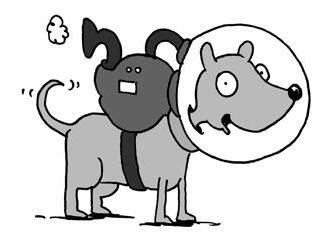
A Doggy Hero
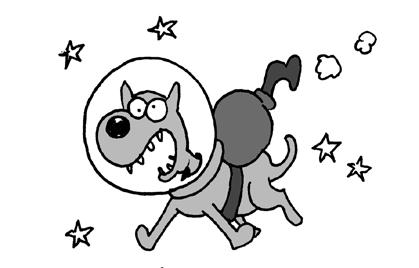
The first animal to orbit Earth was a dog named Laika. She was sent to space in a Soviet Union spacecraft named Sputnik II in 1957. Laika was a stray dog caught on the streets of Moscow. She was nicknamed ‘Muttnik’ by the American media. While in space, Laika’s heart rate and other vital signs were monitored so that scientists could determine whether it was safe to send humans into orbit. She was harnessed into the spacecraft. The mission was not a return mission, and there was never any intention to bring Laika home. Scientists believe Laika overheated in the spacecraft and died within seven days.
Why was Laika nicknamed Muttnik? I 2
Read A Doggy Hero. Why is Laika referred to as a hero?
A clause is a unit of meaning that includes a verb . A simple sentence is one clause. Conjunctions link clauses to form compound and complex sentences. and so because but or until
Circle the conjunctions in the sentences below. Underline the verbs. 3
Laika was born in Moscow and she became a very famous Russian dog.
Laika was the first animal to orbit the Earth and she became famous. Laika was harnessed into the spacecraft but she could reach her food and water.
Laika was the first animal to orbit Earth but she was not the first animal in space.
Cross out the incorrect conjunction in each example.
Laika overheated (so/or) she died. Laika died (so/because) Sputnik II’s heat shield failed. The dog’s name was Laika (but/so) the media called her ‘Muttnik’.
A Doggy Hero has not been written in paragraphs. Draw a dividing line in the text where you think each paragraph should begin. 4 5
A complex sentence has two or more clauses. One of the clauses is the main (independent) clause . The other clauses in the sentence are dependent clauses . They depend on the main clause to fully make sense.
Join the sentences using conjunctions. 6
Laika was harnessed into the spacecraft. She couldn’t move around.
Russian scientists said Laika showed no ill effects from her space flight. She overheated. She died.
Laika was a stray dog. No-one objected to sending Laika into space.
Laika died in space. She became famous.
Personal pronouns replace or refer to nouns for people, places, animals and things. I me you we us he him she her they them it
Circle the personal pronouns in A Doggy Hero. 7
Use a personal pronoun from the box to complete each sentence. 8 him he it it her she
Laika ate her dinner and then licked her lips. Ralph, the dog, sat under his favourite tree while waited for dinner. I bought a new lunch box and took to school. My cat was sick so I took to the vet.
Lena doesn’t like it when I tickle
Russell is funny, but don’t tell I said so!
Rewrite the pair of sentences as one sentence. Use a conjunction and a personal pronoun. 9
Elena and Frankie went to the park. Elena and Frankie needed some fresh air.
Find out about some other animals that were sent into space, such as spiders, monkeys or mice. Write an information report. Use conjunctions to connect clauses in the sentences. Use pronouns to refer to the animals.
This imaginative text is an excerpt from a narrative. It uses noun groups to describe the characters and the setting.
Battle for the Planets
In the deep wilderness of space, there lived a peaceful community of Ferlings. The Ferlings were kind, gentle, nomadic creatures. For centuries, they had roamed from planet to planet, constantly under threat of attack by the not-so-friendly Grimlies, of the planet Grima.
One day, a group of Ferlings was collecting sweet, juicy Moonberries and tasty little Jupiternuts when they realised that a gang of huge, fierce Grimlies was moving towards them. They immediately hid behind a nearby rocky outcrop, hoping that they hadn’t been seen and waited until they thought the coast was clear before stepping out.
They were wrong! The Grimlies were waiting for them.
Narratives are based on one or more themes. Read Battle for the Planets. Which of the following themes might apply to Battle for the Planets?
love hate family survival greed good vs evil courage revenge loyalty death prejudice power freedom war betrayal justice/injustice
Nouns name people, places, animals, things and ideas. A noun group is a group of words built around a noun to give a more detailed description. A noun group can include an article ( a, an, the ), adjectives that describe ( spectacular, dangerous ) and an adjectival phrase (the distant planet with the red ocean ).
Write a noun group for each noun below. Use words from the narrative or your own words.
Create an interesting noun group for each noun
4
5
Underline the personal pronouns in Battle for the Planets. Write the noun/nouns that the pronouns refer to.
Ferlings and Grimlies each begin with a capital letter because they are proper nouns. They are the names for creatures from particular places. Write the proper nouns for people from the following places.
Australia
Iraq
Japan
Somalia
6
Earth
Germany
Philippines
Spain
Verbs are words for doing, saying, thinking, feeling and relating. A verb group can include a verb and a helping (auxiliary) verb. is called had vanished hadn’t been seen wasn’t sleeping are trying
Underline the helping (auxiliary) verb in each sentence. Circle the verb groups
The alien was flying. The children were giggling. The Ferlings are collecting berries. The Grimly was shouting. The star has exploded. Joseph is jumping.
A plural noun needs a matching auxiliary verb . Grimlies were A singular noun needs a matching auxiliary verb . A Grimly Collective nouns are singular. The gang was
Circle the collective nouns in Battle for the Planets. 7
Circle the helping (auxiliary) verb that matches each underlined noun. 8
A group of Grimlies (are/is) setting a trap.
The dogs (were/was) running through the park.
A pack of wolves (was/were) hunting.
The seagulls (is/are) flying overhead.
The boy (is/are) going to be late.
The pod of whales (are/is) moving north past Moreton Bay.
The herd (is/are) heading for the river.
Write an ending for the narrative Battle for the Planets. Or write a narrative of your own about creatures from outer space. Create interesting descriptions of characters and settings using noun groups with adjectives
This newspaper article uses complex sentences to convey the information.
THE EAGLE HAS LANDED
An estimated 700 million people around the world watched in awe as the lunar module Eagle landed in the dusty Sea of Tranquillity, and its Commander, Neil Armstrong, and Lunar Module Pilot, Edwin ‘Buzz’ Aldrin, stepped onto the surface of the Moon, while the Command Module Pilot, Michael Collins, orbited above them. Apollo 11 was launched on 16th July from the Kennedy
Space Center in Florida. The astronauts spent two and a half hours on the surface taking photographs, collecting rocks and drilling for core samples.
Conjunctions can join a dependent clause to a main (independent) clause . while since after when before if unless although therefore because as as if
Read The Eagle has Landed. The first paragraph is a single sentence with four clauses. Mark where each clause begins. Hint! Look for the conjunctions as, and and while. They function to link clauses. Also remember, a clause must contain a verb. Underline the verbs. I
Write the clauses from question 1 as four simple sentences. 2
Mark the clauses in the sentences. Hint! Find the conjunctions and the verbs first. 3
Over half a billion people watched televisions around the world as Armstrong climbed down the ladder of the lunar module and took his first footstep on the Moon’s surface.
Aldrin joined Armstrong on the lunar surface and described the moonscape as ‘magnificent desolation’.
The astronauts were trained to control all equipment and land the module themselves if the computers broke down.
4
Use conjunctions to join each group of simple sentences to create complex sentences.
The Daily News sold out on 20th July. The paper had to be reprinted. Everyone wanted souvenir copies of the paper.
Armstrong and Aldrin walked on the Moon. Collins orbited above the Moon. The team on Earth watched excitedly.
5
Every clause (or simple sentence) needs a verb. Circle the verb in each row.
watched lunar ship astronaut Moon dust rock landed newspaper stepped daily space centre Michael orbited while surface
7
Tick the box for each row below that is a sentence. Add sentence punctuation where it is needed. 6
the astronauts collected materials rocks, soil and dust they reprinted the paper souvenir copies of the paper the Kennedy Space Center
Commas are punctuation marks that are used to separate
• words in a list ( apples, bananas and oranges )
• a phrase in a sentence ( After lunch, we went for a walk. )
• a dependent clause in a sentence where the dependent clause comes first ( While orbiting above the moon, Collins did safety checks. ).
Add commas to these sentences to make the meaning clear.
During their walk Armstrong and Aldrin collected rocks soil and dust from the surface. Because of their Moon mission Neil Armstrong Buzz Aldrin and Michael Collins are very famous. During his time in orbit Collins checked his instruments and equipment.
After the worker was injured workplace rules have become more strict. The astronauts took photos collected rocks and drilled for core samples.
Choose a famous event in history to research. Write a news article about it. How did people react to the event at the time? Include statements from witnesses and experts.
This poem uses noun groups and adjectives to describe the Milky Way galaxy.
The Milky Way
A spiral galaxy. A dusty, gassy, pinwheel with a massive black hole at its centre, surrounded by 200 billion stars. Some in clusters. Some young. Some old. Some brighter than our Sun. Some obscured by space dust but still luminous, spiralling in the night sky, strung together by gravity.
A hungry galaxy, consuming other galaxies and growing over time – billions of years of time. An ancient galaxy, nearly as old as the universe itself. So vast. So much unknown. A pinwheel in space holding our solar system, our Earth, our sun on just one arm.
A noun group can include adjectives that quantify or tell number ( one galaxy, some authors, many people ), determiners that point out ( this space suit, those stars ) and nouns that classify other nouns ( apple pie ).
Read The Milky Way. Underline the adjectives that describe. I
In The Milky Way, circle three nouns used to classify other nouns in the noun group.
Find and write two noun groups in The Milky Way that include words that quantify or tell number.
What is the main idea in the poem? Hint! This is the idea the poet wants you to accept or understand.
Personification is when human qualities are given to non-human things. What human qualities does the poet give to the Milky Way?
Some poems use alliteration. Recite The Milky Way. Did you notice any letter sound that is used more frequently than other sounds? What is it?
A noun group can include a possessive adjective to show possession. my our your his her their its
Complete the sentence with possessive adjectives
The Milky Way has gravity that holds solar system on arm.
Use a word from the box to show possession in each noun group.
my our your his her their its
They ran to catch bus.
Give me hand while we cross the road.
I’ll lend you compass to take on the hike.
Ask Giselle if you can borrow ruler.
The Earth rotates on axis.
Mr Webster has forgotten keys.
‘Look, Dane! There’s base camp,’ said Zoe.
Circle the adjectival clauses and underline the nouns they describe. 7 8 8
Adjectival clauses help to build detailed descriptions. Use words such as who , whom , whose , which or that to join an adjectival clause to a main clause . The koala that had a sore leg climbed to the top of the tree. I met the teacher who will take over from Ms Willis .
We only buy cherries that are grown in Australia.
Investors who have an interest in space are funding the flight.
Where are the instructions that we need to follow?
The novel, which is science fiction, will keep you intrigued.
Children for whom reading is difficult will be given extra tutoring.
The teachers were very proud of students who achieved improved results.
Our sun, whose warmth lights our days, is halfway through its life.
Planets that we can see in the night sky include Venus, Mars, Saturn and Jupiter.
I’m looking for a planet that looks golden in colour.
Write a poem that uses adjectives and extended noun groups to describe the topic. Use personification, alliteration and other poetic devices to help readers imagine or form a mental picture of the topic.