Focus on
a language , literature and literacy course
Rex Sadler
Sandra Sadler
Viv Winter

Rex Sadler
Sandra Sadler
Viv Winter
Rex Sadler
Sandra Sadler
Viv Winter
This edition published in 2021 by
Matilda Education Australia, an imprint of Meanwhile Education Pty Ltd
Level 1/274 Brunswick St Fitzroy, Victoria Australia 3065
T: 1300 277 235
E: customersupport@matildaed.com.au www.matildaeducation.com.au
First edition published in 2016 by Macmillan Science and Education Australia Pty Ltd
Copyright © Rex Sadler, Sandra Sadler and Viv Winter 2016
The moral rights of the author have been asserted.
All rights reserved.
Except under the conditions described in the Copyright Act 1968 of Australia (the Act) and subsequent amendments, no part of this publication may be reproduced, stored in a retrieval system, or transmitted in any form or by any means, electronic, mechanical, photocopying, recording or otherwise, without the prior written permission of the copyright owner.
Educational institutions copying any part of this book for educational purposes under the Act must be covered by a Copyright Agency Limited (CAL) licence for educational institutions and must have given a remuneration notice to CAL. Licence restrictions must be adhered to. For details of the CAL licence, contact: Copyright Agency Limited, Level 11, 66 Goulburn Street, Sydney, NSW 2000. Telephone: (02) 9394 7600. Facsimile: (02) 9394 7601.
Email: memberservices@copyright.com.au
Publication data
Authors: Rex Sadler, Sandra Sadler and Viv Winter
Title: Focus on English 10: A Language, Literature and Literacy Course
ISBN: 978 1 4586 5051 1
Publisher: Viv Winter
Project editor: Barbara Delissen
Editor: Ronél Redman
Cover designer: Dim Frangoulis
Text designer: Norma van Rees
Permissions clearance and photo research: Vanessa Roberts
Typeset in Melior Medium 10.75/14 pt by Norma van Rees
Cover image: Shutterstock/Edhar Shvets
Printed in <country> by <printer name> 1 2 3 4 5 6 7 25 24 23 22 21 20
Internet addresses
At the time of printing, the internet addresses appearing in this book were correct. Owing to the dynamic nature of the internet, however, we cannot guarantee that all these addresses will remain correct.
Warning: It is recommended that Aboriginal and Torres Strait Islander peoples exercise caution when viewing this publication as it may contain images of deceased persons.
Focus on English 10 covers essential English skills for students in their fourth year of secondary school. It is a carefully sequenced program that enables students to develop and reinforce their literature, language and literacy skills.
There are 20 cohesive units, each of which focuses on a specific text type, literary technique, writing skill, genre or theme that is relevant to any Year 10 English program. The featured texts provide a meaningful context for language and literacy learning.
For consistency and ease of navigation, each unit is organised into the umbrella strands of Literature, Language and Literacy. The format of every unit is as follows:
Literature
• Introduction: a brief overview of basic skills, terms or concepts covered in the unit
• Texts: high-interest literary, non-literary and multimodal texts for comprehension and analysis.
Language
• Language and grammar: sequential explanations of rules and conventions, clear examples, and exercises for major parts of speech, phrases, sentences and much more.
Literacy
• Word skills: a spelling and vocabulary word list, exercises on list words and a word origins task
• Creative writing: imaginative writing tasks that are linked to the ideas and techniques contained in the Literature section.
Our primary goal in writing this book is to develop essential English skills, but we also hope that students will feel motivated to engage with the world of texts and develop confidence in their own ability to make the best possible language choices and become effective communicators.
Rex
Sadler, Sandra Sadler and Viv Winter
In today’s digital world, images play a more vital role in conveying meaning than ever before. Some images, such as photographs and paintings, can stand alone. However, cartoons, films, picture books, video clips, newspapers and the internet integrate images with written words, spoken dialogue or music in a multitude of ways.
When you are analysing an image and its effect, consider the following:
• Context: What is the personal, cultural, social or historical context of the image? Does this affect your interpretation?
• Purpose: Why was the image created?
• Content: What can you see in the image as a whole? For example, look closely at people, animals, objects, clothing and the detail of the setting.
• Structure: How is the image arranged or organised? What is in the foreground? What is in the background? What stands out? Is the subject close-up or at a distance? Consider patterns, the use of colour, light and shade, and how the image is framed.
• Message: Does the image support a particular message or point of view? Does it capture a special moment in time? Does it have strong emotional overtones? How does it position the viewer?
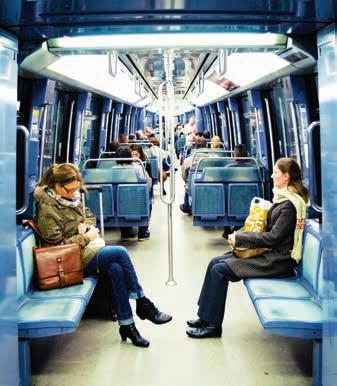
Read the sample analysis provided for each of the following photographs. Some useful terms are shown in bold type.
• Dominant colours of blue and silver give a crisp, cool, clean effect.
• T he image is framed by the walls and roof of the carriage.
• T he image is symmetrical —the left and right halves mirror each other.
• The lighting is bright and almost clinical.
• Two women are in the foreground and the rest of the carriage is in the background
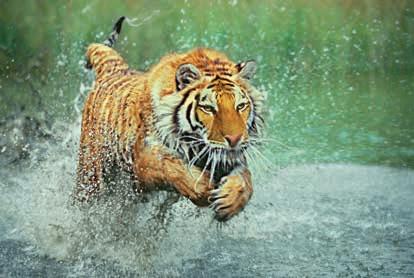
• T he tiger is in the foreground and its gaze is directed at something outside the image.
• Movement is conveyed by the splashing water and the tiger’s outstretched front legs.
• T he tiger’s stripes create a pattern of vertical and horizontal lines.
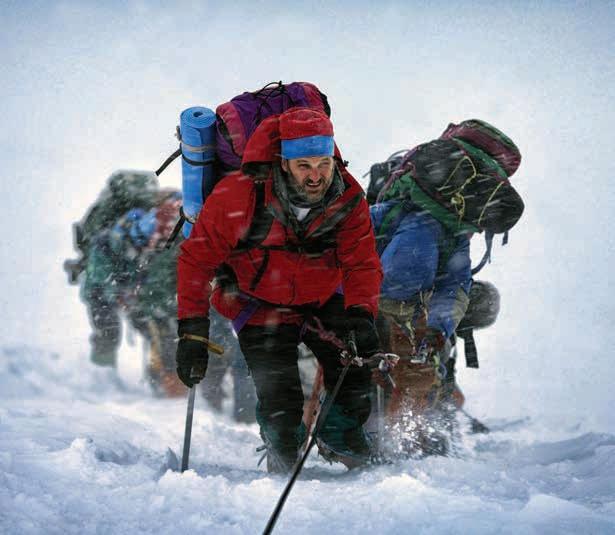
Context: The following still is from the action adventure film Everest (2015), which is based on a real-life disaster that occurred at Mount Everest in May 1996. After scaling most of the mountain, climbers were trapped during a violent blizzard and faced a desperate struggle to survive. Tragically, eight climbers died in one day. The still shows actor Jason Clarke as Rob Hall, who led one of the expedition teams up the mountain. This still was selected for promotional purposes and supplied to film reviewers around the world.
1 Context and purpose
From the contextual information given above the still, why do you think the film studio chose this image to promote the film Everest ?
2 Content and structure
a What is noticeable about Rob Hall’s face?
b What emotion is shown in his face and by his body language?
c What is the effect of his red clothes in contrast with the blue clothes worn by the rest of the team?
d Describe the background of the still. What does it suggest about the plight of the climbers?
3 Message
a Is the viewer positioned above or below the group of climbers? What impression does this give?
b What persuasive message about the film Everest is contained in the still?








Context: Collins Street, 5 p.m. was painted by major Australian artist John Brack in 1955. Collins Street is in Melbourne’s city centre and the painting depicts peak hour at the end of the working day.
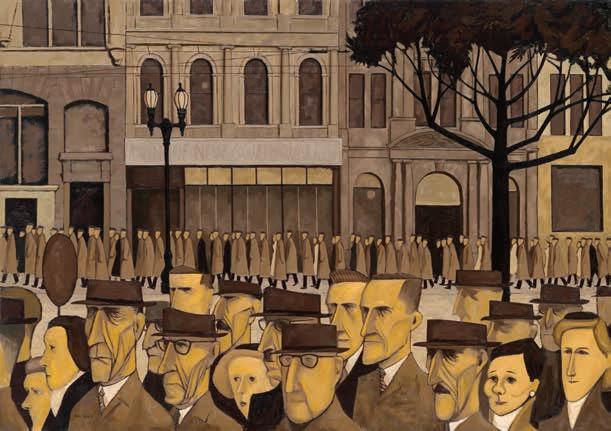
1 W hat is happening in the painting?
2 The dominant colour is brown. What impression does this give of the whole scene?
3 W hat do you notice about the faces of the workers in the foreground of the painting?
4 What do you notice about the clothing worn by the row of workers in the background?
5 There is no communication between any of the workers. What comment is the artist making about the way these people feel?
6 W hat does the painting suggest about the everyday lives of city workers?
Context: The following headline, photograph and caption accompanied a news report about a devastating typhoon that had hit the Philippines, a country that experiences many natural disasters each year. In the report, the journalist focuses on the human cost of the typhoon by describing its impact on individual villagers and the difficulty of getting food and other aid to remote locations.

BY LINDSAY MURDOCH, LAT-OSAN VILLAGE, LEYTE ISLAND
‘Our children are hungry already … what can we do?’ says a homeless Mercy Daguil, with 5-month-old son Andrei, standing on a concrete slab where her home once stood.
Photo: Brendan Esposito

from The Age
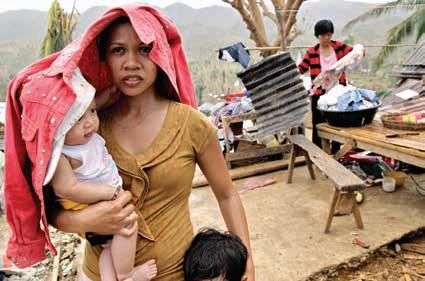

1 What is the literal meaning of the headline? What is its broader meaning?
2 What does the caption reveal about what is left of Mercy Daguil’s house?
3 What is represented in the background of the photograph?
4 What practical use has Mercy made of the red jacket?
5 Describe the direction of both Mercy’s and her baby’s gaze as well as each one’s facial expression.
6 What effect is the photo likely to have on the emotions of readers?
The types of nouns are common nouns, proper nouns, collective nouns and abstract nouns.
Common and proper nouns
Common nouns are the general names given to people, places, animals and things. man kitten teacher restaurant chair banana book giraffe
Proper nouns are the names given to particular people, places, animals and things. They are easily identified because they always start with a capital letter.
Rachel Mazda Vegemite Greece Qantas Twitter February Phar Lap
Match these common and proper nouns with their meanings below.
Microsoft octopus Vesuvius pasta violin Hanoi gold Hollywood Facebook submarine Pluto waltz microscope Hyundai Januar y Rhine
Collective nouns are used to name a collection or a group of people, animals or things. a choir of angels a herd of cattle a bundle of newspapers
Complete the sentences by inserting the correct collective nouns from the ones in brackets.
1 Amidst a of bullets, a of police pursued the of thieves. (squad, gang, fusillade)
2 The tourists on safari saw a of lions, a of monkeys and a of storks. (flock, pride, troop)
3 The of cricketers ran down the of stairs and through the of spectators. (flight, crowd, team)
4 The new of directors decided to purchase a of cars and a of paintings. (collection, board, fleet)
5 Taking out a of banknotes, the millionaire purchased a of diamonds and a of pearls. (cluster, string, roll)
Abstract nouns are words that name qualities, emotions and actions. They are usually things that you cannot see or touch. truth love frustration excitement peace laughter
Change the following words to abstract nouns. For example: prosper—prosperity hate—
blizzard plentiful exertion isolation avalanche precipice solitude summit desolation disintegrate freezing breathe hurriedly crevasse wilderness jeopardy parallel urgently tenacious malnutrition altitude gauge occurs disastrous exhilarating climber latitude exposure cascading Antarctic


Match the meanings and clues below with a word from the list. The first letter is given to help you.
1 the sudden fall of a mass of snow, rock or mud down a slope a
2 physical weakness caused by the lack of correct foods m
3 an area that is uncultivated and uninhabited w
4 a severe snow storm with strong winds b
5 relating to the south polar region A
6 the situation of being alone without other people s
7 the height above sea level of a point on the Earth’s surface a
8 physical or mental effort e
9 to become weaker; to break into small fragments d
10 a very steep side of a cliff or mountain p
11 the state of having no protection from something harmful e
12 the highest point of a hill or mountain s
13 making one feel very excited and happy e
14 falling quickly and in large amounts c
15 a deep open crack, especially in a glacier c
16 a person or animal that climbs; a mountaineer c
17 persistent; sticking or holding on firmly t
18 to calculate an amount especially by using a measuring device g
19 a position north or south of the equator l
Find appropriate list words to complete the passage below. The first letter of each word is given to help you.
A exploration began at the end of the 19th century, often with d results caused by the treacherous landscape. When a c o , there is a movement in sheets of ice. If someone falls into such a crevasse, they are usually in great j and must be rescued u before tonnes of ice start c into the crack. The f temperatures make it difficult to b and the body’s heat drops dangerously. The t explorers also experienced i in the frozen d . Ernest Shackleton led the first expedition, which reached the l of 88º South. Another famous explorer was Robert Scott. He and his four companions suffered from m and e . They all died in the b conditions on their return journey from the South Pole.
Complete the following sentences by using the correct forms of the words in brackets.
1 The climber, heavily, scaled the cliff-face. (breathe, tenacious)
2 The water down the crevasse. (cascading, precipice)
3 The soldier was not about to his life by himself to enemy fire. (jeopardy, exposure)
The altitude of a mountain or plane is its height in relation to ground level or sea level. The word ‘altitude’ is derived from the Latin word altus, which means ‘high’. The following words are all derived from altus. Use the dictionary at the back of the book to write their meanings.
altar: al to: al timeter: exalt:
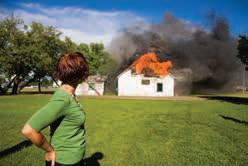
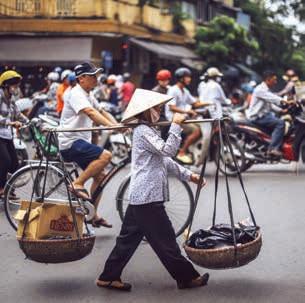
Photographs and other visual texts are often open to more than one interpretation, and sometimes they convey different messages to different people. Choose one of the photos on this page and think about how you interpret it. Consider the mood of the photograph first. Is it frightening, light-hearted, mysterious, or something else? Perhaps something has just happened or is about to happen. Who is involved? What are they feeling? Where are they? Now write a 250-word story or description that captures your interpretation of your chosen photo.