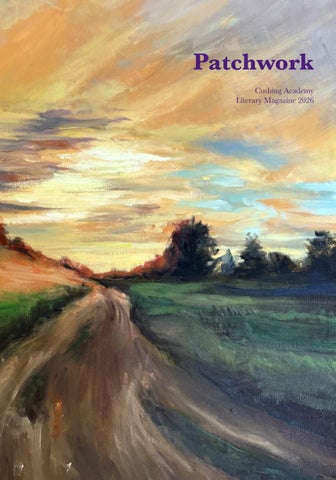
Patchwork
Cushing Academy Literary Magazine 2026
Editors
Fendy Deng ’28
Brady Dickerson ’26
Zachary Jia ’29
Xiangyu Sophia Kong ’26
Dowon Lee ’27
Jasmine Lou ’26
Kristen Ma ’26
Arina Masalskaia ’27
Nathan Park ’29
Jobe Streeter ’29
Karen Wang ’27
Staff
Olivette Chen ’26
Zoom Nguyen ’26
Stella Sun ’27
Adiya Xia ’27
Faculty Sponsor Mr. Simon Hunt
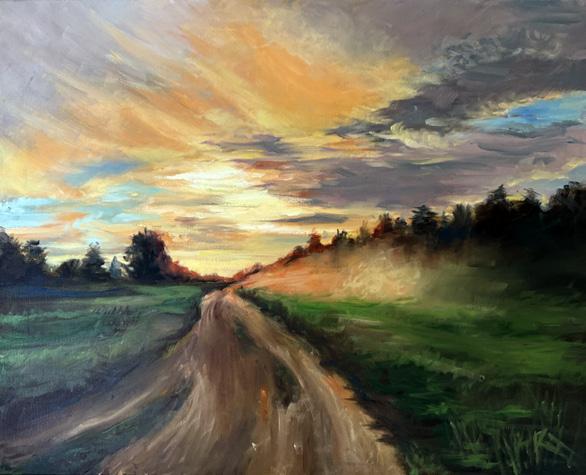
Patchwork gratefully acknowledges the support of Ms. Sarah Catlin, Ms. Tina Costa, Ms. Rebecca Cinclair, Mr. Donny Connors, Ms. Jeanine Eschenbach, Mr. Christian Housh, Mrs. Melissa Hunt, Mr. Brian Krauss, Ms. Amy Logan, Ms. Cathy Melanson, Dr. Anne Nelson, Ms. Nancy Ni, Ms. NhuPhuong Trieu-Hindle, Mr. L.I. Waisman, and the Cushing English Department.
Cover Art Renee Xue ’28
Table of Contents
2 Pending | Arina Masalskaia ’27
7 Strands of Story | Kam Zellers ’26
8 Vulpes / The Fox | Michael Bruso ’27
Ambulatio in Lunae Luce / Moonlight Walk | Grace Angeloni ’28
9 Trust | Jimmy Monahan ’26
10 The Frog in Room 207 | Yuki Takahashi ’26
11 The Game | Lukas Botnick ’26
12 The Window in Hawthorne Hall | Umar Khan ’26
16 水调歌头 / Prelude to Water Melody | Stella Sun ’27
17 A Red Pen | Coley Mark ’27
18 If My House Caught on Fire | Katherine Hull ’26
20 Larry | Axel Favreau ’26
21 Memoirs | Angie Yu ’26
22 birds & | Kristen Ma ’26
24 5 Minutes | David Cha ’26
26 Six Word Stories | Various
30 Petrichor | Xiangyu Sophia Kong ’26
32 To Be From a Place I Cannot Go:
The Distance Between Freedoms | Ines Khamis ’27
34 Querida América / Dear America | Junior Beyoko ’26
36 Saltwalker | Katherine Hull ’26
38 朝阙歌 / The Court Audience Scroll | Adiya Xia ’27
39 Do I Consider Myself Lucky? | Ms. Brittany Bernardini
40 The Butcher | Jianjing Hou ’26
43 Schwann Cells | Fendy Deng ’28
44 Reminders of Japan | Yuki Takahashi ’26
Haiku
5 Ophylia Li ’26
7 Vassilios Kakavitsas ’26
10 Kam Zellers ’26
15 Yuki Takahashi ’26
Tiffany Chang ’26
18 Mrs. Melissa Hunt
19 Tim Howard ’27
21 Yuki Takahashi ’26
22 David Cha ’26
25 Emma Pham ’27
Mao Fujikawa ’26
37 William Wong ’26
44 Mao Fujikawa ’26
Images
6 Charlotte Ciarletta ’26
13 Colin Halloran ’28
17 Catherine Li ’27
19 Chloe Hoang ’28
22 Nate Lansky ’26
27 Tom Zhuo ’27
29 Alex Pope-Storm ’27
33 Xiangyu Sophia Kong ’26
39 Stella Hunter ’27
41 Xiangyu Sophia Kong ’26
Pending
SECTION ONE: NAME OF APPLICANT
My name?
They changed it at the airport.
At school.
At the DMV.
At the border.
Say it how my grandmother said it
Say it how the train conductor whispered it between stops, between lives. Alias.
Case number. Accent.
Alien.
The one who doesn’t belong here, but doesn’t belong there either.
SECTION TWO: DATE OF ENTRY
What do you want?
The exact time my breath crossed your line?
Do you want the night I left?
The snow?
The war?
The silence?
Or the moment I became a question instead of a person?
SECTION THREE: METHOD OF ENTRY
Airplane.
A hand pulling mine too tightly through customs. A visa we overextended.
A boat that smelled of diesel and forgetting. Or no method at all, just the slow migration of dreams. You ask how I got here?
Ask how I stayed.
Arina Masalskaia ’27
SECTION FOUR: PURPOSE OF STAY
To study. To work.
To write poetry in a language that tastes like metal in my mouth. To exist in between identities, quiet enough to avoid the clipboard. To survive. Is that not enough?
SECTION FIVE: LIST HOUSEHOLD MEMBERS
One father, who was an aspiring film student in one country and a dishwasher in another. Who still irons his shirt like someone will notice. One mother, Who missed birthdays, nosebleeds, the first time I rode a bike and fell. She asked how I was, but not why I sounded older. I needed arms. I got dial tones. She wasn’t allowed in. So I learned how to need less.
SECTION SIX: ADDRESS OF STAY
The apartment complex with chipped balconies and laundry lines, where screen doors slam like punctuation. The neighborhood where knocks go unanswered, not out of rudeness but caution. Where curtains close before the sirens remember to leave. Where our lives are temporary, but our fear is permanent.
SECTION SEVEN: HAVE YOU EVER VIOLATED TERMS OF STAY?
Yes.
I learned your language too well. I got too comfortable. I tried to stay and made the mistake of hoping that meant I could.
SECTION EIGHT: ATTACH EVIDENCE OF GOOD CONDUCT
Here is my silence. Here is every time I said thank you when I wanted to scream. Here is the poem I never showed anyone because it was about home, and home is a sore subject. Here is my father’s spine, bent from cleaning a country that never welcomed him.
SECTION NINE: DESCRIBE ANY ENCOUNTERS WITH AUTHORITY
No one stormed in.
No one shouted.
But the mail got heavier. Bold words. Deadlines. Status pending.
Voluntary departure. My father waited on hold for hours. They moved his case to nowhere. No knock. Just silence loud enough to obey.
SECTION TEN: SIGNATURE
No pen.
Use the calluses on my father’s hands. Use my voice, even if it shakes and mispronounces your words. I sign with my breath. With my spine still standing. I sign for every child who had to choose between silence and survival. I sign for myself, because no one else will.
DECISION PENDING.
Pending what?
Whether I’m quiet enough? Useful enough?
Pending the day you forget that borders are real only when they benefit you.
Pending nothing. Because I am already here. And I will not fold myself smaller to fit your forms.
EPILOGUE:
We left countries on fire just to walk into yours with our hands raised and our papers trembling. We did not come to steal. We came to live. Don’t call it safety. Call it what it is: Inheritance wrapped in barbed wire.
Airport gates closing, tears blur the last wave goodbye, a suitcase feels heavy.
– Ophylia Li ’26

Charlotte Ciarletta ’26
Strands of Story
Kam Zellers ’26
Her hair was the length of the universe. It glowed like an Indian mango in March. Each strand was a different memory.
Some fell and drifted away on her journey–But fallen memories still hold stories.
The stories were forever hers as they grew from her temple. Treasures untold, bound by secrecy, long held to her mind. Foreign limbs grasped, unwanted or not–
Twisting and accessorizing her locks.
But still,
The stories were hers–the only thing that mattered was that she knew it. No matter the changes made by others’ curiosity, She knew her roots were gold.
Every day I pray However every day I sin
– Vassilios Kakavitsas ’26
Vulpes / The Fox
Michael Bruso
’27
Sub galliario
Under the henhouse Est vulpes sine cibo. Is a fox without food. Intrat in galliarium He enters into the henhouse Cibum petens. Seeking food.
Ambulatio in Lunae Luce / Moonlight Walk
Grace Angeloni ’28
Luna splendet super cum dulci amore. The moon shines above with sweet love. Canis dormit sub molli pluviae fragore. The dog sleeps under the soft noise of rain. Per noctem ambulamus, lumine perfusi. We walk, drenched with light, through the night.
There once was a young boy who got lost in a garden. For a forever, he explored with great wonder, finding things only he got to name. After many years, the young boy grew tired of having nobody around–besides the man at the gate, but he never replied. Maybe the man couldn’t hear. The boy spent days sitting by the river. Waiting. Maybe to find things to do, maybe to stop altogether. One day, a young girl found him. For a time, they didn’t communicate, just trying to find any language.
The girl found ivy climbing the walls of their garden. One day, she started climbing and found she couldn’t reach the impossibly high tops of the walls. When looking down, she saw the beautiful glade across the river. She asked the boy if he had ever been there, and he hadn’t known there was anything there at all.
She woke up the next morning to watch it all over again.
The boy and girl forded the stream together and found the glade. At the center, there was a pile of bones with the furrowing branches of a tree growing from it. For days, they just sat to watch the tree, thinking its fruit would drop and there would be bones hiding inside.
The young man grew tired of the tree and went back to living as though there was nothing across the river. However, the young woman sat and watched the tree until she dozed off in the grass. She woke up the next morning to watch it all over again.
One day the woman saw a creature slide up the tree’s trunk and pluck its sweet fruit. She watched as its fangs sank into its flesh, juice oozing out. In her hunger-filled stupor, she rose to feast as well. She gorged on the fruit, eating all but two of them.
She went to the man and told him of the fruit’s sweetest taste, but he had no interest at all.
“Please will you try the fruit?” she asked him for just one thing.
The two had never once lied to one another, so her desire was everything and more than he needed for convincing.
The man and woman forded the river together again, the water now just kissing their knees. The man trusted the woman and tried the fruit that could only be described as divine.
They heard a horn come from beyond the walls–and a voice.
“Why did you wound me, my first son? When I created you, there was just one rule here in the Garden: to never eat the fruit of knowledge. I gave you food, and I gave you a love. Wasn’t the whole world enough for you, Adam?”
Adam had no way of knowing the command he was given as a baby, but he had known to trust the woman.
And thus, mankind was sentenced to damnation.
Jimmy Monahan ’26
The Frog in Room 207
Yuki
Takahashi ’26
A small green frog sat quietly on a hospital windowsill. The building was crowded and full of noise—machines beeped, nurses rushed by, and patients murmured in tired voices. No one noticed the frog, except a young boy named Ken lying in the bed nearby. Ken had been in the hospital for weeks after breaking his leg. Every day felt the same until he saw the frog. “Hey there, little guy,” he whispered. The frog blinked slowly, as if listening.
Each morning, the frog returned. Ken began to imagine the frog had a tiny house somewhere outside—maybe near the hospital garden—where it lived with other frogs, safe and free. He drew pictures of it, a small house made of leaves and pebbles, with a pond nearby.
One rainy afternoon, Ken’s doctor said he could finally go home. Before leaving, he looked toward the window. The frog was there again, watching. Ken smiled. “You have your house,” he said softly. “Now I get to go back to mine.” The frog gave a quiet croak, and for a moment, the noisy hospital felt peaceful. Then, as the elevator doors closed, the frog leaped away—back toward the world beyond the glass, where its own little house waited.
He gazed into the water –His father’s reflection stared back –Ripples blurred his face.
– Kam Zellers ’26
The Game
The whistle blows, sharp and cutting, and the field’s a blur of motion, everyone’s heart pounding, feet ripping up the grass. The ball is a blur, slipping through sticks, a dance between us, fast and desperate, the air thick with the sound of it the clink of helmets, the crash of bodies, shouts that crumble the air, I’m chasing it, the weight of the game deep within my chest, the sweat slick on my palms. The goal is a magnet now.
I need a goal pulling me in, one step, one dodge, I take the shot, the net ripples, a split second of glory, but only for a moment.
Then – the clock winds down, every second stretching out like decades. The other team breaks through, their sticks fluid, their eyes set on victory, and I can’t stop it. The ball slips past, and the final whistle blows. It’s over.
The weight of defeat crashes down, heavier than the pads on my shoulders, each breath feels like a knife stabbing me, each step feels wrong.
The field’s silent now, and the taste of it, the loss, sticks in my mouth, bitter, like something I can’t swallow, and I just stand there, thinking.
Lukas Botnick ’26
The Window in Hawthorne Hall
Umar Khan ’26
I never expected the quietest part of campus to become the center of the weirdest night of my life. Hawthorne Hall always felt old, but the good kind of old–stone steps that stayed cold even in summer, wooden doors that groaned every time they moved, and windows that rattled when the wind pressed against them. People joked that the dorm was haunted, but everybody joked about old buildings, so I ignored it.
At least until the night everything changed.
It happened right before winter break, when the campus felt half-asleep and the wind blew so hard it pushed snow against the windows like handfuls of sand. Most people stayed inside, except for the two-minute sprint to the dining hall and back. I liked the quiet, honestly. No shouts down the hallway. No people racing around. Just soft footsteps and the hum of heaters struggling to keep up.
That night, I was working on an English assignment at my desk. I was tired but not tired enough to sleep, and the room felt too still. My roommate, Connor, had gone home early, leaving his side of the room perfectly neat for the first time all semester. I stared at my laptop screen, reading the same sentence over and over, until something moved in my peripheral vision. It came from the window. At first I thought it was just snow sliding down the glass, but when I looked over, the shape wasn’t snow. It was a silhouette. A person. Standing outside on the narrow ledge. I froze. Someone was outside my second-floor window in the middle of a snowstorm? That made no sense. I blinked, rubbed my eyes, and looked again. The figure had vanished. My heartbeat picked up, fast and tight. I told myself it was wind, shadows, anything to avoid thinking about someone standing that close.
A person. Standing outside on the narrow ledge.
But curiosity–dangerous, stubborn curiosity–pushed me to get up. I walked slowly to the window and pressed my hand to the cold glass. It was empty. Just swirling snow and the faint glow from the walkway lights below. I backed away, feeling stupid for even checking, when I noticed something new: a faint tapping sound. Not loud enough to be someone knocking. More like something brushing the door from the hallway. Tap. Tap. Tap. The sound got under my skin. I swallowed and stepped toward the door. The tapping stopped. Everything went silent. I waited. One second. Two. Nothing. I cracked the door open. The hallway was empty except for a piece of paper lying on the floor–thin, wrinkled, and faintly damp. I picked it up. There was handwriting on it, shaky and uneven: “Do not open the window. T.” My stomach dropped. At first, I laughed nervously. It felt like a prank, probably one of the seniors messing with underclassmen. But something about the handwriting bothered me. It looked desperate, almost scratched into the page. I closed my door and sat on my bed, holding the note.
I tried to think of anyone whose name started with T. Tyler on the floor below? Theo from math class? Tom who cleaned the dining hall tables? None of them made sense. And why deliver a warning like this? I should’ve thrown the note away. I know that now. But instead, I slipped it into my desk drawer and tried to get back to my homework. That lasted maybe ten minutes. The tapping returned, only this time it wasn’t at the door. It came from the window. My whole body tensed. The taps were soft but clear, like fingertips brushing the glass. Slow. Careful. Almost testing. I stood and backed up until my legs hit the bed frame. Tap. Tap. Tap.
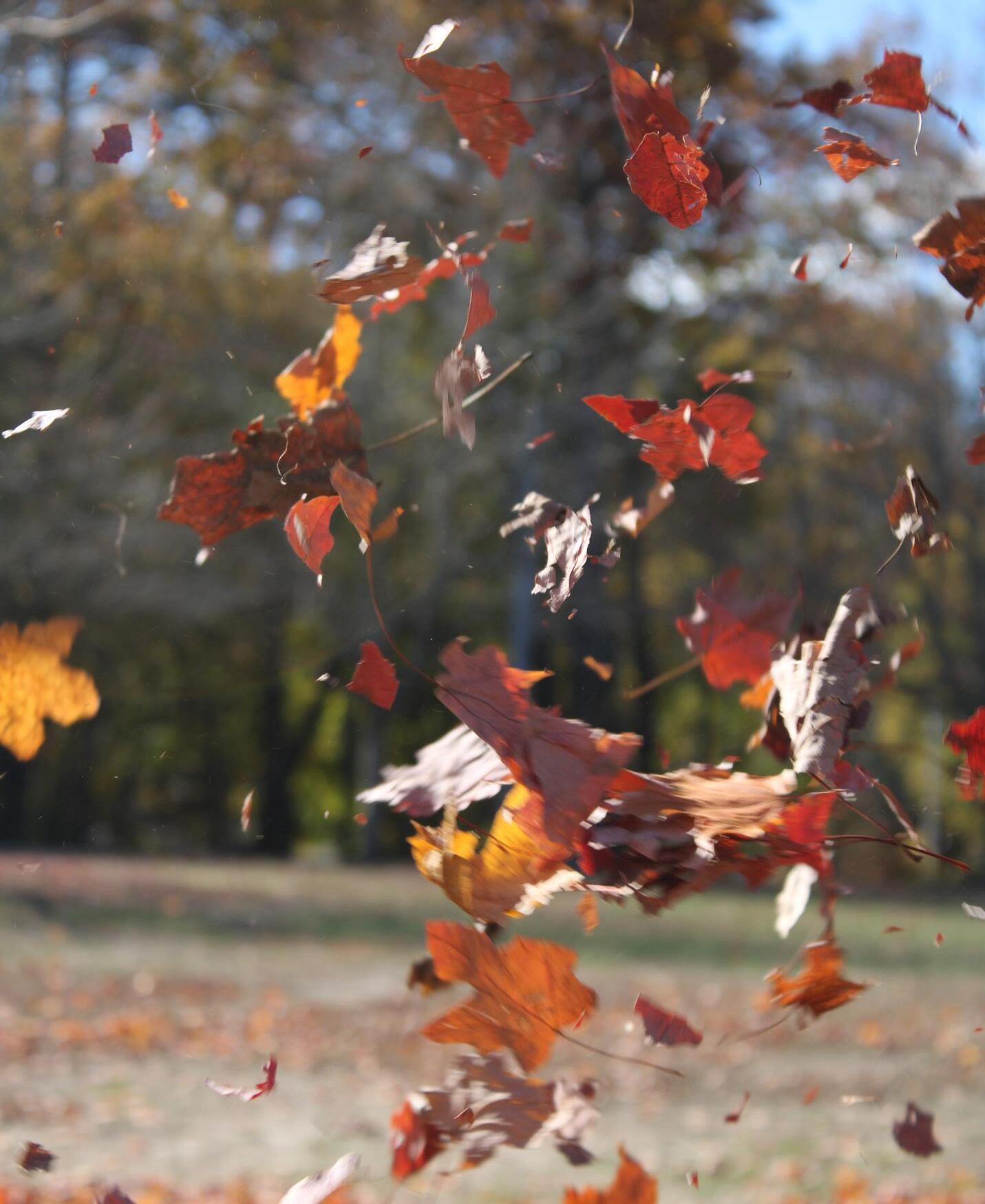
Colin Halloran ’28
I wanted to run, but where would I go? My phone sat charging on my desk, and for a moment I considered calling campus security. But then the tapping stopped again, leaving a silence so heavy it pressed on my ears. I forced myself to look. There was no face, no figure. Just a small dark mark on the outside of the glass, like someone had pressed a fingertip there. I stepped closer, feeling stupid again, until my breath fogged the inside of the window. I wiped it with my sleeve, then froze.
The mark wasn’t on the outside. It was on the inside.
Before I could react, a gust of wind slammed against the window from outside. The glass groaned loudly, and something rattled. I jumped back. I didn’t know if the window was going to break, or if it was just old and reacting to the pressure. The wind kept pounding, harder and harder. Then the latch on the window shook. Not from the wind. From inside. My room suddenly felt freezing. The heater hummed, but it wasn’t doing anything. A tight knot formed in my throat. I grabbed my jacket and shoes and bolted for the door. In the hallway, warm air hit my face and I exhaled sharply. A couple of students walked down the hall laughing about something, and everything looked normal again. That almost made me feel stupid for panicking. I headed downstairs to the common room, figuring I’d stay there until I calmed down. Usually it was loud and crowded, but being so close to break, it was empty except for one person sitting on the couch.
A tall boy I had never seen before. He wore a long, dark coat that looked too thin for winter. His hair was messy and damp, like he’d just come in from the snow, but there wasn’t a single snowflake on the floor around him. He was staring at the wall without blinking. I hesitated at the bottom of the stairs. Something about him felt… off. He turned his head slowly, like he already knew I was standing there.
“You opened the window,” he said. His voice was calm. Too calm.
“N-no,” I stammered. “I didn’t.”
“You touched it,” he said. “It’s the same thing.” My mouth went dry. I wanted to ask who he was, or what he was talking about, or how he even knew anything about my room. But the words wouldn’t come out. He stood up. Taller than I expected. His eyes were dark, strange, almost reflective. “Once you touch it,” he said quietly, “it knows you now.”
A chill ran up my spine. I stepped back, ready to sprint upstairs or outside or anywhere away from him. But he didn’t move toward me. He reached into his coat and pulled out a folded piece of paper–the same kind as the note outside my door. He held it out. I swallowed and forced myself to take it. When I looked down to read it, he spoke again, barely above a whisper: “Do not go back tonight.” I looked up. He was gone. Not walking away. Not opening the door. Gone. The common room door had not even moved. My heartbeat hammered in my chest. My hands shook as I unfolded the paper. It said: “It is patient. T.” I didn’t stay in the dorm that night. I headed straight to the Student Center, which stayed open late during finals week. I stayed in a chair by the vending machines under the bright fluorescent lights. No windows directly behind me. No shadows near my feet. Just other students studying or napping. Safe. When people asked why I was there, I shrugged and said studying was easier outside the dorm. Nobody questioned it.
Relief hit me, quick and warm. Then I noticed something else.
By morning, everything felt almost normal again. The sun was out. The snow had stopped. The campus looked soft and bright. I told myself I had imagined half of it. Stress. Lack of sleep. Shadows on glass. Still, I felt sick walking back to Hawthorne. My room looked exactly how I’d left it, except the air felt colder. I hugged my jacket tighter, took a deep breath, and walked to the window. The mark on the glass was gone. Relief hit me, quick and warm. Then I noticed something else. A new note. It was on my desk, placed neatly on top of my closed laptop. I hadn’t left my laptop closed. Hands shaking, I picked up the note. There was only one sentence: “You shouldn’t have left.” No signature. No “T.” The paper slipped from my fingers and drifted to the floor. I backed out of the room slowly, heart pounding so loudly I could hear it in my ears. The hallway looked normal. Everything looked normal. But I didn’t go back inside. Not then. And not alone.
That afternoon, I asked my dorm head to switch my room “for heating issues.” He didn’t ask questions; he just gave me a new room upstairs. Warm. Bright. With a window that didn’t rattle. I never opened the old door again. Sometimes, when I pass by Hawthorne Hall at night, I look up at my old window. Most nights there’s nothing there. But every now and then, on windy evenings when the sky is dark and the glass reflects almost nothing, I swear I see a faint silhouette standing behind the glass. Watching. Waiting. Exactly like the note said. Patient.
Smoke circles the sky Bonfires whisper old secrets Night tastes like cedar
– Yuki Takahashi ’26
A river flowing through, stones are polished smooth, time leaves its mark.
– Tiffany Chang ’26
水调歌头 / Prelude to Water Melody
For Eissis Yu ’25 on Graduation Day Stella Sun ’27
烟蹙暮云处, 寒雨破春来。霖霖多少心事, 一任野风裁。可叹群峦缥缈, 映我孤灯对案, 枯笔诉襟怀。何日绿丘上, 再看晓云开? 野草径, 闲蛛网, 旧青苔。相看无厌, 林深曾幸有人来。不见明年山雨, 唤起菌丛一地, 朵朵为君开。春去君何在, 秋至我徘徊。
Where wisps of smoke entwine the twilight clouds, a chill rain arrives and breaks apart the spring. As the ceaseless shower falls, I surrender my thoughts to be spliced by whims of the wind. Alas, the surrounding peaks loom faint and ethereal, accompanying the lamplight that falls on my shoulder; with a withered pen, I pour from my chest. Oh, when shall we once again stand upon the hills together, watching the morning clouds flow?
Paths of grasses, idle spiderwebs, and mosses of age—I gaze upon them wearilessly. What a blessing to these woods, deep and verdant, to be once greeted by your presence.
I am yet to see the rains of the coming autumn, as I imagine mushrooms sprouting forth from the earth, each delicate bloom—they open for you. Now that spring has left, your sail will soon be set; when autumn comes, here I’ll linger and remain.
A Red Pen
A mark, a scribble, a weapon for minute destruction.
Born to color, forced to cover, a misunderstood utensil.
Red is fear. Red is rain. Red is death. Red is pain.
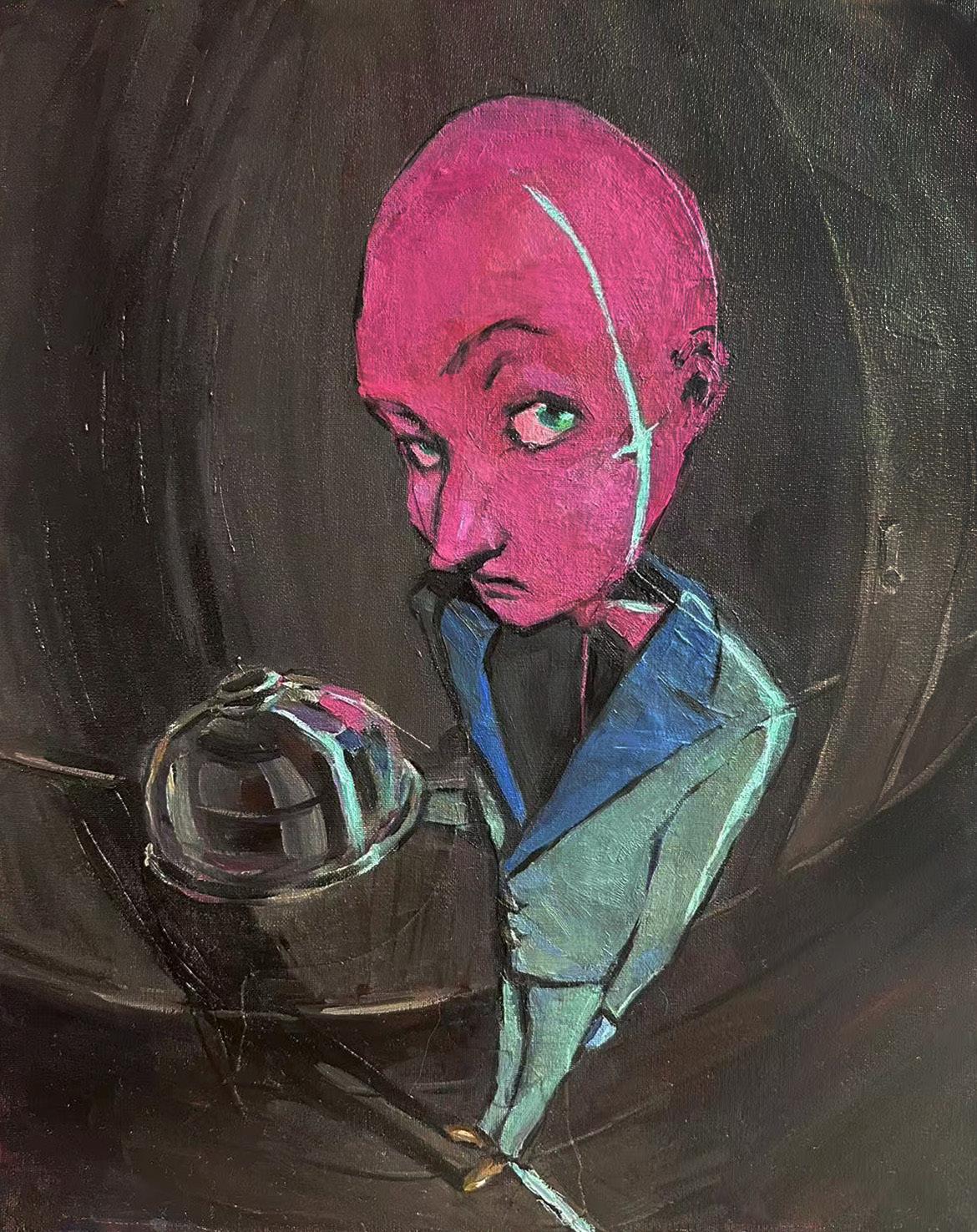
Coley Mark ’27
Catherine Li ’27
If My House Caught on Fire
If my house caught on fire, wood crackling and burning, the one thing I would take is my stuffed owl.
His grey matted fur was once white. He’s been where I’ve been, seen what I’ve seen, alongside me —
the Caribbean air, salt stinging my cuts.
Small towns enveloped by the Swiss Alps, farmhouse in the snow, searching for constellations at night.
Parisian streets: passing ashtrays on tables, croissant crumbling in my mouth, the Eiffel Tower sparkling a nuit.
New York City, cars honking, the city that never sleeps.
My house is not burning. The journey is not over.
Katherine
Hull ’26
“I am an artist!” she had to yell all the time. Who’s she convincing?
– Mrs. Melissa Hunt
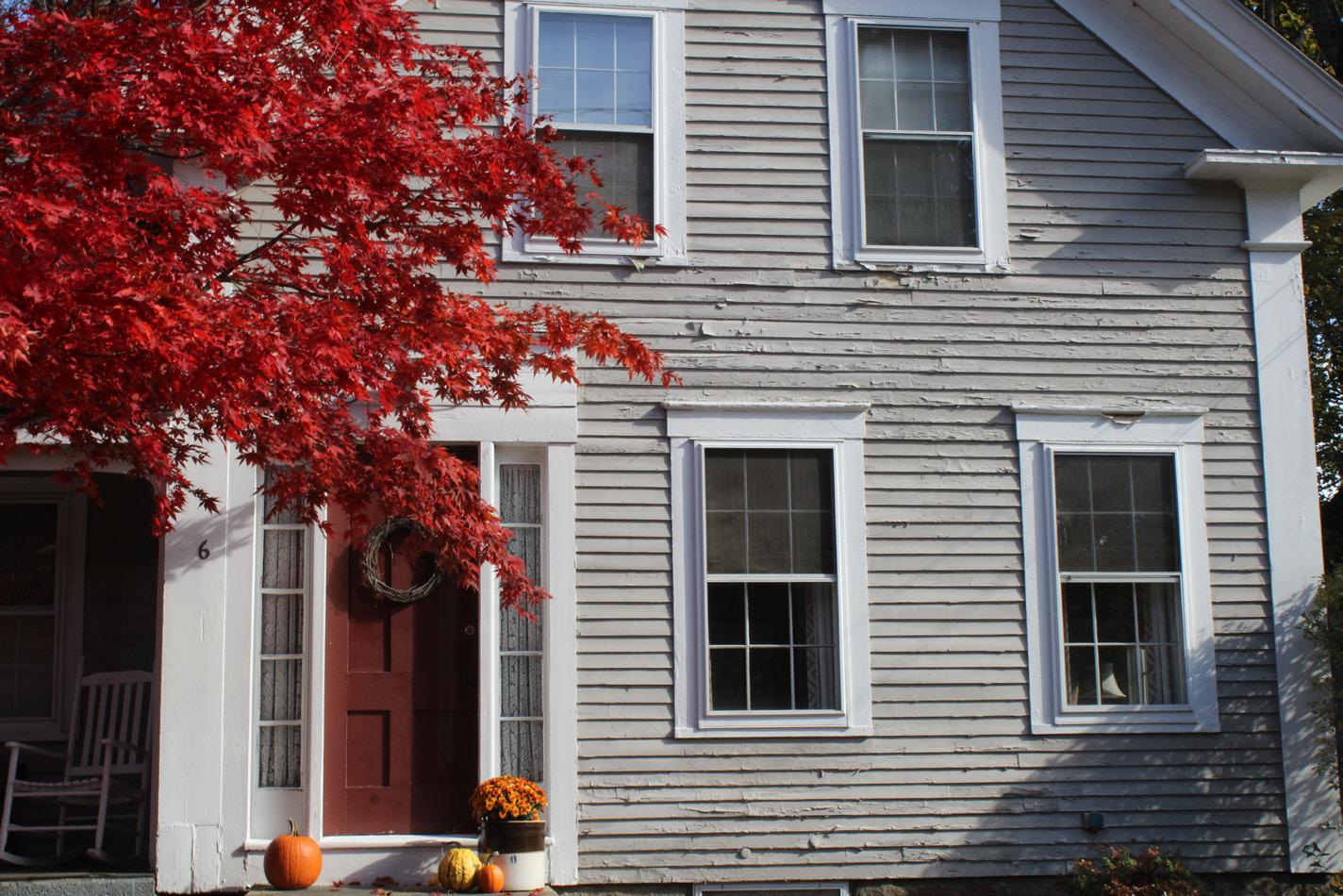
Boots march, shots fired. Engraved on a monument, My name admired.
– Tim Howard ’27
Chloe Hoang ’28
Larry
Axel Favreau ’26
He completed the same morning routine every single day; the only time he didn’t was when he didn’t wake up until afternoon. The routine would have seemed impossible for many, but for Larry, it was just another morning. When Larry’s alarm went off, the clock read 11 a.m., and he started by finishing the beer that was left on his bedside table. He soon got out of bed, walking over the empty take-out boxes and making his way into the kitchen. The apartment was no bigger than his childhood bedroom, and it was getting smaller by the day. He opened the fridge to fuel himself for the long day ahead. He took the carton of eggs out of the fridge but quickly found himself opening another beer. At the same time every morning, he wondered why he had to rush to get out the door. He cracked the eggs, 8 of them to be exact, pouring them into a large glass that sat on the side of the dish-filled sink. Without hesitation, Larry raised the glass to his mouth, swallowing all 8 eggs like they were water. He ran back into his bedroom, finally putting on clothes, and frantically looked to find his keys, like every other day. It took him a moment, but on this particular day he remembered that he no longer had a car.
Today was the day; his life was on the line.
Larry was out of money; he had lost all of his life savings at the casino over the last few months. His only option had been to list his car on Facebook Marketplace; yesterday, he had sold it to a teenager for $15,000. His rent was 4 months overdue, and bills filled the kitchen table. Today was the day; his life was on the line. He needed to turn his $15,000 into enough money to pay the landlord, who was threatening to change the locks. If he didn’t pay him, Larry would be packing his stuff, heading for the streets, and possibly ending his life.
Larry grabbed from under his bed the white envelope that read “car money.” And for a moment, it hit him: this white envelope was all he had left. His wife and kids were gone, and he was one day away from homelessness. He couldn’t understand what had happened to him over this past year and how his life could be so upside down. Before closing the door, Larry ripped off the note from his landlord, adding one more to the already overflowing bin on his porch. He set off for the casino.
As Larry walked down the broken sidewalk, all he could think about was what he would need to do at the casino to turn his life around. Suddenly, he noticed a sign on a business: “Hiring. Apply Inside.” Larry turned around and walked into the business. He was tired of being a mess; he wanted to turn his life around and get his wife and kids back. The business owner raised an eyebrow at his sloppy outfit but gave him an application anyway.
Memoirs
As the old screen door let out a dull groan, it seemed to sing an afternoon song.
I touched the wooden handrail. Its uneven texture felt like kneading dough as jasmine fragrance climbed nearby.
Grandma set down a jar of jasmine jam. Its sweet sun-warmed flavor lingered on my tongue.
Fireflies twinkled golden, like stars.
Crickets darted through the woods, singing a nighttime lullaby.
The chirping of crickets echoed in the cool night air.
She handed me a warm, small jar.
We watched the sky turn to amber, her laughter, soft as moss, warming my heart.
“Some nights smell like home.”
This is the one that’s etched in my bones.
Roasted chestnut steam drifts through lantern-lit alleys smoke stitches the dusk.
– Yuki Takahashi ’26
Angie Yu ’26
birds &
Kristen Ma ’26
t here i was planted, so there i will stay.
h ow do i confess, that i should’ve outgrown this tattered plaid by now? holes and threads,
e stranged and effusing like chewed skin and abandoned veins; abrasions tearing through my hat...
s ecrets. i hear all and i witness and i bear all, for muteness is half my purpose; static among fields,
c hased by hope and caught by nothing. maybe i’m afraid of knowing. knowing how fragile i really am,
a fraid of those who wear my name better than i ever have. i was planted to be brave, yet here i cower,
r eeling in dreams of gentler touches—then goes the scatter of wings.
e ven statues deserve to cry; haunted by their own permanence. even then, my eyes were too
c alloused. oh how deeply in love i was, with the way things can fly, but i wanted to behave and suddenly
r usting sword in one hand, my caving spine in the other, i was swinging at the silent air. they still
o rbit, those daring birds, just above my little straw home; harmless, scared, but unforgivably kind.
w indows all the way through, and i am blind.
alone in the darkness lighting birthday candles happy birthday, me.
– David Cha
’26
image: Nate Lansky ’26
5 Minutes
David Cha ’26
There once was a boy named John Little. He was an average student, timid and studious. He had no friends at school, but he didn’t mind it. He enjoyed the peace and quiet of being alone. One day, John headed back to his classroom after lunch and checked his watch: 11:17 a.m. He would have around 40 minutes for a quick nap. He lay his head on his desk, closed his eyes, and soon drifted off to wonderland in his sleep.
After what seemed like hours, John finally woke up from his deep sleep. He checked his watch again and froze. It was still 11:17. Thinking his watch must’ve broken, he looked at the clock on the wall, but that also said 11:17. “What is actually happening?” he asked out loud, puzzled. Total silence followed his words. He felt very refreshed from his nap, yet no time had passed at all. Feeling uneasy, John checked his watch again: 11:21. He started pacing back and forth, trying to think of an explanation for this situation–then, suddenly, he found himself sitting at his desk again.
A sharp chill went down his spine. He had just gone from standing across the room to being back at his seat in an instant. He whipped his head towards the clock on the wall: 11:17. He couldn’t believe his eyes. He pinched himself on the neck to see if he was dreaming, but a sharp sting told him he wasn’t. John, being the scholarly student he was, decided to find out what was going on. He kept looking at the clock as the seconds and minutes ticked away. And when it hit 11:22, the minute hand instantly went back to 17. He was stuck in a time loop.
He whipped his head towards the clock on the wall: 11:17. He couldn’t believe his eyes.
5 minutes. John only had 5 minutes to figure out how he was going to break the loop and get back to his normal life. When the time reset, he sprinted out of the classroom, out into the hallway, trying to find anybody. He ran into his homeroom teacher, Mr. Degon, around the corner and started ranting about his situation. Overwhelmed by John’s blabbering, Mr. Degon stuck his hand out and said, “Whoa, whoa, whoa, hold your horses. If you have something that important to say, slow down and fill me in from the start.” John took a deep breath, but before he was able to utter a single word, he found himself sitting at his desk once again. But he wasn’t going to let one failure get him down. He tried, tried, and tried again to tell the facts to Mr. Degon, but he kept running out of time. Eventually, he had to accept the fact that Mr. Degon helping him would be impossible. John felt devastated. After hundreds of tries, he figured out that nobody would be able to help him. He ran in every direction to find anyone, but even when he found somebody, time always ran out before he was done explaining his situation. And after thousands of tries, he was too mentally tired to continue. He felt like he was done for.
Years, or rather, hundreds of thousands of 5 minute loops passed, and John was still stuck in the classroom. Every once in a while, he would go out and see if anything had changed, but of course, nothing had. He spent all his time just existing. He embraced the fact that he was stuck forever. Decades passed, and while John still had the physical appearance of an 18-year-old high school student, mentally he was very old. As he barely had anybody to talk to, he became mute at some point, forgetting how to talk. It is scary what isolation can do to a person. One day, he lay down on the hard wooden floor and closed his eyes. Before the 5 minutes had passed, he emptied all of his thoughts from his mind and drifted off to wonderland once more. He eventually stopped thinking altogether and never woke up again. As his body lay still on the ground, the minute hand on the clock reached 22. But this time, the loop didn’t restart. The second hand kept ticking away. Time had started to flow once again.
mưa lại đến nữa rồi lòng em lại mang một nỗi buồn day dứt mãi không thôi
rain has come again my heart is filled with sadness it lingers forever
–
Emma Pham ’27
八時半 白き朝光 まぶた重し
It is eight thirty; the pale morning light has made my eyelids heavy.
– Mao Fujikawa ’26
Six Word Stories
What is a six-word story? – Burke Aubuchon ’29 Great question, Burke! The stories on this and the following pages, including two illustrated by photography students, represent a selection of what Cushing produced in response to Patchwork’s fourth annual six-word story contest: the largest (and best?) set of submissions yet!
One blink: toys gone, taxes due.
– Zoom Nguyen ’26
I look like dad’s best friend. – David Cha ’26
I need a vacation from thoughts.
– Mrs. Melissa Hunt
Sock lost; dryer ate it again. – Angie Yu ’26
I finally, FINALLY graduated. What now?
– David Cha ’26
Wait–this is not my body! – Karen Wang ’27
Knowing you became my longest season.
– Noria Chang ’26
Thank God I missed the plane.
– Stella Sun ’27
Teary faces shrinking in rear windows.
– Mrs. Chelle Salvucci
Just so you know, it’s fireproof.
– Dowon Lee ’27
Childhood’s flower crown became white veil.
– Jamie Park ’27
Wifi down. Talked to family. Weird. – Sebastian Mogull ’27
The devil stole my silver crucifix. – Frank Salazar ’27
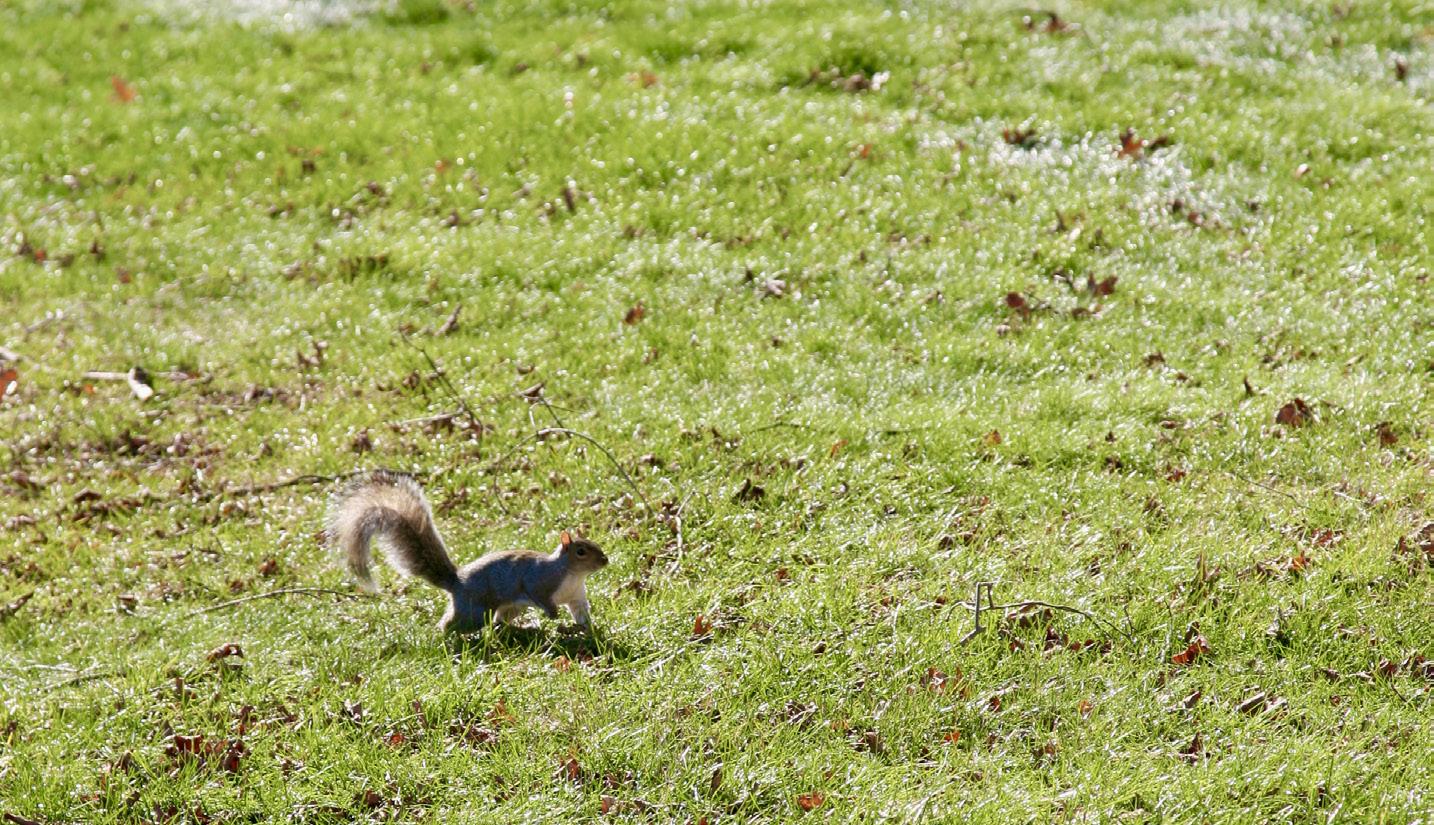
She was king in her story. She was king in her story.
story: Lily Van Zandt ’26; image: Tom Zhuo ’27
I’m sorry; he won’t make it.
– Vassilios Kakavitsas ’26
Diet started Monday. Pizza arrived Tuesday.
– William Wong ’26
Always, but never, but maybe sometimes.
– Matty Goldman ’26
Why rush if you’re not ready?
– Kam Zellers ’26
It’s God’s words, so I listen.
– Brayden Holt ’26
The diary ended in mid-sentence.
– Tiffany Chang ’26
He ran, but dreams ran faster.
– Axel Favreau ’26
“One rule here: Don’t touch the–”
– Jimmy Monahan ’26
Different journey doesn’t mean different destination.
– James Williams ’26
Nowhere to be; everywhere to go.
– Brian Yandle ’26
Always felt small; always dreamed big.
– Cam McDonough ’26
One life jacket; two lovers drowned.
– Jaden Han ’29
Is love worth it with costs?
– Nathan Park ’29
Finally going home; no more snoring.
– Jacob Nosek ’26
Fell for you, as gravity does.
– Seehu Park ’28
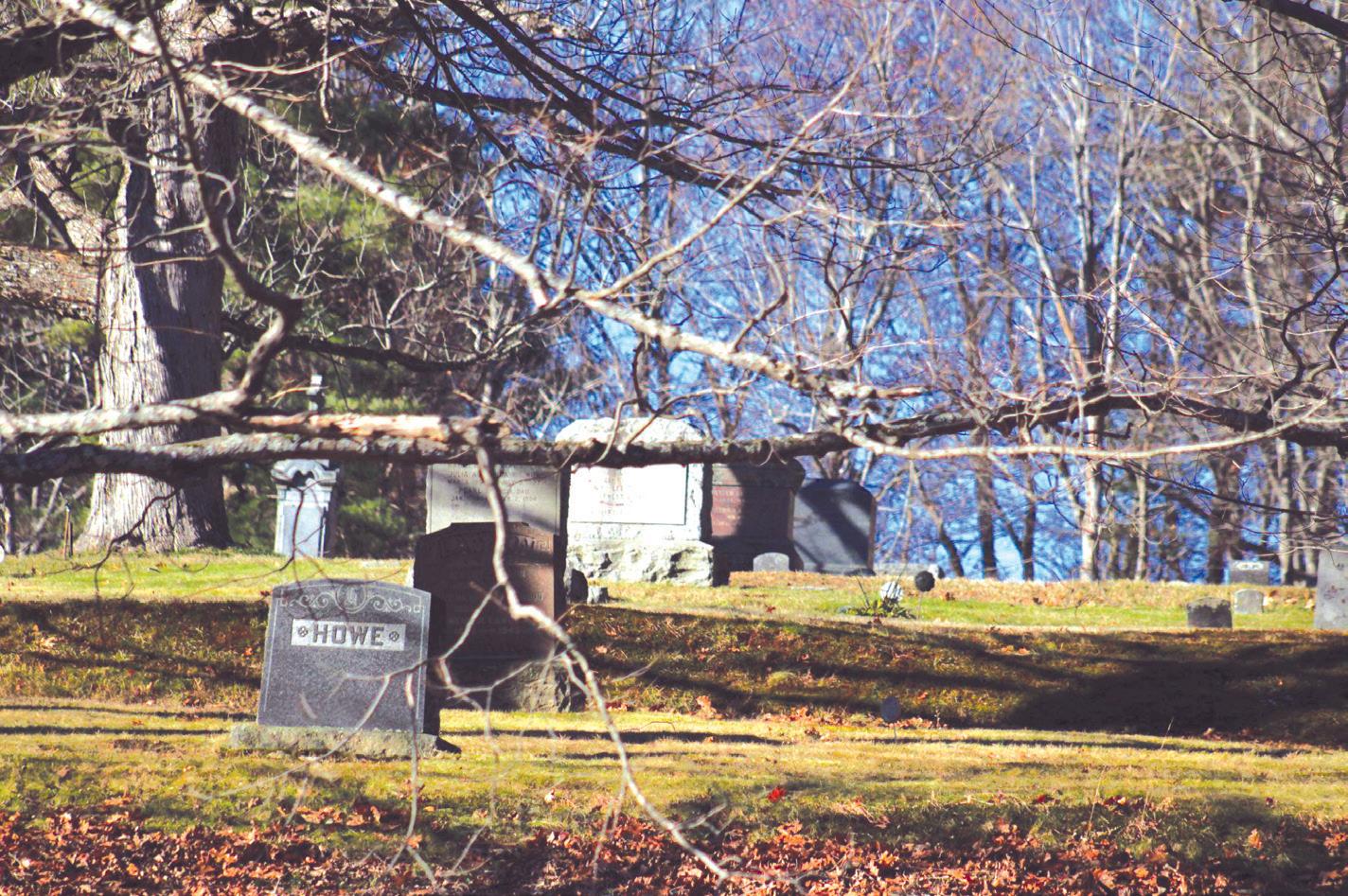
Six brave sons. Six empty graves.
story: Kristen Ma ’26; image: Alex Pope-Storm ’27
Petrichor
Xiangyu Sophia Kong ’26
White structures peek out of the dunes. Their curved roofs, concerningly white like the sun-bleached bones of a long forgotten carcass polished by countless storms, blend smoothly into the expanse. A lone figure stumbles through, clad in nothing but dusty leather and thinning sandals–barely surviving on what little water and sustenance he has managed to consume before his abrupt and inexplicable exile.
Due to never setting foot outside his kingdom of birth, he has no inkling of the lands beyond the walls. All he knows is that he needs to go somewhere. Any place with food, shelter, and protection from the sweltering sun will do. With a mind poisoned from thirst and no compass nor pocketwatch in hand, he wanders aimlessly, guided only by the blazing sun and his own ephemeral footprints.
As the structures gradually appear on the horizon, like smooth smiling clams on the seabed, he doesn’t question their existence in the reality that possesses him. Despite the almost alien nature of the structures that seem to grow infinitely as he draws closer, he continues onwards, lured by the vast, dark shadows the endless smooth roofs cast onto the sand below. As the size of the clam before him grows so tall he has to crane his neck to acknowledge it in its entirety, he detects a faint rain-like smell emanating from its direction. This drives him almost manic, like a starving child before the aroma of freshly baked cake. After what seems to be hours of walking, he finally feels the distance between the formation and himself shorten. Now, the once impossibly smooth ivory surface of the overhanging roof breaks down into thousands of thin, tubular vines, twisting into uniformly patterned braids. This momentarily distracts him, before the aroma that hints of water draws his attention away again. The dry air which once tickled his throat now scratches against his cracking skin, granting him the strength he needs to push forwards into the mouth of the closest structure.
All he knows is that he needs to go somewhere.
When he finally crosses the boundary where the sun-soaked sand meets the shadow, he collapses to his knees. He flops back and notes several sparse stalactites growing above him, but no sign of any liquid life which might have steadily dripped them into existence. They are unusually sharp, with no matching stalagmites below. As he rolls around, the polished beads of sand pull him in like memory foam, allowing the trauma he has accumulated in his journey to begin melting away.
Sitting back up and pivoting his head, he pinpoints the precise direction of what he had smelled before: a rich, sweet, and slightly earthy scent from deep within the shade. There, despite its increasing distance from light, the pale shadow maintains the same luminosity throughout. Drawing closer—after finally resolving to get up and move again—the end of the shadow becomes clear: a gate seemingly carved out of the same tubular material, its patterns too precise to be organic. He now notes it to be smooth to the touch, and the source of the smell of rain. It resists his jabs and,
as he would soon discover, lacks the sponginess of the rest of the structure. With no knob nor knocker, it gives no sign of how it is to be operated.
No matter what he tries, from knocking politely and calling, to loudly threatening until his parched throat cracks while attempting to kick the gate in, no tricks he has successfully—albeit unlawfully—used prior will work.
Remembering the stalactites he had seen before, specifically a broken one stuck vertically in the sand like a warning, he trudges leagues back the way he came, and wraps the blunt end with a strip of leather he tears from his tunic. With his new ivory shiv in hand, he returns to the cursed door: surely, the final obstacle before his reunion with rain. The thought of quenching his thirst gives him a burst of power, and down the shiv flies. Point-blank, with accuracy and skill only possible through experience, he strikes the weak spot he perceives in the gate.
It erupts.
Like a geyser, the symbols spray forth liquid both earthy and metallic, as if he strikes the artery in the throat of a beast. This sudden yet anticipated appearance of what his burning eyes and shriveled nose assume to be water does not alert him to anything abnormal, thus fueling him further. He rips the jagged stalactite out to leave lacerations, then stabs it again in the same place. A crazed expression overcomes his features as he moves to bathe before the geyser. Continuing onwards, he relentlessly repeats these actions, ripping a hole through the gate. Unfortunately, as he is blinded by the refreshing shower and basking in the departure of his thirst, he does not notice the darkness seeping out of the rough hole. Or the gradual darkening of the shadows around him. With water filling his ears, all he hears are the wondrous bubbles of life, and not the muffled clicks of hidden stalagmites appearing around him, the growing number of stalactites above, or the disappearance of the echoes of his laughter.
As the ground tilts towards the gate and water wells up on the floor to soak him up to his knees, the ceiling–a slightly spongier texture than the gate–presses down slowly against his head. Paying it no mind, he yields and lies prone before the gate, breath slowing down as he leaves his frantic state, never noting the implausibility of inhalation in a pool of “water.”
It flows into his nose, his mouth, then fills his ears. It soaks through his garment and skin. It sinks into his muscles, then cells, until what little nutrients and life he possesses is slowly flushed out, and all that was living breaks down and washes away. Satisfied with his disintegration, the liquid within the cavernous mouth recedes, disappearing into the wounded gate that now opens. Beyond, the darkness floods out, only to retreat just as quickly as it appeared. Even as it shuts the gate, new tubules are forming over wounds, returning the gate to its previously pristine condition. Teeth recede. The roof elevates once more. A quake causes sand waves to form, rolling gently outwards to push the crumbling hair that remains, along with the fallen tooth, away. Beyond the protection of the shadows, they will soon disintegrate, leaving neither proof of his existence nor warning.
It opens once more, like the thousands of others that irregularly dot these unending dunes. Each waiting innocently, emitting the same sweet and inviting smell. Each waiting for the next exile, the next restless wanderer. Never moving, never breathing, decorating an eerily empty expanse with false hope.
To Be From a Place I Cannot Go:
The Distance Between Freedoms
The sky has fallen an ocean away, but I still wake to a normal day. Another morning I’m up for school while somewhere else humanity is breaking rules of what a child should never see, but here it’s just the news to me. I scroll my feed and my eyes sting, each post another painful thing. I smile and nod, I laugh, I try, but every thought of peace feels like a lie. They ask me softly where I’m from. I say the word, and they go numb.
Names of some I’ve never met, grief my soul cannot forget.
I walk the halls. No one knows, my home’s a place I cannot go.
They tell me I’m safe, that I am free, but freedom’s not the same to me.
Because across the sea, there’s a father’s grave and a child who prays to be saved. I hide my truth to fit within, but peace should never feel like a sin. At night, the dorm lights buzz and hum. I laugh along, so no one asks me where I’m from. Everyone talks about prom and plans for snow, while I think of a home they’ll never know.
My family and friends built their home from dust, with calloused hands and endless trust.
My mom and dad taught me love means more than land. It’s what you build with what you can. And so I learn to live with pain, to find small joy inside the rain, to wake each day and still feel hope, though my heart still yearns for ways to cope.
To speak with care, to love with grace, to see my homeland in every face because grief can grow roots and loss can still remain.
These past few years I’ve learned to live and to see that home is more than geography.
Ines Khamis ’27
So though the world may never see, Palestine still lives inside of me, in every dawn and every sea. My grandmother and grandfather’s legacy that was not given the chance to continue will live within me.
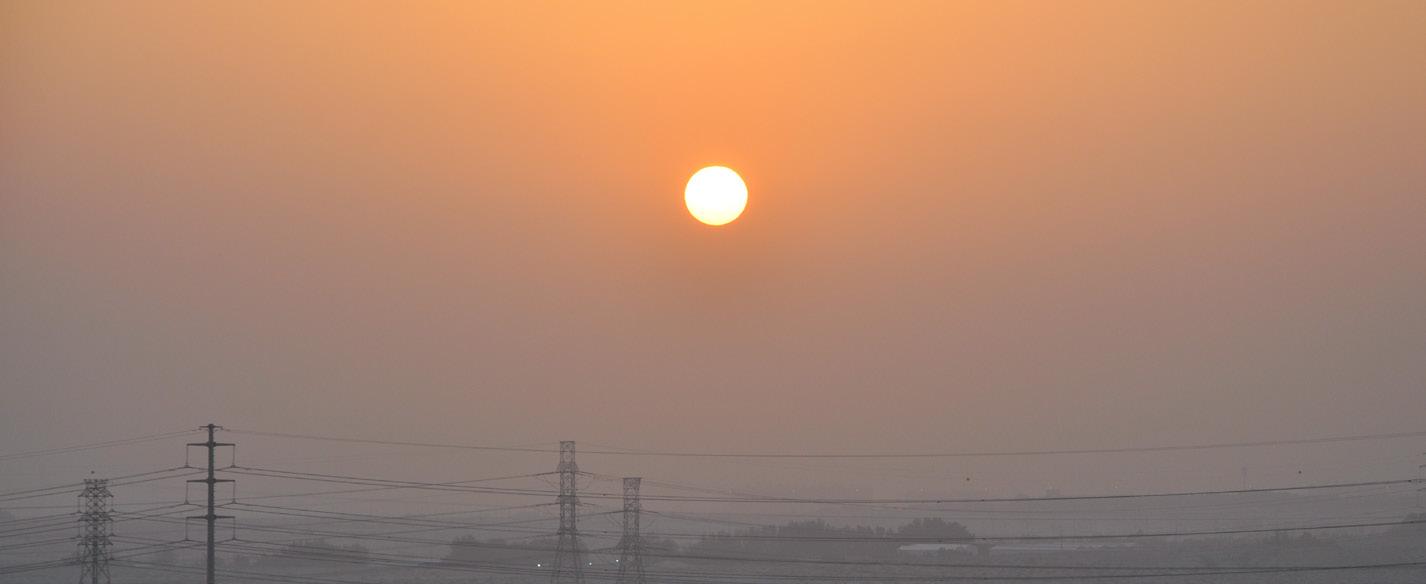
Xiangyu Sophia Kong ’26
Querida América / Dear America
Querida América,
Por que te chamam de país dos sonhos?
Por que te chamam de um país de oportunidades?
É porque ofereces liberdade?
Ou talvez porque dás às pessoas esperança de uma vida melhor?
Que a América seja a América, um país onde todos nós podemos chamar de lar
Não importa qual seja nosso passado.
Um lugar onde as pessoas não têm medo de viver.
Um lugar onde todos nos sentimos protegidos,
Porque no final do dia, você deveria ser um país dos sonhos.
Queridos americanos,
Que a América seja a América.Que a América seja livre como escrever um poema, livre como pintar.
A vida é curta, ainda mais se não tivermos liberdade.
Qual é o sentido de chamá-la de “meu país dos sonhos”
Se você não está vivendo seu sonho?
O que é um sonho sem liberdade?
É como ter uma casa sem portas ou janelas, você está “dentro”, mas está preso.
“Vamos todos normalizar colocar a humanidade em primeiro lugar.”
Querida América,
Mostre ao mundo quão grande você pode ser,
Mostre ao mundo que você é o que eles chamam você,
Um país dos sonhos para muitos,
Um lugar que todos nós esperávamos viver.
Um país de oportunidades que uma vez sonhamos.
Esta é a América, não apenas para alguns, mas para todos, Africanos, Europeus, Asiáticos, Hispânicos ou Latinos – Não importa
Todos pertencemos a uma e única raça, a raça humana.
Junior Beyoko ’26
Dear America,
Why do they call you dream country?
Why do they call you a country of opportunities?
Is it because you offer freedom?
Or maybe because you give people hope for a better life?
Let America be America, a country where we all can call home
No matter what our background is.
A place where people don’t fear living.
A place where we all feel protected,
Because at the end of the day, you’re supposed to be a dream country.
Dear Americans,
Let America be America.
Let America be free like writing a poem, free like painting.
Life is short, even more if we don’t have freedom.
What’s the point of calling it “my dream country”
If you’re not living your dream?
What’s a dream without freedom?
It’s like having a house with no doors or windows, you’re “inside,” but you’re trapped.
“Let’s all normalize putting humanity first.”
Dear America,
Show the world how great you can be,
Show the world that you are what they call you,
A dream country for many,
A place we all hoped to live in.
A country of opportunities we once dreamed of.
This is America, not only for a few, but for everyone, African, European, Asian, Hispanic or Latino – It doesn’t matter We all belong to the one and only race, the human race.
Saltwalker
Katherine Hull ’26
Prologue
Standing at the top of the Alborz Mountains, there is a city that is about to run out of water. Officials and experts say Tehran, Iran, is close to “day zero.” Residents already experience frequent water shortages and power outages. Some neighborhoods have gone hours without water. This story imagines what might happen if this looming crisis is not prevented–one possible future for the land that was once called the fertile crescent.
Chapter 1: The Baby
In the heart of the Mesopotamian valley, two rivers flow: the Tigris and the Euphrates. Their waters poured life into the land, and thus the first human civilization was born.
There was a legend, however, that one day the rivers would run dry. The once fertile valley would become cracked desert ground. The Gods would one day become disillusioned by the sins of humanity and unleash their wrath upon the world.
I was 16 when the government announced that we had hit day zero. The taps would be turned off. Not just at night or a few hours during the summer anymore–there was nothing left. Reservoirs and underground water storage no longer existed. They had been depleted and managed with corruption. Every day was a fight for survival.
My life was not always like this. I had once lived in a developed country with electricity, modern medicine, plumbing, and all the things I used to think were basic human rights. I attended school, watched tv with my friends, and took weekend vacations to the lake. I never understood how my government had allowed this to happen. They blamed it on drought, but the real causes could not be hidden. Water had been turned into a weapon.
Every once in a while, I dream of those lakes, feeling the moisture soaking into my skin, making my fingers prune as my wet hair sticks to my back. I see kids playing in the streets, realizing that they are too young to remember those times. The rivers used to be a network of trade; now only salt flats exist in their place. I am what people call a “saltwalker”. Trade is rare, but I’m one of the few people who gives us a glimmer of hope that one day our world might be connected again.
Travelling through the salt flats is dangerous. The “eskimos,” a violent rebel group, roam the flats looking for travelers to rob. Coming in contact with them is a death wish, but I’ve learned to navigate with precision. Rock formations that used to exist underwater, now form a complex tunnel system. Private investors were able to build these routes years ago, but they have now been overrun with eskimos and wild animals searching for shelter from the hot sun. There are tunnels, however, that are
unknown to most people, and that is why I’m the best at what I do. I lead merchants and bankers, moving only under the light of a single flame. We don’t stop moving, not even to sleep; it’s too dangerous. The journey can take some people up to twelve hours, but I can do it in eight.
Water had been turned into a weapon.
That day, I was traveling by myself, feeling confident that I could do it in seven hours this time. I had a light load and had just gotten my paycheck, so I was feeling good. I was moving at a steady pace when I saw a tunnel that I had never seen before. I stopped in my tracks, almost falling over in the process. I walked closer, dragging my feet through the thick sand, looking into the darkness before me. I realized it was the first time in a long while I had felt genuine hope. The eerie silence sent a jolt of adrenaline to my stomach, and I knew I had to traverse this unknown path that had been set before me. My feet left light footprints in the seemingly untouched ground of the tunnel as I ventured further in, pushing my fear as far down as I could. I began to make out an object in the dark. Or was it an object? As I came closer, I saw a child, swaddled in cloth, sleeping peacefully in a straw woven basket. I looked around, trying to figure out if it was a hallucination, but as I let my fingers softly touch the blankets, I knew it was real. The baby was holding something. I carefully moved her arms and gently took the bottle out of her hands. It was smooth and cold, and there was some sort of liquid inside…
To be continued…
After the rain snails cross the sidewalk without hurry
– William Wong ’26
朝阙歌 / The Court Audience Scroll
Adiya Xia ’27
绮筵沉檀列金绸, 罗袖轻翻孔雀舞。
万国衣冠朝紫阙, 华灯长夜不知秋。
Ornate banquets - rows of golden silks lie on the dark sandalwood. Gossamer sleeves sway with the dance of peacocks.
Robed, hatted dignitaries from myriad states make their way to the vermillion palace, as if in pilgrimage.
Splendid lanterns burn through long nights so people forget their autumn grievances outside.
This poem depicts the Tang dynasty, an era renowned for its prosperity, cultural brilliance, and lavish displays of luxury. The poem’s imagery reflects this period, including in its allusion to the Silk Road, the great trade route through which envoys and merchants from distant lands came to pay homage and exchange goods. The poem is written as a seven-character quatrain (qiyan jueju), the most prevalent poetic form of the Tang dynasty. In this form, the first and final lines rhyme (here, 绸/chou and 秋/qiu), creating a sense of closure.
Do I Consider Myself Lucky?
Ms. Brittany Bernardini
What a loaded question that can be.
Sure, I am Irish (to some degree), but not enough to be lucky. The big, strong, connected family–though a generality–did not find its way to me. Neither did the gold coin analogy, whether positively or negatively.
But luck can be about other things–like the lottery–but The last time I won something it was defaulty, as I was only one of two to compete, and the second place prize had to go to somebody.
When I look at the cards life handed to me, no, I don’t see them as lucky. In comparison to other hands, life has me folding on the first round. In truth, we know the dealer always wins, no matter what the game. Even when I don’t poke the beast, my days end with the sound of my chips clanking in someone else’s hands.
I’ve learned to play a defensive game this way.
But then I will meet someone, see someone, be told their story, and that’s when the phrase “It could always be worse” finds a home in me.
With 10 fingers, and 4 limbs, 2 eyes, and a sound mind, I’ve struck that Irish gold, because how can I find myself unlucky when I take a breath and it’s not my last?
With that in mind, I will always cash out my chips when given the chance, grateful I get to play again someday.
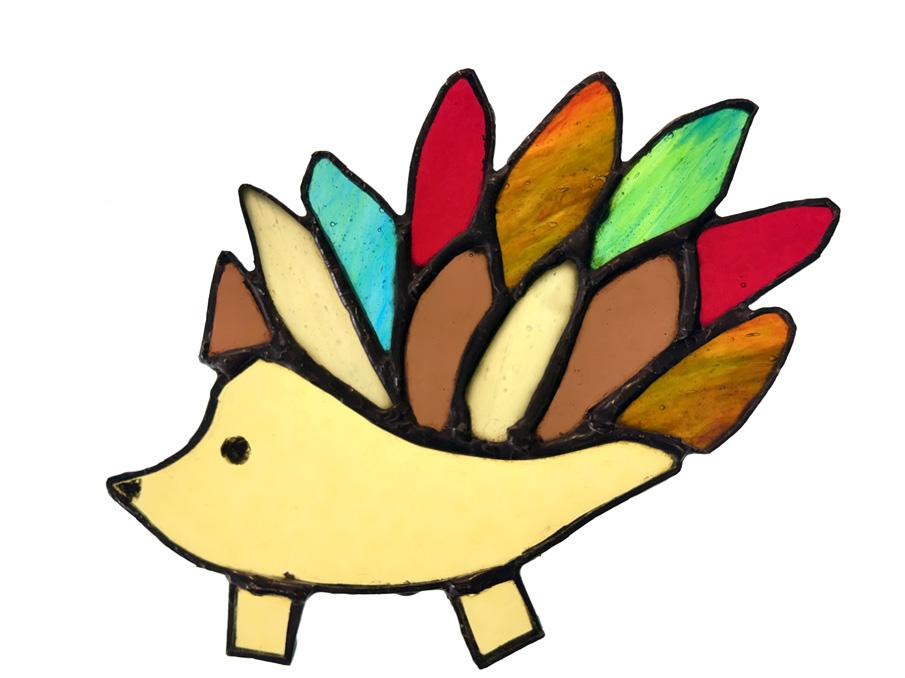
Stella Hunter ’27
The Butcher
Jianjing Hou ’26
Vibrant, colorful fields faded, as autumnal hues broke into the green and saturating coldness seeped into the ground. The streets of Saint Benoît were busier today. Shoulders brushed against each other in the market; business was thriving as people remembered to prepare for the bitterness of winter. Some were gathering before the boulangerie, enjoying fine desserts. To the right, a table of old men were playing cards with violent enthusiasm, which young Henri judged excessive for their age. He marched through the crowd, hearing the rhythms of music springing from the café as he pondered his evening activities.
At sixteen, Henri was unlike his peers. His father had left the family soon after he turned six, perhaps inspired by a lifelong passion for gambling, or, if the rumors were true, had fled the country with a price on his head. His father’s sudden departure left an unwelcome inheritance: a huge debt that he and his mother were forced to repay. Life, thus, was not so much inspiring as burdensome for Henri. Instead of playing and discovering his talents, like other children, he delivered mail door-to-door. Still, his family persisted admirably and had recently finished paying his father’s debts.
One mystery continued to perplex him, though.
Henri had become a keen observer. Years of carrying mail had made him adept in navigating the city’s corners and streets and educated him on the stories of many of its citizens. One mystery continued to perplex him, though.
Months earlier, residents of the city had been informed that a butchery was to open in the southern part of town. Barely a week later, strange rumors had begun to circulate about the new butcher, M. Lefebvre. Some claimed to have glimpsed mountains of bones in the back room of his shop, apparently washed and set out to dry. While individual accounts differed, residents quickly agreed on the disturbing nature of the butcher’s unusual collection. Some gossips went further, alleging without evidence that the man had once killed somebody. Though initial enthusiasm was high, as weeks passed, the butcher gradually slipped from the hot topics in town.
Two turns left from the musée d’art was La Maison Durand, the remnant of a once prosperous family whose fate was forever changed by The Great War, and now the central post office. By the time Henri readied himself for his last stop, the sky was already tainted with hues of rose and gold, and nightfall would soon follow. Henri reached into his leather pouch for the final letter, as a chilling breeze blew through the trees guarding the sidewalk. The address was stamped onto the envelope:
M. Edward Lefebvre
5 Rue du Lac
Henri was not usually responsible for mail in the southern part of town. In fact, the handful of times when duty had called him to that area were mistakes in the mail office. This letter was nothing like the ones from those experiences. The handwriting
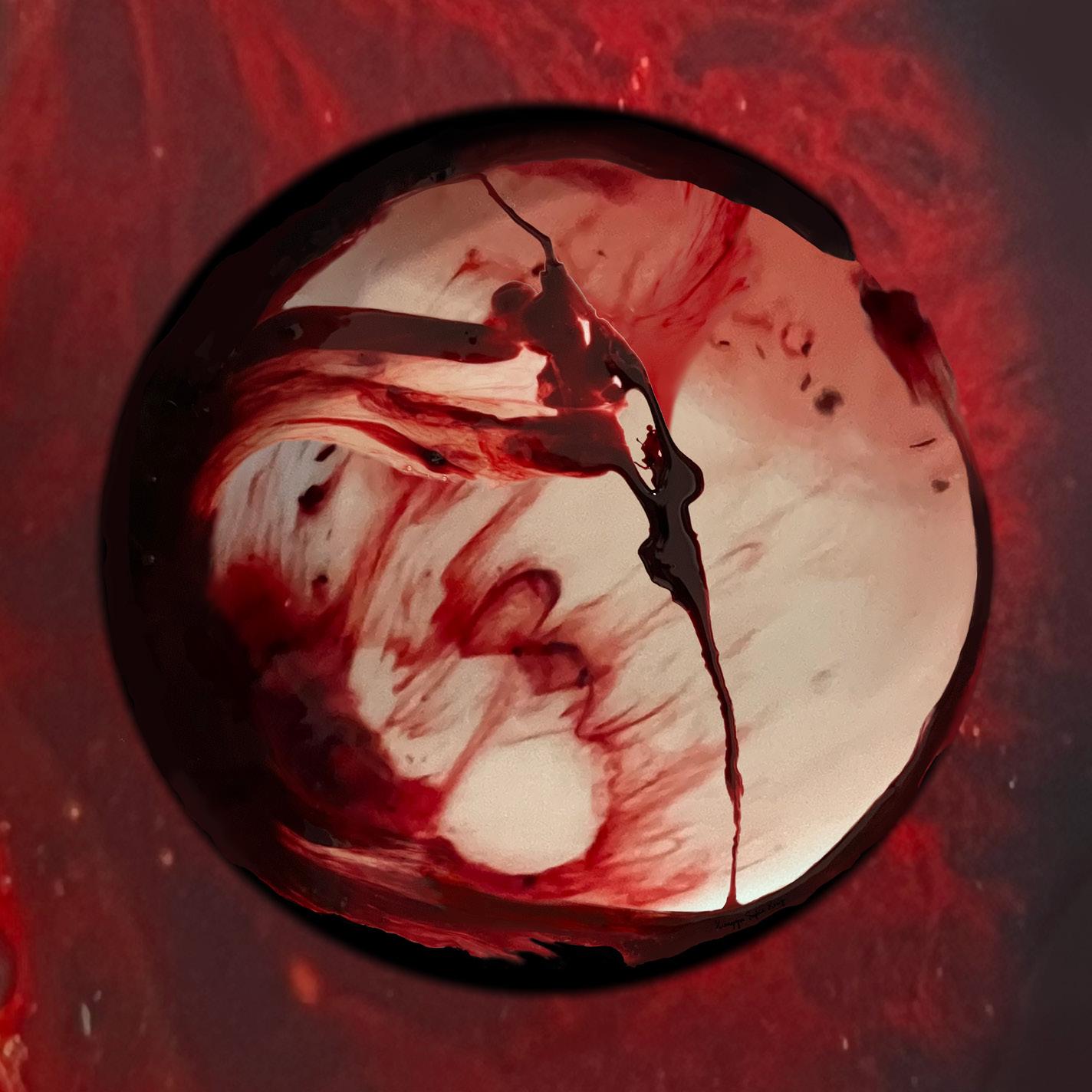
was easily distinguishable, and no features of the envelope could have led to this confounding task. The letter seemed like an invitation, which fostered excitement within the young boy. Bound by both duty and the spirit of adventure, Henri jumped onto his bicycle and pedaled rapidly towards the infamous butchery.
The sky darkened into a blind night, and rain drops feathered the ground as Henri arrived on Rue du Lac. Warm light radiated from electric street lamps, outlining the finely laid red bricks of the butchery. As he observed the surroundings of the shop, Henri saw no mailbox. He steered the bicycle towards the sidewalk, locked it to a fence post, and walked towards the building. The shutters on the house were bolted, hiding the window panes. The butchery appeared to be closed.
He marched up the marble steps and crouched to slip the envelope through the gap beneath the door. To his surprise, the unlocked door swung inwards as he brushed against it.
Within, four flickering candles on the counter lit up the room. Henri strode into the shop and closed the door firmly behind him. The room was old-fashioned. A framed print of a British Crusader hung on one wall. On another, there was an
Xiangyu Sophia Kong ’26
infographic chart of imported American beef. The wallpaper’s pattern was pale red and white stripes, though parts of it had already flaked onto the floor. As he set the damp envelope onto the wooden counter, Henri inadvertently noticed the entrance to the backroom, the door visibly unlocked. At this moment, the months-old rumors of M. Lefebvre and the mystery surrounding his alleged collection of bones came to Henri’s mind, promptly followed by unquenchable curiosity that took control of his body. This was his chance to untangle the mystery. He walked cautiously towards the doorway.
This was his chance to untangle the mystery.
The backroom was quieter. Ceramic tiles walled the room, blocking most sound from outside, leaving only the echoes of Henri’s steps to remind him of his sanity. He directed his attention to the farthest side of the room. The carcass of an animal loomed there, its shape obscured by the dim lighting, resembling a sacrifice to a divine god. He sensed a chill in the room as his muscles became tense and his steps even heavier. Two steps closer towards the abomination, and he realized horror beyond reality. Bright red veins laced the skinless and still twitching flesh. Blood seeped unceasingly from the bones, the white tiles below forever stained. His heartbeat grew wild, as he felt his consciousness dissolving into instinctive fear. He commanded his body to sprint towards the exit, but to no avail. The more he resisted, the less his feet cooperated. He stood in the middle of the room, staring helplessly at the source of all his fears, unable to move.
Footsteps. Rhythmic footsteps. Behind him.
M. Lefebvre paced into the room, flicking the light switch with his left hand as he passed through the doorframe. Brightness flooded the small room, bouncing off every tile. The shadows receded as imaginary shapes transformed to the true colors of reality. When the initial shock passed, the boy slowly opened his eyes. There were no horrors to confront. The white tiles on the floor shone like crystals, illuminating the room delightfully. Cuts of beef and lamb were stacked on the table, and in the center, delicately carved pieces of bone appeared in familiar forms and lively figures.
The boy’s sanity gradually returned. He gasped for air as he turned to face the gentleman. A shade of redness invaded his cheeks as he realized the deception of his mind. He apologized profusely for his trespass and for disturbing the man, who had been enjoying a nighttime read. M. Lefebvre, beginning to comprehend the situation, offered the boy tea, before thanking him for his prompt delivery of the letter.
The knife sliced easily into the seal, as Edward Lefebvre fished out the precious contents within: photographs of young men–soldiers–before the great machines of war, some confronting the final moments of their lives. He held them in his hands like fragile insects’ wings, as if any pressure could tear the images apart. Tides of memory flooded his senses, prompting him to share with Henri a story that the boy had never heard before. Edward told in great detail that he had been brought up outside London and that Lefebvre was not his original name. He shed tears of sorrow when he spoke of his brothers lost in North Africa. Much of his past was buried beneath the soil of Great Britain, but his memory of his brothers and their glory in death was commemorated here in his art with chisel and bone.
The rain halted abruptly at nine, and the two parted ways into their separate lives.
Schwann Cells
Schwann cells are special helper cells that live in the nerves outside your brain and spinal cord. Imagine each one like a jelly roll, wrapping itself around a nerve like a blanket wraps around your body when you’re cold. This makes a protective cover called “myelin” that helps nerve messages travel fast. Fun fact: if you accidentally cut your finger, Schwann cells help fix your nerves so you can feel and move your finger again. Without Schwann cells, signals within your body would move as slowly as a snail, but with them, signal conduction can be really fast!
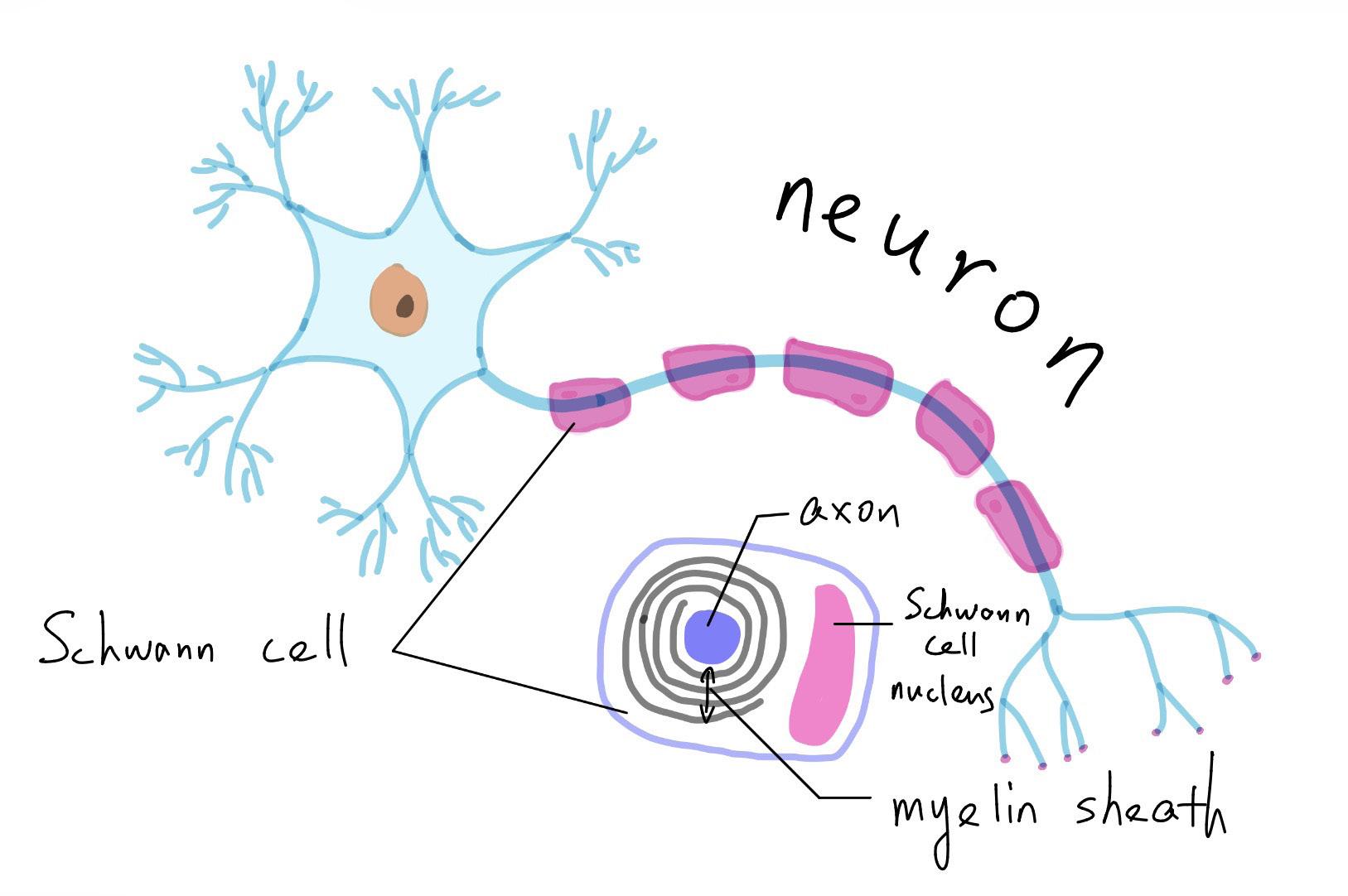
Fendy Deng ’28
Reminders of Japan
Yuki Takahashi ’26
Shoji light like sifted rice on the floor.
A temple bell hums—one breath, then quiet.
Cedar incense threads the hallway after rain.
Vermilion torii cut the sky like careful brushstrokes.
Tatami presses its grass-soft pattern into my palms.
Matcha’s gentle bitter wakes the tongue; sweet red bean follows.
Geta clack along wet stone, a festival still far off.
A train chime rings—doo, doo, doo—between mountains and neon.
Koi turn like living fans under a maple’s shadow.
In the pause—ma—I hear home hiding in the silence.
Shoji — Traditional Japanese sliding screens made of wood and translucent paper
Torii — A symbolic gate to a Shinto shrine
Tatami — Straw mats used as flooring in traditional Japanese rooms
Matcha — Finely ground powdered green tea used in the Japanese tea ceremony
Geta — Traditional wooden sandals
Koi — Ornamental carp commonly kept in garden ponds in Japan
Ma — A Japanese aesthetic concept meaning “pause,” emphasizing meaningful silence
音消えて 真白の世界 息ひとつ
The sound has faded. In a pure white world, I hear my solitary breath.
– Mao Fujikawa ’26
Vision Statement
Cushing Academy’s Patchwork literary magazine fosters creativity and excellence in the literary and visual arts by publishing the best work produced in our community each year, with the primary emphasis always on student writers. Each year’s spring edition showcases the diversity of our community – across all grades, the spectrum of gender, numerous perspectives, and multiple genres of writing and art. Patchwork also offers students leadership opportunities as staff and editors of the annual publication.
Patchwork Policies
Patchwork editors enroll in “Literary Magazine” as their afternoon activity during the Fall and/or Winter season. Other students serve as staff and agree to work on the publication independently and to communicate frequently with the editors and faculty advisor. All members of the Cushing community may submit their work to Patchwork at any time. Patchwork also holds several contests each year, enabling Cushing Penguins to compete in writing challenges for prizes and possible publication. Once submitted, pieces are assessed by the editors, staff, and faculty advisor. Works chosen for publication are edited by the Patchwork team and placed into the annual publication provided to interested Cushing readers every spring. Patchwork does not consider or publish plagiarized, previously-published, or AI-generated work.