© Robert Mankoff The New Yorker Collection/ The Cartoon Bank. All Rights Reserved.
3
Personal and shared knowledge
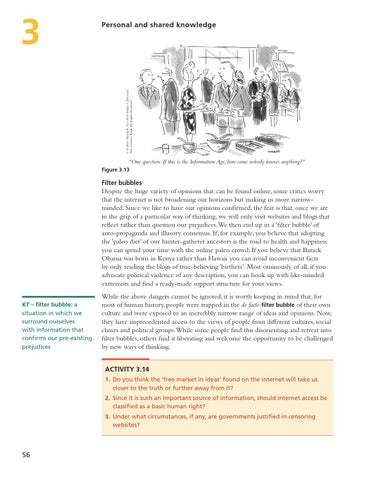
“One question: If this is the Information Age, how come nobody knows anything?” Figure 3.13
Filter bubbles
Despite the huge variety of opinions that can be found online, some critics worry that the internet is not broadening our horizons but making us more narrowminded. Since we like to have our opinions confirmed, the fear is that, once we are in the grip of a particular way of thinking, we will only visit websites and blogs that reflect rather than question our prejudices. We then end up in a ‘filter bubble’ of auto-propaganda and illusory consensus. If, for example, you believe that adopting the ‘paleo diet’ of our hunter-gatherer ancestors is the road to health and happiness you can spend your time with the online paleo crowd. If you believe that Barack Obama was born in Kenya rather than Hawaii you can avoid inconvenient facts by only reading the blogs of true-believing ‘birthers’. Most ominously of all, if you advocate political violence of any description, you can hook up with like-minded extremists and find a ready-made support structure for your views. KT – filter bubble: a situation in which we surround ourselves with information that confirms our pre-existing prejudices
While the above dangers cannot be ignored, it is worth keeping in mind that, for most of human history, people were trapped in the de facto filter bubble of their own culture and were exposed to an incredibly narrow range of ideas and opinions. Now, they have unprecedented access to the views of people from different cultures, social classes and political groups. While some people find this disorienting and retreat into filter bubbles, others find it liberating and welcome the opportunity to be challenged by new ways of thinking. ACTIVITY 3.14 1. Do you think the ‘free market in ideas’ found on the internet will take us closer to the truth or further away from it? 2. Since it is such an important source of information, should internet access be classified as a basic human right? 3. Under what circumstances, if any, are governments justified in censoring websites?
56