3
Personal and shared knowledge
ACTIVITY 3.5 1. Do you agree or disagree with the claim that in the internet age what matters is not so much knowing the answers as knowing where to find the answers? 2. Which of the following do you think an educated person should know without having to use the internet? a. The periodic table b. Key dates in history c. Mental arithmetic d. Correct spelling e. Capital cities f. Common fallacies g. Newtonian physics h. Great literature 3. Despite the growth of knowledge, what evidence, if any, is there that the average person is less gullible and superstitious than their ancestors were five hundred years ago? 4. ‘Even if we could be learned with other men’s learning, at least wise we cannot be except by our own wisdom’ (Montaigne, 1533–92). What do you think Montaigne meant by this? Do you agree?
KT – illusion of explanatory depth: the illusion that you understand something in detail when in fact you do not
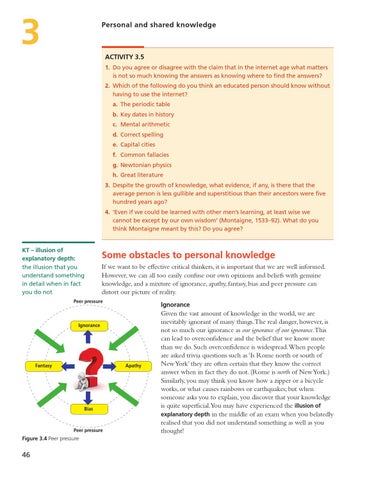
Some obstacles to personal knowledge If we want to be effective critical thinkers, it is important that we are well informed. However, we can all too easily confuse our own opinions and beliefs with genuine knowledge, and a mixture of ignorance, apathy, fantasy, bias and peer pressure can distort our picture of reality.
Peer pressure
Ignorance
Ignorance
Fantasy
Apathy
Bias
Peer pressure
Figure 3.4 Peer pressure
46
Given the vast amount of knowledge in the world, we are inevitably ignorant of many things. The real danger, however, is not so much our ignorance as our ignorance of our ignorance. This can lead to overconfidence and the belief that we know more than we do. Such overconfidence is widespread. When people are asked trivia questions such as ‘Is Rome north or south of New York’ they are often certain that they know the correct answer when in fact they do not. (Rome is north of New York.) Similarly, you may think you know how a zipper or a bicycle works, or what causes rainbows or earthquakes; but when someone asks you to explain, you discover that your knowledge is quite superficial.You may have experienced the illusion of explanatory depth in the middle of an exam when you belatedly realised that you did not understand something as well as you thought!