Cambridge International AS & A Level Mathematics: Worked Solutions Manual
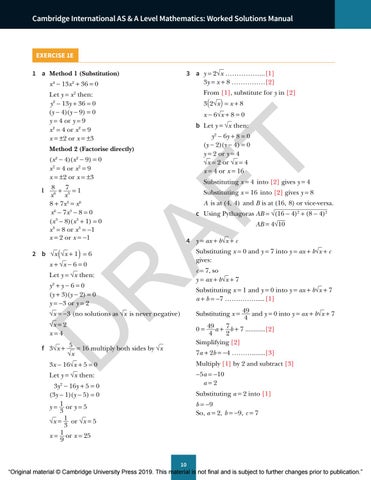
EXERCISE 1E 3 a y = 2√x ……………...[1] 3y = x + 8 ……………[2]
1 a Method 1 (Substitution) x − 13x + 36 = 0 4
2
From [1], substitute for y in [2]
Let y = x 2 then: y 2 − 13y + 36 = 0 (y − 4)(y − 9) = 0 y = 4 or y = 9 x 2 = 4 or x 2 = 9 x = ±2 or x = ±3
3(2√x) = x + 8
x − 6√x + 8 = 0 b Let y = √x then: y 2 − 6y + 8 = 0 (y − 2)(y − 4) = 0 y = 2 or y = 4 √x = 2 or √x = 4 x = 4 or x = 16
AF T
Method 2 (Factorise directly) (x 2 − 4)(x 2 − 9) = 0 x 2 = 4 or x 2 = 9 x = ±2 or x = ±3
Substituting x = 4 into [2] gives y = 4
l 86 + 73 = 1 x x 8 + 7x 3 = x 6 x 6 − 7x 3 − 8 = 0 (x 3 − 8)(x 3 + 1) = 0 x 3 = 8 or x 3 = −1 x = 2 or x = −1 2 b √x (√x + 1) = 6 x + √x − 6 = 0
Substituting x = 16 into [2] gives y = 8 A is at (4, 4) and B is at (16, 8) or vice-versa.
c Using Pythagoras AB = √(16 − 4) 2 + (8 − 4) 2 AB = 4√10
4 y = ax + b√x + c
Substituting x = 0 and y = 7 into y = ax + b√x + c gives: c = 7, so y = ax + b√x + 7
R
Let y = √x then:
y2 + y − 6 = 0 (y + 3)(y − 2) = 0 y = −3 or y = 2
Substituting x = 1 and y = 0 into y = ax + b√x + 7 a + b = −7 …………….... [1]
√x = −3 (no solutions as √x is never negative)
D
√x = 2 x=4
f 3√x + 5 = 16 multiply both sides by √x √x
Substituting x = 49 and y = 0 into y = ax + b√x + 7 4 49 7 0= a + b + 7 ............[2] 2 4 Simplifying [2] 7a + 2b = −4 ………........[3]
3x − 16√x + 5 = 0
Multiply [1] by 2 and subtract [3]
Let y = √x then:
−5a = −10 a=2
3y − 16y + 5 = 0 (3y − 1)(y − 5) = 0 y = 1 or y = 5 3 √x = 1 or √x = 5 3 x = 1 or x = 25 9 2
Substituting a = 2 into [1] b = −9 So, a = 2, b = −9, c = 7
10
“Original material © Cambridge University Press 2019. This material is not final and is subject to further changes prior to publication.”