Cambridge Pre-U Chemistry
S3: Electrons in atoms ■
describe the concept of shielding in multi-electron atoms use the relationship between group number and successive ionisation energies
N
■
LY
Learning Outcomes
O
S3.3 Three factors that influence the successive ionisation energies of an atom The size of the nuclear charge
EV IE
W
As the atomic number (number of protons) increases, the positive nuclear charge increases. The bigger the positive charge, the greater the attractive electrostatic force between the nucleus and the electrons. So, more energy is needed to overcome these attractive forces if an electron is to be removed. In general, ionisation energy increases as the proton number increases.
Distance of outer electrons from the nucleus
The force of attraction between positive and negative charges decreases rapidly as the distance between them increases. So, electrons in shells further away from the nucleus are less attracted to the nucleus than those closer to the nucleus. The further the outer electron shell is from the nucleus, the lower the ionisation energy. This is related to the shielding effect, discussed below.
Shielding effect and repulsion of electrons
FO R
R
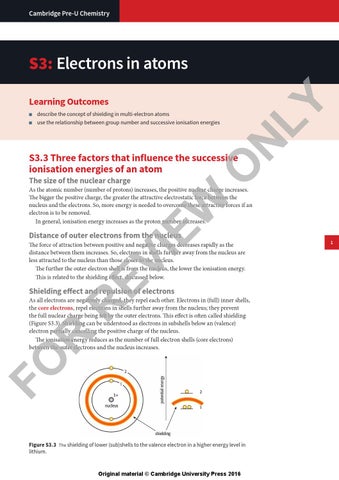
As all electrons are negatively charged, they repel each other. Electrons in (full) inner shells, the core electrons, repel electrons in shells further away from the nucleus; they prevent the full nuclear charge being felt by the outer electrons. This effect is often called shielding (Figure S3.3). Shielding can be understood as electrons in subshells below an (valence) electron partially cancelling the positive charge of the nucleus. The ionisation energy reduces as the number of full electron shells (core electrons) between the outer electrons and the nucleus increases.
Figure S3.3 The shielding of lower (sub)shells to the valence electron in a higher energy level in lithium.
Original material © Cambridge University Press 2016
1