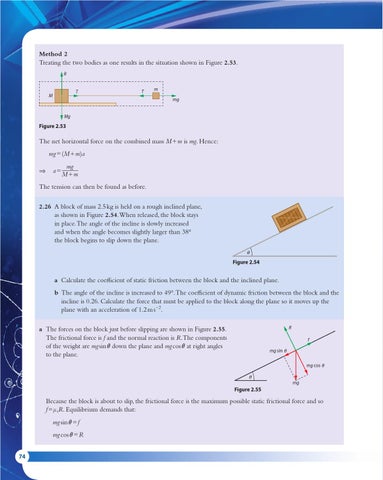
Method 2 Treating the two bodies as one results in the situation shown in Figure 2.53. R
T
M
T
m mg
Mg
Figure 2.53
The net horizontal force on the combined mass M + m is mg. Hence: mg = (M + m)a ⇒
a=
mg M+m
The tension can then be found as before. 2.26 A block of mass 2.5 kg is held on a rough inclined plane, as shown in Figure 2.54. When released, the block stays in place. The angle of the incline is slowly increased and when the angle becomes slightly larger than 38° the block begins to slip down the plane. θ
Figure 2.54
a Calculate the coefficient of static friction between the block and the inclined plane. b The angle of the incline is increased to 49°. The coefficient of dynamic friction between the block and the incline is 0.26. Calculate the force that must be applied to the block along the plane so it moves up the plane with an acceleration of 1.2 m s−2. R
a The forces on the block just before slipping are shown in Figure 2.55. The frictional force is f and the normal reaction is R. The components of the weight are mg sin down the plane and mg cos at right angles to the plane.
f mg sin θ mg cos θ θ
mg
Figure 2.55
Because the block is about to slip, the frictional force is the maximum possible static frictional force and so f = µ sR. Equilibrium demands that: mg sin = f mg cos = R 74