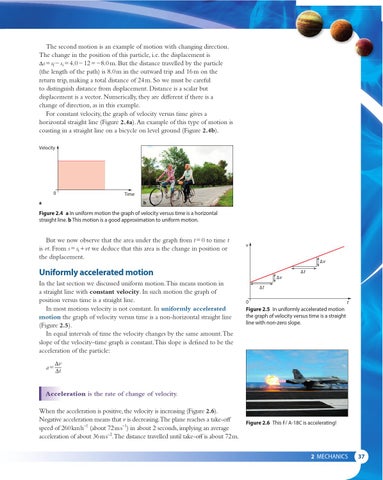
The second motion is an example of motion with changing direction. The change in the position of this particle, i.e. the displacement is s = sf − si = 4.0 − 12 = −8.0 m. But the distance travelled by the particle (the length of the path) is 8.0 m in the outward trip and 16 m on the return trip, making a total distance of 24 m. So we must be careful to distinguish distance from displacement. Distance is a scalar but displacement is a vector. Numerically, they are different if there is a change of direction, as in this example. For constant velocity, the graph of velocity versus time gives a horizontal straight line (Figure 2.4a). An example of this type of motion is coasting in a straight line on a bicycle on level ground (Figure 2.4b). Velocity
0
Time
a
b
Figure 2.4 a In uniform motion the graph of velocity versus time is a horizontal straight line. b This motion is a good approximation to uniform motion.
But we now observe that the area under the graph from t = 0 to time t is vt. From s = si + vt we deduce that this area is the change in position or the displacement.
v ∆v
Uniformly accelerated motion In the last section we discussed uniform motion. This means motion in a straight line with constant velocity. In such motion the graph of position versus time is a straight line. In most motions velocity is not constant. In uniformly accelerated motion the graph of velocity versus time is a non-horizontal straight line (Figure 2.5). In equal intervals of time the velocity changes by the same amount. The slope of the velocity–time graph is constant. This slope is defined to be the acceleration of the particle: a=
∆v
∆t
∆t
0
t
Figure 2.5 In uniformly accelerated motion the graph of velocity versus time is a straight line with non-zero slope.
v t
Acceleration is the rate of change of velocity. When the acceleration is positive, the velocity is increasing (Figure 2.6). Negative acceleration means that v is decreasing.The plane reaches a take-off speed of 260 km h–1 (about 72 m s–1) in about 2 seconds, implying an average acceleration of about 36 m s–2.The distance travelled until take-off is about 72 m.
Figure 2.6 This F/ A-18C is accelerating!
2 MECHANICS
37