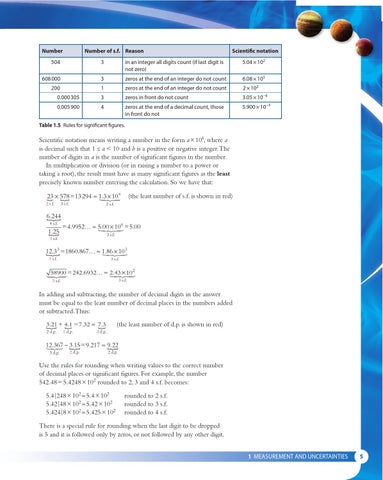
Number
Number of s.f. Reason
Scientific notation
504
3
in an integer all digits count (if last digit is not zero)
5.04 × 10²
608 000
3
zeros at the end of an integer do not count
6.08 × 10⁵
200
1
zeros at the end of an integer do not count
2 × 10²
0.000 305
3
zeros in front do not count
3.05 × 10⁻⁴
0.005 900
4
zeros at the end of a decimal count, those in front do not
5.900 × 10⁻³
Table 1.5 Rules for significant figures.
Scientific notation means writing a number in the form a × 10b, where a is decimal such that 1 ≤ a < 10 and b is a positive or negative integer. The number of digits in a is the number of significant figures in the number. In multiplication or division (or in raising a number to a power or taking a root), the result must have as many significant figures as the least precisely known number entering the calculation. So we have that: 4 23 294 ≈ 1.3 × 10 % × 578=13 % ! #" # $
2 s.f.
3 s.f.
6.244 % 4 s.f.
1.25 %
(the least number of s.f. is shown in red)
2 s.f.
0 =4.9952… ≈ 5.00 ×# 10 !#" $ =5.00 3 s.f.
3 s.f.
3 3 12.3 ×# 10 % =1860.867… ≈ 1.86 !#" $ 3 s.f.
3 s.f.
2 58900 ×# 10 !#" $ !" # # $ = 242.6932… ≈ 2.43 3 s.f.
3 s.f.
In adding and subtracting, the number of decimal digits in the answer must be equal to the least number of decimal places in the numbers added or subtracted. Thus: 3.21 ! + 4.1 ! =7.32 ≈ 7.3 ! 2 d.p.
1 d.p.
(the least number of d.p. is shown in red)
1 d.p.
12.367 ≈ 9.22 $ $ !"# − 3.15=9.217 3 d.p.
2 d.p.
2 d.p.
Use the rules for rounding when writing values to the correct number of decimal places or significant figures. For example, the number 542.48 = 5.4248 × 10² rounded to 2, 3 and 4 s.f. becomes: 5.4|248 × 102 ≈ 5.4 × 10² 5.42|48 × 102 ≈ 5.42 × 10² 5.424|8 × 10² ≈ 5.425 × 10²
rounded to 2 s.f. rounded to 3 s.f. rounded to 4 s.f.
There is a special rule for rounding when the last digit to be dropped is 5 and it is followed only by zeros, or not followed by any other digit. 1 MEASUREMENT AND UNCERTAINTIES
5