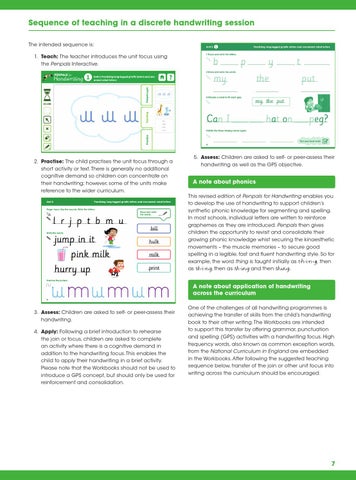
Sequence of teaching in a discrete handwriting session The intended sequence is: 1. Teach: The teacher introduces the unit focus using the Penpals Interactive.
2. Practise: The child practises the unit focus through a short activity or text. There is generally no additional cognitive demand so children can concentrate on their handwriting; however, some of the units make reference to the wider curriculum.
5. Assess: Children are asked to self- or peer-assess their handwriting as well as the GPS objective.
A note about phonics This revised edition of Penpals for Handwriting enables you to develop the use of handwriting to support children’s synthetic phonic knowledge for segmenting and spelling. In most schools, individual letters are written to reinforce graphemes as they are introduced. Penpals then gives children the opportunity to revisit and consolidate their growing phonic knowledge whist securing the kinaesthetic movements – the muscle memories – to secure good spelling in a legible, fast and fluent handwriting style. So for example, the word thing is taught initially as t-h-i-n-g, then as t<h-i-n<g, then as t<h-i<n<g and then t<h<i<n<g.
A note about application of handwriting across the curriculum 3. Assess: Children are asked to self- or peer-assess their handwriting. 4. Apply: Following a brief introduction to rehearse the join or focus, children are asked to complete an activity where there is a cognitive demand in addition to the handwriting focus. This enables the child to apply their handwriting in a brief activity. Please note that the Workbooks should not be used to introduce a GPS concept, but should only be used for reinforcement and consolidation.
One of the challenges of all handwriting programmes is achieving the transfer of skills from the child’s handwriting book to their other writing. The Workbooks are intended to support this transfer by offering grammar, punctuation and spelling (GPS) activities with a handwriting focus. High frequency words, also known as common exception words, from the National Curriculum in England are embedded in the Workbooks. After following the suggested teaching sequence below, transfer of the join or other unit focus into writing across the curriculum should be encouraged.
7