1 Understanding Number
Prime Numbers, Factors and Multiples In this section we will use natural numbers only.
Key term Prime numbers can be divided only by themselves and 1 without leaving a remainder, for example 2, 11, 37, 101
Prime numbers are natural numbers that can only be divided by themselves or by 1. Some examples of prime numbers are: 2, 3, 5, 7, 11, 13, 17, … Notice that 1 is not counted as a prime number, and 2 is the only even prime number. Example 2 Write a list of all the prime numbers between 20 and 35. Answer 2 23, 29, 31 (all the other numbers between 20 and 35 can be divided by numbers other than just themselves or 1)
Key terms Factors of a number can be multiplied together to make that number, for example 1, 2, 3, and 6 are factors of 6. Multiples of a number are the result of multiplying that number by any of the natural numbers, for example 6, 12, 36 and 600 are multiples of 6.
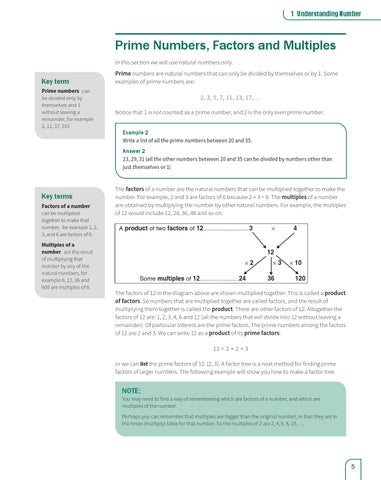
The factors of a number are the natural numbers that can be multiplied together to make the number. For example, 2 and 3 are factors of 6 because 2 × 3 = 6. The multiples of a number are obtained by multiplying the number by other natural numbers. For example, the multiples of 12 would include 12, 24, 36, 48 and so on. A product of two factors of 12...........................3
×
4
12 ×2 Some multiples of 12.......................24
×3 36
× 10 120
The factors of 12 in the diagram above are shown multiplied together. This is called a product of factors. So numbers that are multiplied together are called factors, and the result of multiplying them together is called the product. There are other factors of 12. Altogether the factors of 12 are: 1, 2, 3, 4, 6 and 12 (all the numbers that will divide into 12 without leaving a remainder). Of particular interest are the prime factors. The prime numbers among the factors of 12 are 2 and 3. We can write 12 as a product of its prime factors: 12 = 2 × 2 × 3 or we can list the prime factors of 12: {2, 3}. A factor tree is a neat method for finding prime factors of larger numbers. The following example will show you how to make a factor tree.
NOTE:
You may need to find a way of remembering which are factors of a number, and which are multiples of the number. Perhaps you can remember that multiples are bigger than the original number, or that they are in the times (multiply) table for that number. So the multiples of 2 are 2, 4, 6, 8, 10, …
5