1 Understanding Number
Sets of Numbers The numbers that we use today have developed over a period of time as the need arose. At first humans needed numbers just to count things, so the simplest set of numbers was the set of natural or counting numbers. We use the symbol N to represent the counting numbers, and we use curly brackets to list some of these numbers.
Key terms
Natural (or Counting) numbers: N are the whole numbers you need to count individual items, for example 1, 5, 72, 1000. Integers: Z are the counting numbers and also zero and negative whole numbers, for example −50, −2, 0, 11, 251. Rational numbers: Q are the counting numbers, integers and also numbers which can be written as fractions (or ratios) , for example 3 1 −20, – 4 , 0, 1, 50 2 . Real numbers: R include natural numbers, integers, rational numbers and also irrational numbers. Irrational numbers: are numbers which cannot be written as fractions, for example p, √2, √51
Practical Work
N = {1, 2, 3, 4, …} The dots at the end mean ‘and so on’ because the list goes on forever. (Lists like these are often shown in curly brackets. However, this is not essential.) When addition and subtraction were introduced, a new set of numbers was needed. For example, I had three goats. Three were stolen. How many goats do I have now? We know that the answer is none or zero, which does not appear in the counting numbers. Subtraction also meant that negative numbers were needed, as we will see later in this chapter. Our next set of numbers is the set of integers, which have the symbol Z, and include negative whole numbers, zero and the natural numbers. Z = {…, −3, −2, −1, 0, 1, 2, 3, …} After addition and subtraction came division and multiplication. What happens when we divide two by three? The answer is that we get the fraction 23 . But where does that fit in with our latest set of numbers? We need another set which includes all the fractions or rational numbers. This is the set Q. Rational numbers can all be expressed as fractions or ratios made up of one integer over another. Remember, for example, that 5 can be written as 51 , so integers themselves are included in the set of rational numbers. We can only list some examples of this set because there is an infinite number of members belonging to Q. Some examples of rational numbers are: 2 5 3, 2,
–2 12 ,
3 100 ,
5, 0, 29, –500, etc
The last set we need for our number sets is the set of real numbers, R. This includes all the previous sets and also the irrational numbers. Irrational numbers are numbers which cannot be written as fractions (or ratios) made up of one integer over another. •
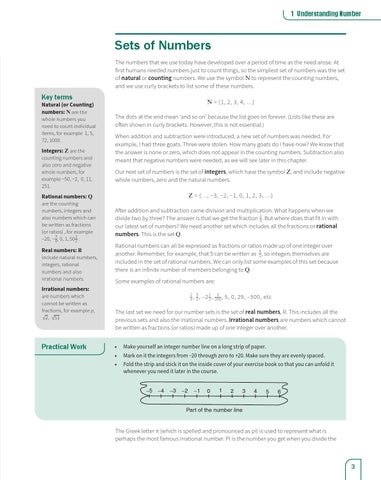
Make yourself an integer number line on a long strip of paper.
•
Mark on it the integers from −20 through zero to +20. Make sure they are evenly spaced.
•
Fold the strip and stick it on the inside cover of your exercise book so that you can unfold it whenever you need it later in the course.
−5 −4
−3
−2
−1
0
1
2
3
4
5
6
Part of the number line
The Greek letter π (which is spelled and pronounced as pi) is used to represent what is perhaps the most famous irrational number. Pi is the number you get when you divide the
3