Cambridge International AS & A Level Further Mathematics: Worked Solutions Manual We are working with Cambridge Assessment International Education towards endorsement of this title. y c Points of intersection: when x = 0, y = − 1 and y = 0 4 when x = 1 5 1 x + –4 – y= 2
4
2
y
y=
x+
–√ 5 – 1
2
–
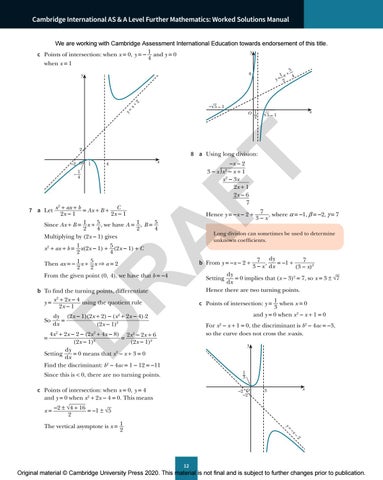
8 a Using long division:
1
4
1 4
x
−x − 2 2 ⟌ 3−x x −x+1 x 2 − 3x 2x + 1 2x − 6 7
2 7 a Let x + ax + b = Ax + B + C 2x − 1 2x − 1 Since Ax + B = 1 x + 5 , we have A = 1 , B = 5 2 2 4 4 Multiplying by (2x − 1) gives x 2 + ax + b = 1 x(2x − 1) + 5 (2x − 1) + C 2 4
Hence y = −x − 2 +
7 , where a = −1, b = −2, g = 7 3−x
A
Long division can sometimes be used to determine unknown coefficients.
Then ax = − 1 x + 5 x ⇒ a = 2 2 2 From the given point (0, 4), we have that b = −4
R
b From y = −x − 2 +
D
b To find the turning points, differentiate x 2 + 2x − 4 y= using the quotient rule 2x − 1 dy (2x − 1)(2x + 2) − (x 2 + 2x − 4) .2 So = dx (2x − 1) 2
7 , dy = −1 + 7 3 − x dx (3 − x) 2
dy = 0 implies that (x − 3) 2 = 7, so x = 3 ± √7 dx Hence there are two turning points. Setting
c Points of intersect ion: y = 1 when x = 0 3 and y = 0 when x 2 − x + 1 = 0 For x 2 − x + 1 = 0, the discriminant is b 2 − 4ac = −3, so the curve does not cross the x-axis.
4x 2 + 2x − 2 − (2x 2 + 4x − 8) 2x 2 − 2x + 6 = (2x − 1) 2 (2x − 1) 2 dy Setting = 0 means that x 2 − x + 3 = 0 dx Find the discriminant: b 2 − 4ac = 1 − 12 = −11 =
y
1 3
Since this is < 0, there are no turning points. c Points of intersection: when x = 0, y = 4 and y = 0 when x 2 + 2x − 4 = 0. This means x=
x
√5 – 1
FT
–2 O
O 1 2
–2 O –2
x
3
−2 ± √4 + 16 = −1 ± √5 2 y=
The vertical asymptote is x = 1 2
–x – 2
12
Original material © Cambridge University Press 2020. This material is not final and is subject to further changes prior to publication.