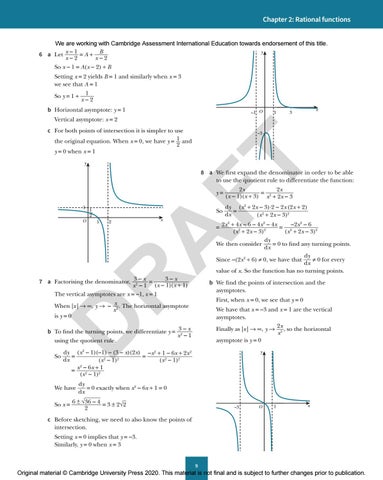
Chapter 2: Rational functions We are working with Cambridge Assessment International Education towards endorsement of this title. y 6 a Let x − 1 = A + B x−2 x−2 So x − 1 = A(x − 2) + B Setting x = 2 yields B = 1 and similarly when x = 3 we see that A = 1 So y = 1 + 1 x−2 b Horizontal asymptote: y = 1
–1 O
1
x
3
Vertical asymptote: x = 2 c For both points of intersection it is simpler to use the original equation. When x = 0, we have y = 1 and 2 y = 0 when x = 1
FT
y
–3
8 a We first expand the denominator in order to be able to use the quotient rule to differentiate the function:
1
1
2
x
2x 2x = (x − 1)(x + 3) x 2 + 2x − 3
So
dy (x 2 + 2x − 3) .2 − 2x (2x + 2) = dx (x 2 + 2x − 3) 2
2x 2 + 4x − 6 − 4x 2 − 4x −2x 2 − 6 = 2 2 2 (x + 2x − 3) (x + 2x − 3) 2 dy We then consider = 0 to find any turning points. dx dy Since −(2x 2 + 6) ≠ 0, we have that ≠ 0 for every dx value of x. So the function has no turning points. =
A
O
1 2
y=
R
3−x 7 a Factorising the denominator, 32 − x = x − 1 (x − 1)(x + 1) The vertical asymptotes are x = −1, x = 1 When |x | → ∞, y → − x2 . The horizontal asymptote x is y = 0
b We find the points of intersection and the asymptotes. First, when x = 0, we see that y = 0
D
We have that x = −3 and x = 1 are the vertical asymptotes. 2x Finally as |x | → ∞, y → 2 , so the horizontal x asymptote is y = 0
b To find the turning points, we differentiate y = 32 − x x −1 using the quotient rule. So
dy (x 2 − 1)(−1) − (3 − x)(2x) −x 2 + 1 − 6x + 2x 2 = = dx (x 2 − 1) 2 (x 2 − 1) 2 2 = x −2 6x +21 (x − 1)
We have So x =
y
dy = 0 exactly when x 2 − 6x + 1 = 0 dx
6 ± √36 − 4 = 3 ± 2√2 2
–3
O
1
x
c Before sketching, we need to also know the points of intersection. Setting x = 0 implies that y = −3. Similarly, y = 0 when x = 3 9
Original material © Cambridge University Press 2020. This material is not final and is subject to further changes prior to publication.