2 Data transmission
There are several error detection methods that can be used, these include: •
parity check
•
checksum
•
echo check.
Each of these methods is designed to check for errors after the data has been transmitted from one device to another.
KEY WORDS
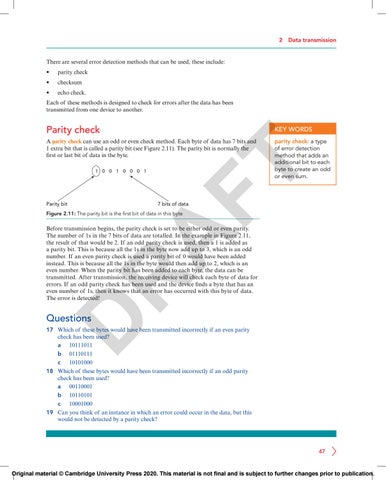
A parity check can use an odd or even check method. Each byte of data has 7 bits and 1 extra bit that is called a parity bit (see Figure 2.11). The parity bit is normally the first or last bit of data in the byte.
parity check: a type of error detection method that adds an additional bit to each byte to create an odd or even sum.
1 0 0 1 0 0 0 1
Parity bit
FT
Parity check
7 bits of data
Figure 2.11: The parity bit is the first bit of data in this byte
R
A
Before transmission begins, the parity check is set to be either odd or even parity. The number of 1s in the 7 bits of data are totalled. In the example in Figure 2.11, the result of that would be 2. If an odd parity check is used, then a 1 is added as a parity bit. This is because all the 1s in the byte now add up to 3, which is an odd number. If an even parity check is used a parity bit of 0 would have been added instead. This is because all the 1s in the byte would then add up to 2, which is an even number. When the parity bit has been added to each byte, the data can be transmitted. After transmission, the receiving device will check each byte of data for errors. If an odd parity check has been used and the device finds a byte that has an even number of 1s, then it knows that an error has occurred with this byte of data. The error is detected!
D
Questions
17 Which of these bytes would have been transmitted incorrectly if an even parity check has been used? a 10111011 b 01110111 c 10101000 18 Which of these bytes would have been transmitted incorrectly if an odd parity check has been used? a 00110001 b 10110101 c 10001000 19 Can you think of an instance in which an error could occur in the data, but this would not be detected by a parity check?
47 Original material © Cambridge University Press 2020. This material is not final and is subject to further changes prior to publication.