v v
v a
Fmagnetic
a dr
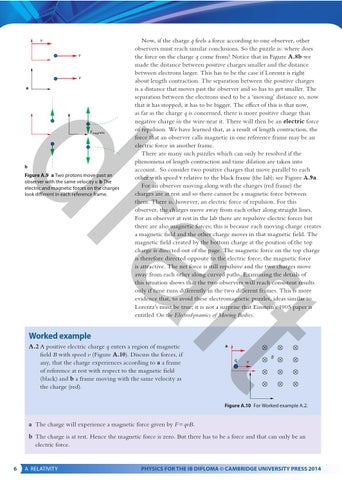
Now, if the charge q feels a force according to one observer, other observers must reach similar conclusions. So the puzzle is: where does the force on the charge q come from? Notice that in Figure A.8b we made the distance between positive charges smaller and the distance between electrons larger. This has to be the case if Lorentz is right about length contraction. The separation between the positive charges is a distance that moves past the observer and so has to get smaller. The separation between the electrons used to be a ‘moving’ distance so, now that it has stopped, it has to be bigger. The effect of this is that now, as far as the charge q is concerned, there is more positive charge than negative charge in the wire near it. There will then be an electric force of repulsion. We have learned that, as a result of length contraction, the force that an observer calls magnetic in one reference frame may be an electric force in another frame. There are many such puzzles which can only be resolved if the phenomena of length contraction and time dilation are taken into account. So consider two positive charges that move parallel to each other with speed v relative to the black frame (the lab); see Figure A.9a. For an observer moving along with the charges (red frame) the charges are at rest and so there cannot be a magnetic force between them. There is, however, an electric force of repulsion. For this observer, the charges move away from each other along straight lines. For an observer at rest in the lab there are repulsive electric forces but there are also magnetic forces; this is because each moving charge creates a magnetic field and the other charge moves in that magnetic field. The magnetic field created by the bottom charge at the position of the top charge is directed out of the page. The magnetic force on the top charge is therefore directed opposite to the electric force; the magnetic force is attractive. The net force is still repulsive and the two charges move away from each other along curved paths. Examining the details of this situation shows that the two observers will reach consistent results only if time runs differently in the two different frames. This is more evidence that, to avoid these electromagnetic puzzles, ideas similar to Lorentz’s must be true; it is not a surprise that Einstein’s 1905 paper is entitled On the Electrodynamics of Moving Bodies.
b
Figure A.9 a Two protons move past an observer with the same velocity v. b The electric and magnetic forces on the charges look different in each reference frame.
ft
Worked example
A.2 A positive electric charge q enters a region of magnetic field B with speed v (Figure A.10). Discuss the forces, if any, that the charge experiences according to a a frame of reference at rest with respect to the magnetic field (black) and b a frame moving with the same velocity as the charge (red).
a
q
v
B
Figure A.10 For Worked example A.2.
a The charge will experience a magnetic force given by F = qvB. b The charge is at rest. Hence the magnetic force is zero. But there has to be a force and that can only be an electric force.
6
A RELATIVITY
Phys_ib_dip_student material_6ed_wm_optiona_1st proof.indd 6
PHYSICS FOR THE IB DIPLOMA © CAMBRIDGE UNIVERSITY PRESS 2014
03/09/2014 08:23