Cambridge International AS Level English General Paper
Original word (base word)
Comparative
Superlative
good
better
best
well
better
best
a little
less
least
some
more
most
much
more
most
many
more
most
bad, badly
worse
worst
LE
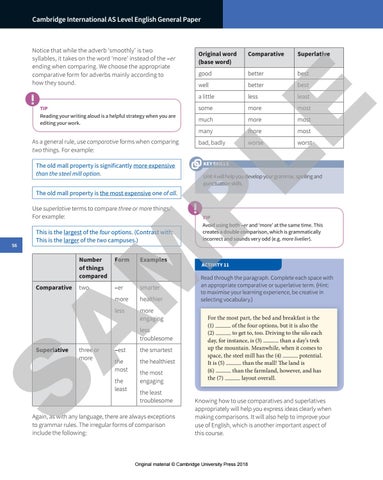
Notice that while the adverb ‘smoothly’ is two syllables, it takes on the word ‘more’ instead of the –er ending when comparing. We choose the appropriate comparative form for adverbs mainly according to how they sound.
TIP
Reading your writing aloud is a helpful strategy when you are editing your work.
As a general rule, use comparative forms when comparing two things. For example: The old mall property is significantly more expensive than the steel mill option.
KEY SKILLS
Unit 4 will help you develop your grammar, spelling and punctuation skills.
M P
The old mall property is the most expensive one of all. Use superlative terms to compare three or more things. For example:
Comparative
Number of things compared
Form
two
–er
smarter
more
healthier
less
more engaging
A
56
This is the largest of the four options. (Contrast with: This is the larger of the two campuses.)
three or more
S
Superlative
Examples
less troublesome
–est
the smartest
the most
the healthiest
the least
the most engaging the least troublesome
Again, as with any language, there are always exceptions to grammar rules. The irregular forms of comparison include the following:
TIP
Avoid using both –er and ‘more’ at the same time. This creates a double comparison, which is grammatically incorrect and sounds very odd (e.g. more livelier).
ACTIVITY 11
Read through the paragraph. Complete each space with an appropriate comparative or superlative term. (Hint: to maximise your learning experience, be creative in selecting vocabulary.)
For the most part, the bed and breakfast is the of the four options, but it is also the (1) (2) to get to, too. Driving to the silo each day, for instance, is (3) than a day’s trek up the mountain. Meanwhile, when it comes to space, the steel mill has the (4) potential. It is (5) than the mall! The land is (6) than the farmland, however, and has the (7) layout overall.
Knowing how to use comparatives and superlatives appropriately will help you express ideas clearly when making comparisons. It will also help to improve your use of English, which is another important aspect of this course.
Original material © Cambridge University Press 2018