Unit 1.3: Exploring language and style
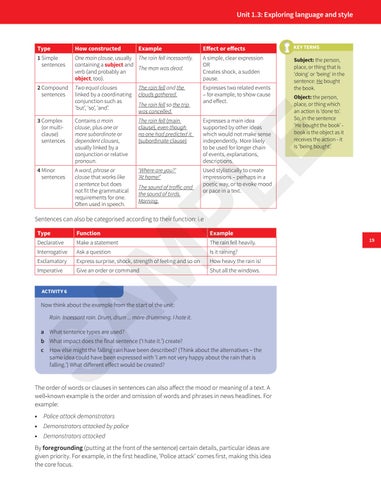
Example
Effect or effects
KEY TERMS
A simple, clear expression OR Creates shock, a sudden pause.
Subject: the person, place, or thing that is ‘doing’ or ‘being’ in the sentence: He bought the book.
Type
How constructed
1 Simple sentences
One main clause, usually The rain fell incessantly. containing a subject and The man was dead. verb (and probably an object, too).
2 Compound sentences
Two equal clauses linked by a coordinating conjunction such as ‘but’, ‘so’, ‘and’.
The rain fell and the clouds gathered.
3 Complex (or multiclause) sentences
Contains a main clause, plus one or more subordinate or dependent clauses, usually linked by a conjunction or relative pronoun.
The rain fell (main clause), even though no one had predicted it. (subordinate clause)
Expresses a main idea supported by other ideas which would not make sense independently. More likely to be used for longer chain of events, explanations, descriptions.
4 Minor sentences
A word, phrase or clause that works like a sentence but does not fit the grammatical requirements for one. Often used in speech.
‘Where are you?’ ‘At home!’
Used stylistically to create impressions – perhaps in a poetic way, or to evoke mood or pace in a text.
The rain fell so the trip was cancelled.
The sound of traffic and the sound of birds. Morning.
Expresses two related events – for example, to show cause and effect.
Object: the person, place, or thing which an action is ‘done to’. So, in the sentence ‘He bought the book’ book is the object as it receives the action - it is ‘being bought’.
Sentences can also be categorised according to their function: i.e Type
Function
Example
Declarative
Make a statement
The rain fell heavily.
Interrogative
Ask a question
Is it raining?
Exclamatory
Express surprise, shock, strength of feeling and so on
How heavy the rain is!
Imperative
Give an order or command
Shut all the windows.
ACTIVITY 6
Now think about the example from the start of the unit: Rain. Incessant rain. Drum, drum ... more drumming. I hate it. a What sentence types are used? b What impact does the final sentence (‘I hate it.’) create? c How else might the falling rain have been described? (Think about the alternatives – the same idea could have been expressed with ‘I am not very happy about the rain that is falling.’) What different effect would be created?
The order of words or clauses in sentences can also affect the mood or meaning of a text. A well-known example is the order and omission of words and phrases in news headlines. For example: •
Police attack demonstrators
•
Demonstrators attacked by police
•
Demonstrators attacked
By foregrounding (putting at the front of the sentence) certain details, particular ideas are given priority. For example, in the first headline, ‘Police attack’ comes first, making this idea the core focus.
19