2
The Nature of the Cold War
the decisions of this body. In the event of a veto, the matter passed to the General Assembly. In reality, the US and the USSR tended to dominate the Security Council, as they were the two most powerful states. With these two states – increasingly at odds with each other after 1945 – on the Security Council, it soon became clear that the UN would find it hard to follow an independent and neutral line in any crises that seemed to threaten peace and security. As the US and the USSR adopted policies in their respective ‘spheres of influence’ in Western and Eastern Europe, the UN was sidelined. For example, it was powerless to intervene during the Berlin Blockade and Airlift of 1948–49 (see 4.3, The 1948 Crisis in Berlin – the Berlin Blockade). One historian, David J. Whittaker, summed up the position of the new UN with these words: ‘Europe’s collective security relied on the superpowers pulling back from the brink, without any prospect of UN intervention.’ A whole range of different conflicts that the UN attempted to solve via mediation – in order to avoid becoming completely irrelevant – thus, in turn, influenced and were influenced by the events and development of the Cold War. By 1950, the USSR increasingly saw the UN as a tool for Western capitalism, evidenced by its refusal to recognise the new communist government of China in 1949. Meanwhile, as early as 1948, US president Harry S. Truman had described the UN as ‘a God-given tool’ to resist the actions of the USSR and to protect US interests. Of the many conflicts or crises that involved and affected the UN during the Cold War, a good example is provided by events in the Congo from 1960 to 1964.
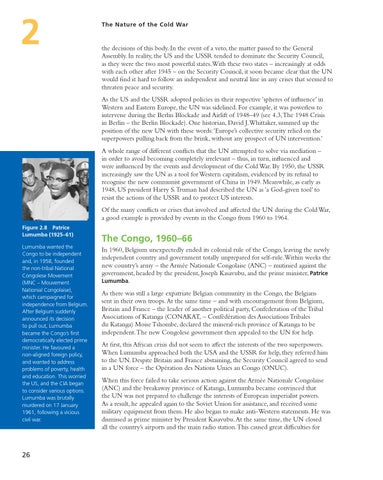
Figure 2.8 Patrice Lumumba (1925–61) Lumumba wanted the Congo to be independent and, in 1958, founded the non-tribal National Congolese Movement (MNC – Mouvement Nationial Congolaise), which campaigned for independence from Belgium. After Belgium suddenly announced its decision to pull out, Lumumba became the Congo’s first democratically elected prime minister. He favoured a non-aligned foreign policy, and wanted to address problems of poverty, health and education. This worried the US, and the CIA began to consider various options. Lumumba was brutally murdered on 17 January 1961, following a vicious civil war.
26
The Congo, 1960–66 In 1960, Belgium unexpectedly ended its colonial rule of the Congo, leaving the newly independent country and government totally unprepared for self-rule. Within weeks the new country’s army – the Armée Nationale Congolaise (ANC) – mutinied against the government, headed by the president, Joseph Kasavubu, and the prime minister, Patrice Lumumba. As there was still a large expatriate Belgian community in the Congo, the Belgians sent in their own troops. At the same time – and with encouragement from Belgium, Britain and France – the leader of another political party, Confederation of the Tribal Associations of Katanga (CONAKAT, – Confédération des Associations Tribales du Katanga) Moise Tshombe, declared the mineral-rich province of Katanga to be independent. The new Congolese government then appealed to the UN for help. At first, this African crisis did not seem to affect the interests of the two superpowers. When Lumumba approached both the USA and the USSR for help, they referred him to the UN. Despite Britain and France abstaining, the Security Council agreed to send in a UN force – the Opération des Nations Unies au Congo (ONUC). When this force failed to take serious action against the Armée Nationale Congolaise (ANC) and the breakaway province of Katanga, Lumumba became convinced that the UN was not prepared to challenge the interests of European imperialist powers. As a result, he appealed again to the Soviet Union for assistance, and received some military equipment from them. He also began to make anti-Western statements. He was dismissed as prime minister by President Kasavubu. At the same time, the UN closed all the country’s airports and the main radio station. This caused great difficulties for