Answers to Activity Book exercise
Ideas for the lesson
1
•
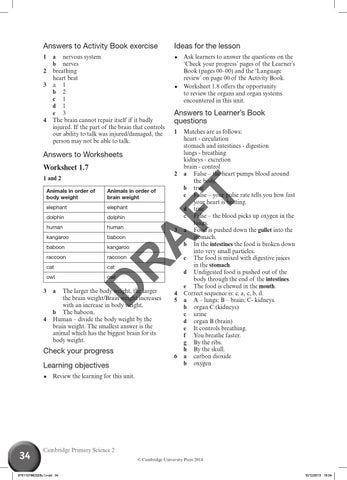
a nervous system b nerves breathing heart beat a 1 b 2 c 1 d 1 e 3 The brain cannot repair itself if it badly injured. If the part of the brain that controls our ability to talk was injured/damaged, the person may not be able to talk.
2 3
4
•
Answers to Learner’s Book questions 1
Answers to Worksheets Worksheet 1.7
2
1 and 2 Animals in order of brain weight
elephant
elephant
dolphin
dolphin
human
human
kangaroo
baboon
baboon
kangaroo
raccoon
raccoon
3
4
a
A
R
owl
3
cat
owl
D
cat
The larger the body weight, the larger the brain weight/Brain weight increases with an increase in body weight. b The baboon. Human – divide the body weight by the brain weight. The smallest answer is the animal which has the biggest brain for its body weight.
Check your progress Learning objectives
•
34
Matches are as follows: heart - circulation stomach and intestines - digestion lungs - breathing kidneys - excretion brain - control a False – the heart pumps blood around the body. b true c False – your pulse rate tells you how fast your heart is beating. d true e False – the blood picks up oxygen in the lungs. a Food is pushed down the gullet into the stomach. b In the intestines the food is broken down into very small particles. c The food is mixed with digestive juices in the stomach. d Undigested food is pushed out of the body through the end of the intestines. e The food is chewed in the mouth. Correct sequence is: e, a, c, b, d. a A – lungs; B – brain; C- kidneys. b organ C (kidneys) c urine d organ B (brain) e It controls breathing. f You breathe faster. g By the ribs. h By the skull. a carbon dioxide b oxygen
FT
Animals in order of body weight
Ask learners to answer the questions on the ‘Check your progress’ pages of the Learner’s Book (pages 00–00) and the ‘Language review’ on page 00 of the Activity Book. Worksheet 1.8 offers the opportunity to review the organs and organ systems encountered in this unit.
4 5
6
Review the learning for this unit.
Cambridge Primary Science 2
9781107662025u1.indd 34
© Cambridge University Press 2014
10/12/2013 16:04