CAMBRIDGE PRIMARY Activity Book
Heading to go here
Aenean leo ligula, porttitor eu, consequat vitae, eleifend ac, enim. Aliquam lorem ante, dapibus in, viverra quis, feugiat a, tellus. Phasellus viverra nulla ut metus varius laoreet. Quisque rutrum. Aenean
Nam eget dui. Etiam rhoncus. Maecenas tempus, tellus eget condim entum rhoncus, sem quam semper libero, sit amet adipiscing sem neque sed ipsum. Nam quam nunc, blandit vel, luctus pulvinar, hendrerit id, lorem. Maecenas nec odio et ante tincidunt tempus. Donec vitae sapien ut libero venenatis faucibus. Nullam quis ante. Etiam sit amet orci eget eros faucibus tincidunt. Duis leo. Sed fringilla mauris sit amet nibh. Donec sodales sagittis magna. Sed consequat, leo eget bibendum sodales, augue velit cursus nunc,
Science
4
ISBN 000 0000 00000 0
ISBN 000 0000 00000 0
ISBN 000 0000 00000 0
Activity Book
4
Baxter, Dilley and Cross
Donec pede justo, fringilla vel, aliquet nec, vulputate eget, arcu. In enim justo, rhoncus ut, imperdiet a, venenatis vitae, justo. Nullam dictum felis eu pede mollis pretium. Integer tincidunt. Cras dapibus. Vivamus elementum semper nisi. Aenean vulputate eleifend tellus.
imperdiet. Etiam ultricies nisi vel augue. Curabitur ullamcorper ultricies nisi.
CAMBRIDGE PRIMARY
Activity Book
Lorem ipsum dolor sit amet, consectetuer adipiscing elit. Aenean commodo ligula eget dolor. Aenean massa. Cum sociis natoque penatibus et magnis dis parturient montes, nascetur ridiculus mus. Donec quam felis, ultricies nec, pellentesque eu, pretium quis, sem. Nulla consequat massa quis enim.
4
Cambridge Primary Science
Science
Fiona Baxter, Liz Dilley and Alan Cross
Introduction The Cambridge Primary Science series has been developed to match the Cambridge International Examinations Primary Science curriculum framework. It is a fun, flexible and easy to use course that gives both learners and teachers the support they need. In keeping with the aims of the curriculum itself, it encourages learners to be actively engaged with the content, and develop enquiry skills as well as subject knowledge. This Activity Book for Stage 4 is designed to be used alongside the Learner’s Book for the same stage, ISBN 978-1-107-67450-9. In this book you will find a single-page exercise to accompany each topic presented in the Learner’s Book, as well as a language review exercise at the end of each unit to practise the key vocabulary. The exercises are designed to be completed as pen-and-paper exercises, and learners can work on them individually or in pairs or small groups. You can set the exercises as in-class work or homework. There are different styles of exercise throughout to maintain interest and to suit different purposes. The main aims of the exercises in this book are: consolidate the subject knowledge presented in the Learner’s Book • to o encourage learners to apply the knowledge in new situations, thus developing • tunderstanding practise scientific language • ttoo develop scientific enquiry skills such as presenting and interpreting results from • investigations. The answers to the exercises in this Activity Book are available in the Teacher’s Resource for Stage , ISBN 978-1-107-66151-6. This resource also contains extensive guidance on all the topics, ideas for classroom activities, and guidance notes on all the activities presented in the Learner’s Book. You will also find a large collection of worksheets. We hope you enjoy using this series. With best wishes, the Cambridge Primary Science team. Introduction
3
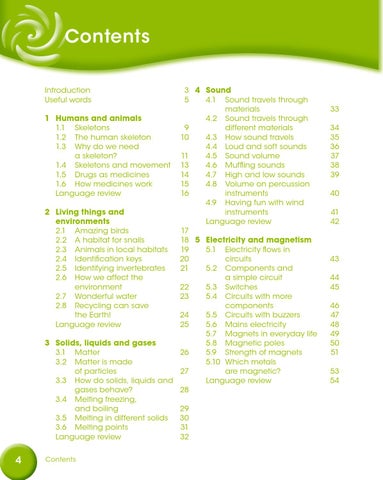
Contents 3 4 Sound 5 4.1 Sound travels through materials 33 1 Humans and animals 4.2 Sound travels through 1.1 Skeletons 9 different materials 34 1.2 The human skeleton 10 4.3 How sound travels 35 1.3 Why do we need 4.4 Loud and soft sounds 36 a skeleton? 11 4.5 Sound volume 37 1.4 Skeletons and movement 13 4.6 Muffling sounds 38 1.5 Drugs as medicines 14 4.7 High and low sounds 39 1.6 How medicines work 15 4.8 Volume on percussion Language review 16 instruments 40 4.9 Having fun with wind 2 Living things and instruments 41 environments Language review 42 2.1 Amazing birds 17 2.2 A habitat for snails 18 5 Electricity and magnetism 2.3 Animals in local habitats 19 5.1 Electricity flows in 2.4 Identification keys 20 circuits 43 2.5 Identifying invertebrates 21 5.2 Components and 2.6 How we affect the a simple circuit 44 environment 22 5.3 Switches 45 2.7 Wonderful water 23 5.4 Circuits with more 2.8 Recycling can save components 46 the Earth! 24 5.5 Circuits with buzzers 47 Language review 25 5.6 Mains electricity 48 5.7 Magnets in everyday life 49 3 Solids, liquids and gases 5.8 Magnetic poles 50 3.1 Matter 26 5.9 Strength of magnets 51 3.2 Matter is made 5.10 Which metals of particles 27 are magnetic? 53 3.3 How do solids, liquids and Language review 54 gases behave? 28 3.4 Melting freezing, and boiling 29 3.5 Melting in different solids 30 3.6 Melting points 31 Language review 32 Introduction Useful words
4
Contents
Useful words arrange
to put things in a certain order or pattern Lan will arrange the pasta shapes to make a skeleton.
apply to do something with the help of knowledge you already have Aruna will apply her knowledge of the particle theory to solve the problem. bar chart
a chart that shows results using bars; the lengths of the bars show the sizes of the results Yusef drew a bar chart to show the volume of water absorbed by different paper towels.
check
to make sure that you have done something correctly You should always check your answers before you give your teacher your work.
choose
to select things from a group Tabitha’s aunt said she could choose which sweets she would like from all the sweets in the shop.
compare
to look at the similarities and differences between things They will compare the weather in Mumbai and Qatar by looking at the monthly temperature and rainfall for each city.
Useful words
5
complete
to finish something Ahmed will complete his work by the end of the lesson.
compress
to squash or squeeze Joseph will compress the air into the cylinder to allow him to swim underwater.
conclusion
a statement of what has been found out Bimla’s conclusion was ‘From the objects I have tested, only the paper clip is magnetic. The others are non-magnetic.’
demonstrate to show somebody that you can do something Paula will demonstrate that she can sing in front of the class. design
to plan something by sketches and written ideas Paulo liked making drawings to help him to design a new car.
identify
to recognise something from a group of things Long was able to identify an example of a frog from a group of animals.
instructions
information that tells you how to do something The book gave instructions on how to draw a graph.
6
Useful words
investigate
to do a test or experiment to find something out Meng was told to investigate which objects were magnetic.
label
to name the parts of something on a diagram Juma will label six parts of a flower on the diagram in his science book.
list
to write or give examples of things, one after the other I will list the things I need you to get at the shop.
measure
to find the mass, length or volume of something Ranjit will measure how long his thigh bone is.
plan
to decide how to do an investigation Ali wrote a plan to test different objects with a magnet.
practise
to do something several times so that you get better at doing it Liam will practise the guitar every day until he can play the piece without a mistake.
predict
to think about what the result of an investigation might be Aba was asked to predict which objects would be magnetic.
Useful words
7
record
to write or draw to show what happened Janis wrote the results in a table to record what happened.
research
to look for information by investigation or using books or the internet Jamil used the internet to research magnetism.
results
the observations or measurements made in a test Gopal’s results showed that many objects were not magnetic.
suggest
to think of some examples to be considered I will suggest three dishes that we can make for the birthday lunch.
table
a way of writing numbers or words in rows and columns The table showed which objects were magnetic and which were non-magnetic.
8
Useful words
1
Humans and animals
Exercise 1.1 Skeletons In this exercise, you will match the skeletons with the animals they come from. You will identify their bones and fill in a table. A
1 Fill in the table.
Animal
Y
X
W
Skeleton Z
bird
B
rabbit frog crocodile
C 2 Write the names of the parts on skeleton A.
W is the
.
X is the
.
Y is the
.
Z is the
.
D
1 Humans and animals
9
Exercise 1.2 The human skeleton In this exercise, you will put bones in the right places to make a human skeleton. You will label the bones. 1 Trace, or copy, the bones. 2 Cut them out and arrange them to make a skeleton. 3 Stick your skeleton onto a piece of paper. 4 Label the different bones on your skeleton using these words. skull
ribs
thigh bone
finger bones
upper arm bone
toe bones
hip bone
upper arm
thigh bone
10
1 Humans and animals
Exercise 1.3
Why do we need a skeleton?
In this exercise, you will find information from a bar chart.
Length of upper arm bone in cm
Nasreen measured the length of the upper arm bone of some people in her family. She drew this bar chart to show her results. Use the bar chart to answer the questions. 36 34 32 30 28 26 24 22 20 18 16 14 12 10 8 6 4 2 0
Nasreen
Ahmed
Meshack
Fatima
Ali
1 Who had the longest upper arm bone?
2 How long is the shortest upper arm bone?
1 Humans and animals
11
3 Nasreen has two brothers. Their names are Ahmed and Ali. Which brother is the oldest? Explain your answer.
4 Put Nasreen and her brothers in age order. Explain your answer.
5 a Who are Nasreen’s parents?
b Explain how you know this.
6 Predict the length of Meschack’s father’s upper arm bone. Explain your answer.
12
1 Humans and animals
Exercise 1.4
Skeletons and movement
In this exercise, you will draw a diagram to explain how your muscles work.
A B
Amira and Jessie made a model to show how muscles work. This is what their model looked like.
D
C
1 Write down the body parts for each of the labels A–D.
A B C D 2 a What happens to part C when you pull up on part B?
b Make a drawing to show this.
3 Underline the correct words in the sentences to explain your drawing.
Part B relaxes/contracts and gets shorter/longer. Part B pulls/pushes on part C and makes it drop/lift. 1 Humans and animals
13
Exercise 1.5
Drugs as medicines
In this exercise, you will think about medicines. 1 Mark each of these statements as true [✔] or false [✘].
a Drugs are substances that make your body change in some way. b Medicines make us better when we are sick.
c Medicines are the same as drugs.
d Medicines cannot stop us from getting illnesses. 2 Find four ways we take medicines in the word square. Some words are written across the box and others are written
down the box.
i
n
j
e
c
t
i
o
n
t
n
w
e
r
t
y
n
i
o
a
h
a
s
d
f
g
h
n
l
b
a
c
b
i
u
n
l
t
h
l
l
e
d
b
n
t
m
m
d
e
e
v
f
p
o
w
d
e
r
t
r
u
r
k
l
g
o
n
i
u
m
i
x
t
u
r
e
t
p
m
3 Choose three different medicines. Complete the table to say what each medicine is used for.
Medicine
14
1 Humans and animals
What the medicine is used for