Cambridge Pre-U Mathematics Example 3.8.6. Solve the inequalities: (a) 2x2 − 8x + 11 ≤ 0,
(b) 2x2 − 10x + 7 ≤ 0.
(a) Completing the square tells us that 2x2 −8x+11 = 2(x−2)2 +3. Since it is a square, (x−2)2 ≥ 0 for all real x, and so 2x2 −8x+11 ≥ 3 for all real x, so there are no solutions to the inequality 2x2 − 8x + 11 ≤ 0. (b) Completing the square gives 2x2 − 10x + 7 ≤ 0 2 ≤ 0 2 x − 52 − 11 2 2 x − 52 ≤ 11 4 √ √ and hence − 12 11 ≤ x − 52 ≤ 12 11, and so the solution is the interval √ √ 1 1 2 (5 − 11) ≤ x ≤ 2 (5 + 11) The properties of the discriminant can lead to solving quadratic inequalities. Example 3.8.7. The quadratic 2x2 − kx + 50 has 2 real roots. What does this tell us about the constant k ? This quadratic must have positive discriminant, and so k 2 − 400 > 0, which tells us that either k > 20 or k < −20. Example 3.8.8. Solve the inequality
x+3 5x−1
≤ 13 .
When solving equations of this type, our first instinct is to clear the denominators. This creates a problem, because we do not know whether 5x − 1 is positive or not; multiplying this inequality by 5x − 1 will change the direction of the inequality when x < 15 . We avoid this problem by multiplying by (5x − 1)2 , which is always nonnegative. Note that the original inequality only makes sense if x 15 (otherwise we are being asked to divide by 0), and so we may assume that (5x − 1)2 > 0 for all relevant values of x. Thus the inequality becomes, after multiplying by 3(5x − 1)2 , 3(x + 3)(5x − 1)
≤
(5x − 1)2
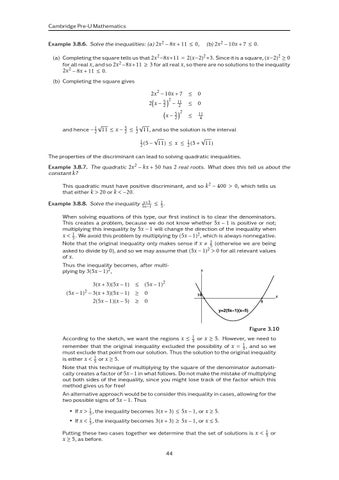
(5x − 1)2 − 3(x + 3)(5x − 1) ≥ 0 2(5x − 1)(x − 5) ≥ 0
Figure 3.10 According to the sketch, we want the regions x ≤ or x ≥ 5. However, we need to remember that the original inequality excluded the possibility of x = 15 , and so we must exclude that point from our solution. Thus the solution to the original inequality is either x < 15 or x ≥ 5. Note that this technique of multiplying by the square of the denominator automatically creates a factor of 5x −1 in what follows. Do not make the mistake of multiplying out both sides of the inequality, since you might lose track of the factor which this method gives us for free! An alternative approach would be to consider this inequality in cases, allowing for the two possible signs of 5x − 1. Thus 1 5
• If x > 15 , the inequality becomes 3(x + 3) ≤ 5x − 1, or x ≥ 5. • If x < 15 , the inequality becomes 3(x + 3) ≥ 5x − 1, or x ≤ 5. Putting these two cases together we determine that the set of solutions is x < x ≥ 5, as before. 44
1 5
or