2 Fractions, Decimals and Percentages
You have probably noticed that in Example 2a parts ii, iii and iv the working could have been shortened considerably by simplifying earlier. We will look at this now. In Example 2a ii: 5×2=5 6 3 6
2=5 3 6
2÷ 2 = 5 3÷ 2 9
So we could have simplified before doing the multiplication: 5 ×2 = 5 = 5 6 3 3 3 9
(dividing the top and bottom of the fraction by 2)
In Example 2a iii: 6 ×21 7 3
6 7
7 3
6 3
2 (divide top and bottom by 7 first, and then by 3)
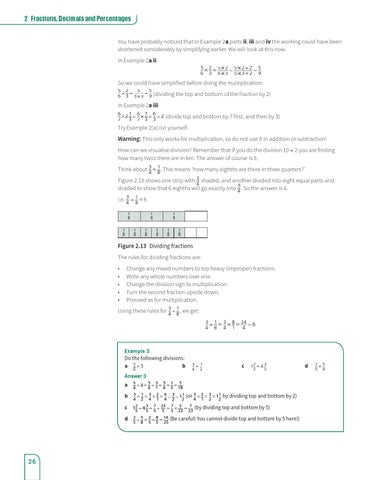
Try Example 2(a) (iv) yourself. Warning: This only works for multiplication, so do not use it in addition or subtraction! How can we visualise division? Remember that if you do the division 10 ÷ 2 you are finding how many twos there are in ten. The answer of course is 5. Think about 43 ÷ 81 . This means ‘how many eighths are there in three quarters?’ Figure 2.13 shows one strip with 43 shaded, and another divided into eight equal parts and shaded to show that 6 eighths will go exactly into 43 . So the answer is 6. i.e. 43 ÷ 81 = 6 1 4 1 8
1 4 1 8
1 8
1 4 1 8
1 8
1 8
Figure 2.13 Dividing fractions The rules for dividing fractions are: • • • • •
Change any mixed numbers to top heavy (improper) fractions. Write any whole numbers over one. Change the division sign to multiplication. Turn the second fraction upside down. Proceed as for multiplication.
Using these rules for 43 ÷ 81 , we get: 3 ÷ 1 = 3 × 8 = 24 4 8 4 1 4
Example 3 Do the following divisions: a 5÷3 b 6
3÷1 4 2
c
=6
12 ÷ 4 3 5
5
Answer 3
26
a
5 ÷3= 5 ÷ 3 = 5 × 1= 5 6 6 1 6 3 18
b
3 ÷ 1 = 3 × 2 = 6 = 3 = 11 4 2 4 1 4 2 2
c
12 ÷ 4 3 = 7 ÷ 23 = 7 × 5 = 7 5 5 5 5 5 23 23
d
2 ÷ 5 = 2 × 8 = 16 (Be careful! You cannot divide top and bottom by 5 here!) 5 8 5 5 25
(or 3 × 2 = 3 = 11 by dividing top and bottom by 2) 4
1
2
2
(by dividing top and bottom by 5)
d
2÷5 5 8