Cambridge International AS Level Physics
Sometimes, applying the principle of conservation of energy can seem like a scientific fiddle. When physicists were investigating radioactive decay involving beta particles, they found that the particles after the decay had less energy in total than the particles before. They guessed that there was another, invisible particle which was carrying away the missing energy. This particle, named the neutrino, was proposed by the theoretical physicist Wolfgang Pauli in 1931. The neutrino was not detected by experimenters until 25 years later. Although we cannot prove that energy is always conserved, this example shows that the principle of conservation of energy can be a powerful tool in helping us to understand what is going on in nature, and that it can help us to make fruitful predictions about future experiments. QUESTION 15 A stone falls from the top of a cliff, 80 m high. When
it reaches the foot of the cliff, its speed is 38 m s−1. a Calculate the proportion of the stone’s initial g.p.e. that is converted to k.e. b What happens to the rest of the stone’s initial energy?
80
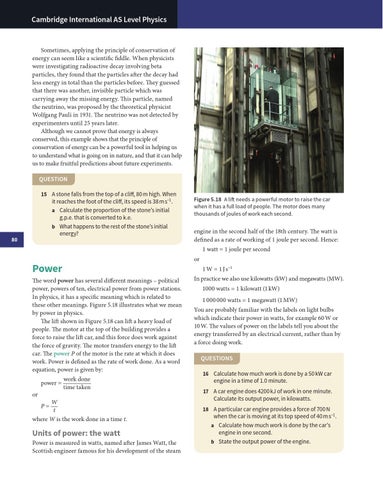
Figure 5.18 A lift needs a powerful motor to raise the car when it has a full load of people. The motor does many thousands of joules of work each second.
engine in the second half of the 18th century. The watt is defined as a rate of working of 1 joule per second. Hence: 1 watt = 1 joule per second
Power The word power has several different meanings – political power, powers of ten, electrical power from power stations. In physics, it has a specific meaning which is related to these other meanings. Figure 5.18 illustrates what we mean by power in physics. The lift shown in Figure 5.18 can lift a heavy load of people. The motor at the top of the building provides a force to raise the lift car, and this force does work against the force of gravity. The motor transfers energy to the lift car. The power P of the motor is the rate at which it does work. Power is defined as the rate of work done. As a word equation, power is given by:
or
work done power = time taken
W P= t where W is the work done in a time t.
Units of power: the watt
Power is measured in watts, named after James Watt, the Scottish engineer famous for his development of the steam
or 1 W = 1 J s−1 In practice we also use kilowatts (kW) and megawatts (MW). 1000 watts = 1 kilowatt (1 kW) 1 000 000 watts = 1 megawatt (1 MW) You are probably familiar with the labels on light bulbs which indicate their power in watts, for example 60 W or 10 W. The values of power on the labels tell you about the energy transferred by an electrical current, rather than by a force doing work. QUESTIONS 16 Calculate how much work is done by a 50 kW car
engine in a time of 1.0 minute.
17 A car engine does 4200 kJ of work in one minute.
Calculate its output power, in kilowatts.
18 A particular car engine provides a force of 700 N
when the car is moving at its top speed of 40 m s−1. a Calculate how much work is done by the car’s engine in one second. b State the output power of the engine.