Cambridge International AS Level Physics
BOX 2.1: Laboratory measurements of acceleration (continued)
Measurements using a motion sensor The computer software which handles the data provided by the motion sensor can calculate the acceleration of a trolley. However, because it deduces velocity from measurements of position, and then calculates acceleration from values of velocity, its precision is relatively poor.
QUESTIONS 6
7
Sketch a section of ticker-tape for a trolley which travels at a steady velocity and which then decelerates. Figure 2.11 shows the dimensions of an interrupt card, together with the times recorded as it passed through a light gate. Use these measurements to calculate the acceleration of the card. (Follow the steps outlined on page 19.) 0s
20
0.20 s
0.30 s
5.0 cm
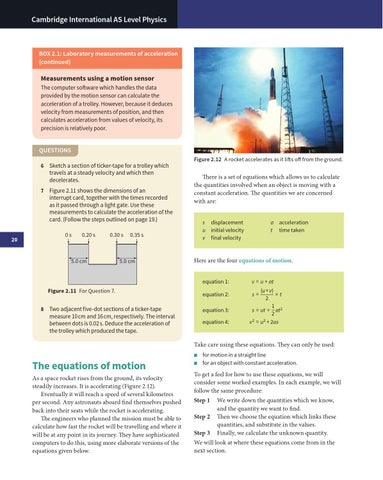
Figure 2.12 A rocket accelerates as it lifts off from the ground.
There is a set of equations which allows us to calculate the quantities involved when an object is moving with a constant acceleration. The quantities we are concerned with are: s displacement u initial velocity v final velocity
0.35 s
5.0 cm
Here are the four equations of motion. equation 1:
Figure 2.11 For Question 7. 8
a acceleration t time taken
equation 2:
Two adjacent five-dot sections of a ticker-tape measure 10 cm and 16 cm, respectively. The interval between dots is 0.02 s. Deduce the acceleration of the trolley which produced the tape.
equation 3: equation 4:
v = u + at (u + v) ×t 2 1 s = ut + at2 2 2 2 v = u + 2as s=
Take care using these equations. They can only be used: ■
The equations of motion As a space rocket rises from the ground, its velocity steadily increases. It is accelerating (Figure 2.12). Eventually it will reach a speed of several kilometres per second. Any astronauts aboard find themselves pushed back into their seats while the rocket is accelerating. The engineers who planned the mission must be able to calculate how fast the rocket will be travelling and where it will be at any point in its journey. They have sophisticated computers to do this, using more elaborate versions of the equations given below.
■
for motion in a straight line for an object with constant acceleration.
To get a feel for how to use these equations, we will consider some worked examples. In each example, we will follow the same procedure: Step 1 Step 2 Step 3
We write down the quantities which we know, and the quantity we want to find. Then we choose the equation which links these quantities, and substitute in the values. Finally, we calculate the unknown quantity.
We will look at where these equations come from in the next section.