Cambridge International AS and A level Computer Science
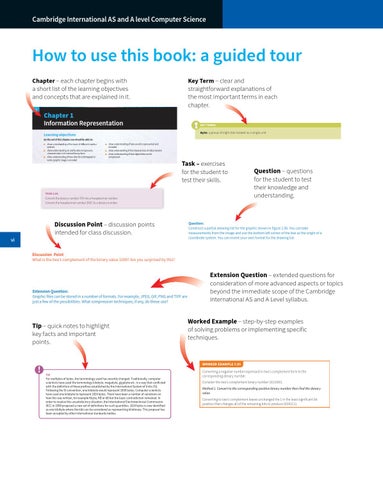
How to use this book: a guided tour Chapter – each chapter begins with a short list of the learning objectives and concepts that are explained in it.
Key Term – clear and straightforward explanations of the most important terms in each chapter.
2
Chapter 1 Information Representation
KEY TERMS
Byte: a group of eight bits treated as a single unit
Learning objectives By the end of this chapter you should be able to: ■
■
■
■
systems show understanding of, and be able to represent, character data in its internal binary form show understanding of how data for a bitmapped or vector graphic image is encoded
■ ■
show understanding of how sound is represented and encoded show understanding of the characteristics of video streams show understanding of how digital data can be compressed.
Task – exercises for the student to test their skills.
TASK 1.01 Convert the denary number 374 into a hexadecimal number.
Question – questions for the student to test their knowledge and understanding.
Convert the hexadecimal number 3A2C to a denary number.
Discussion Point – discussion points intended for class discussion. vi
Question: Construct a partial drawing list for the graphic shown in figure 1.06. You can take measurements from the image and use the bottom left corner of the box as the origin of a coordinate system. You can invent your own format for the drawing list.
Discussion Point What is the two’s complement of the binary value 1000? Are you surprised by this?
Extension Question: Graphic files can be stored in a number of formats. For example, JPEG, GIF, PNG and TIFF are just a few of the possibilities. What compression techniques, if any, do these use?
Tip – quick notes to highlight key facts and important points.
!
TIP For multiples of bytes, the terminology used has recently changed. Traditionally, computer scientists have used the terminology kilobyte, megabyte, gigabyte etc. in a way that conflicted with the definition of these prefixes established by the International System of Units (SI). Following the SI convention, one kilobyte would represent 1000 bytes. Computer scientists have used one kilobyte to represent 1024 bytes. There have been a number of variations on how this was written, for example Kbyte, KB or kB but the basic contradiction remained. In order to resolve this unsatisfactory situation, the International Electrotechnical Commission (IEC) in 1998 proposed a new set of definitions for such quantities. 1024 bytes is now identified as one kibibyte where the kibi can be considered as representing kilobinary. This proposal has been accepted by other international standards bodies.
Extension Question – extended questions for consideration of more advanced aspects or topics beyond the immediate scope of the Cambridge International AS and A Level syllabus. Worked Example – step-by-step examples of solving problems or implementing specific techniques.
Converting a negative number expressed in two’s complement form to the corresponding denary number. Consider the two’s complement binary number 10110001. Method 1. Convert to the corresponding positive binary number then find the denary value Converting to two’s complement leaves unchanged the 1 in the least significant bit position then changes all of the remaining bits to produce 01001111.