Cambridge International AS and A level Computer Science
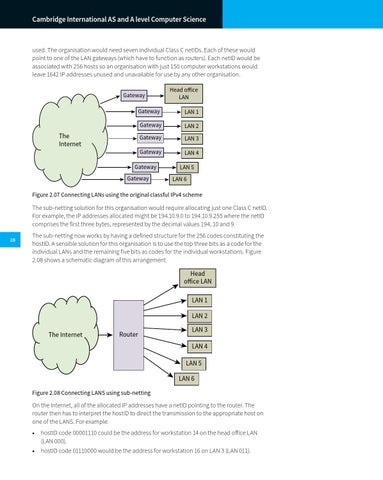
used. The organisation would need seven individual Class C netIDs. Each of these would point to one of the LAN gateways (which have to function as routers). Each netID would be associated with 256 hosts so an organisation with just 150 computer workstations would leave 1642 IP addresses unused and unavailable for use by any other organisation. Gateway
The Internet
Head office LAN
Gateway
LAN 1
Gateway
LAN 2
Gateway
LAN 3
Gateway
LAN 4
Gateway Gateway
LAN 5 LAN 6
Figure 2.07 Connecting LANs using the original classful IPv4 scheme
The sub-netting solution for this organisation would require allocating just one Class C netID. For example, the IP addresses allocated might be 194.10.9.0 to 194.10.9.255 where the netID comprises the first three bytes, represented by the decimal values 194, 10 and 9. 28
The sub-netting now works by having a defined structure for the 256 codes constituting the hostID. A sensible solution for this organisation is to use the top three bits as a code for the individual LANs and the remaining five bits as codes for the individual workstations. Figure 2.08 shows a schematic diagram of this arrangement.
Head office LAN LAN 1 LAN 2 The Internet
Router
LAN 3 LAN 4 LAN 5 LAN 6
Figure 2.08 Connecting LANS using sub-netting
On the Internet, all of the allocated IP addresses have a netID pointing to the router. The router then has to interpret the hostID to direct the transmission to the appropriate host on one of the LANS. For example: • hostID code 00001110 could be the address for workstation 14 on the head office LAN (LAN 000). • hostID code 01110000 would be the address for workstation 16 on LAN 3 (LAN 011).