Cambridge International AS Level Chemistry
WORKED EXAMPLE
WORKED EXAMPLE
1 How many moles of sodium chloride are present in 117.0 g of sodium chloride, NaCl?
2 What mass of sodium hydroxide, NaOH, is present in 0.25 mol of sodium hydroxide?
( Ar values: Na = 23.0, Cl = 35.5)
( Ar values: H = 1.0, Na = 23.0, O = 16.0)
molar mass of NaCl = 23.0 + 35.5
molar mass of NaOH = 23.0 + 16.0 + 1.0
= 58.5 g mol–1 number of moles
= 40.0 g mol–1
mass = ___________ molar mass
mass = number of moles × molar mass = 0.25 × 40.0 g
117.0 = _____
= 10.0 g NaOH
58.5
= 2.0 mol
QUESTION 4 Use these Ar values: C = 12.0, Fe = 55.8, H = 1.0, O = 16.0, Na = 23.0. Calculate the mass of the following: a 0.20 moles of carbon dioxide, CO2 b 0.050 moles of sodium carbonate, Na2CO3 c
5.00 moles of iron(II) hydroxide, Fe(OH)2
Mole calculations
6
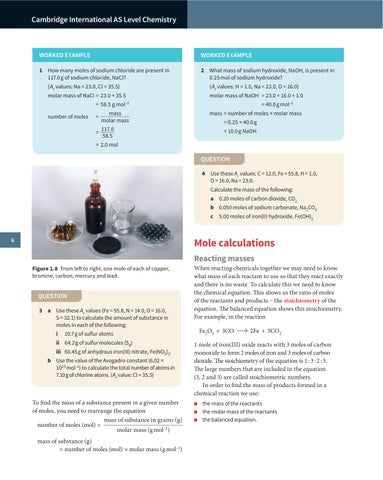
Reacting masses Figure 1.8 From left to right, one mole of each of copper, bromine, carbon, mercury and lead.
QUESTION 3 a Use these Ar values (Fe = 55.8, N = 14.0, O = 16.0, S = 32.1) to calculate the amount of substance in moles in each of the following: i
When reacting chemicals together we may need to know what mass of each reactant to use so that they react exactly and there is no waste. To calculate this we need to know the chemical equation. This shows us the ratio of moles of the reactants and products – the stoichiometry of the equation. The balanced equation shows this stoichiometry. For example, in the reaction Fe2O3 + 3CO
10.7 g of sulfur atoms
ii 64.2 g of sulfur molecules (S8) iii 60.45 g of anhydrous iron(III) nitrate, Fe(NO3)3. b Use the value of the Avogadro constant (6.02 × 10²³ mol–1) to calculate the total number of atoms in 7.10 g of chlorine atoms. (Ar value: Cl = 35.5)
To find the mass of a substance present in a given number of moles, you need to rearrange the equation mass of substance in grams (g) number of moles (mol) = __________________________ molar mass (g mol–1) mass of substance (g) = number of moles (mol) × molar mass (g mol–1)
2Fe + 3CO2
1 mole of iron(III) oxide reacts with 3 moles of carbon monoxide to form 2 moles of iron and 3 moles of carbon dioxide. The stoichiometry of the equation is 1 : 3 : 2 : 3. The large numbers that are included in the equation (3, 2 and 3) are called stoichiometric numbers. In order to find the mass of products formed in a chemical reaction we use: ■ ■ ■
the mass of the reactants the molar mass of the reactants the balanced equation.