Cambridge International AS and A level Physics
Chapter 22: Ideal gases Chapter outline ■ ■
■
■ ■
recall the equation of state for an ideal gas and use it to solve problems state the assumptions of the kinetic theory and use it to relate the macroscopic properties of a gas to the microscopic properties of its particles, including an explanation of Brownian motion deduce the relationship between the pressure and volume of a gas and the number and mean square speed of its particles recall the definition of the Boltzmann constant deduce that the average translational kinetic energy of a molecule is proportional to the absolute temperature
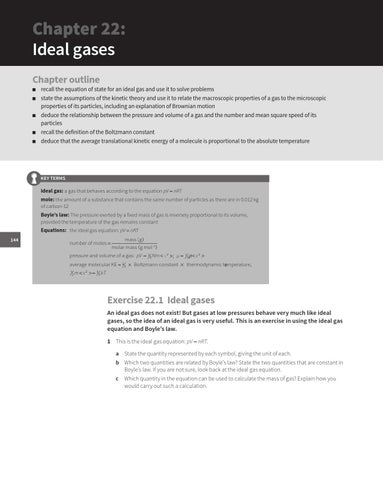
KEY TERMS
ideal gas: a gas that behaves according to the equation pV = nRT mole: the amount of a substance that contains the same number of particles as there are in 0.012 kg of carbon-12 Boyle’s law: The pressure exerted by a fixed mass of gas is inversely proportional to its volume, provided the temperature of the gas remains constant Equations: the ideal gas equation: pV = nRT 144
number of moles =
mass (g ) molar mass (g mol− )
pressure and volume of a gas: pV =
1 3
N < c2 > p = Nm
1 3
ρ< c 2 >
average molecular KE = 3 2 × Boltzmann constant × thermodynamic temperature e ; 1 m < c 2 > = 3 kT 2 2
Exercise 22.1 Ideal gases An ideal gas does not exist! But gases at low pressures behave very much like ideal gases, so the idea of an ideal gas is very useful. This is an exercise in using the ideal gas equation and Boyle’s law. 1 This is the ideal gas equation: pV = nRT. a State the quantity represented by each symbol, giving the unit of each. b Which two quantities are related by Boyle’s law? State the two quantities that are constant in Boyle’s law. If you are not sure, look back at the ideal gas equation. c Which quantity in the equation can be used to calculate the mass of gas? Explain how you would carry out such a calculation.