Questions
Activity 4.2 A question of balance
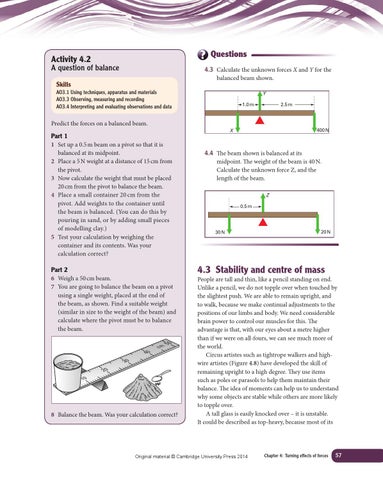
4.3 Calculate the unknown forces X and Y for the balanced beam shown.
Skills AO3.1 Using techniques, apparatus and materials AO3.3 Observing, measuring and recording AO3.4 Interpreting and evaluating observations and data
Y 1.0 m
2.5 m
Predict the forces on a balanced beam. 400 N
X
Part 1 1 Set up a 0.5 m beam on a pivot so that it is balanced at its midpoint. 2 Place a 5 N weight at a distance of 15 cm from the pivot. 3 Now calculate the weight that must be placed 20 cm from the pivot to balance the beam. 4 Place a small container 20 cm from the pivot. Add weights to the container until the beam is balanced. (You can do this by pouring in sand, or by adding small pieces of modelling clay.) 5 Test your calculation by weighing the container and its contents. Was your calculation correct? Part 2 6 Weigh a 50 cm beam. 7 You are going to balance the beam on a pivot using a single weight, placed at the end of the beam, as shown. Find a suitable weight (similar in size to the weight of the beam) and calculate where the pivot must be to balance the beam. 40
cm
50
30 20 10
8 Balance the beam. Was your calculation correct?
4.4 The beam shown is balanced at its midpoint. The weight of the beam is 40 N. Calculate the unknown force Z, and the length of the beam. Z 0.5 m
30 N
20 N
4.3 Stability and centre of mass People are tall and thin, like a pencil standing on end. Unlike a pencil, we do not topple over when touched by the slightest push. We are able to remain upright, and to walk, because we make continual adjustments to the positions of our limbs and body. We need considerable brain power to control our muscles for this. The advantage is that, with our eyes about a metre higher than if we were on all-fours, we can see much more of the world. Circus artistes such as tightrope walkers and highwire artistes (Figure 4.8) have developed the skill of remaining upright to a high degree. They use items such as poles or parasols to help them maintain their balance. The idea of moments can help us to understand why some objects are stable while others are more likely to topple over. A tall glass is easily knocked over – it is unstable. It could be described as top-heavy, because most of its
Original material Š Cambridge University Press 2014
Chapter 4: Turning effects of forces
57