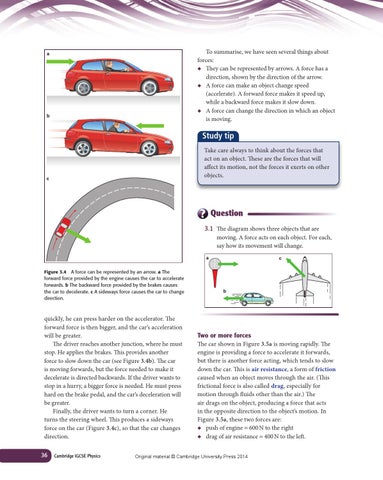
To summarise, we have seen several things about forces: ◆ They can be represented by arrows. A force has a direction, shown by the direction of the arrow. ◆ A force can make an object change speed (accelerate). A forward force makes it speed up, while a backward force makes it slow down. ◆ A force can change the direction in which an object is moving.
a
b
Studyy tip p Take care always to think about the forces that act on an object. These are the forces that will affect its motion, not the forces it exerts on other objects.
c
Question 3.1 The diagram shows three objects that are moving. A force acts on each object. For each, say how its movement will change. a Figure 3.4 A force can be represented by an arrow. a The forward force provided by the engine causes the car to accelerate forwards. b The backward force provided by the brakes causes the car to decelerate. c A sideways force causes the car to change direction.
quickly, he can press harder on the accelerator. The forward force is then bigger, and the car’s acceleration will be greater. The driver reaches another junction, where he must stop. He applies the brakes. This provides another force to slow down the car (see Figure 3.4b). The car is moving forwards, but the force needed to make it decelerate is directed backwards. If the driver wants to stop in a hurry, a bigger force is needed. He must press hard on the brake pedal, and the car’s deceleration will be greater. Finally, the driver wants to turn a corner. He turns the steering wheel. This produces a sideways force on the car (Figure 3.4c), so that the car changes direction. 36
Cambridge IGCSE Physics
c
b
Two or more forces The car shown in Figure 3.5a is moving rapidly. The engine is providing a force to accelerate it forwards, but there is another force acting, which tends to slow down the car. This is air resistance, a form of friction caused when an object moves through the air. (This frictional force is also called drag, especially for motion through fluids other than the air.) The air drags on the object, producing a force that acts in the opposite direction to the object’s motion. In Figure 3.5a, these two forces are: ◆ push of engine = 600 N to the right ◆ drag of air resistance = 400 N to the left.
Original material © Cambridge University Press 2014