Cambridge IGCSE Physics, Second edition matches the requirements of the 2016 Cambridge IGCSE Physics syllabus (0625). It is endorsed by Cambridge International Examinations for use with their examination.
The Coursebook contains: • total coverage of the syllabus • language accessible to students of a wide range of abilities • a clear indication of the chapter content at the beginning of each chapter • activities to help students develop practical and investigative skills • study tips throughout to aid with understanding • highlighted definition boxes • in-chapter questions and end-of-chapter questions, including exam-style questions to test students’ knowledge • a glossary of key physical terms. The accompanying CD-ROM contains: • advice on how to revise for and approach examinations • self-assessment check lists for making drawings, constructing and completing results tables, drawing graphs, and designing experiments • revision check lists for each chapter • answers to the end-of-chapter questions, including the exam-style questions • model exam papers and mark schemes • multiple-choice self tests and answers • expanded notes on the activities from the Coursebook with full teacher/technician notes for the activities • a series of animations to aid understanding.
David Sang
Cambridge IGCSE®
Physics
Coursebook Second edition
Other components of IGCSE Physics, Second edition: Workbook Teacher’s resource
ISBN 978-1-107-61488-8 ISBN 978-1-107-61490-1
Completely Cambridge – Cambridge resources for Cambridge qualifications Cambridge University Press works closely with Cambridge International Examinations as parts of the University of Cambridge. We enable thousands of students to pass their Cambridge exams by providing comprehensive, high-quality, endorsed resources. To find out more about Cambridge International Examinations visit www.cie.org.uk
Sang
9780521757843 Cambers & Sibley: IGCSE Physics Cover. C M Y K
The Coursebook content has been revised ensuring that it is up to date and comprehensive in its coverage with supplementary material clearly marked. A Workbook and Teacher’s Resource are also available.
Cambridge IGCSE Physics Second edition Coursebook
Cambridge IGCSE Physics , Second edition Coursebook with CD-ROM David Sang
Visit education.cambridge.org/cie for information on our full range of Cambridge IGCSE titles including e-book versions and mobile apps.
Original material © Cambridge University Press 2014
David Sang
Cambridge IGCSEÂŽ
Physics Coursebook Second edition
Original material Š Cambridge University Press 2014
University Printing House, Cambridge cb bs, United Kingdom Cambridge University Press is part of the University of Cambridge. It furthers the University’s mission by disseminating knowledge in the pursuit of education, learning and research at the highest international levels of excellence. www.cambridge.org Information on this title: www.cambridge.org/ © Cambridge University Press This publication is in copyright. Subject to statutory exception and to the provisions of relevant collective licensing agreements, no reproduction of any part may take place without the written permission of Cambridge University Press. First published xxxx Second edition Printed in the United Kingdom by xxxxxxx xxxxxxxxxx xxxxxxxxxx A catalogue record for this publication is available from the British Library Library of Congress Cataloguing in Publication data
isbn ---- Paperback with CD-ROM for Windows® and Mac® Cambridge University Press has no responsibility for the persistence or accuracy of URLs for external or third-party internet websites referred to in this publication, and does not guarantee that any content on such websites is, or will remain, accurate or appropriate. Information regarding prices, travel timetables, and other factual information given in this work is correct at the time of first printing but Cambridge University Press does not guarantee the accuracy of such information thereafter.
Original material © Cambridge University Press 2014
Contents Introduction
vi
Block 1: General physics
1
1 Making measurements
2
1.1 1.2 1.3 1.4
3 5 6 9
Measuring length and volume Improving precision in measurements Density Measuring time
2 Describing motion 2.1 2.2 2.3 2.4
Understanding speed Distance–time graphs Understanding acceleration Calculating speed and acceleration
3 Forces and motion 3.1 3.2 3.3 3.4 3.5 3.6
15 16 20 21 24
34
We have lift-off Mass, weight and gravity Falling and turning Force, mass and acceleration The idea of momentum More about scalars and vectors
35 37 40 41 44 46
4 Turning effects of forces
52
4.1 The moment of a force 4.2 Calculating moments 4.3 Stability and centre of mass
5 Forces and matter 5.1 5.2 5.3 5.4 5.5
Forces acting on solids Stretching springs Hooke’s law Pressure Calculating pressure
53 55 57
64 64 65 67 69 73
6 Energy transformations and energy transfers 6.1 6.2 6.3 6.4
Forms of energy Energy conversions Conservation of energy Energy calculations
80 81 84 85 88
7 Energy resources
97
7.1 The energy we use 7.2 Energy from the Sun
97 102
8 Work and power
105
8.1 8.2 8.3 8.4
Doing work Calculating work done Power Calculating power
105 106 110 110
Block 2: Thermal physics
117
9 The kinetic model of matter
118
9.1 9.2 9.3 9.4
States of matter The kinetic model of matter Forces and the kinetic theory Gases and the kinetic theory
10 Thermal properties of matter 10.1 10.2 10.3 10.4 10.5 10.6
Temperature and temperature scales Designing a thermometer Thermal expansion Thermal capacity Specific heat capacity Latent heat
119 121 125 127
134 135 137 139 142 142 146
11 Thermal (heat) energy transfers 151 11.1 11.2 11.3 11.4
Conduction Convection Radiation Some consequences of thermal (heat) energy transfer
Original material © Cambridge University Press 2014
152 154 157 159 Contents
iii
Block 3: Physics of waves 12 Sound 12.1 12.2 12.3 12.4
168
Making sounds At the speed of sound Seeing sounds How sounds travel
169 170 172 175
13 Light 13.1 13.2 13.3 13.4
167
180
Reflecting light Refraction of light Total internal reflection Lenses
181 184 189 193
14 Properties of waves
202
14.1 Describing waves 14.2 Speed, frequency and wavelength 14.3 Explaining wave phenomena
15 Spectra
203 207 208
216
15.1 Dispersion of light 15.2 The electromagnetic spectrum
217 218
19 Electric circuits 19.1 19.2 19.3 19.4
Circuit components Combinations of resistors Electronic circuits Electrical safety
20 Electromagnetic forces 20.1 The magnetic effect of a current 20.2 How electric motors are constructed 20.3 Force on a current-carrying conductor
21 Electromagnetic induction 21.1 Generating electricity 21.2 Power lines and transformers 21.3 How transformers work
225
16 Magnetism
226
16.1 Permanent magnets 16.2 Magnetic fields
17.1 Charging and discharging 17.2 Explaining static electricity 17.3 Electric fields and electric charge
18 Electrical quantities 18.1 18.2 18.3 18.4
iv
Cambridge IGCSE Physics
284 285 287
294 295 299 302
309
22 The nuclear atom
310
22.1 Atomic structure 22.2 Protons, neutrons and electrons
320
Answers to questions
338
236
Appendix 1
350
237 238 241
Appendix 2
352
Glossary
353
Index
359
Acknowledgements
370
247 251 254 256
23.1 23.2 23.3 23.4
311 313
321 323 327 329
246
Current in electric circuits Electrical resistance More about electrical resistance Electricity and energy
283
Radioactivity all around The microscopic picture Radioactive decay Using radioisotopes
227 230
17 Static electricity
263 268 272 275
Block 5: Atomic physics
23 Radioactivity
Block 4: Electricity and magnetism
262
Original material Š Cambridge University Press 2014
Terms and Conditions of use for the CD-ROM CD-ROM Activities Notes on activities for teachers/technicians Self-assessment checklists
000
Answers to end-of-chapter questions Study and revision skills Revision checklists Self-assessment tests Model papers and mark schemes Animations
Original material Š Cambridge University Press 2014
Contents
v
Introduction Studying physics Why study physics? Some people study physics for the simple reason that they find it interesting. Physicists study matter, energy and their interactions. They might be interested in the tiniest sub-atomic particles, or the nature of the Universe itself. (Some even hope to discover whether there are more universes than just the one we live in!) On a more human scale, physicists study materials to try to predict and control their properties. They study
the interactions of radiation with matter, including the biological materials we are made of. Some people do not want to study physics simply for its own sake. They want to know how it can be used, perhaps in an engineering project, or for medical purposes. Depending on how our knowledge is applied, it can make the world a better place. Some people study physics as part of their course because they want to become some other type of scientist – perhaps a chemist, biologist or geologist. These branches of science draw a great deal on ideas from physics, and physics may draw on them.
Thinking physics How do physicists think? One of the characteristics of physicists is that they try to simplify problems – reduce them to their basics – and then solve them by applying some very fundamental ideas. For example, you will be familiar with the idea that matter is made of tiny particles that attract and repel each other and move about. This is a very powerful idea, which has helped us to understand the behaviour of matter, how sound travels, how electricity flows, and so on.
When they were first discovered, X-rays were sometimes treated as an entertaining novelty. Today, they can give detailed views of a patient’s bones and organs.
vi
Cambridge IGCSE Physics
Physicists often work in extreme conditions. Here, physicists at the UK’s National Physical Laboratory prepare a dilution refrigerator, capable of cooling materials down almost to absolute zero, the lowest possible temperature.
Original material © Cambridge University Press 2014
The internet, used by millions around the world. Originally invented by a physicist, Tim Berners-Lee, the internet is used by physicists to link thousands of computers in different countries to form supercomputers capable of handling vast amounts of data.
A computer-generated view of the Milky Way, our Galaxy. Although we can never hope to see it from this angle, careful measurements of the positions of millions of stars has allowed astronomers to produce this picture.
Once a fundamental idea is established, physicists look around for other areas where it might help to solve problems. One of the surprises of 20th-century physics was that, once physicists had begun to understand the fundamental particles of which atoms are made, they realised that this helped to explain the earliest moments in the history of the Universe, at the time of the Big Bang. The more you study physics, the more you will come to realise how the ideas join up. Also, physics is still expanding. Many physicists work in economics and finance, using ideas from physics to predict how markets will change. Others use their understanding of
particles in motion to predict how traffic will flow, or how people will move in crowded spaces. Physics relies on mathematics. Physicists measure quantities and process their data. They invent mathematical models – equations and so on – to explain their findings. (In fact, a great deal of mathematics was invented by physicists, to help them to understand their experimental results.) Computers have made a big difference in physics. Because a computer can ‘crunch’ vast quantities of data, whole new fields of physics have opened up. Computers can analyse data from telescopes, control distant spacecraft and predict the behaviour of billions of atoms in a solid material.
Joining in So, when you study physics, you are doing two things. (i) You are joining in with a big human project – learning more about the world around us, and applying that knowledge. (ii) At the same time, you will be learning to think like a physicist – how to apply some basic ideas, how to look critically at data, and how to recognise underlying patterns. Whatever your aim, these ideas can stay with you throughout your life.
Original material © Cambridge University Press 2014
Introduction
vii
Original material Š Cambridge University Press 2014
Block 1 General physics In your studies of science, you will already have come across many of the fundamental ideas of physics. In this block, you will develop a better understanding of two powerful ideas: (i) the idea of force and (ii) the idea of energy. Where do ideas in physics come from? Partly, they come from observation. When Galileo looked at the planets through his telescope, he observed the changing face of Venus. He also saw that Jupiter had moons. Galileo’s observations formed the basis of a new, more scientific, astronomy. Ideas also come from thought. Newton (who was born in the year that Galileo died) is famous for his ideas about gravity. He realised that the force that pulls an apple to the ground is the same force that keeps the Moon in its orbit around the Earth. His ideas about forces are explored in this block. You have probably studied some basic ideas about energy. However, Newton never knew about energy. This was an idea that was not developed until more than a century after his death, so you are already one step ahead of him!
In 1992, a spacecraft named Galileo was sent to photograph Jupiter and its moons. On its way, it looked back to take this photograph of the Earth and the Moon.
Original material Š Cambridge University Press 2014
Block 1: General physics
1
1
Making measurements
In this chapter, you will find out: ◆
S ◆ ◆
how to make measurements of length, volume and time how to increase the precision of measurements of length and time how to determine the densities of solids and liquids.
How measurement improves Galileo Galilei did a lot to revolutionise how we think of the world around us, and in particular how we make measurements. For example, he observed a lamp swinging. Galileo noticed that the time it took for each swing was the same, whether the lamp was swinging through a large or a small angle. He realised that a swinging weight – a pendulum – could be used as a timing device. He designed a clock regulated by a swinging pendulum. In Galileo’s day, many measurements were based on the human body – for example, the foot and the yard (a pace). Units of weight were based on familiar objects such as cereal grains. These ‘natural’ units are inevitably variable – one person’s foot is longer than another’s – so efforts were made to standardise them. Today, there are international agreements on the basic units of measurement. For example, the metre is defined as the distance travelled by light in 1 second in a vacuum. Laboratories around 299792 458 the world are set up to check that measuring devices match this standard. Figure 1.1 shows a new atomic clock, undergoing development at the UK’s National Physical Laboratory. Clocks like this are accurate to 1 part in 1014, or one-billionth of a second in a day. You might think that this is far more precise than we could ever need. In fact, if you use a ‘satnav’ device
2
Cambridge IGCSE Physics
Figure 1.1 Professor Patrick Gill of the National Physical Laboratory is devising an atomic clock that will be 1000 times more accurate than previous types.
to find your way around, you rely on ultra-precise time measurements. A ‘satnav’ detects radio signals from satellites orbiting the Earth, and works out your position to within a fraction of a metre. Light 1 travels one metre in about second, or 300000000 0.000 000 003 second. So, if you are one metre further away from the satellite, the signal will arrive this tiny fraction of a second later. Hence the electronic circuits of the ‘satnav’ device must measure the time at which the signal arrives to this degree of accuracy.
Original material © Cambridge University Press 2014
Measuring volumes There are two approaches to measuring volumes, depending on whether or not the shape is regular. For a regularly shaped object, such as a rectangular block, measure the lengths of the three different sides and multiply them together. For objects of other regular shapes, such as spheres or cylinders, you may have to make one or two measurements and then look up the formula for the volume. For liquids, measuring cylinders can be used. (Recall that these are designed so that you look at the scale horizontally, not at an oblique angle, and read the level of the bottom of the meniscus.) Think carefully about the choice of cylinder. A 1 dm3 cylinder is unlikely to be suitable for measuring a small volume such as 5 cm3. You will get a more accurate answer using a 10 cm3 cylinder. 500 sheets 13
In physics, we make measurements of many different lengths – for example, the length of a piece of wire, the height of liquid in a tube, the distance moved by an object, the diameter of a planet or the radius of its orbit. In the laboratory, lengths are often measured using a rule (such as a metre rule). Measuring lengths with a rule is a familiar task. But when you use a rule, it is worth thinking about the task and just how reliable your measurements may be. Consider measuring the length of a piece of wire (Figure 1.2). ◆ The wire must be straight, and laid closely alongside the rule. (This may be tricky with a bent piece of wire.) ◆ Look at the ends of the wire. Are they cut neatly, or are they ragged? Is it difficult to judge where the wire begins and ends? ◆ Look at the markings on the rule. They are probably 1 mm apart, but they may be quite wide. Line one end of the wire up against the zero of the scale. Because of the width of the mark, this may be awkward to judge. ◆ Look at the other end of the wire and read the scale. Again, this may be tricky to judge. Now you have a measurement, with an idea of how precise it is. You can probably determine the length of the wire to within a millimetre. But there is something else to think about – the rule itself. How sure can you be that it is correctly calibrated? Are the marks at the ends of a metre rule separated by exactly one metre? Any error in this will lead to an inaccuracy (probably small) in your result. The point here is to recognise that it is always important to think critically about the measurements you make, however straightforward they may seem. You have to consider the method you use, as well as the instrument (in this case, the rule).
several thicknesses and then calculate the average. You can use the same approach when measuring something very thin, such as a sheet of paper. Take a stack of 500 sheets and measure its thickness with a rule (Figure 1.3). Then divide by 500 to find the thickness of one sheet. For some measurements of length, such as curved lines, it can help to lay a thread along the line. Mark the thread at either end of the line and then lay it along a rule to find the length. This technique can also be used for measuring the circumference of a cylindrical object such as a wooden rod or a measuring cylinder.
12
1.1 Measuring length and volume
11
More measurement techniques
9
10
If you have to measure a small length, such as the thickness of a wire, it may be better to measure
1
2
3
4
5
6
Figure 1.2 Simple measurements – for example, finding the length of a wire – still require careful technique.
7
8
0
Figure 1.3
Making multiple measurements.
Original material © Cambridge University Press 2014
Chapter 1: Making measurements
3
Measuring volume by displacement Most objects do not have a regular shape, so we cannot find their volumes simply by measuring the lengths of their sides. Here is how to find the volume of an irregularly shaped object. This technique is known as measuring volume by displacement. ◆ Select a measuring cylinder that is about three or four times larger than the object. Partially fill it with water (Figure 1.4), enough to cover the object. Note the volume of the water. ◆ Immerse the object in the water. The level of water in the cylinder will increase. The increase in its volume is equal to the volume of the object.
Units of length and volume In physics, we generally use SI units (this is short for Le Système International d’Unités or The International System of Units). The SI unit of length is the metre (m). Table 1.1 shows some alternative units of length, together with some units of volume. Note that the litre cm3 100
Figure 1.4
volume of water
Measuring volume by displacement.
Quantity
Units
Length
metre (m) 1 decimetre (dm) = 0.1 m 1 centimetre (cm) = 0.01 m 1 millimetre (mm) = 0.001 m 1 micrometre (μm) = 0.000 001 m 1 kilometre (km) = 1000 m
Volume
Studyy tip p Remember that the unit is as important as the numerical value of a quantity. Take care when reading and writing units. For example, if you write mm instead of cm, your answer will be wrong by a factor of ten.
Activity 1.1 Measuring lengths and volumes Skills AO3.1 Using techniques, apparatus and materials AO3.3 Observing, measuring and recording AO3.4 Interpreting and evaluating observations and data A03.5 Evaluating methods
cm3 100 volume of object
object to be measured
and millilitre are not official SI units of volume, and so are not used in this book. One litre (1 l) is the same as 1 dm3, and one millilitre (1 ml) is the same as 1 cm3.
cubic metre (m3) 1 cubic centimetre (cm3) = 0.000 001 m3 1 cubic decimetre (dm3) = 0.001 m3
Practise measuring lengths and volumes. As you do so, evaluate the method you are using. 1 Measure the length of a toy block. 2 Place ten blocks side-by-side in a row. Measure the length of the row and calculate the average length of one block. 3 Write a comment about these two methods for finding the length of a block. Which is better, and why? 4 Repeat steps 1 and 2 to find the average diameter of a ball-bearing and the average thickness of the wire. 5 Evaluate the methods you have used. 6 Measure the three sides of a rectangular block and calculate its volume. 7 Measure the volume of the same block by displacement. Is one method better than the other? Give a reason for your answer. 8 Look at the pebble and compare it with the block. Is it bigger or smaller? Estimate its volume. 9 Measure the volume of the pebble by displacement. How good was your estimate?
Table T bl 1 1.1 1 S Some units it off llength th and d volume l iin th the SI system. t
4
Cambridge IGCSE Physics
Original material © Cambridge University Press 2014
Questions
beam
1.1 A rectangular block of wood has dimensions 240 mm × 20.5 cm × 0.040 m. Calculate its volume in cm3. 1.2 Ten identical lengths of wire are laid closely side-by-side. Their combined width is measured and found to be 14.2 mm. Calculate: a the radius of a single wire b the volume in mm3 of a single wire if its length is 10.0 cm (volume of a cylinder = πr2h, where r = radius and h = height). 1.3 The volume of a piece of wood (which floats in water) can be measured as shown. Write a brief paragraph to describe the procedure. State the volume of the wood.
water
cm3 80 70 60
cm3 80 70 60
50
50
40 30
40 30
20
20
10
10
0
steel block
S
0
wood
1.2 Improving precision in measurements A rule is a simple measuring instrument, with many uses. However, there are instruments designed to give greater precision in measurements. Here we will look at how to use two of these.
Vernier calipers The calipers have two scales, the main scale and the vernier scale. Together, these scales give a measurement of the distance between the two inner faces of the jaws (Figure 1.5). The method is as follows: ◆ Close the calipers so that the jaws touch lightly but firmly on the sides of the object being measured.
S
main scale 0
1
2
4
3
6
0
7
8
9
10
vernier scale
10
sliding jaw
fixed jaw main scale
3
0
Figure 1.5
vernier scale
4
10
Using vernier calipers.
◆
Look at the zero on the vernier scale. Read the main scale, just to the left of the zero. This tells you the length in millimetres. ◆ Now look at the vernier scale. Find the point where one of its markings is exactly aligned with one of the markings on the main scale. Read the value on the vernier scale. This tells you the fraction of a millimetre that you must add to the main scale reading. For the example in Figure 1.5: thickness of rod = main scale reading + vernier reading = 35 mm + 0.7 mm = 35.7 mm
Micrometer screw gauge Again, this has two scales. The main scale is on the shaft, and the fractional scale is on the rotating barrel. The fractional scale has 50 divisions, so that one complete turn represents 0.50 mm (Figure 1.6). The method is as follows: ◆ Turn the barrel until the jaws just tighten on the object. Using the friction clutch ensures just the right pressure. ◆ Read the main scale to the nearest 0.5 mm. ◆ Read the additional fraction of a millimetre from the fractional scale.
Original material © Cambridge University Press 2014
Chapter 1: Making measurements
5
S
0
to discover that it contains heavy books. A large box of chocolates may have a mass of only 200 g – a great disappointment! The mass of an object is the amount of matter it is made of. Mass is measured in kilograms. But density is a property of a material. It tells us how concentrated its mass is. (There is more about the meaning of mass and how it differs from weight in Chapter 3.) In everyday speech, we might say that lead is heavier than wood. We mean that, given equal volumes of lead and wood, the lead is heavier. In scientific terms, the density of lead is greater than the density of wood. So we define density as shown, in words and as an equation.
20 15
20
0
15
Figure 1.6
Using a micrometer screw gauge.
For the example in Figure 1.6: thickness of rod = main scale reading + fractional scale reading = 2.5 mm + 0.17 mm = 2.67 mm
Key definition density – the ratio of mass to volume for a substance. mass volume M ρ= V
density =
Question 1.4 State the measurements shown in the diagrams on the scale of: a the vernier calipers 0 cm
1
2
0
3
10
The symbol for density is ρ, the Greek letter rho. The SI unit of density is kg/m3 (kilograms per cubic metre). You may come across other units, as shown in Table 1.2. A useful value to remember is the density of water (Table 1.3): density of water = 1000 kg/m3
Studyy tip p b the micrometer screw gauge. 0
It is important to be able to recall equations such as density = mass/volume. You may recall this in words, or in symbols (ρ = M/V). An alternative is to recall the units of density, such as kg/m3. This should remind you that density is a mass divided by a volume.
25 20
1.3 Density
Values of density
Our eyes can deceive us. When we look at an object, we can judge its volume. However, we can only guess its mass. We may guess incorrectly, because we misjudge the density. You may offer to carry someone’s bag, only
Some values of density are shown in Table 1.3. Here are some points to note: ◆ Gases have much lower densities than solids or liquids.
6
Cambridge IGCSE Physics
Original material © Cambridge University Press 2014
Unit of mass
Unit of volume
Unit of density
Density of water
kilogram, kg
cubic metre, m3
kilograms per cubic metre
1000 kg/m3
kilogram, kg
cubic decimetre, dm3
kilograms per cubic decimetre
1.0 kg/dm3
gram, g
cubic centimetre, cm3
grams per cubic centimetre
1.0 g/cm3
Table T bl 1.2 12 U Units it off d density. it
Material Gases
Liquids
◆
Gold is denser than silver. Pure gold is a soft metal, so jewellers add silver to make it harder. The amount of silver added can be judged by measuring the density. It is useful to remember that the density of water is 1000 kg/m3, 1 kg/dm3 or 1.0 g/cm3.
1.29
hydrogen
0.09
helium
0.18
carbon dioxide
1.98
water
1000
Calculating density
alcohol (ethanol)
790
To calculate the density of a material, we need to know the mass and volume of a sample of the material.
ice
13 600
◆
920
wood
400–1200
polythene
910–970
glass
2500–4200
steel
7500–8100
lead
11 340
silver
10 500
gold
19 300
Table 1.3 Densities of some substances. For gases, these are given at a temperature of 0 °C and a pressure of 1.0 × 10⁵ Pa.
◆
◆
air
mercury Solids
Density / kg / m3
Density is the key to floating. Ice is less dense than water. This explains why icebergs float in the sea, rather than sinking to the bottom. Many materials have a range of densities. Some types of wood, for example, are less dense than water and will float. Others (such as mahogany) are more dense and sink. The density depends on the composition.
Worked example 1.1 A sample of ethanol has a volume of 240 cm3. Its mass is found to be 190.0 g. What is the density of ethanol? Step 1: Write down what you know and what you want to know. mass M = 190.0 g volume V = 240 cm3 density D = ? Step 2: Write down the equation for density, substitute values and calculate D. M V 190 = 240 = 0.79 g/cm3
D=
Original material © Cambridge University Press 2014
Chapter 1: Making measurements
7
Measuring density The easiest way to determine the density of a substance is to find the mass and volume of a sample of the substance. For a solid with a regular shape, find its volume by measurement (see section 1.1). Find its mass using a balance. Then calculate the density. Figure 1.7 shows one way to find the density of a liquid. Place a measuring cylinder on a balance. Set the balance to zero. Now pour liquid into the cylinder. Read the volume from the scale on the cylinder. The balance shows the mass.
Activity 1.2 Measuring density AO3.1 Using techniques, apparatus and materials AO3.3 Observing, measuring and recording AO3.4 Interpreting and evaluating observations and data
In this experiment, you are going to make measurements to determine the densities of some different materials. Use blocks that have a regular shape.
Measuring the density of a liquid.
Mass / g
Length / cm
Width / cm
Height / cm
Volume / cm3
Density / g / cm3
20.7
2.4
2.5
3.0
18.0
1.15
cheddar cheese
8
Figure 1.7
100
1 Start by comparing two blocks of different materials by hand, as shown. Can you tell which is the more dense? Can you put them all in order, from least dense to most dense? (This will be relatively easy if the blocks are all the same size, but you will still be able to make a judgement for blocks of different sizes.) 2 Use a balance to find the mass of each block. 3 Use a rule to measure the dimensions of the block. (If they are cubes, you should check that the sides are truly equal.) 4 Calculate the volume and density for each block. For repeated calculations like this, it helps to record your results and calculations in a table like the one shown. Alternatively, if you have access to a computer with a spreadsheet program, devise a spreadsheet that will perform the calculations for you. 5 Compare the results of your measurements with your earlier judgements. Did you put the materials in the correct order?
Skills
Material
100
Cambridge IGCSE Physics
Original material © Cambridge University Press 2014
Questions 1.5 Calculate the density of mercury if 500 cm3 has a mass of 6.60 kg. Give your answer in g/cm3. 1.6 A steel block has mass 40 g. It is in the form of a cube. Each edge of the cube is 1.74 cm long. Calculate the density of the steel. 1.7 A student measures the density of a piece of steel. She uses the method of displacement to find its volume. Her measurements are shown in the diagram. Calculate the volume of the steel and its density. cm3 200
cm3 200
steel block
100 100
0 0
Figure 1.8 The female athletics coach uses a stopwatch to time a sprinter, who can then learn whether she has improved.
In the lab, you might need to record the temperature of a container of water every minute, or find the time for which an electric current is flowing. For measurements like these, stopclocks and stopwatches can be used. You may come across two types of timing device: ◆ An analogue clock is like a traditional clock whose hands move round the clock’s face. You find the time by looking at where the hands are pointing on the scale. ◆ A digital clock is one that gives a direct reading of the time in numerals. For example, a digital stopwatch might show a time of 23.45 s. When studying motion, you may need to measure the time taken for a rapidly moving object to move between two points. In this case, you might use a device called a light gate connected to an electronic timer. This is similar to the way in which runners are timed in major athletics events. An electronic timer starts when the marshal’s gun is fired, and stops as the runner crosses the finishing line. There is more about how to use electronic timing instruments in Chapter 2.
1.4 Measuring time The athletics coach in Figure 1.8 is using her stopwatch to time a sprinter. For a sprinter, a fraction of a second (perhaps just 0.01 s) can make all the difference between winning and coming second or third. It is different in a marathon, where the race lasts for more than two hours and the runners are timed to the nearest second.
Measuring short intervals of time Figure 1.9 shows a typical lab pendulum. A weight, called a ‘bob’, hangs on the end of a string. The string is clamped tightly at the top between two wooden ‘jaws’. If you pull the bob gently to one side and release it, the pendulum will swing from side to side.
Original material © Cambridge University Press 2014
Chapter 1: Making measurements
9
The time for one swing of a pendulum (from left to right and back again) is called its period. A single period is usually too short a time to measure accurately. However, because a pendulum swings at a steady rate, you can use a stopwatch to measure the time for a large number of swings (perhaps 20 or 50), and calculate the average time per swing. Any inaccuracy in the time at which the stopwatch is started and stopped will be much less significant if you measure the total time for a large number of swings.
Studyy tip p Remember that ‘one complete swing’ of a pendulum is from one side to the other and back again. When using a stopwatch, it may be easier to start timing when the pendulum passes through the midpoint of its swing. Then one complete swing is to one side, to the other side, and back to the midpoint. Figure 1.9
A simple pendulum.
Activity 1.3 The period of a pendulum Skills AO3.1 Using techniques, apparatus and materials AO3.2 Planning AO3.3 Observing, measuring and recording AO3.4 Interpreting and evaluating observations and data
In this experiment, you will measure the time for one complete swing of the pendulum. You will need a stopwatch to time the swings. You may have a watch or mobile phone that can act as a digital stopwatch. One complete swing of a pendulum is from the centre to the right, to the left, and back to the centre. The time for this is the period of the pendulum. 1 Set the pendulum swinging. It is easier to start and stop the watch when the pendulum passes through the middle of its swing, that is, when the string is vertical. Measure the time for a single complete swing. Repeat this ten times. How much do your values vary? Now calculate the average. 2 Time a sequence of 20 complete swings and find the average time for one swing.
10
Cambridge IGCSE Physics
3 Repeat step 2. Do your answers differ by much? 4 A student has noticed that, if the pendulum is shorter, it swings more quickly. She has an idea and says: ‘If we halve the length of the string, the period of the pendulum will also be halved’. Test this idea. 5 Devise a means of testing Galileo’s idea, mentioned at the start of this chapter, that the period of a pendulum does not depend on the size of its swing.
Original material © Cambridge University Press 2014
Questions 1.8 Many television sets show 25 images, called ‘frames’, each second. What is the time interval between one frame and the next? 1.9 A pendulum is timed, first for 20 swings and then for 50 swings: time for 20 swings = 17.4 s time for 50 swings = 43.2 s Calculate the average time per swing in each case. The answers are slightly different. Suggest some possible experimental reasons for this.
Summary
S
You should know: ◆ how to measure length, volume, mass and time ◆ how to measure small quantities ◆ that special instruments are available to measure with greater precision ◆ all about density.
End-of-chapter questions 1
The table shows four quantities that you may have to measure in physics. Copy the table and complete it by listing one or more measuring instruments for each of these quantities. Mass
2
S
3
Length
Volume
Time
To find the density of a substance, we need to measure the mass and volume of a sample of the substance. a Write the equation that links these three quantities. b The units of density depend on the units we use when measuring mass and volume. Copy and complete the table to show the correct units for density. Unit of mass
Unit of volume
kg
m3
g
cm3
Unit of density
a Name two instruments that are used for measuring small lengths, such as the thickness of a wire. b A tap is dripping. The drops fall at regular intervals of time. Describe how you would find an accurate value for the time between drops. Original material © Cambridge University Press 2014
Chapter 1: Making measurements
11
4
An ice cube has the following dimensions.
5.5 cm
8.4 cm 8.0 cm
Its mass is 340 g. Calculate: a its volume b its density. 5
[3] [3]
A student is collecting water as it runs into a measuring cylinder. She uses a clock to measure the time interval between measurements. The level of the water in the cylinder is shown at two times, together with the clock at these times.
55 60 50 45
55 60
5 10
50
15
45
40 20 35 30 25
cm3
5 10 15
40 20 35 30 25
cm3
100
100
90
90
80
80
70
70
60
60
50
50
40
40
30
30
20
20
10
10
0
0
Calculate: a the volume of water collected between these two times b the time interval.
12
Cambridge IGCSE Physics
Original material Š Cambridge University Press 2014
[2] [2]
6
A student is measuring the density of a liquid. He places a measuring cylinder on a balance and records its mass. He then pours liquid into the cylinder and records the new reading on the balance. He also records the volume of the liquid. Mass of empty cylinder = 147 g Mass of cylinder + liquid = 203 g Volume of liquid = 59 cm3
7
S
8
9
Using the results shown, calculate the density of the liquid.
[5]
The inside of a sports hall measures 80 m long by 40 m wide by 15 m high. The air in it has a density of 1.3 kg/m3 when it is cool. a Calculate the volume of the air in the sports hall, in m3. b Calculate the mass of the air. State the equation you are using.
[3] [3]
A geologist needs to measure the density of an irregularly shaped pebble. a Describe how she can find its volume by the method of displacement. b What other measurement must she make if she is to find its density?
[4] [1]
An IGCSE student thinks it may be possible to identify different rocks (A, B and C) by measuring their densities. She uses an electronic balance to measure the mass of each sample and uses the ‘displacement method’ to determine the volume of each sample. The diagram shows her displacement results for sample A.
cm3
cm3
100
100
80
80
60
60
pebble 40
40
20
20
V1
V2
a State the volume shown in each measuring cylinder. b Calculate the volume V of the rock sample A. c Sample A has a mass of 102 g. Calculate its density.
Original material Š Cambridge University Press 2014
[2] [2] [3]
Chapter 1: Making measurements
13
The table shows the student’s readings for samples B and C.
S
Sample
m/g
…… / ……
…… / ……
V / ……
Density / ……
B
144
80
44
……
……
C
166
124
71
……
……
d Copy and complete the table by inserting the appropriate column headings and units, and calculating the densities.
[12]
10 A flask with a tap has a volume of 200 cm3. When full of air, the flask has a mass of 30.98 g. The flask is connected to a vacuum pump, the air is pumped out and then the tap is closed. The flask now has a mass of 30.72 g. Calculate: a the mass of the air in the flask before connecting to the vacuum pump, in g b the density of the air in the flask.
[2] [4]
[Cambridge IGCSE® Physics 0625/23, Question 5, October/November, 2011]
11 The volume of a stone is to be found using the equipment illustrated.
stone
measuring cylinder
water
The following five steps are intended to describe how the volume of the stone is found. Copy and complete the sentences by adding appropriate words. a Pour some into the measuring cylinder. b Take the reading of the from the scale on the measuring cylinder. c Carefully put into the measuring cylinder. d Take the new reading of the from the scale on the measuring cylinder. e To calculate the volume of the stone, [Cambridge IGCSE® Physics 0625/22, Question 1, May/June, 2011]
14
Cambridge IGCSE Physics
Original material © Cambridge University Press 2014
[1] [1] [1] [1] [2]
2
Describing motion
In this chapter, you will find out: ◆ ◆
S ◆ S ◆
how to interpret distance–time and speed–time graphs how to calculate speed and distance how to calculate acceleration the difference between scalar and vector quantities.
Measuring speed If you travel on a major highway or through a large city, the chances are that someone is watching you (see Figure 2.1). Cameras on the verge and on overhead gantries keep an eye on traffic as it moves along. Some cameras are there to monitor the flow, so that traffic managers can take action when blockages develop, or when accidents occur. Other cameras are equipped with sensors to spot speeding motorists, or those who break the law at traffic lights. In some
busy places, traffic police may observe the roads from helicopters. Drivers should know how fast they are moving – they have a speedometer to tell them their speed at any instant in time. Traffic police can use a radar speed ‘gun’ to give them an instant readout of another vehicle’s speed (such ‘guns’ use the Doppler effect to measure a car’s speed). Alternatively, traffic police may time a car between two fixed points on the road. Knowing the distance between the two points, they can calculate the car’s speed.
Figure 2.1 Traffic engineers use sophisticated cameras and computers to monitor traffic. Understanding how drivers behave is important not only for safety, but also to improve the flow of traffic.
Original material © Cambridge University Press 2014
Chapter 2: Describing motion
15
2.1 Understanding speed In this chapter, we will look at ideas of motion and speed. In Chapter 3, we will look at how physicists came to understand the forces involved in motion, and how to control them to make our everyday travel possible.
Distance, time and speed As we have seen, there is more than one way to determine the speed of a moving object, which is defined as shown.
Key definition speed – the distance travelled by an object in unit time. speed =
distance time
Several methods to determine speed rely on making two measurements: ◆ the total distance travelled between two points ◆ the total time taken to travel between these two points. We can then work out the average speed between the two points: average speed =
total distance total time
We can use the equation for speed in the definition when an object is travelling at a constant speed. If it travels 10 m in 1 s, it will travel 20 m in 2 s. Its speed is 10 m/s. Notice that the other equation tells us the vehicle’s average speed. We cannot say whether it was travelling at a steady speed, or if its speed was changing. For example, you could use a stopwatch to time a friend cycling over a fixed distance – say, 100 m (see Figure 2.2). Dividing distance by time would tell you their average speed, but they might have been speeding up or slowing down along the way. Table 2.1 shows the different units that may be used in calculations of speed. SI units are the ‘standard’ units used in physics (SI is short for Le Système International d’Unités or The International System of Units). In practice, many other units are used. In US 16
Cambridge IGCSE Physics
Figure 2.2 Timing a cyclist over a fixed distance. Using a stopwatch involves making judgements as to when the cyclist passes the starting and finishing lines. This can introduce an error into the measurements. An automatic timing system might be better.
space programmes, heights above the Earth are often given in feet, while the spacecraft’s speed is given in knots (nautical miles per hour). These awkward units did not prevent them from reaching the Moon!
Studyy tip p The units m/s (metres per second) should remind you that you divide a distance (in metres, m) by a time (in seconds, s) to find speed.
Quantity
SI unit
Distance
metre, m
kilometre, km
miles
Time
second, s
hour, h
hour, h
Speed
metres per second, m/s, m s−1
kilometres per hour, km/h
miles per hour, mph
Table 2.1 of speed.
Other units
Quantities, symbols and units in measurements
Original material © Cambridge University Press 2014
Measuring speed in the lab
Worked example 2.1 A cyclist completed a 1500 m stage of a race in 37.5 s. What was her average speed? Step 1: Start by writing down what you know, and what you want to know. distance = 1500 m time = 37.5 s speed = ?
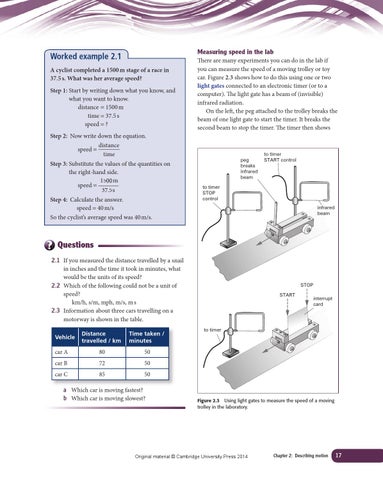
There are many experiments you can do in the lab if you can measure the speed of a moving trolley or toy car. Figure 2.3 shows how to do this using one or two light gates connected to an electronic timer (or to a computer). The light gate has a beam of (invisible) infrared radiation. On the left, the peg attached to the trolley breaks the beam of one light gate to start the timer. It breaks the second beam to stop the timer. The timer then shows
Step 2: Now write down the equation. distance speed = time Step 3: Substitute the values of the quantities on the right-hand side. 1500 m speed = 37.5s Step 4: Calculate the answer. speed = 40 m/s So the cyclist’s average speed was 40 m/s.
peg breaks infrared beam
to timer START control
to timer STOP control infrared beam
Questions 2.1 If you measured the distance travelled by a snail in inches and the time it took in minutes, what would be the units of its speed? 2.2 Which of the following could not be a unit of speed? km/h, s/m, mph, m/s, m s 2.3 Information about three cars travelling on a motorway is shown in the table. Distance travelled / km
Time taken / minutes
car A
80
50
car B
72
50
car C
85
50
Vehicle
a Which car is moving fastest? b Which car is moving slowest?
STOP START
interrupt card
to timer
Figure 2.3 Using light gates to measure the speed of a moving trolley in the laboratory.
Original material © Cambridge University Press 2014
Chapter 2: Describing motion
17
Activity 2.1 Measuring speed
◆
Skills AO3.1 Using techniques, apparatus and materials AO3.2 Planning AO3.3 Observing, measuring and recording AO3.4 Interpreting and evaluating observations and data A03.5 Evaluating methods
Safety Take care when running or cycling. The aim is to move at a steady speed, not to go as fast as possible. Do not stand close to where people are running or cycling. Do not leave the school grounds unless you have permission to do so. In athletics contests, runners are usually timed from the moment when the race starts to when they cross the finishing line. Your task is to measure the speed of someone moving quickly in the school grounds. They may be running or cycling. You should try to develop a method that is as accurate as possible.
How accurately can you measure the time taken? ◆ How will you record your measurements and calculate the results? 4 When you have made your measurements, calculate their average speed: average speed =
total distance total time
5 Work with a partner, who makes the same measurements as you. Compare your results and try to explain any differences. This may help you to refine your technique. 6 Now compare your method with the methods developed by other members of the class. How can you decide whose is best?
FINISH
START
1 Decide on two points between which they must run or cycle. 2 Decide how to measure this distance. 3 Decide how you will measure the time they take. Some points to consider: ◆ Should the runner/cyclist travel a short distance or a long distance? ◆ How accurately can you measure the distance they move?
the time taken to travel the distance between the two light gates. On the right, a piece of card, called an interrupt card, is mounted on the trolley. As the trolley passes through the gate, the leading edge of the interrupt card breaks the
18
Cambridge IGCSE Physics
beam to start the timer. When the trailing edge passes the gate, the beam is no longer broken and the timer stops. The faster the trolley is moving, the shorter the time for which the beam is broken. Given the length of the interrupt card, the trolley’s speed can be calculated.
Original material © Cambridge University Press 2014
Activity 2.2 Measuring speed in the lab Skills AO3.1 Using techniques, apparatus and materials AO3.2 Planning AO3.3 Observing, measuring and recording AO3.4 Interpreting and evaluating observations and data
Use lab equipment to measure the speed of a moving trolley or toy car. Start by checking whether you will be able to use one or two light gates to determine the speed of the trolley. Then try the following.
S
Rearranging the equation
allows us to calculate speed from measurements of distance and time. We can rearrange the equation to allow us to calculate distance or time. For example, a railway signalman might know how fast a train is moving, and need to be able to predict
The equation speed =
1 Place a book under one end of a long plank to form a long, gently sloping ramp. 2 Place the trolley at the top end of the ramp, and release it so that it runs down the slope. (Make sure that someone or something is positioned to catch the trolley at the lower end.) 3 Measure the speed of the trolley close to the foot of the slope. 4 Increase the slope of the ramp by adding more books. How does the speed of the trolley depend on the height of the top end of the ramp?
distance time
Worked example 2.2 A spacecraft is orbiting the Earth at a steady speed of 8 km/s (see the diagram). How long will it take to complete a single orbit, a distance of 40 000 km?
Step 1: Start by writing down what you know, and what you want to know. speed = 8 km/s distance = 40 000 km time = ? Step 2: Choose the appropriate equation, with the unknown quantity ‘time’ as the subject (on the left-hand side). time =
distance speed
Step 3: Substitute values – it can help to include units. time =
40000 km 8 km/s
Step 4: Perform the calculation. time = 5000 s This is about 83 minutes. So the spacecraft takes 83 minutes to orbit the Earth once.
Original material © Cambridge University Press 2014
Chapter 2: Describing motion
19
S
where it will have reached after a certain length of time: distance = speed × time Similarly, the crew of an aircraft might want to know how long it will take for their aircraft to travel between two points on its flight path: time =
distance speed
Worked example 2.2 illustrates the importance of keeping an eye on units. Because speed is in km/s and distance is in km, we do not need to convert to m/s and m. We would get the same answer if we did the conversion: 40000000 m time = 8 m/s = 5000 s
Studyy tip p It is better to remember one version of an equation and how to rearrange it than to try to remember three different versions.
Questions 2.4 An aircraft travels 1000 m in 4.0 s. What is its speed? 2.5 A car travels 150 km in 2 hours. What is its speed? (Show the correct units.) 2.6 An interplanetary spacecraft is moving at 20 000 m/s. How far will it travel in one day? (Give your answer in km.) 2.7 How long will it take a coach travelling at 90 km/h to travel 300 km along a highway?
After five minutes, it reached the highway, where it was able to speed up. After ten minutes, it was forced to stop because of congestion.’ We can show the same information in the form of a distance–time graph, as shown in Figure 2.4. This graph is in three sections, corresponding to the three sections of the coach’s journey: A The graph slopes up gently, showing that the coach was travelling at a slow speed. B The graph becomes steeper. The distance of the coach from its starting point is increasing more rapidly. It is moving faster. C The graph is flat (horizontal). The distance of the coach from its starting point is not changing. It is stationary. The slope of the distance–time graph tells us how fast the coach was moving. The steeper the graph, the faster it was moving (the greater its speed). When the graph becomes horizontal, its slope is zero. This tells us that the coach’s speed was zero in section C. It was not moving.
Question 2.8 Sketch a distance–time graph to show this: ‘The car travelled along the road at a steady speed. It stopped suddenly for a few seconds. Then it continued its journey, at a slower speed than before.’
C
Distance travelled
S
B A 0
5
10
15
Time / min
2.2 Distance–time graphs You can describe how something moves in words: ‘The coach pulled away from the bus stop. It travelled at a steady speed along the main road, heading out of town.
20
Cambridge IGCSE Physics
Figure 2.4 A graph to represent the motion of a coach, as described in the text. The slope of the graph tells us about the coach’s speed. The steepest section (B) corresponds to the greatest speed. The horizontal section (C) shows that the coach was stationary.
Original material © Cambridge University Press 2014
Activity 2.3 Story graphs Sketch a distance–time graph. Then ask your partner to write a description of it on a separate sheet of paper. Choose four graphs and their descriptions. Display them separately and challenge the class to match them up.
Express trains, slow buses An express train is capable of reaching high speeds, perhaps more than 300 km/h. However, when it sets off on its journey, it may take several minutes to reach this top speed. Then it takes a long time to slow down when it approaches its destination. The famous French TGV trains (Figure 2.5) run on lines that are reserved solely for their operation, so that their high-speed journeys are not disrupted by slower, local trains. It takes time to accelerate (speed up) and decelerate (slow down). A bus journey is full of accelerations and decelerations (Figure 2.6). The bus accelerates away from the stop. Ideally, the driver hopes to travel at a steady speed until the next stop. A steady speed means that you can sit comfortably in your seat. Then there is a rapid deceleration as the bus slows to a halt. A lot of accelerating and decelerating means that you are likely to be thrown
Figure 2.6 It can be uncomfortable on a packed bus as it accelerates and decelerates along its journey.
about as the bus changes speed. The gentle acceleration of an express train will barely disturb the drink in your cup. The bus’s rapid accelerations and decelerations would make it impossible to avoid spilling the drink.
2.3 Understanding acceleration Some cars, particularly high-performance ones, are advertised according to how rapidly they can accelerate. An advert may claim that a car goes ‘from 0 to 60 miles per hour (mph) in 6 s’. This means that, if the car accelerates at a steady rate, it reaches 10 mph after 1 s, 20 mph after 2 s, and so on. We could say that it speeds up by 10 mph every second. In other words, its acceleration is 10 mph per second. So, we say that an object accelerates if its speed increases. Its acceleration tells us the rate at which its speed is changing – in other words, the change in speed per unit time. If an object slows down, its speed is also changing. We say that it is decelerating. Instead of an acceleration, it has a deceleration.
Speed–time graphs
Figure 2.5 France’s high-speed trains, the TGVs (Trains à Grande Vitesse), run on dedicated tracks. Their speed has made it possible to travel 600 km from Marseille in the south to Paris in the north, attend a meeting, and return home again within a single day.
Just as we can represent the motion of a moving object by a distance–time graph, we can also represent it by a speed–time graph. (It is easy to get these two types of graph mixed up. Always check out any graph by looking at the axes to see what their labels say.) A speed–time graph shows how the object’s speed changes as it moves.
Original material © Cambridge University Press 2014
Chapter 2: Describing motion
21
Speed
Figure 2.7 shows a speed–time graph for a bus as it follows its route through a busy town. The graph frequently drops to zero because the bus must keep stopping to let people on and off. Then the line slopes up, as the bus accelerates away from the stop. Towards the end of its journey, it manages to move at a steady speed (horizontal graph), as it does not have to stop. Finally, the graph slopes downwards to zero again as the bus pulls into the terminus and stops. The slope of the speed–time graph tells us about the bus’s acceleration: ◆ The steeper the slope, the greater the acceleration. ◆ A negative slope means a deceleration (slowing down). ◆ A horizontal graph (slope = 0) means a constant speed.
B C
A
D Time Figure 2.8 An example of a speed–time graph for a train during part of its journey. This illustrates how such a graph can show acceleration (section A), constant speed (section B), deceleration (section C) and zero speed (section D).
The fact that the graph lines are curved in sections A and C tells us that the train’s acceleration was changing. If its speed had changed at a steady rate, these lines would have been straight.
Speed
Questions 2.9 A car travels at a steady speed. When the driver sees the red traffic lights ahead, she slows down and comes to a halt. Sketch a speed–time graph for her journey. 2.10 Look at the speed–time graph.
Time Figure 2.7 A speed–time graph for a bus on a busy route. At first, it has to halt frequently at bus stops. Towards the end of its journey, it maintains a steady speed. Speed
Graphs of different shapes Speed–time graphs can show us a lot about an object’s movement. Was it moving at a steady speed, or speeding up, or slowing down? Was it moving at all? The graph shown in Figure 2.8 represents a train journey. If you study the graph, you will see that it is in four sections. Each section illustrates a different point. A Sloping upwards: speed increasing – the train was accelerating. B Horizontal: speed constant – the train was travelling at a steady speed. C Sloping downwards: speed decreasing – the train was decelerating. D Horizontal: speed has decreased to zero – the train was stationary.
22
Cambridge IGCSE Physics
A
G B
C F
D E
Time
Name the sections that represent: a steady speed b speeding up (accelerating) c being stationary d slowing down (decelerating).
Finding distance moved A speed–time graph represents an object’s movement. It tells us about how its speed changes. We can use the
Original material © Cambridge University Press 2014
graph to deduce how far the object moves. To do this, we have to make use of the equation
distance = area under speed–time graph
Worked example 2.4 You set off down a steep ski slope. Your initial speed is 0 m/s. After 10 s you are travelling at 30 m/s (see the graph). Calculate the distance you travel in this time.
To understand this equation, consider these two worked examples.
You cycle for 20 s at a constant speed of 10 m/s (see the graph). Calculate the distance you travel if you cycle for 20 s at a constant speed of 20 m/s.
shaded area = distance travelled
Speed / m/s
Worked example 2.3
30
0 0
Speed / m/s
shaded area = distance travelled
10 Time / s
This is a little more complicated. To calculate the distance moved, we can use the fact that your average speed is 15 m/s. The distance you travel is:
10
distance moved = 15m/s × 10 s = 150 m 0 0
20 Time / s
The distance you travel is: distance moved = 10 m/s × 20 s = 200 m This is the same as the shaded area under the graph. This rectangle is 20 s long and 10 m/s high, so its area is 10 m/s × 20 s = 200 m.
1 area = × 10 s × 30 m/s = 150 m 2
Question
Study tip The area under any straight-line graph can be broken down into rectangles and triangles. Then you can calculate the area using: area of rectangle = width × height area of a triangle =
Again, this is represented by the shaded area under the graph. In this case, the shape is a triangle whose height is 30 m/s and whose base is 10 s. Since area of a triangle = 12 × base × height, we have:
1 × base × height 2
2.11 a Draw a speed–time graph to show the following motion. A car accelerates uniformly from rest for 5 s. Then it travels at a steady speed of 6 m/s for 5 s. b On your graph, shade the area that shows the distance travelled by the car in 10 s. c Calculate the distance travelled in this time.
Original material © Cambridge University Press 2014
Chapter 2: Describing motion
23
Worked example 2.5 Calculate the distance travelled in 60 s by the train whose motion is represented in the graph below.
Speed / m/s
14.0
6.0
0 0
20
60 Time / s
The graph has been shaded to show the area we need to calculate to find the distance moved by the train. This area is in two parts: ◆ a rectangle (pink) of height 6 m/s and width 60 s
2.4 Calculating speed and acceleration From a distance–time graph, we can find how fast something is moving. Here is an example that shows how this is done. Table 2.2 shows information about a car journey between two cities. The car travelled more slowly at some times than at others. It is easier to see this if we present the information as a graph (see Figure 2.9). From the graph, you can see that the car travelled slowly at the start of its journey, and also at the end, when it was travelling through the city. The graph is steeper in the middle section, when it was travelling on the open road between the cities. The graph of Figure 2.9 also shows how to calculate the car’s speed. Here, we are looking at the straight section of the graph, where the car’s speed was constant. We need to find the value of the gradient (or slope) of the graph, which will tell us the speed:
area = 6 m/s × 60 s = 360 m (this tells us how far the train would have travelled if it had maintained a constant speed of 6 m/s) ◆ a triangle (orange) of base 40 s and height (14 m/s − 6 m/s) = 8 m/s
speed = gradient of distance–time graph
Distance travelled / km
1 area = × base × height 2 1 = × 40 s × 8 m/s 2 = 160 m
total distance travelled = 360 m + 160 m = 520 m So, in 60 s, the train travelled 520 m. We can check this result using an alternative approach. The train travelled for 20 s at a steady speed of 6 m/s, and then for 40 s at an average speed of 10 m/s. So: distance travelled = (6 m/s × 20 s) + (10 m/s × 40 s) = 120 m + 400 m = 520 m
24
Cambridge IGCSE Physics
Time taken / h
0
0.0
10
0.5
20
0.8
100
1.8
110
2.3
Table 2.2 Distance and time data for a car journey. This data is represented by the graph in Figure 2.13. 120 Distance travelled / km
(this tells us the extra distance travelled by the train because it was accelerating). We can add these two contributions to the area to find the total distance travelled:
S
100 80 60
80 km
40 20
1.0 h
0 0
0.5
1.0
1.5
2.0
2.5
Time taken / h Figure 2.9 Distance–time graph for a car journey, for the data from Table 2.2.
Original material © Cambridge University Press 2014
S
These are the steps you take to find the gradient: Step 1: Identify a straight section of the graph. Step 2: Draw horizontal and vertical lines to complete a right-angled triangle. Step 3: Calculate the lengths of the sides of the triangle. Step 4: Divide the vertical height by the horizontal width of the triangle (‘up divided by along’). Here is the calculation for the triangle shown in Figure 2.9: vertical height = 80 km horizontal width = 1.0 h gradient =
8 km 1.0 h
Question 2.12 The table shows information about a train journey.
Ayton Beeston
Distance travelled / km
S
In physics, the words speed and velocity have different meanings, although they are closely related: velocity is an object’s speed in a particular stated direction. So, we could say that an aircraft has a speed of 200 m/s but a velocity of 200 m/s due north. We must give the direction of the velocity or the information is incomplete. Velocity is an example of a vector quantity. Vectors have both magnitude (size) and direction. Another example of a vector is weight – your weight is a force that acts downwards, towards the centre of the Earth. Speed is an example of a scalar quantity. Scalars only have magnitude. Temperature is an example of another scalar quantity. There is more about vectors and scalars in Chapter 3.
Calculating acceleration
= 80 km/h
So the car’s speed was 80 km/h for this section of its journey. It helps to include units in this calculation. Then the answer will automatically have the correct units – in this case, km/h.
Station
Speed and velocity, vectors and scalars
Time taken / minutes
0
0
20
30
Seatown
28
45
Deeville
36
60
Eton
44
70
Use the data in the table to plot a distance– time graph for the train. Find the train’s average speed between Beeston and Deeville. Give your answer in km/h.
Picture an express train setting off from a station on a long, straight track. It may take 300 s to reach a velocity of 300 km/h along the track. Its velocity has increased by 1 km/h each second, and so we say that its acceleration is 1 km/h per second. These are not very convenient units, although they may help to make it clear what is happening when we talk about acceleration. To calculate an object’s acceleration, we need to know two things: ◆ its change in velocity (how much it speeds up) ◆ the time taken (how long it takes to speed up). Then the acceleration of the object is defined as shown.
Key definition acceleration – the rate of change of an object’s velocity. acceleration =
change in velocity time taken
We can write the equation for acceleration in symbols. We use a for acceleration and t for time taken. Because there are two velocities, we need two symbols. So we use u = initial velocity and v = final velocity. Now we can write the equation for acceleration like this:
Original material © Cambridge University Press 2014
a=
v u t
Chapter 2: Describing motion
25
S
In the example of the express train at the start of this subsection, we have initial velocity u = 0 km/h, final velocity v = 300 km/h and time taken t = 300 s. So 300 − 0 acceleration a = = 1 km/h per second. Worked 300 example 2.6 uses the more standard velocity units of m/s.
Other units for acceleration are possible. Earlier we saw examples of acceleration in mph per second and km/h per second, but these are unconventional. It is usually best to work in m/s2.
Studyy tip p Units of acceleration
Acceleration is a vector quantity – it has a direction. It can be forwards (positive) or backwards (negative). So it is important always to think about velocity rather than speed when working out accelerations, because velocity is also a vector quantity.
In Worked example 2.6, the units of acceleration are given as m/s2 (metres per second squared). These are the standard units of acceleration. The calculation shows that the aircraft’s velocity increased by 2 m/s every second, or by 2 metres per second per second. It is simplest to write this as 2 m/s2, but you may prefer to think of it as 2 m/s per second, as this emphasises the meaning of acceleration.
Questions Worked example 2.6
2.13 Which of the following could not be a unit of acceleration? km/s2, mph/s, km/s, m/s2 2.14 A car sets off from traffic lights. It reaches a speed of 27 m/s in 18 s. What is its acceleration? 2.15 A train, initially moving at 12 m/s, speeds up to 36 m/s in 120 s. What is its acceleration?
An aircraft accelerates from 100 m/s to 300 m/s in 100 s. What is its acceleration? Step 1: Start by writing down what you know, and what you want to know. initial velocity u = 100 m/s final velocity v = 300 m/s time t = 100 s acceleration a = ? Step 2: Now calculate the change in velocity. change in velocity = 300 m/s − 100 m/s = 200 m/s Step 3: Substitute into the equation. change in velocity acceleration = time taken 200 m/s = 100 s = 2 m/s2 Alternatively, you could substitute the values of u, v and t directly into the equation. v u a= t 300 − 100 = = 2 m/s2 100
26
Cambridge IGCSE Physics
Acceleration from speed–time graphs A speed–time graph with a steep slope shows that the speed is changing rapidly – the acceleration is greater. It follows that we can find the acceleration of an object by calculating the gradient of its speed–time graph: acceleration = gradient of speed – time graph Three points should be noted: The object must be travelling in a straight line; its velocity is changing but its direction is not. ◆ If the speed–time graph is curved (rather than a straight line), the acceleration is changing. ◆ If the graph is sloping down, the object is decelerating. The gradient of the graph is negative. So a deceleration is a negative acceleration. ◆
Original material © Cambridge University Press 2014
S
S
Worked example 2.7 A train travels slowly as it climbs up a long hill. Then it speeds up as it travels down the other side. The table below shows how its speed changes. Draw a speed–time graph to show this data. Use the graph to calculate the train’s acceleration during the second half of its journey. Time / s
Speed / m/s
Step 1: The illustration shows the speed–time graph drawn using the data in the table. You can see that it falls into two parts. ◆ the initial horizontal section shows that the train’s speed was constant (zero acceleration) ◆ the sloping section shows that the train was then accelerating.
0
6.0
14.0
10
6.0
12.0
20
6.0
30
8.0
40
10.0
50
12.0
60
14.0
Before starting to draw the graph, it is worth looking at the data in the table. The values of speed are given at equal intervals of time (every 10 s). The speed is constant at first (6.0 m/s). Then it increases in equal steps (8.0, 10.0, and so on). In fact, we can see that the speed increases by 2.0 m/s every 10 s. This is enough to tell us that the train’s acceleration is 0.2 m/s2. However, we will follow through the detailed calculation to illustrate how to work out acceleration from a graph.
Speed / m/s
S
10.0 8.0 6.0 4.0 2.0 0 0
10
20
30 40 Time / s
50
60
Step 2: The triangle shows how to calculate the slope of the graph. This gives us the acceleration. acceleration = =
14.0 m/s − 6.0 m/s 60 s 20 s 8 0 m/s
40 s = 0 2 m/s2 So, as we expected, the train’s acceleration down the hill is 0.2 m/s2.
Question 2.16 A car travels for 10 s at a steady speed of 20 m/s along a straight road. The traffic lights ahead change to red, and the car slows down with a constant deceleration, so that it halts after a further 8 s.
a Draw a speed–time graph to represent the car’s motion during the 18 s described. b Use the graph to deduce the car’s deceleration as it slows down. c Use the graph to deduce how far the car travels during the 18 s described.
Original material © Cambridge University Press 2014
Chapter 2: Describing motion
27
Summary
S S
You should know: ◆ about graphs of distance–time and speed–time ◆ the meaning of acceleration ◆ about vector and scalar quantities, speed and velocity ◆ that acceleration is a vector quantity.
End-of-chapter questions 1
A bus is travelling along a road. It travels a distance of 400 m in a time of 25 s. a Write the equation used to calculate the average speed of the bus. b What is the unit of average speed? The graph shows that the bus’s speed is constant.
Speed / m/s
20 15 10 5 0 0
5
10
15 Time / s
20
25
c Explain how you can tell that the bus has no acceleration. d Copy the graph and shade the area that represents the distance travelled by the bus. Label this area ‘distance travelled’. 2
Here are two graphs that represent the motion of two different objects.
Speed
Distance travelled
S
Time A
Time B
a Copy the distance–time graph. Use your graph to explain how you would find the object’s speed. b The object is moving with constant speed. Explain how you can tell this from the graph. c Copy the speed–time graph. Use your graph to explain how you would find the object’s acceleration.
28
Cambridge IGCSE Physics
Original material © Cambridge University Press 2014
3
The table shows the difference between vector and scalar quantities. Quantity
Description
Examples
has magnitude only has magnitude and direction
a Copy the table and complete the first column with the words vector and scalar in the correct rows. b Write the words listed below in the correct spaces in the third column. speed velocity distance acceleration weight 4
A runner travels 400 m in 50 s. What is her average speed?
[3]
5
The graph represents the motion of a bus. It is in two sections, A and B. What can you say about the motion of the bus during these two sections?
[2]
B
Distance
S
A
Time
6
How far will a bus travel in 30 s at a speed of 15 m/s?
[3]
7
The table shows the distance travelled by a car at intervals during a short journey. Distance / m
0
200
400
600
800
Time / s
0
10
20
30
40
a Draw a distance–time graph to represent this data. b What does the shape of the graph tell you about the car’s speed?
Original material © Cambridge University Press 2014
[4] [2]
Chapter 2: Describing motion
29
8
The graph shows the distance travelled by a car on a roller-coaster ride, at different times along its trip. It travels along the track, and then returns to its starting position. Study the graph and decide which point best fits the following descriptions. In each case, give a reason to explain why you have chosen that point. 5
Distance
4 3 6 1
2
Time
a b c d e
The car is stationary. The car is travelling its fastest. The car is speeding up. The car is slowing down. The car starts on its return journey.
[2] [2] [2] [2] [2]
9 Scientists have measured the distance between the Earth and the Moon by reflecting a beam of laser light off the Moon. They measure the time taken for light to travel to the Moon and back. a What other piece of information is needed to calculate the Earth–Moon distance? b How would the distance be calculated? 10 Copy and complete the table showing information about the motion of a number of objects. Object
Distance travelled
bus
20 km
taxi
6 km
aircraft snail
S
Time taken
[4]
Speed
0.8 h 30 m/s 5.5 h
3 mm
[1] [1]
900 km/h
10 s
11 The speed–time graph for part of a train journey is a horizontal straight line. What does this tell you about the train’s speed, and about its acceleration?
[2]
12 Sketch speed–time graphs to represent the following two situations. a An object starts from rest and moves with constant acceleration. b An object moves at a steady speed. Then it slows down and stops.
[3] [3]
13 A runner accelerates from rest to 8 m/s in 2 s. What is his acceleration?
[3]
14 A runner accelerates from rest with an acceleration of 4 m/s2 for 2.3 s. What will her speed be at the end of this time?
[4]
30
Cambridge IGCSE Physics
Original material © Cambridge University Press 2014
15 A car can accelerate at 5.6 m/s2. Starting from rest, how long will it take to reach a speed of 24 m/s?
[3]
16 The table shows how the speed of a car changed during a section of a journey. Speed / m/s
0
9
18
27
27
27
Time / s
0
10
20
30
40
50
a Draw a speed–time graph to represent this data. Use your graph to calculate: b the car’s acceleration during the first 30 s of the journey c the distance travelled by the car during the journey.
[4] [3] [5]
17 The graph shows how a car’s speed changed as it travelled along.
D Speed
S
B
C
A
E
Time
a In which section(s) was its acceleration zero? b In which section(s) was its acceleration constant? c What can you say about its acceleration in the other section(s)?
[2] [2] [2]
18 A bus travels 1425 m in 75 s. a What is its speed? b What other piece of information do we need in order to state its velocity?
Original material © Cambridge University Press 2014
[3] [1]
Chapter 2: Describing motion
31
19 The diagram shows the route OPQR taken by a car.
m
R
10 k
P 5 km
10
km
Q O
Speed
The graph shows the speed–time graph for the car journey. The car starts from rest at O.
O
P
Q Time
R
a State the value of the distance represented by the shaded area. b State what the car was doing during the interval: i OP ii PQ iii QR. c Is the average speed during the journey the same as, less than or more than the maximum speed shown on the graph? [Cambridge IGCSE® Physics 0625/23, Question 1, October/November, 2011]
32
Cambridge IGCSE Physics
Original material © Cambridge University Press 2014
[1] [1] [1] [1] [1]
20 The first graph is a distance–time graph showing the motion of an object. 25
Distance / m
20 15 10 5 0 0
1
2 Time / s
3
4
a i ii
Describe the motion shown for the first 2 s, calculating any relevant quantity. After 2 s the object accelerates. Copy the first graph on graph paper, and on it sketch a possible shape of the graph for the next 2 s. b Describe how a distance–time graph shows an object that is stationary. The second graph shows the axes for a speed–time graph.
[2] [1] [1]
10 8 Speed / m/s
S
6 4 2 0 0
1
2 Time / s
3
4
c Copy the axes of the second graph on graph paper, and draw i the graph of the motion for the first 2 s as shown in the first graph ii an extension of the graph for the next 2 s, showing the object accelerating at 2 m/s2. d Describe how a speed–time graph shows an object that is stationary.
[3] [2]
[Cambridge IGCSE® Physics 0625/32, Question 1, May/June, 2012]
Original material © Cambridge University Press 2014
Chapter 2: Describing motion
33
3
Forces and motion
In this chapter, you will find out: ◆ ◆ ◆
S ◆ S ◆ S ◆ S ◆ S ◆
how to identify the forces acting on an object how a resultant force changes the motion of an object the difference between mass and weight how a resultant force can give rise to motion in a circle the effect of air resistance on a moving object how force, mass and acceleration are related how a force changes an object’s momentum how to calculate the resultant of two or more vectors.
Roller-coaster forces Some people get a lot of pleasure out of sudden acceleration and deceleration. Many fairground rides involve sudden changes in speed. On a rollercoaster (Figure 3.1), you may speed up as the car runs downhill. Then, suddenly, you veer off to the left – you are accelerated sideways. A sudden braking gives you a large, negative acceleration (a deceleration). You will probably have to be fastened in to your seat to avoid being thrown out of the car by these sudden changes in speed. What are the forces at work in a roller-coaster? If you are falling downwards, it is gravity that affects you. This gives you an acceleration of about 10 m/s2. We say that the G-force acting on you is 1 (that is, one unit of gravity). When the brakes slam on, the G-force may be greater, perhaps as high as 4. The brakes make use of the force of friction. Changing direction also requires a force. So when you loop the loop or veer to the side, there must be a force acting. This is simply the force of the track,
34
Cambridge IGCSE Physics
Figure 3.1 A roller-coaster ride involves many rapid changes in speed. These accelerations and decelerations give the ride its thrill. The ride’s designers have calculated the accelerations carefully to ensure that the car will not come off its track, and the riders will stay in the car.
whose curved shape pushes you round. Again, the G-force may reach as high as 4. Roller-coaster designers have learned how to surprise you with sudden twists and turns. You can be scared or exhilarated. However you feel, you can release the tension by screaming.
Original material © Cambridge University Press 2014
3.1 We have lift-off
◆
It takes an enormous force to lift the giant space shuttle off its launch pad, and to propel it into space (Figure 3.2). The booster rockets that supply the initial thrust provide a force of several million newtons. As the spacecraft accelerates upwards, the crew experience the sensation of being pressed firmly back into their seats. That is how they know that their craft is accelerating.
Forces change motion One moment, the shuttle is sitting on the ground, stationary. The next moment, it is accelerating upwards, pushed by the force provided by the rockets. In this chapter, we will look at how forces – pushes and pulls – affect objects as they move. You will be familiar with the idea that the unit used for measuring forces is the newton (N). To give an idea of the sizes of various forces, here are some examples: ◆ You lift an apple. The force needed to lift an apple is roughly one newton (1 N). ◆ You jump up in the air. Your leg muscles provide the force needed to do this, about 1000 N. ◆ You reach the motorway in your high-performance car, and ‘put your foot down’. The car accelerates forwards. The engine provides a force of about 5000 N.
You are crossing the Atlantic in a Boeing 777 jumbo jet. The four engines together provide a thrust of about 500 000 N. In total, that is about half the thrust provided by each of the space shuttle’s booster rockets.
Some important forces Forces appear when two objects interact with each other. Figure 3.3 shows some important forces. Each force is represented by an arrow to show its direction.
Forces produce acceleration The car driver in Figure 3.4a is waiting for the traffic lights to change. When they go green, he moves forwards. The force provided by the engine causes the car to accelerate. In a few seconds, the car is moving quickly along the road. The arrow in the diagram shows the force pushing the car forwards. If the driver wants to get away from the lights more b
a
weight contact force
friction
The weight of an object is the pull of gravity on it. Weight always acts vertically downwards. When two objects touch, there is a contact force. It is the contact force that stops you falling through the floor.
Friction opposes motion. Think about the direction in which an object is moving (or trying to move). Friction acts in the opposite direction.
c
d
air resistance
upthrust
Figure 3.2 The space shuttle accelerating away from its launch pad. The force needed is provided by several rockets. Once each rocket has used all its fuel, it will be jettisoned, to reduce the mass that is being carried up into space.
Air resistance or drag is the force of friction when an object moves through air or water.
Figure 3.3
Upthrust is the upward push of a liquid or gas on an object. The upthrust of water makes you float in the swimming pool.
Some common forces.
Original material © Cambridge University Press 2014
Chapter 3: Forces and motion
35
To summarise, we have seen several things about forces: ◆ They can be represented by arrows. A force has a direction, shown by the direction of the arrow. ◆ A force can make an object change speed (accelerate). A forward force makes it speed up, while a backward force makes it slow down. ◆ A force can change the direction in which an object is moving.
a
b
Studyy tip p Take care always to think about the forces that act on an object. These are the forces that will affect its motion, not the forces it exerts on other objects.
c
Question 3.1 The diagram shows three objects that are moving. A force acts on each object. For each, say how its movement will change. a Figure 3.4 A force can be represented by an arrow. a The forward force provided by the engine causes the car to accelerate forwards. b The backward force provided by the brakes causes the car to decelerate. c A sideways force causes the car to change direction.
quickly, he can press harder on the accelerator. The forward force is then bigger, and the car’s acceleration will be greater. The driver reaches another junction, where he must stop. He applies the brakes. This provides another force to slow down the car (see Figure 3.4b). The car is moving forwards, but the force needed to make it decelerate is directed backwards. If the driver wants to stop in a hurry, a bigger force is needed. He must press hard on the brake pedal, and the car’s deceleration will be greater. Finally, the driver wants to turn a corner. He turns the steering wheel. This produces a sideways force on the car (Figure 3.4c), so that the car changes direction. 36
Cambridge IGCSE Physics
c
b
Two or more forces The car shown in Figure 3.5a is moving rapidly. The engine is providing a force to accelerate it forwards, but there is another force acting, which tends to slow down the car. This is air resistance, a form of friction caused when an object moves through the air. (This frictional force is also called drag, especially for motion through fluids other than the air.) The air drags on the object, producing a force that acts in the opposite direction to the object’s motion. In Figure 3.5a, these two forces are: ◆ push of engine = 600 N to the right ◆ drag of air resistance = 400 N to the left.
Original material © Cambridge University Press 2014
Question
a air resistance, 400 N push of engine, 600 N
3.2 The forces acting on three objects are shown in the diagram. a
b
c 270 N
70 N b
600 N
80 N
60 N
600 N
100 N 30 N 320 N
Figure 3.5 A car moves through the air. Air resistance acts in the opposite direction to its motion.
For each of a, b and c: i Say whether the forces are balanced or unbalanced. ii If the forces are unbalanced, calculate the resultant force on the object and give its direction. iii Say how the object’s motion will change.
We can work out the combined effect of these two forces by subtracting one from the other to give the resultant force acting on the car.
3.2 Mass, weight and gravity The resultant force is the single force that has the same effect as two or more forces.
So in Figure 3.5a: resultant force = 600 N − 400 N = 200 N to the right This resultant force will make the car accelerate to the right, but not as much as if there was no air resistance. In Figure 3.5b, the car is moving even faster, and air resistance is greater. Now the two forces cancel each other out. So in Figure 3.5b: resultant force = 600 N − 600 N = 0 N We say that the forces on the car are balanced. There is no resultant force and so the car no longer accelerates. It continues at a constant speed in a straight line. ◆ If no resultant force acts on an object, it will not accelerate; it will remain at rest or it will continue to move at a constant speed in a straight line. ◆ If an object is at rest or is moving at a constant speed in a straight line, we can say that there is no resultant force acting on it.
If you drop an object, it falls to the ground. It is difficult to see how a falling object moves. However, a multiflash photograph can show the pattern of movement when an object falls. Figure 3.6 shows a ball falling. There are seven images of the ball, taken at equal intervals of time. The ball falls further in each successive time interval. This shows that its speed is increasing – it is accelerating. If an object accelerates, there must be a force that is causing it to do so. In this case, the force of gravity is pulling the ball downwards. The name given to the force of gravity acting on an object is its weight. Because weight is a force, it is measured in newtons (N). Every object on or near the Earth’s surface has weight. This is caused by the attraction of the Earth’s gravity. The Earth pulls with a force of 10 N (approximately) on each kilogram of matter, so an object of mass 1 kg has a weight of 10 N: weight of 1 kg mass = 10 N Because the Earth pulls with the same force on every kilogram of matter, every object falls with the
Original material © Cambridge University Press 2014
Chapter 3: Forces and motion
37
fall g. We can write this as an equation in words and in symbols:
weight = mass × acceleration of free fall W = mg
Distinguishing mass and weight
Figure 3.6 The increasing speed of a falling ball is captured in this multi-flash image.
It is important to understand the difference between the two quantities, mass and weight. ◆ The mass of an object, measured in kilograms, tells you how much matter it is composed of. ◆ The weight of an object, measured in newtons, is the gravitational force that acts on it. If you take an object to the Moon, it will weigh less than it does on Earth, because the Moon’s gravity is weaker than the Earth’s. However, its mass will be unchanged, because it is made of just as much matter as when it was on Earth. When we weigh an object using a balance, we are comparing its weight with that of standard weights on the other side of the balance (Figure 3.7). We are making use of the fact that, if two objects weigh the same, their masses will be the same.
Studyy tip p same acceleration close to the Earth’s surface. If you drop a 5 kg ball and a 1 kg ball at the same time, they will reach the ground at the same time. The acceleration caused by the pull of the Earth’s gravity is called the acceleration of free fall or the acceleration due to gravity. This quantity is given the symbol g and its value is 10 m/s2 close to the surface of the Earth:
We always talk about weighing an object. However, if the balance we use has a scale in kilograms or grams, we will find its mass, not its weight.
250 g
acceleration of free fall g = 10 m/s2
Calculating weight We have seen that an object of mass 1 kg has a weight of 10 N; an object of mass 2 kg has a weight of 20 N; and so on. To calculate an object’s weight W from its mass m, we multiply by 10, the value of the acceleration of free
38
Cambridge IGCSE Physics
Figure 3.7 When the balance is balanced, we know that the weights on opposite sides are equal, and so the masses must also be equal.
Original material © Cambridge University Press 2014
Activity 3.1 Comparing masses Skills AO3.1 Using techniques, apparatus and materials AO3.3 Observing, measuring and recording AO3.4 Interpreting and evaluating observations and data A03.5 Evaluating methods
You can compare the masses of two objects by holding them. How good are you at judging mass?
Method B: Pick up two objects, one in each hand. Assess their masses. Which is greater?
In science, we use instruments to make measurements. For example, we use a balance to measure the mass of an object. But some balances are more sensitive than others. For example, if you weigh yourself, the scales may give your mass to the nearest 100 g or 10 g. Digital kitchen scales may give the mass of flour to the nearest gram. A lab balance may measure to the nearest milligram or better. In this activity, you will test your own sensitivity. How good are you at comparing the masses of two objects? There are two methods that you can use to compare the masses of two objects. Method A: Pick up an object in one hand. Give yourself enough time to assess its mass. (Moving your hand up and down can help when assessing the mass of an object.) Then put it down and pick up another object. Assess its mass. Which has the greater mass?
1 Try out the two methods described above. Compare masses that are similar. Which method is more sensitive? 2 Use your preferred method. What is the smallest difference in mass that you can detect? For example, if you compare a 100 g mass with a 120 g mass, can you tell the difference?
Questions 3.3 A book is weighed on Earth. It is found to have a mass of 1 kg. So its weight on the Earth is 10 N. What can you say about its mass and its weight if you take it: a to the Moon, where gravity is weaker than on Earth? b to Jupiter, where gravity is stronger?
3.4 An astronaut has a mass of 90 kg. a Calculate her weight on the surface of the Earth. b The astronaut travels to Mars, where gravity is weaker. The acceleration of free fall on the surface of Mars has a value g = 3.7 m/s2. Calculate her weight on Mars.
Original material Š Cambridge University Press 2014
Chapter 3: Forces and motion
39
3.3 Falling and turning Force is a vector quantity – it has direction as well as magnitude. That is why we represent forces using arrows. In this section, we will look at two situations where we have to think carefully about the directions of forces. ◆ When an object is falling, two forces act on it, one downwards and the other upwards. ◆ When an object is changing direction, a force acts on it sideways, pushing it round the corner.
Falling through the air
unbalanced, and he slows down. The idea is to reach a new, slower, terminal velocity of about 10 m/s, at which speed he can safely land. At this point, weight = drag, and so the forces on the parachutist are balanced. The graph in Figure 3.10 shows how the parachutist’s speed changes during a fall. ◆ When the graph is horizontal, speed is constant and forces are balanced. ◆ When the graph is sloping, speed is changing. The parachutist is accelerating or decelerating, and forces are unbalanced.
The Earth’s gravity is equally strong at all points close to the Earth’s surface. If you climb to the top of a tall building, your weight will stay the same. We say that there is a uniform gravitational field close to the Earth’s surface. This means that all objects fall with the same acceleration as the ball shown in Figure 3.6, provided there is no other force acting to reduce their acceleration. For many objects, the force of air resistance can affect their acceleration. Parachutists make use of air resistance. A free-fall parachutist (Figure 3.8) jumps out of an aircraft and accelerates downwards. Figure 3.9 shows the forces on a parachutist at different points in his fall. At first, air resistance has little effect. However, air resistance increases as he falls, and eventually this force balances his weight. Then the parachutist stops accelerating – he falls at a steady rate known as the terminal velocity. Opening the parachute greatly increases the area and hence the air resistance. Now there is a much bigger force upwards. The forces on the parachutist are again
air resistance
weight
Figure 3.9 The forces on a falling parachutist. Notice that his weight is constant. When air resistance equals weight, the forces are balanced and the parachutist reaches a steady speed. The parachutist is always falling (velocity downwards), although his acceleration is upwards when he opens his parachute.
parachute opens Speed
S
Figure 3.8 Free-fall parachutists, before they open their parachutes. They can reach a terminal velocity of more than 50 m/s.
40
Cambridge IGCSE Physics
Time Figure 3.10
A speed–time graph for a falling parachutist.
Original material © Cambridge University Press 2014
S
S
3.4 Force, mass and acceleration
Question 3.5 Look at the speed–time graph of Figure 3.10. Find a point where the graph is sloping upwards. a Is the parachutist accelerating or decelerating? b Which of the two forces acting on the parachutist is greater? c Explain the shape of the graph after the parachute has opened.
Going round in circles When a car turns a corner, it changes direction. Any object moving along a circular path is changing direction as it goes. A force is needed to do this. Figure 3.11 shows three objects following curved paths, together with the forces that act to keep them on track. a The boy is whirling an apple around on the end of a piece of string. The tension in the string pulls on the apple, keeping it moving in a circle. b An aircraft ‘banks’ (tilts) to change direction. The lift force on its wings provides the necessary force. c The Moon is held in its orbit around the Earth by the pull of the Earth’s gravity. For an object following a circular path, the object is acted on by a force at right angles to its velocity.
Studyy tip p The force that keeps an object moving in a circle always acts towards the centre of the circle. If the force disappears, the object will move off at a tangent to the circle; it will not fly outwards, away from the centre.
a
A car driver uses the accelerator pedal to control the car’s acceleration. This alters the force provided by the engine. The bigger the force acting on the car, the bigger the acceleration it gives to the car. Doubling the force produces twice the acceleration, three times the force produces three times the acceleration, and so on. There is another factor that affects the car’s acceleration. Suppose the driver fills the boot with a lot of heavy boxes and then collects several children from college. He will notice the difference when he moves away from the traffic lights. The car will not accelerate so readily, because its mass has been increased. Similarly, when he applies the brakes, it will not decelerate as readily as before. The mass of the car affects how easily it can be accelerated or decelerated. Drivers learn to take account of this. The greater the mass of an object, the smaller the acceleration it is given by a particular force. So, big (more massive) objects are harder to accelerate than small (less massive) ones. If we double the mass of the object, its acceleration for a given force will be halved. We need to double the force to give it the same acceleration. This tells us what we mean by mass. It is the property of an object that resists changes in its motion.
Force calculations These relationships between force, mass and acceleration can be combined into a single, very useful, equation, as shown.
b
path of apple when string breaks
S
c
Moon
lift pull of gravity
tension lift
Earth gravity
Figure 3.11
Examples of motion along a curved path. In each case, there is a sideways force holding the object in its circular path. Original material © Cambridge University Press 2014
Chapter 3: Forces and motion
41
S
Key definition
Worked example 3.2
force – the action of one body on a second body that causes its velocity to change. force = mass × acceleration F = ma The quantities involved in this equation, and their units, are summarised in Table 3.1. The unit of force is the newton, which is defined as shown. Worked examples 3.1 and 3.2 show how to use the equation.
Key definition newton (N) – the force required to give a mass of 1 kg an acceleration of 1 m/s2.
Quantity
Symbol
SI unit
force
F
newton, N
mass
m
kilogram, kg
acceleration
a
metres per second squared, m/s2
Table 3.1 The three quantities related by the equation force = mass × acceleration.
An Airbus A380 aircraft has four jet engines, each capable of providing 320 000 N of thrust. The mass of the aircraft is 560 000 kg when loaded. What is the greatest acceleration that the aircraft can achieve? Step 1: The greatest force provided by all four engines working together is: 4 × 320 000 N = 1 280 000 N Step 2: Now we have: force = 1 280 000 N
Worked example 3.1 When you strike a tennis ball that another player has hit towards you, you provide a large force to reverse its direction of travel and send it back towards your opponent. You give the ball a large acceleration. What force is needed to give a ball of mass 0.1 kg an acceleration of 500 m/s2?
mass = 560 000 kg acceleration = ? Step 3: The greatest acceleration the engines can produce is then given by: acceleration =
Step 1: We have: mass = 0.1 kg
=
acceleration = 500 m/s2
force mass 1280000 N 560000 kg
= 2.29 m/s2
force = ? Step 2: Substituting in the equation to find the force gives: force = mass × acceleration = 0.1 kg × 500 m/s2 = 50 N 42
Cambridge IGCSE Physics
Studyy tip p Note that mass must be in kg, not g, if the force is to work out in N.
Original material © Cambridge University Press 2014
S
S
Questions 3.6 What force is needed to give a car of mass 600 kg an acceleration of 2.5 m/s2? 3.7 A stone of mass 0.2 kg falls with an acceleration of 10.0 m/s2. How big is the force that causes this acceleration?
Activity 3.2 F, m and a
◆
Skills AO3.1 AO3.2 AO3.3 AO3.4
Using techniques, apparatus and materials Planning Observing, measuring and recording Interpreting and evaluating observations and data
If you change the force acting on an object, its acceleration changes. If you change the mass of the object, its acceleration changes. The picture shows one way to investigate this using a laboratory trolley, a light gate and a timer. The trolley is placed on a runway. A string passes over a pulley. Weights on the end of the string provide the force needed to make the trolley accelerate.
Two important points to note: ◆
3.8 What acceleration is produced by a force of 2000 N acting on a person of mass 80 kg? 3.9 One way to find the mass of an object is to measure its acceleration when a force acts on it. If a force of 80 N causes a box to accelerate at 0.1 m/s2, what is the mass of the box?
The force F pulling the trolley is the weight of the masses m hanging from the end of the string. Calculate the force using F = mg.
The mass m that is accelerating is the mass of the trolley plus the mass on the end of the string.
Investigate how the trolley’s acceleration a depends on the force F acting on it and on the mass m. 1 Set up the trolley on a runway, as shown. Decide how you will measure its acceleration. You can use a light gate and an interrupt card, or two light gates, or a motion sensor, and a data-logger and a computer. Alternatively, you could use a ticker-timer and ticker-tape. 2 Hang weights on the end of the string and release the trolley. Be ready to catch it when it reaches the end of the runway. Check that you can measure its acceleration. 3 To find out how the acceleration depends on the mass of the trolley, you must keep the force constant. Do not change the load on the end of the string. Increase the mass of the trolley by placing masses on top of it. 4 To find out how the acceleration depends on the force, you must change the number of masses on the end of the string. To keep the total mass constant, start with one mass on the string and nine masses on the trolley. Then, one by one, transfer masses from the trolley to the end of the string.
Original material © Cambridge University Press 2014
Chapter 3: Forces and motion
43
S
3.5 The idea of momentum A force will change an object’s motion. It will make the object accelerate; it may make it change direction. The effect of a force F depends on two things: ◆ how big the force is ◆ the time t it acts for. The bigger the force and the longer it acts for, the more the object’s motion will change. The impulse equation sums this up: Ft = mv − mu
Worked example 3.3 a
A car of mass 600 kg is moving at 15 m/s. Calculate its momentum. momentum = mass × velocity = 600 kg × 15 m/s = 900 kg m/s
b The driver accelerates gently so that a force of 30 N acts on the car for 10 s. Calculate the impulse of the force. impulse = force × time = 30 N × 10 s = 300 N s
The quantity on the left, Ft, is called the impulse of the force. On the right we have mv (mass × final velocity) and mu (mass × initial velocity). The quantity mass × velocity is known as the momentum (ρ) of the object, so the right-hand side of the equation mv − mu is the change in the object’s momentum. So we can write the impulse equation like this:
c
Calculate the momentum of the car after the accelerating force has acted on it.
The impulse of the force tells us how much the car’s momentum changes. The car is speeding up, so its momentum increases by 300 N s.
impulse of force = change of momentum
final momentum = initial momentum + impulse of force = 900 + 300 = 1200 kg m/s
Impulse and momentum are both defined by equations:
(Note that the unit of momentum is kg m/s; this is the same as N s, the unit of impulse.)
impulse = force × time for which it acts = Ft momentum ρ = mass × velocity = mv The impulse equation is related to the equation v u , so we can F = ma. We know that acceleration a = t substitute for a to give: F=
m(v − u) t
or Ft = m(v − u)
Questions 3.10 Calculate the momentum of a car of mass 600 kg moving at 25 m/s. 3.11 A force of 20 N acts on a rocket for 350 s, causing the rocket’s velocity to increase. a Calculate the impulse of the force. b By how much does the rocket’s momentum increase?
which is the impulse equation.
44
Cambridge IGCSE Physics
Original material © Cambridge University Press 2014
S
S
Momentum in a collision Figure 3.12 shows a game in which a ball hangs from a length of string. The player hits the ball horizontally with a racket. How can we use the idea of momentum to describe what happens? We need to think about momentum before the racket collides with the ball, and then after the collision.
a Before the collision: The racket is moving to the right; it has momentum. The ball is stationary, so it has no momentum. b After the collision: The racket is moving to the right, but more slowly than before. It has lost momentum. The ball is moving rapidly to the right. It has gained momentum. So you can see that, when the racket exerts a force on the ball, momentum is transferred from the racket to the ball. Whenever a force acts on an object, its momentum changes. At the same time, the momentum of the object causing the force also changes. If one object gains momentum, then the other loses an equal amount of momentum. This is known as the principle of the conservation of momentum. We can state the principle in a different way. Whenever two objects interact, the total amount of momentum before they interact is the same as the total amount of momentum afterwards:
total momentum before = total momentum after
S
Worked example 3.4 The illustration below shows the masses and velocities of the racket and ball shown in Figure 3.12. Find: a the momentum of the racket before and after the collision b the momentum of the ball after the collision c the velocity of the ball.
m = 3 kg m = 0.25 kg u = 20 m/s u = 0
m = 3 kg v = 18 m/s
before
a
m = 0.25 kg v = 24 m/s
after
We can calculate the momentum of the racket using momentum = mass × velocity. Before the collision: momentum = 3 kg × 20 m/s = 60 kg m/s After the collision, the racket is moving more slowly and so its momentum is less: momentum = 3 kg × 18 m/s = 54 kg m/s
b The momentum gained by the ball is equal to the momentum lost by the racket. So: momentum of ball = 60 − 54 = 6 kg m/s
The next worked example shows how we can use this to work out how fast the ball in Figure 3.12 will be moving after it has been hit by the racket.
c
We can calculate the velocity of the ball by rearranging the equation for momentum: velocity = =
momentum mass 6 kg m/s
0 25 kg = 24 m/s The ball will move off with a velocity of 24 m/s to the right. a Figure 3.12 the hit.
b Hitting a ball with a racket: a before the hit; b after
Original material © Cambridge University Press 2014
Chapter 3: Forces and motion
45
S
3.6 More about scalars and vectors
S a
We can represent forces using arrows because a force has a direction as well as a magnitude. This means that force is a vector quantity (see Chapter 2). Table 3.2 lists some scalar and vector quantities.
500 N
350 N
Scalar quantities
Vector quantities
speed
velocity
mass
force
energy
weight
density
acceleration
b 4N
temperature Table 3.2
Some scalar and vector quantities.
Every vector quantity has a direction. However, it is not always necessary to state the direction if this is obvious – for example, we might say ‘The weight of the block is 10 N,’ without saying that this force acts downwards.
Adding forces What happens if an object is acted on by two or more forces? Figure 3.13a shows someone pushing a car. Friction opposes their pushing force. Because the forces are acting in a straight line, it is simple to calculate the resultant force, provided we take into account the directions of the forces: resultant force = 500 N − 350 N = 150 N to the right Note that we must give the direction of the resultant force, as well as its magnitude. The car will accelerate towards the right. Figure 3.13b shows a more difficult situation. A firework rocket is acted on by two forces.
Cambridge IGCSE Physics
Figure 3.13 Adding forces: a two forces in a straight line; b two forces in different directions.
◆
Studyy tip p
46
3N
The thrust of its burning fuel pushes it towards the right. ◆ Its weight acts vertically downwards. Worked example 3.5 shows how to find the resultant force by the method of drawing a vector triangle (graphical representation of vectors).
Rules for vector addition You can add two or more forces by the following method – simply keep adding arrows end-to-end: ◆ Draw arrows end-to-end, so that the end of one is the start of the next. ◆ Choose a scale that gives a large triangle. ◆ Join the start of the first arrow to the end of the last arrow to find the resultant. Other vector quantities (for example, two velocities) can be added in this way. Imagine that you set out to swim across a fast-flowing river. You swim towards the opposite bank, but the river’s velocity carries you downstream. Your resultant velocity will be at an angle to the bank. Airline pilots must understand vector addition. Aircraft fly at high speed, but the air they are moving through is also moving fast. If they are to fly in a straight line towards their destination, the pilot must take account of the wind speed.
Original material © Cambridge University Press 2014
S
S
Worked example 3.5 Find the resultant force acting on the rocket shown in Figure 3.13b. What effect will the resultant force have on the rocket?
◆
Step 1: Look at the diagram. The two forces are 4 N horizontally and 3 N vertically.
Step 3: Complete the triangle by drawing an arrow from the start of the first arrow to the end of the second arrow. This arrow represents the resultant force.
Step 2: Draw a scale diagram to represent these forces, as follows. In the diagram we are using a scale of 1 cm to represent 1 N. ◆
Draw a horizontal arrow, 4 cm long, to represent the 4 N force. Mark it with an arrow to show its direction.
Step 4: Measure the arrow, and use the scale to determine the size of the force it represents. (You could also calculate this using Pythagoras’ theorem.) ◆ ◆
4N 37˚
3N 5N
Using the end of this arrow as the start of the next arrow, draw a vertical arrow, 3 cm long, to represent the 3 N force.
length of line = 5 cm resultant force = 5 N
Step 5: Use a protractor to measure the angle of the force. (You could also calculate this angle using trigonometry.) ◆
angle of force = 37° below horizontal
So the resultant force acting on the rocket is 5 N acting at 37° below the horizontal. The rocket will be given an acceleration in this direction.
Question 3.12 An aircraft can fly at a top speed of 600 km/h. a What will its speed be if it flies into a headwind of 100 km/h? (A head-wind blows in the opposite direction to the aircraft.)
b The pilot directs the aircraft to fly due north at 600 km/h. A side-wind blows at 100 km/h towards the east. What will be the aircraft’s resultant velocity? (Give both its speed and its direction.)
Summary
S S S S S
You should know: ◆ how forces affect motion ◆ about resultant forces ◆ that weight is the force of gravity on an object ◆ the relationship between force, mass and acceleration ◆ about motion along a circular path ◆ about the motion of an object falling through air ◆ expressions for momentum and the impulse of a force ◆ that force and momentum are vector quantities. Original material © Cambridge University Press 2014
Chapter 3: Forces and motion
47
End-of-chapter questions 1
Read the following sentence: A force can make an object change direction, slow down, or speed up. Copy the sentence, changing the words in italics to the correct scientific terms.
S
2
An object may be acted on by several forces. What name is given to the single force that has the same effect as these forces?
3
What name is given to the force on an object caused by the Earth’s gravitational pull?
4
A force causes an object with mass to accelerate. a Write the equation that links the quantities force, mass and acceleration. b Copy the table and complete the second column, to show the three quantities and their units. Quantity
Unit
Scalar or vector?
mass acceleration force
c In the third column, state whether each quantity is a scalar or a vector. 5
A car is travelling around a circular track at a steady speed. A force causes it to follow the track. What is the angle between this force and the car’s velocity? Draw a diagram to illustrate your answer.
6
The diagram shows the forces acting on a table tennis ball as it falls.
a b c d
48
Copy the diagram and label the force arrows weight and air resistance. The two forces are equal but opposite. What is the resultant force acting on the ball? Explain why the ball falls at a steady speed. What name is given to this steady speed?
Cambridge IGCSE Physics
Original material Š Cambridge University Press 2014
S
7 When a force acts on an object, the object’s momentum changes, according to the symbol equation: F×t = m×v−m×u a Copy and complete this word equation: impulse of force = b Explain what each of the five symbols in the symbol equation represents. c Is momentum a scalar or a vector quantity? 8 What are the units of a mass, b force and c acceleration?
[3]
9 a Why is it sensible on diagrams to represent a force by an arrow? b Why should mass not be represented by an arrow?
[1] [1]
10 Which will produce a bigger acceleration: a force of 10 N acting on a mass of 5 kg, or a force of 5 N acting on a mass of 10 kg?
[2]
11 An astronaut is weighed before he sets off to the Moon. He has a mass of 80 kg. a What will his weight be on Earth? b When he arrives on the Moon, will his mass be more, less, or the same? c Will his weight be more, less, or the same?
[3] [1] [1]
12 The diagram shows the forces acting on a lorry as it travels along a flat road. 5000 N 1200 N 1300 N
5000 N
a Two of the forces have effects that cancel each other out. Which two? Explain your answer. b What is the resultant force acting on the lorry? Give its magnitude and direction. c What effect will this resultant force have on the speed at which the lorry is travelling? S
[2] [3] [1]
13 What force is needed to give a mass of 20 kg an acceleration of 5 m/s2?
[3]
14 A train of mass 800 000 kg is slowing down. What acceleration is produced if the braking force is 1 400 000 N?
[3]
15 A car speeds up from 12 m/s to 20 m/s in 6.4 s. If its mass is 1200 kg, what force must its engine provide?
[6]
16 The gravitational field of the Moon is weaker than that of the Earth. It pulls on each kilogram of mass with a force of 1.6 N. What will be the weight of a 50 kg mass on the Moon?
[3]
Original material © Cambridge University Press 2014
Chapter 3: Forces and motion
49
S
17 The diagram shows a diver underwater.
680 N
600 N
a Calculate the resultant force on the diver. b Explain how his motion will change.
[3] [1]
18 a An aeroplane is flying horizontally at a steady speed in a straight line. The diagram shows three of the four forces acting on it.
air friction engine thrust
weight
i ii
In order to fly horizontally at a steady speed, which two of the forces shown on the aeroplane must be equal? In order to fly horizontally in a straight line, there must be a fourth force acting on the plane. Copy the diagram and draw an arrow to represent this force.
b The aeroplane flies an outward journey from Budapest (Hungary) to Palermo (Italy) in 2.75 hours. The distance is 2200 km. i Calculate, in km/h, the average speed of the aeroplane. ii On the return journey from Palermo to Budapest, the journey time is shorter, even though the engine thrust is the same. Suggest what might have caused the return journey to be shorter. ÂŽ
[Cambridge IGCSE Physics 0625/22, Question 3, October/November, 2010]
50
Cambridge IGCSE Physics
Original material Š Cambridge University Press 2014
[1] [1]
[3] [1]
19 A young athlete has a mass of 42 kg. On a day when there is no wind, she runs a 100 m race in 14.2 s. A sketch graph (not to scale) showing her speed during the race is.
Speed / m/s
S
8.0
0 0
3.0
14.2 Time / s
a Calculate: i the acceleration of the athlete during the first 3.0 s of the race ii the accelerating force on the athlete during the first 3.0 s of the race iii the speed with which she crosses the finishing line.
[2] [2] [3]
b Suggest two differences that might be seen in the graph if there had been a strong wind opposing the runners in the race.
[2]
ÂŽ
[Cambridge IGCSE Physics 0625/33, Question 1, October/November, 2010]
Original material Š Cambridge University Press 2014
Chapter 3: Forces and motion
51
4
Turning effects of forces
In this chapter, you will find out: ◆ ◆ ◆ ◆
how to describe the turning effect of a force the conditions needed for an object to be in equilibrium how to calculate moments, forces and distances how the centre of mass of an object affects its stability.
Keeping upright Human beings are inherently unstable. We are tall and thin and walk upright. Our feet are not rooted into the ground. So you might expect us to keep toppling over. Human children learn to stand and walk at the age of about 12 months. It takes a lot of practice to get it right. We have to learn to coordinate our muscles so that our legs, body and arms move correctly. There is a special organ in each of our ears (the semicircular canals) that keeps us aware of whether we are vertical or tilting. Months of practice and many falls are needed to develop the skill of walking.
Figure 4.1
52
We have the same experience later in life if we learn to ride a bicycle (Figure 4.1). A bicycle is even more unstable than a person. If you ride a bicycle, you are constantly adjusting your position to maintain your stability and to remain upright. If the bicycle tilts slightly to the left, you automatically lean slightly to the right to provide a force that tips it back again. You make these adjustments unconsciously. You know intuitively that, if you let the bicycle tilt too far, you will not be able to recover the situation, and you will end up sprawling on the ground.
This cyclist must balance with great care because the load he is carrying on his head makes him even more unstable.
Cambridge IGCSE Physics
Original material © Cambridge University Press 2014
4.1 The moment of a force Figure 4.2 shows a boy who is trying to open a heavy door by pushing on it. He must make the turning effect of his force as big as possible. How should he push? First of all, look for the pivot – the fixed point about which the door will turn. This is the hinge of the door. To open the door, push with as big a force as possible, and as far as possible from the pivot – at the other edge of the door. (That is why the door handle is fitted there.) To have a big turning effect, the person must push hard at right angles to the door. Pushing at a different angle gives a smaller turning effect. The quantity that tells us the turning effect of a force about a pivot is its moment. ◆ The moment of a force is bigger if the force is bigger. ◆ The moment of a force is bigger if it acts further from the pivot. ◆ The moment of a force is greatest if it acts at 90° to the object it acts on.
on the left. Her father presses down on the other end. If he can press with a force greater than her weight, the see-saw will tip to the right and she will come up in the air. Now, suppose the father presses down closer to the pivot. He will have to press with a greater force if the turning effect of his force is to overcome the turning effect of his daughter’s weight. If he presses at half the
a
b
Making use of turning effects Figure 4.3 shows how understanding moments can be useful. ◆ Using a crowbar to lift a heavy paving slab – pull near the end of the bar, and at 90°, to have the biggest possible turning effect. ◆ Lifting a load in a wheelbarrow – the long handles help to increase the moment of the lifting force.
Balancing a beam Figure 4.4 shows a small child sitting on the left-hand end of a see-saw. Her weight causes the see-saw to tip down
Figure 4.3 tasks.
Understanding moments can help in some difficult
weight of girl
Figure 4.2 Opening a door – how can the boy have a big turning effect?
father’s push
Figure 4.4 Two forces are causing this see-saw to tip. The girl’s weight causes it to tip to the left, while her father provides a force to tip it to the right. He can increase the turning effect of his force by increasing the force, or by pushing down at a greater distance from the pivot.
Original material © Cambridge University Press 2014
Chapter 4: Turning effects of forces
53
distance from the pivot, he will need to press with twice the force to balance her weight. A see-saw is an example of a beam, a long, rigid object that is pivoted at a point. The girl’s weight is making the beam tip one way. The father’s push is making it tip the other way. If the beam is to be balanced, the moments of the two forces must cancel each other out.
Equilibrium When a beam is balanced, we say that it is in equilibrium. If an object is in equilibrium: ◆ the forces on it must be balanced (no resultant force)
Activity 4.1 Balancing Skills AO3.1 Using techniques, apparatus and materials AO3.3 Observing, measuring and recording AO3.4 Interpreting and evaluating observations and data
Can you make a beam balance?
40
cm
◆
the turning effects of the forces on it must also be balanced (no resultant turning effect). If a resultant force acts on an object, it will start to move off in the direction of the resultant force. If there is a resultant turning effect, it will start to rotate.
Studyy tip p In science and in other subjects, you will often hear about things that are ‘in equilibrium’. This always means that two or more things are balanced.
3 Try different combinations of weights. For example, place 2 N at 20 cm from the pivot. Where must you place a 1 N weight to balance this? Copy the table shown and record your results in it. Can you see a pattern? Weight on left / N
Distance from pivot / cm
Weight on right / N
Distance from pivot / cm
50
30 20 10 0
1 Practise balancing the beam on the pivot. It should balance at its midpoint, as shown. 2 Check that the beam will still balance when you place single weights on each side at equal distances from the pivot.
40
cm
4 Can you balance the beam with a single weight? You will have to move the pivot from the midpoint. Can you work out how to use this method to measure the mass of the beam?
50
30 20 10 0
54
Cambridge IGCSE Physics
Original material © Cambridge University Press 2014
Figure 4.5 shows an example. The 40 N force is 2.0 m from the pivot, so:
Questions 4.1 Three different forces are shown pulling on a heavy trapdoor. Which force will have the biggest turning effect? Explain your answer.
Studyy tip p If distances are given in cm, the unit of moment will be N cm. Take care not to mix these different units (N m and N cm) in a single calculation.
F3 = 200 N
F2 = 200 N
moment of force = 40 N × 2.0 m = 80 N m
F1 = 100 N
Balancing moments hinge
trapdoor
4.2 A tall tree can survive a gentle breeze but it may be blown over by a high wind. Explain why a tall tree is more likely to blow over than a short tree.
4.2 Calculating moments We have seen that, the greater a force and the further it acts from the pivot, the greater is its moment. We can write an equation for calculating the moment of a force, as shown.
Key definition moment of a force – the turning effect of a force about a point. moment of a force = force × perpendicular distance from pivot to force
The three children in Figure 4.6 have balanced their see-saw – it is in equilibrium. The weight of the child on the left is tending to turn the see-saw anticlockwise. So the weight of the child on the left has an anticlockwise moment. The weights of the two children on the right have clockwise moments. From the data in Figure 4.6, we can calculate these moments: anticlockwise moment = 500 × 2.0 = 1000 N m clockwise moments = (300 × 2.0) + (400 × 1.0) = 600 N m + 400 N m = 1000 N m (The brackets are included as a reminder to perform the multiplications before the addition.) We can see that, in this situation: total clockwise moment = total anticlockwise moment So the see-saw in Figure 4.6 is balanced. 2m
1m
1m
Now let us consider the unit of moment. Since moment is a force (N) multiplied by a distance (m), its unit is simply the newton metre (N m). There is no special name for this unit in the SI system.
2.0 m
500 N
beam
Figure 4.5
pivot
40 N
Calculating the moment of a force.
400 N
300 N
Figure 4.6 A balanced see-saw. On her own, the child on the left would make the see-saw turn anticlockwise; her weight has an anticlockwise moment. The weight of each child on the right has a clockwise moment. Since the see-saw is balanced, the sum of the clockwise moments must equal the anticlockwise moment.
Original material © Cambridge University Press 2014
Chapter 4: Turning effects of forces
55
The idea that an object is balanced when clockwise and anticlockwise moments are equal is known as the principle of moments. We can use this principle to find the value of an unknown force or distance, as shown in Worked example 4.1.
Worked example 4.1 The beam shown in the illustration below is 2.0 m long and has a weight of 20 N. It is pivoted as shown. A force of 10 N acts downwards at one end. What force F must be applied downwards at the other end to balance the beam? 0.5 m
0.5 m
F
1.0 m
20 N
10 N
Step 1: Identify the clockwise and anticlockwise forces. Two forces act clockwise: 20 N at a distance of 0.5 m, and 10 N at 1.5 m. One force acts anticlockwise: the force F at 0.5 m. Step 2: Since the beam is in equilibrium, we can write total clockwise moment = total anticlockwise moment
In equilibrium In the drawing of the three children on the see-saw (Figure 4.6), three forces are shown acting downwards. There is also the weight of the see-saw itself, 200 N, to consider, which also acts downwards, through its midpoint. If these were the only forces acting, they would make the see-saw accelerate downwards. Another force acts to prevent this from happening. There is an upward contact force where the see-saw sits on the pivot. Figure 4.7 shows all five forces. Because the see-saw is in equilibrium, we can calculate this contact force. It must balance the four downward forces, so its value is (500 + 200 + 400 + 300) N = 1400 N, upwards. This force has no turning effect because it acts through the pivot. Its distance from the pivot is zero, so its moment is zero. Now we have satisfied the two conditions that must be met if an object is to be in equilibrium: ◆ there must be no resultant force acting on it ◆ total clockwise moment = total anticlockwise moment. You can use these two rules to solve problems concerning the forces acting on objects in equilibrium.
Studyy tip p Sometimes we know that the forces and moments acting on an object are balanced. Then we can say that it is in equilibrium. Sometimes we know the reverse, namely, that an object is in equilibrium. Then we can say that there is no resultant force on it, and no resultant moment.
Step 3: Substitute in the values from Step 1, and solve.
contact force = 1400 N
(20 N × 0.5 m) + (10 N × 1.5 m) = F × 0.5 m 10 N m + 15 N m = F × 0.5 m 25 N m = F × 0.5 m F=
25 Nm 0 5m
= 50 N
So a force of 50 N is needed. (You might have been able to work this out in your head, by looking at the diagram. The 20 N weight requires 20 N to balance it, and the 10 N at 1.5 m needs 30 N at 0.5 m to balance it. So the total force needed is 50 N.)
56
Cambridge IGCSE Physics
500 N
200 N
400 N
300 N
Figure 4.7 A force diagram for the see-saw shown in Figure 4.6. The upward contact force of the pivot on the see-saw balances the downward forces of the children’s weights and the weight of the seesaw itself. The contact force has no moment about the pivot because it acts through the pivot. The weight of the see-saw is another force that acts through the pivot, so it also has no moment about the pivot.
Original material © Cambridge University Press 2014
Questions
Activity 4.2 A question of balance
4.3 Calculate the unknown forces X and Y for the balanced beam shown.
Skills AO3.1 Using techniques, apparatus and materials AO3.3 Observing, measuring and recording AO3.4 Interpreting and evaluating observations and data
Y 1.0 m
2.5 m
Predict the forces on a balanced beam. 400 N
X
Part 1 1 Set up a 0.5 m beam on a pivot so that it is balanced at its midpoint. 2 Place a 5 N weight at a distance of 15 cm from the pivot. 3 Now calculate the weight that must be placed 20 cm from the pivot to balance the beam. 4 Place a small container 20 cm from the pivot. Add weights to the container until the beam is balanced. (You can do this by pouring in sand, or by adding small pieces of modelling clay.) 5 Test your calculation by weighing the container and its contents. Was your calculation correct? Part 2 6 Weigh a 50 cm beam. 7 You are going to balance the beam on a pivot using a single weight, placed at the end of the beam, as shown. Find a suitable weight (similar in size to the weight of the beam) and calculate where the pivot must be to balance the beam. 40
cm
50
30 20 10
8 Balance the beam. Was your calculation correct?
4.4 The beam shown is balanced at its midpoint. The weight of the beam is 40 N. Calculate the unknown force Z, and the length of the beam. Z 0.5 m
30 N
20 N
4.3 Stability and centre of mass People are tall and thin, like a pencil standing on end. Unlike a pencil, we do not topple over when touched by the slightest push. We are able to remain upright, and to walk, because we make continual adjustments to the positions of our limbs and body. We need considerable brain power to control our muscles for this. The advantage is that, with our eyes about a metre higher than if we were on all-fours, we can see much more of the world. Circus artistes such as tightrope walkers and highwire artistes (Figure 4.8) have developed the skill of remaining upright to a high degree. They use items such as poles or parasols to help them maintain their balance. The idea of moments can help us to understand why some objects are stable while others are more likely to topple over. A tall glass is easily knocked over – it is unstable. It could be described as top-heavy, because most of its
Original material Š Cambridge University Press 2014
Chapter 4: Turning effects of forces
57
mass is concentrated high up, above its stem. Figure 4.9 shows what happens if the glass is tilted.
a When the glass is upright, its weight acts downwards and the contact force of the table acts upwards. The two forces are in line, and the glass is in equilibrium. b If the glass is tilted slightly to the right, the forces are no longer in line. There is a pivot at the point where the base of the glass is in contact with the table. The line of the glass’s weight is to the left of this pivot, so it has an anticlockwise moment, which tends to tip the glass back to its upright position. c Now the glass is tipped further. Its weight acts to the right of the pivot, and has a clockwise moment, which makes the glass tip right over.
Centre of mass In Figure 4.9, the weight of the glass is represented by an arrow starting at a point inside the liquid in the bowl of the glass. Why is this? The reason is that the glass behaves as if all of its mass were concentrated at this point, known as the centre of mass. The glass is top-heavy because its centre of mass is high up. The force of gravity acts on the mass of the glass – each bit of the glass is pulled by the Earth’s gravity. However, rather than drawing lots of weight arrows, one for each bit of the glass, it is simpler to draw a single arrow acting through the centre of mass. (Because we can think of the weight of the glass acting at this point, it is sometimes known as the centre of gravity.)
Figure 4.10 shows the position of the centre of mass for several objects. A person is fairly symmetrical, so their centre of mass must lie somewhere on the axis of symmetry. (This is because half of their mass is on one side of the axis, and half on the other.) The centre of mass is in the middle of the body, roughly level with the navel. A ball is much more symmetrical, and its centre of mass is at its centre. For an object to be stable, it should have a low centre of mass and a wide base. The pyramid in Figure 4.10 is an example of this. (The Egyptian pyramids are among the Wonders of the World. It has been suggested that, if they had been built the other way up, they would have been even greater wonders!) The high-wire artiste shown in Figure 4.8 has to adjust her position so that her centre of mass remains above her ‘base’ – the point where her feet make contact with the wire.
Finding the centre of mass Balancing is the clue to finding an object’s centre of mass. A metre rule balances at its midpoint, so that is where its centre of mass must lie. The procedure for finding the centre of mass of a more irregularly shaped object is shown in Figure 4.11. In this case, the object is a piece of card, described as a plane lamina. The card is suspended from a pin. If it is free to move, it hangs with its centre of mass below the point of suspension. (This is because its weight pulls it round until the weight and the contact force at the pin are lined up. Then there is no moment about the pin.) A plumb-line is used to mark a vertical line below the pin. The centre of mass must lie on this line.
a
b
c
weight contact force Figure 4.8 This high-wire artiste is using a long pole to maintain her stability on the wire. If she senses that her weight is slightly too far to the left, she can redress the balance by moving the pole to the right. Frequent, small adjustments allow her to walk smoothly along the wire.
58
Cambridge IGCSE Physics
Figure 4.9 A tall glass is easily toppled. Once the line of action of its weight is beyond the edge of the base, as in c, the glass tips right over.
Original material © Cambridge University Press 2014
Figure 4.10 The weight of an object acts through its centre of mass. Symmetry can help to judge where the centre of mass lies. An object’s weight can be considered to act through this point. Note that, for the table, its centre of mass is in the air below the table top.
The process is repeated for two more pinholes. Now there are three lines on the card, and the centre of mass must lie on all of them, that is, at the point where they intersect. (Two lines might have been enough, but it is advisable to use at least three points to show up any inaccuracies.)
Studyy tip p Whatever experiment you are performing, it is important to think about how the experiment is designed to reduce inaccuracies.
Activity 4.3 Centre of mass of a plane lamina Skills AO3.1 Using techniques, apparatus and materials AO3.3 Observing, measuring and recording AO3.4 Interpreting and evaluating observations and data
Find the centre of mass of a sheet of card. 1 Cut a shape from the card. This is your lamina. 2 Use the pin to make three holes around the edge of the lamina. 3 Fix the pin horizontally in the clamp.
Figure 4.11 Finding the centre of mass of an irregularly shaped piece of card. The card hangs freely from the pin. The centre of mass must lie on the line indicated by the plumb-line hanging from the pin. Three lines are enough to find the centre of mass.
4 Using one hole, hang the lamina from the pin. Make sure that it can turn freely. 5 Hang the string from the pin so that the weight makes it hang vertically. Mark two points on the lamina along the length of the string. 6 Repeat steps 4 and 5 using the other two holes. 7 Lay the lamina on the bench and, using a ruler, draw lines joining each pair of points. Where the lines cross is the centre of mass of the lamina. If the three lines cross exactly at a point, you have done well!
Original material Š Cambridge University Press 2014
Chapter 4: Turning effects of forces
59
Questions 4.5 Use the ideas of stability and centre of mass to explain the following. a Double-decker buses have heavy weights attached to their undersides. b The crane has a heavy concrete block attached to one end of its arm, and others placed around its base.
4.6 The diagram shows the forces acting on a cyclist. a
weight
contact force
b
weight
contact force
friction
Look at part a of the diagram. a Explain how you can tell that the cyclist shown in part a is in equilibrium. Now look at part b of the diagram. b Are the forces on the cyclist balanced now? How can you tell? c Would you describe the cyclist as stable or unstable? Explain your answer.
Summary You should know: ◆ about the moment of a force ◆ the conditions for a system to be in equilibrium ◆ what is meant by centre of mass and stability ◆ how to calculate moments and resultant forces ◆ about the principle of moments.
End-of-chapter questions 1
Copy the sentences that follow, choosing the correct word from each pair. a If a force increases, its moment will increase / decrease. b If a force acts at a greater distance from the pivot, its moment will increase / decrease.
2
Copy the sentences that follow, filling the gaps with suitable words. a When a body is in equilibrium, the …… force acting on it is zero. b When a body is in equilibrium, the resultant turning effect acting on it is …….
60
Cambridge IGCSE Physics
Original material © Cambridge University Press 2014
3
a Draw diagrams to show two objects: one with a low centre of mass and a wide base, the other with a high centre of mass and a narrow base. Mark and label the centre of mass of each. b Label your diagrams stable object and unstable object correctly.
4
A force F acts on a long, straight beam, at a distance x from a pivot. a Draw a diagram to represent this. b Write the equation you would use to calculate the moment of the force. c Copy and complete the table to show the units of each of these quantities. (Give the symbol for each unit.) Quantity
Unit
force distance moment of force
5
What quantity is a measure of the turning effect of a force?
[1]
6
What two conditions must be met if an object is to be in equilibrium?
[2]
7
Write out step-by-step instructions for an experiment to find the position of the centre of mass of a plane lamina.
[5]
8
The diagram shows a 3.0 m uniform beam AB, pivoted 1.0 m from the end A. The weight of the beam is 200 N. A
1m
2m
B
a Copy the diagram and mark the beam’s centre of mass. b Add arrows to show the following forces: the weight of the beam; the contact force on the beam at the pivot. c A third force F presses down on the beam (at end point A). What value of F is needed to balance the beam? d When this force is applied, what is the value of the contact force that the pivot exerts on the beam?
Original material Š Cambridge University Press 2014
Chapter 4: Turning effects of forces
[1] [2] [5] [3]
61
9
a Copy and complete the following statement: The moment of a force about a point is …… multiplied by ……. b The diagram shows a uniform iron bar B of weight 30 N and length 1.40 m. The bar is being used to lift one edge of a concrete slab S. A stone, placed 0.20 m from one end of B, acts as a pivot.
[1]
1.40 m 0.20 m
force 40 N
iron bar B
concrete slab S stone
A force of 40 N pushing down at the other end of B is just enough to lift the slab and hold it as shown. i Copy the diagram and draw an arrow to show the weight of bar B acting from its centre of mass. ii State the distance d of the centre of mass of bar B from the pivot. iii Calculate the total clockwise moment, about the pivot, of the forces acting on bar B. iv Calculate the downward force which the slab S exerts on the end of bar B. v Suggest a change to the arrangement in the diagram that would reduce the force required to lift the slab.
[1] [1] [3] [2] [1]
[Cambridge IGCSE® Physics 0625/33, Question 3, May/June, 2011] S
10 The diagram shows a mobile bird sculpture that has been created by an artist. tail
bird sculpture
pivot M
hole in sculpture for pivot
12 cm
E
30 cm
M is the centre of mass of the bird sculpture, including its tail (but not including the counter-weight that will be added later). The mass of the bird and tail is 1.5 kg. The bird sculpture is placed on a pivot. The artist adds the counter-weight at the end E of the tail so that the bird remains stationary in the position shown. a Calculate the mass of the counter-weight. b The centre of mass of the sculpture with counter-weight is at the pivot. Calculate the upward force acting at the pivot.
62
Cambridge IGCSE Physics
Original material © Cambridge University Press 2014
[2] [1]
S
c The sculpture is rotated clockwise to the position shown in the second diagram. It is held still, then carefully released.
M
pivot
counter-weight
i ii
State whether the sculpture will stay in that position, rotate further clockwise or rotate back anticlockwise. Explain your answer to i.
[3]
[Cambridge IGCSEÂŽ Physics 0625/32, Question 2, May/June, 2012]
Original material Š Cambridge University Press 2014
Chapter 4: Turning effects of forces
63
5
Forces and matter
In this chapter, you will find out: ◆ ◆
S ◆ S ◆ ◆ ◆
that forces change the shape and size of a body how to carry out experiments to produce extension–load graphs how to interpret extension–load graphs about Hooke’s law and how to apply it what factors affect pressure how to calculate pressure.
5.1 Forces acting on solids Forces can change the size and shape of an object. They can stretch, squash, bend or twist it. Figure 5.1 shows the forces needed for these different ways of deforming
undeformed
stretched (tensile forces)
compressed (compressive forces)
bent (bending forces)
twisted (torsional forces)
Figure 5.1 Forces can change the size and shape of a solid object. These diagrams show four different ways of deforming a solid object.
64
Cambridge IGCSE Physics
an object. You could imagine holding a cylinder of foam rubber, which is easy to deform, and changing its shape in each of these ways. Foam rubber is good for investigating how things deform, because, when the forces are removed, it springs back to its original shape. Here are two more examples of materials that deform in this way: ◆ When a football is kicked, it is compressed for a short while (see Figure 5.2). Then it springs back to its original shape as it pushes itself off the foot of the player who has kicked it. The same is true for a tennis ball when struck by a racket.
Figure 5.2 This remarkable X-ray image shows how a football is compressed when it is kicked. It returns to its original shape as it leaves the player’s boot. (This is an example of an elastic deformation.) The boot is also compressed slightly but, because it is stiffer than the ball, the effect is less noticeable.
Original material © Cambridge University Press 2014