Cambridge IGCSE Development Studies
Education and health care are possible when the government has money from tax revenues to build clinics and schools and people can afford these services when they have an income.
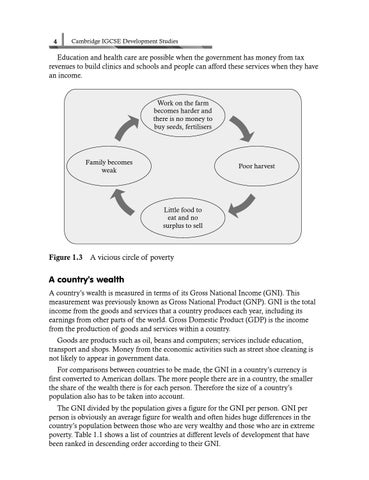
Work on the farm becomes harder and there is no money to buy seeds, fertilisers
Family becomes weak
Poor harvest
Little food to eat and no surplus to sell
Figure 1.3 A vicious circle of poverty
A country’s wealth A country’s wealth is measured in terms of its Gross National Income (GNI). This measurement was previously known as Gross National Product (GNP). GNI is the total income from the goods and services that a country produces each year, including its earnings from other parts of the world. Gross Domestic Product (GDP) is the income from the production of goods and services within a country. Goods are products such as oil, beans and computers; services include education, transport and shops. Money from the economic activities such as street shoe cleaning is not likely to appear in government data. For comparisons between countries to be made, the GNI in a country’s currency is first converted to American dollars. The more people there are in a country, the smaller the share of the wealth there is for each person. Therefore the size of a country’s population also has to be taken into account. The GNI divided by the population gives a figure for the GNI per person. GNI per person is obviously an average figure for wealth and often hides huge differences in the country’s population between those who are very wealthy and those who are in extreme poverty. Table 1.1 shows a list of countries at different levels of development that have been ranked in descending order according to their GNI.