Answers
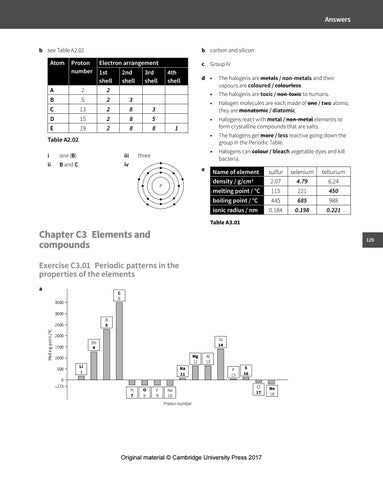
b see Table A2.02
Atom
b carbon and silicon
Proton number
Electron arrangement 1st shell
2nd shell
c Group IV
3rd shell
A
2
2
B
5
2
3
C
13
2
8
3
D
15
2
8
5
E
19
2
8
8
4th shell
d • The halogens are metals / non-metals and their vapours are coloured / colourless. • The halogens are toxic / non-toxic to humans. • H alogen molecules are each made of one / two atoms; they are monatomic / diatomic. alogens react with metal / non-metal elements to • H form crystalline compounds that are salts.
1
• T he halogens get more / less reactive going down the group in the Periodic Table.
Table A2.02 i
• H alogens can colour / bleach vegetable dyes and kill bacteria.
iii three
one (B)
ii B and C
iv
e
Name of element
sulfur
selenium
tellurium
density / g/cm
2.07
4.79
6.24
melting point / °C
115
221
450
boiling point / °C
445
685
988
ionic radius / nm
0.184
0.198
0.221
3
P
Table A3.01
Chapter C3 Elements and compounds
129
Exercise C3.01 Periodic patterns in the properties of the elements a
C 6
3500 3000 B 5
Melting point / ºC
2500 2000
Si 14
Be 4
1500
Mg 12
1000 500 0 –273
Li 3
Na 11 N 7
O 8
F 9
Ne 10
Al 13 P 15
S 16 Cl 17
Proton number
Original material © Cambridge University Press 2017
Ne 18