Cambridge IGCSE Chemistry, Fourth Editon matches the requirements of the latest Cambridge IGCSE Chemistry syllabus (0620). It is endorsed by Cambridge International Examinations for use with their examination. This engaging Workbook is intended to be used alongside the Cambridge IGCSE Chemistry, Fourth edition Coursebook. It contains exercises that are arranged in the same order as the chapters in the Coursebook and covers both Core and Supplementary material. A Teacher’s sThe Workbook: • focuses on developing skills that students need to do well in their exams, including problem solving, interpreting and evaluating data, and applying knowledge • develops skills required for practical work, such as handling, interpretation and presentation of data • includes self-assessment checklists that help students develop an evaluative approach to their work • uses simple and clear language to make the text accessible to all abilities. Answers and workings for the Workbook exercises are included on the Teacher’s Resource CD-ROM.
Cambridge IGCSE Chemistry Workbook
Richard Harwood and Ian Lodge
Cambridge IGCSE®
Chemistry Workbook
Other components of IGCSE Chemistry, Fourth edition: Coursebook ISBN 978-1-107-61503-8 Teacher’s resource ISBN 978-1-107-61501-4
Fourth edition
Completely Cambridge – Cambridge resources for Cambridge qualifications Cambridge University Press works closely with Cambridge International Examinations as parts of the University of Cambridge. We enable thousands of students to pass their Cambridge exams by providing comprehensive, high-quality, endorsed resources. To find out more about Cambridge International Examinations visit www.cie.org.uk Visit education.cambridge.org/cie for information on our full range of Cambridge IGCSE titles including e-book versions and mobile apps.
Harwood and Lodge
9780521757843 Cambers & Sibley: IGCSE Chemistry Cover. C M Y K
Cambridge IGCSE Chemistry, Fourth edition Richard Harwood and Ian Lodge
Original material © Cambridge University Press 2014
Richard Harwood and Ian Lodge
Cambridge IGCSEÂŽ
Chemistry Workbook Fourth edition
Original material Š Cambridge University Press 2014
University Printing House, Cambridge CB2 8BS, United Kingdom Cambridge University Press is part of the University of Cambridge. It furthers the University’s mission by disseminating knowledge in the pursuit of education, learning and research at the highest international levels of excellence. www.cambridge.org Information on this title: www.cambridge.org/xxxxxxxxxxxxx © Cambridge University Press 2014 This publication is in copyright. Subject to statutory exception and to the provisions of relevant collective licensing agreements, no reproduction of any part may take place without the written permission of Cambridge University Press. First published 2010 3rd printing 2011 Printed xxxxxxxxxxxxx A catalogue record for this publication is available from the British Library LOC (to come)
ISBN xxx-x-xxx-xxxxx-x Additional resources for this publication at www.cambridge.org/delange Cambridge University Press has no responsibility for the persistence or accuracy of URLs for external or third-party internet websites referred to in this publication, and does not guarantee that any content on such websites is, or will remain, accurate or appropriate. notice to teachers The photocopy masters in this publication may be photocopied or distributed [electronically] free of charge for classroom use within the school or institution that purchased the publication. Worksheets and copies of them remain in the copyright of Cambridge University Press, and such copies may not be distributed or used in any way outside the purchasing institution.
Original material © Cambridge University Press 2014
Contents Introduction
v
1
1
Planet Earth 1.1 1.2 1.3 1.4 1.5
2
3
Global warming and the ‘greenhouse effect’ 1 Atmospheric pollution, industry and transport 5 Clean water is crucial 8 Gases in the air 10 Hydrogen as a fuel 14
The nature of matter
15
2.1 2.2 2.3 2.4 2.5 2.6
15 17 20 22 23 25
Changing physical state Plotting a cooling curve Diffusion, solubility and separation Chromatography at the races Atomic structure Influential organisation
Elements and compounds
5
7
28 30 31 32 34 36 38 39
42
4.1 4.2 4.3 4.4 4.5 4.6 4.7
43 44 45 46 48 52 54
Key chemical reactions The action of heat on metal carbonates The nature of electrolysis Displacement reactions of the halogens Self-heating cans, hand warmers and cool packs The movement of ions Making and ‘breaking’ copper chloride
Acids, bases and salts
57
5.1 5.2 5.3 5.4 5.5 5.6 5.7
57 58 59 61 62 64
Acid and base reactions – neutralisation Types of salt Antacids Fire extinguishers Descaling a coffee machine The analysis of titration results Thermochemistry – investigating the neutralisation of an acid by an alkali 5.8 Deducing the formula from a precipitation reaction
66 70
71
6.1 Calculating formula masses 6.2 A sense of proportion in chemistry 6.3 Calculating the percentage of certain elements in a compound and empirical formulae 6.4 Calculations involving solutions 6.5 Finding the mass of 5 cm of magnesium ribbon 6.6 Reacting volumes of gases 6.7 Calculation triangles 6.8 Scaling up!
71 73
How far? How fast?
7.5 7.6 7.7 7.8
8
40
Chemical reactions
Quantitative chemistry
7.1 7.2 7.3 7.4
28
3.1 Periodic patterns in the properties of the elements 3.2 The first four periods 3.3 Trends in the halogens 3.4 The chemical bonding in simple molecules 3.5 Formulae of ionic compounds 3.6 The bonding in covalent molecules 3.7 The nature of ionic lattices 3.8 Giant molecular lattices 3.9 Making magnesium oxide – a quantitative investigation
4
6
9
74 75 77 78 80 81
83
Terms of reaction 84 Energy diagrams 85 The collision theory of reaction rates 88 The influence of surface area on the rate of reaction 89 Finding the rate of a reaction producing a gas 92 Runaway reactions 95 CCS (carbon capture and storage) 98 Reversible reactions involving inter-halogen compounds 100
Patterns and properties of metals
102
8.1 8.2 8.3 8.4 8.5
102 103 105 109 111
Group I: The alkali metals The reactivity series of metals Energy from displacement reactions Electrochemical cells Metals and alloys
Industrial inorganic chemistry
113
9.1 9.2 9.3 9.4 9.5 9.6 9.7
113 114 115 118 120 122 124
Metal alloys and their uses Extracting aluminium by electrolysis The importance of nitrogen Making sulfuric acid industrially Concrete chemistry The chlor–alkali industry Making sodium carbonate
10 Organic chemistry 10.1 10.2 10.3 10.4 10.5 10.6
126
Families of hydrocarbons Unsaturated hydrocarbons (the alkenes) The alcohols as fuels Reactions of ethanoic acid Hydrocarbons and their reactions The chemistry of butanol
Original material © Cambridge University Press 2014
Contents
127 128 130 133 135 137 iii
11 Petrochemicals and polymers
139
11.1 Essential processes of the petrochemical industry 140 11.2 Addition polymerisation 141 11.3 The structure of man-made fibre molecules 142 11.4 Condensation polymerisation 143 11.5 The analysis of condensation polymers 145 11.6 Representing condensation polymerisation reactions 147 11.7 Small-scale molecular engineering 149 11.8 Meeting fuel demand 152 11.9 Smooth running 154
iv
Contents
12 Chemical analysis and investigation 12.1 12.2 12.3 12.4 12.5
Titration analysis Chemical analysis Planning a controlled experiment Chemical testing and evaluation Experimental design
Original material Š Cambridge University Press 2014
157 157 159 163 166 169
Introduction This workbook contains exercises designed to help you to develop the skills you need to do well in your IGCSE Chemistry examination. The IGCSE examination tests three different Assessment Objectives. These are: AO1 AO2 AO3
Knowledge with understanding Handling information and problem solving Experimental skills and investigations
In the examination, about 50% of the marks are for objective AO1, 30% for objective AO2 and 20% for AO3. Just learning your work and remembering it is, therefore, not enough to make sure that you get the best possible grade in the exam. Half of all the marks are for objectives AO2 and AO3. You need to be able to use what you have learnt and apply it in unfamiliar contexts (AO2) and to demonstrate experimental and data handling skills (AO3). There are lots of exam-style questions in your coursebook which, together with the material on the accompanying CD-ROM, are aimed at helping you to develop the examination skills necessary to achieve your potential in the exams. Chapter 12 in the coursebook also deals with the experimental skills you will need to apply during your course. This workbook adds detailed exercises to help you further. There are some questions that simply involve remembering things you have been taught (AO1), but most of the exercises require you to use what you have learned to extend your knowledge to novel situations that you have not met before, or to work out, for example, what a set of data means, and indeed to suggest how an experiment might be improved: they are aimed at developing objectives AO2 and AO3. Chemistry is a subject where it is important to understand the connections between the ideas involved. So, while each exercise has a focus on a particular topic, the questions will take you to different connected areas of the subject. There are also exercises, particularly in Chapter 12, aimed at developing your skills in planning practical investigations; an important area of objective AO3. There are a good many opportunities for you to draw graphs, read scales, interpret data and draw conclusions. These skills are heavily examined in Paper 6 of the CIE syllabus and so need continuous practice to get them right. Self-assessment check lists are provided to enable you to judge your work according to criteria similar to those used by examiners. You can try marking your own work using these. This will help you to remember the important points to think about. Your teacher should also mark the work, and will discuss with you whether your own assessments are right. The workbook follows the same chapter breakdown as the coursebook. It is not intended that you should necessarily do the exercises in the order printed, but that you should do them as needed during your course. There are questions from all sections of the syllabus and one aim has been to give a broad range of examples of how the syllabus material is used in exam questions. The workbook is aimed at helping all students that are taking the Chemistry course. In some exercises, you will see this symbol in the margin: S
This indicates that the exercise is intended for students who are studying the Supplement content of the syllabus as well as the Core. We trust that the range and differing approaches of the exercises will help you develop a good understanding of the course material and the skills to do really well in the exams.
Original material © Cambridge University Press 2014
Introduction
v
vi
Cambridge IGCSE Physics
Ca
Calcium
K
Potassium
Actinium
Radium
Francium
Original material © Cambridge University Press 2014
Key
b
X
a
Hf
179
Zirconium
Zr
91
Titanium
Rf
73
Db
262
Tantalum
Ta
181
Niobium
Nb
93
Vanadium
41
23
V
51
b = proton (atomic) number
X = atomic symbol
†
*
90
58
52
Sg
263
Tungsten
232 Thorium
Th
– Tc
Manganese 25
Bh
264
Rhenium
Nd
144
Bohrium 107
75
Re
U
Protactinium Uranium 91 92
Pa
Praseodymium Neodymium 59 60 231 238
141
Pr
Seaborgium 106
74
W
140 Cerium
55
Mn
Technetium Molybdenum 43 42 184 186
Mo
Chromium 24 96
Cr
Ce
Rutherfordium Dubnium † 104 105
a = relative atomic mass
89
Ac
Ra
Fr
88
40
22
48
Ti
Lanthanum Hafnium 57 * 72 227 261
La
139
Yttrium
Y
89
Scandium
226
Barium
56
Caesium
39
21
45
Sc
223
Ba
Cs
*58–71 Lanthanoid series †90–103 Actinoid series
87
55
137
Strontium
38
Rubidium
133
88
Sr
85
Rb
20
Magnesium 12 40
Sodium
39
24
Mg
Beryllium
Lithium
23
Be
Li
4
9
7
Na
37
19
11
3
II
I
27
59
28
59
29
64
30
65
5
56
Hs
265
Osmium
Mt
268
Indium
Ir
192
Rhodium
Sm
150
Meitnerium 109
77
45
Rh
103
Cobalt
Co
Neptunium 93
Np 94
Plutonium
Pu
Promethium Samarium 61 62 237 244
Pm
145
Hassium 108
76
Os
Ruthenium 44 190
Ru
101
Iron
Fe
Ds
281
Platinum
Pt
195
Palladium
79
47
Rg
273
Gold
Au
197
Silver
Ag
108
Copper
Cu
Am
243
Europium
Americium 95
63
Eu
152
96
Curium
Cm
Gadolinium 64 247
Gd
157
Darmstadtium Roentgenium 110 111
78
46
Pd
106
Nickel
Ni
– Cn
Mercury
Hg
201
Cadmium
81
49
31
– Uut
Thallium
Tl
204
Indium
In
115
Gallium
Ga
97
65
Berkelium
Bk
247
Terbium
Tb
159
Californium 98
Cf
Dysprosium 66 251
Dy
163
Ununtrium Copernicium 112 113
80
48
Cd
112
Zinc
Zn
Aluminium 13 70
Al
27
Boron
B 6
Ge
73
Silicon
Tin
– Fl
Lead
Pb
207
7
8
Es
252
Holmium
– Uup
Bismuth
Bi
209
Antimony
Sb
122
Arsenic
84
52
34
16
– Lv
Polonium
Po
209
Tellurium
Te
128
Selenium
Se
79
Sulfur
S
32
Oxygen
O
16
9
85
53
35
17
– Uus
Astatine
At
210
Iodine
I
127
Bromine
Br
80
Chlorine
Cl
35.5
Fluorine
F
19
2
86
54
36
18
10
20
– Uuo
Radon
Rn
222
Xenon
Xe
131
Krypton
Kr
84
Argon
Ar
40
Neon
Ne
68
Fm
257
Erbium
Er
167
Md
258
Thulium 70
173
No
259
Ytterbium
Yb
Mendelevium Nobelium 101 102
69
Tm
169
Lr
262
Lutetium
Lawrencium 103
71
Lu
175
Ununpentium Livermorium Ununseptium Ununoctium 118 115 116 117
83
51
33
As
Phosphorus 15 75
P
31
Nitrogen
N
14
Einsteinium Fermium 99 100
67
Ho
165
Flerovium 114
82
50
Sn
Germanium 32 119
14
Si
28
Carbon
C
12
0
Helium 11
VII
Hydrogen
VI
4
V
He
IV
H
III 1
26
1
Group
The Periodic Table
1 Planet Earth Definitions to learn ◆ ◆ ◆
◆
acid rain rainfall with a pH usually less than 5 resulting from dissolved atmospheric pollution greenhouse gas a gas which absorbs heat (infrared radiation) and keeps the surface of the planet warm photosynthesis the photochemical reaction in the green leaves of plants that turns carbon dioxide and water into glucose and oxygen respiration the biochemical reaction in living cells that produces energy from the reaction of glucose and oxygen to produce carbon dioxide and water
Useful equations carbon dioxide + water → glucose + oxygen
6CO2 + 6H2O → C6H12O6 + 6O2
photosynthesis
glucose + oxygen → carbon dioxide + water
C6H12O6 + 6O2 → 6CO2 + 6H2O
respiration
Exercise 1.1
Global warming and the ‘greenhouse effect’
This exercise will help in developing your skills at processing unfamiliar data and making deductions from novel sources. carbon dioxide in atmosphere
The diagram shows a simplified carbon cycle.
a Describe the process of photosynthesis in simple terms. combustion and respiration
fossil fuels
photosynthesis
oceans
limestone sediments
The ‘greenhouse effect’ is caused by heat from the Sun being trapped inside the Earth’s atmosphere by some of the gases which are present – their molecules absorb infrared radiation. As the amount of these ‘greenhouse gases’ increases, the mean (average) temperature of the Earth increases. It is estimated that, if there were no ‘greenhouse effect,’ the Earth’s temperature would be cooler by 33 °C on average. Some of the gases which cause this effect are carbon dioxide, methane and oxides of nitrogen (NOx). Original material © Cambridge University Press 2014
Chapter 1: Planet Earth
1
Global warming: Since the burning of fossil fuels started to increase in the late nineteenth century, the amount of carbon dioxide in the atmosphere has increased steadily. The changes in the mean temperature of the Earth have not been quite so regular. Below are some data regarding the changes in mean temperature of the Earth and amount of carbon dioxide in the atmosphere. The first table (Table 1) gives the changes over recent years, while the second table gives the longer-term changes (Table 2). The mean temperature is the average over all parts of the Earth’s surface over a whole year. The amount of carbon dioxide is given in ppm (parts of carbon dioxide per million parts of air). Year
CO2 / ppm
Mean temperature / ºC
Year
CO2 / ppm
Mean temperature / ºC
1982
340
14.08
1880
291
13.92
1984
343
14.15
1890
294
13.81
1986
347
14.19
1900
297
13.95
1988
351
14.41
1910
300
13.80
1990
354
14.48
1920
303
13.82
1992
356
14.15
1930
306
13.96
1994
358
14.31
1940
309
14.14
1996
361
14.36
1950
312
13.83
1998
366
14.70
1960
317
13.99
2000
369
14.39
1970
324
14.04
2002
373
14.67
1980
338
14.28
2004
377
14.58
2006
381
14.63
2008
385
14.51
2010
390
14.69
2012
394
14.59
Table 2
Table 1
b Plot these results on the grid using the left-hand y-axis for amount of carbon dioxide and the right-hand y-axis for mean temperature. Draw two separate graphs to enable you to compare the trends. (Use graph paper if you need a larger grid.)
c What do you notice about the trend in amount of carbon dioxide?
d What do you notice about the trend in mean temperature?
2
Cambridge IGCSE Chemistry
Original material © Cambridge University Press 2014
16.2
440
16.0
430
15.8
420
15.6
410
15.4
400
15.2
390
15.0
380
14.8
370
14.6
360
14.4
350
14.2
340
14.0
330
13.8
320
13.6
310
13.4
300
13.2
290 1880
1900
1920
1940
1960 Year
1980
2000
2020
Mean temperature / °C
Carbon dioxide / ppm
450
13.0 2040
e Does the graph clearly show that an increase in carbon dioxide is causing an increase in temperature?
f Estimate the amount of carbon dioxide in the atmosphere and the likely mean temperature of the Earth in the years 2020 and 2040.
g Between the eleventh century and the end of the eighteenth century the amount of carbon dioxide in the atmosphere varied between 275 and 280 ppm. Why did it start to rise from the nineteenth century onwards.
h Other ‘greenhouse gases’ are present in much smaller amounts. However, they are much more effective at keeping in heat than carbon dioxide. Methane (1.7 ppm) has 21 times the effect of carbon dioxide. Nitrogen oxides (0.3 ppm) have 310 times the effect of carbon dioxide. Name a source that releases each of these gases into the atmosphere. Methane: Nitrogen oxides: Original material © Cambridge University Press 2014
Chapter 1: Planet Earth
3
Use the checklist below to give yourself a mark for your graph. For each point, award yourself: 2 marks if you did it really well 1 mark if you made a good attempt at it, and partly succeeded 0 marks if you did not try to do it, or did not succeed. Self-assessment checklist for graphs: Marks awarded
Check point
You
You have plotted each point precisely and correctly for both sets of data – using the different scales on the two vertical axes. You have used a small, neat cross or dot for the points of one graph. You have used a small, but different, symbol for the points of the other graph. You have drawn the connecting lines through one set of points accurately – using a ruler for the lines. You have drawn the connecting lines through the other set of points accurately – using a different colour or broken line. You have ignored any anomalous results when drawing the lines. Total (out of 12)
10–12 7–9 4–6 2–3 1
4
Excellent. Good. A good start, but you need to improve quite a bit. Poor. Try this same graph again, using a new sheet of graph paper. Very poor. Read through all the criteria again, and then try the same graph again.
Cambridge IGCSE Chemistry
Original material © Cambridge University Press 2014
Your teacher
Exercise 1.2 Atmospheric pollution, industry and transport This exercise discusses different aspects of atmospheric pollution and relates it to key aspects of human activity. It will help you in developing your skills in evaluating data and drawing conclusions from them. The following pie charts show estimates of the sources of three major atmospheric pollutants in an industrialised country.
Sulfur dioxide
3% industrial home heating
Nitrogen oxides
10%
10%
home heating
18% power stations
others 1%
industrial
transport 2%
transport
70%
22%
power stations
64%
home heating
others Carbon monoxide
16%
14%
1% power stations
transport 69%
a What is the largest source of sulfur dioxide pollution?
b Name the three major fuels whose combustion gives rise to the levels of sulfur dioxide in the atmosphere.
c Units are being added to the some power stations and industrial plants to prevent the emission of sulfur dioxide. What is the name given to these units?
d Nitrogen oxides (NOx) are another major pollutant of the atmosphere, particularly in large cities. i
Nitrogen monoxide is formed by the reaction of nitrogen and oxygen inside the hot engine of cars and other vehicles. Complete the following equation for the reaction producing nitrogen monoxide. N2 + O2 →
NO
Original material Š Cambridge University Press 2014
Chapter 1: Planet Earth
5
ii When leaving the car, nitrogen monoxide in the exhaust fumes reacts further with oxygen in the air to produce the brown gas which can be seen in the atmosphere over large cities. This gas is nitrogen dioxide. Balance the equation for the production of this gas. nitrogen monoxide + oxygen → nitrogen dioxide NO
+
O2 →
NO2
iii The operating temperature of a diesel engine is significantly higher than that of a petrol (gasoline) engine. Would you expect the level of NOx emissions from a diesel-powered vehicle to be greater or lower than from a petrol-powered vehicle? Give the reason for your answer.
iv What attachment is fitted to modern cars to reduce the level of pollution by oxides of nitrogen?
e Nitrogen oxides, unburnt hydrocarbons and carbon monoxide combine together under the influence of
S
ultraviolet light to produce photochemical smog. i
Why do you think this form of pollution is most common in large cities?
ii What other form of pollution from car exhaust fumes has now almost totally disappeared from modern cities following changes in fuel and pollution monitoring?
f In order to control traffic flow, London introduced a ‘congestion charge’ for vehicles entering the centre of the city in 2003. The table shows figures for the percentage fall in the levels of certain pollutants following the introduction of the congestion charge. Pollutant gas within Congestion Charge Zone NOx
CO2
Overall traffic emissions change 2003 versus 2002 / %
−13.4
−16.4
Overall traffic emissions change 2004 versus 2003 / %
−5.2
−0.9
−17.3
−3.4
Change due to improved vehicle technology, 2003 to 2006 / %
i
6
What was the measured percentage drop in the level of nitrogen oxides within the Congestion Charge Zone over the first two years following the introduction of the charge?
Cambridge IGCSE Chemistry
Original material © Cambridge University Press 2014
S
ii At face value there seems to be a drop in the levels of pollutants following the introduction of the congestion charge. But should we expect the fall in pollution levels to continue?
iii An independent study published in 2011 suggested that other factors should be taken into account, particularly when trying to study a relatively small area within a large city. One factor is hinted at in the third row of figures. What is that factor; and what other influences need to be taken into account in considering this situation?
g The use of fossil fuels in industry and transport also produces carbon dioxide. What is the reasoning behind the slogan painted on these freight containers seen waiting to be loaded on to a freight train outside a major UK station? Outline the argument behind the slogan.
Original material Š Cambridge University Press 2014
Chapter 1: Planet Earth
7
Exercise 1.3
Clean water is crucial
This exercise covers aspects of how we produce clean water for domestic and industrial use, focusing on stages that depend on key physical and chemical techniques. The provision of clean drinking water and sanitation to more of the world’s population is one of the key millennium goals of the United Nations. The lack of this basic provision impacts not only on the levels of disease in an area, in particular the mortality rate of children, but also on the level of education and the role of women within a community. The diagram shows the different stages involved in a modern water plant producing water for domestic and industrial use.
river river water pumping station
precipitators to clear solid particles
storage reservoir
rapid gravity sand filters
pump treated with a small amount of ozone to disinfect the water
screens for straining floating rubbish
main ozone pumps chlorine
microstrainers
a small amount of chlorine is used to disinfect water
activated carbon granules absorb some of the chemicals
the main dose of ozone to break down pesticides and other materials
drinking water service reservoir
a What devices are used in the early stages of processing to remove insoluble debris and material? Include comments on the size of the material removed by these methods.
b What is the common purpose of treating the water with chlorine and/or ozone?
8
Cambridge IGCSE Chemistry
Original material Š Cambridge University Press 2014
c What other purpose does treatment with ozone achieve?
d What type of chemical agent is ozone (O3) behaving as in the reactions involved in part c?
e Countries that have insufficient rainfall, or where water supply is in great demand, may need to use other methods of producing clean water. Here, processes for desalination are used. i
What does the term desalination mean?
ii Name two methods that such countries use for desalination.
iii Give one disadvantage of these methods of desalination.
f Tap water produced by this type of treatment is clean, but it is not pure. It will contain metal and non-metal ions dissolved from the rocks that the rivers and streams have flowed over. i
Chloride ions are present in tap water. Describe a chemical test that would show the presence of chloride ions (Cl−) in the water. Describe the test and what would be observed.
ii One of the chlorides often present in tap water is sodium chloride. Give the word and balanced symbol equation for the reaction taking place in the test you have described above.
S
sodium chloride
+
→
+
NaCl
+
→
+
iii Give the ionic equation for the reaction taking place (include state symbols).
Original material © Cambridge University Press 2014
Chapter 1: Planet Earth
9
Exercise 1.4
Gases in the air
This exercise discusses how the composition of the Earth’s atmosphere has been influenced by volcanic emissions over the duration of the life of the planet. It looks at how the composition of the atmosphere has changed and how we purify the different gases from the air. There have been several spectacular volcanic eruptions in recent years. In 2010, clouds of ash from the relatively small eruption of the Eyjafjallajokoll volcano in Iceland caused disruption in most of European airspace throughout the month of April. The diagram shows the spread of the volcanic ash cloud over Europe during April 2010.
site of the volcano
10
Cambridge IGCSE Chemistry
Original material © Cambridge University Press 2014
Active volcanoes produce many unseen products which are thrown out into the atmosphere. The table below shows the gases released by an active Icelandic volcano. Name of gas
Percentage of total gas released / %
sulfur dioxide
11.70
nitrogen
3.20
water vapour
35.60
hydrogen
0.39
carbon dioxide
47.40
carbon monoxide
1.71
a Which gas is present in the largest quantity in the gases released by the volcano?
b Explain why water is in the gas phase when it comes out of the volcano.
c Comment on what happens to the hydrogen released from the volcano. Why is it not kept within the Earth’s atmosphere?
It is now recognised that the early atmosphere of the Earth was generated by release of gases from volcanoes. The composition of air has changed significantly over millions of years. The following table shows how the composition of the atmosphere has changed since the formation of the planet 4500 million years ago. Time in the past / million years present
formation
0
Approximate proportion of carbon dioxide / %
Approximate proportion of oxygen / %
Approximate proportion of gas X / %
0.04
20
79
500
1
20
78
1000
2
19
77
1500
5
18
75
2000
7
10
70
2500
10
5
60
3000
15
1
55
3500
21
0.5
40
4000
40
0
30
4500
90
0
10
Original material Š Cambridge University Press 2014
Chapter 1: Planet Earth
11
d Using the grid below, draw graphs of how the proportions of the three gases listed in the table have changed over time from the origin of the Earth.
e Identify gas X, giving your reasoning.
f Water vapour is released by volcanoes as a gas. What eventually happened to the water vapour in the atmosphere?
g Mark arrows on the timeline of your graph to indicate the points at which the following occurred: i the oceans were formed ii the first forms of bacteria (including photosynthesising algae) appeared iii vegetation on land appeared.
h Explain why the appearance of photosynthetic algae, followed by land vegetation and plants, caused a change in the level of carbon dioxide present in the air.
12
Cambridge IGCSE Chemistry
Original material Š Cambridge University Press 2014
S
i The gases in the atmosphere can be separated and purified by fractional distillation of liquid air. Dust-free air is cooled to around −80 °C to remove water and carbon dioxide. The air is then cooled to −200 °C at high pressure to liquefy it. The table shows the boiling points of the gases involved. Gas
i
Boiling point / °C
argon
−186
helium
−269
krypton
−157
neon
−246
nitrogen
−196
oxygen
−183
xenon
−108
Which gases will not become liquid at −200 °C?
ii Outline how the liquid air is separated by fractional distillation, stating clearly which gas will be the first to distil over?
iii Which two gases are difficult to separate by this method? Why is this?
iv Give one major use each for liquid nitrogen and liquid oxygen.
Original material © Cambridge University Press 2014
Chapter 1: Planet Earth
13
Exercise 1.5
Hydrogen as a fuel
This exercise introduces hydrogen as an alternative energy source and will help develop your skills at handling information regarding unfamiliar applications. One of the first buses to use hydrogen as a fuel was operated in Erlangen, Germany, in 1996. The hydrogen was stored in thick pressurised tanks on the roof of the bus.
a Describe two advantages of using hydrogen as a fuel rather than gasoline (petrol).
b Suggest one disadvantage of using hydrogen as a fuel.
It is possible to generate electrical energy from hydrogen using a fuel cell. The structure of a typical fuel cell is shown in the diagram.
S
external circuit hydrogen gas
electrolyte
oxygen gas
porous carbon cathode
porous carbon anode
water
c The reaction taking place in such a fuel cell is the combustion of hydrogen. Write the overall equation for that reaction.
d The equation for the reaction at the anode is H2(g) + 2OH−(aq) → 2H2O(l) + 2e− What type of reaction is this? Explain your answer.
e At the cathode oxygen molecules react with water molecules to form hydroxide ions. Write an ionic equation for this reaction.
14
Cambridge IGCSE Chemistry
Original material © Cambridge University Press 2014
2 The nature of matter Definitions to learn ◆ ◆ ◆ ◆ ◆ ◆ ◆ ◆ ◆ ◆ ◆ ◆
◆ ◆ ◆ ◆ ◆ ◆
physical state the three states of matter are solid, liquid and gas condensation the change of state from gas to liquid melting the change of state from solid to liquid freezing the change of state from liquid to solid at the melting point boiling the change of state from liquid to gas at the boiling point of the liquid evaporation the change of state from liquid to gas below the boiling point sublimation the change of state directly from solid to gas (or the reverse) crystallisation the formation of crystals when a saturated solution is left to cool filtration the separation of a solid from a liquid using filter paper distillation the separation of a liquid from a mixture using differences in boiling point fractional distillation the separation of a mixture of liquids using differences in boiling point diffusion the random movement of particles in a fluid (liquid or gas) leading to the complete mixing of the particles chromatography the separation of a mixture of soluble (coloured) substances using paper and a solvent atom the smallest part of an element that can take part in a chemical change proton number (atomic number) the number of protons in the nucleus of an atom of an element nucleon number (mass number) the number of protons and neutrons in the nucleus of an atom electron arrangement the organisation of electrons in their different energy levels (shells) isotopes atoms of the same element which have the same proton number but a different nucleon number
Exercise 2.1
Changing physical state
This exercise will develop your understanding of the kinetic theory and the energy changes involved in changes of physical state.
Temperature / ºC
The graph shows the heating curve for a pure substance. The temperature rises with time as the substance is heated.
D
115
C B
17
A 0
0
Time
a What physical state(s) is the substance in at points A, B, C and D? A
C
B
D Original material © Cambridge University Press 2014
Chapter 2: The nature of matter
15
b What is the melting point of the substance? c What is its boiling point? d What happens to the temperature while the substance is changing state?
e The substance is not water. How do we know this from the graph?
f Complete the passage using the words given below. different diffuse
diffusion random
gas lattice
The kinetic theory states that the
spread vibrate
particles temperature
in a liquid and a
are in constant motion. In a gas, the particles are far apart from each other and their motion is . The particles in a solid are held in fixed positions in a regular
said to be
. In a solid, the particles can only
about their fixed positions.
Liquids and gases are fluid states. When particles move in a fluid, they can collide with each other. When directions. If two gases or liquids are
they collide, they bounce off each other in
out and get mixed up. This process is called
mixed, the different types of particle . At the same
S
particles that have a lower mass move faster than those with higher
mass. This means that the lighter particles will spread and mix more quickly; the lighter particles are said to faster than the heavier particles.
g Use the data given for the substances listed below to answer the questions that follow on their physical state at a room temperature of 25 °C and atmospheric pressure. Substance
Melting point / °C
Boiling point / °C
98
883
−71
−62
ethanol
−117
78
cobalt
1492
2900
nitrogen
−210
−196
propane
−188
−42
16
118
sodium radon
ethanoic acid
16
Cambridge IGCSE Chemistry
Original material © Cambridge University Press 2014
i
Which substance is a liquid over the smallest range of temperature?
ii Which two substances are gaseous at −50 °C? and iii Which substance has the lowest freezing point? iv Which substance is liquid at 2500 °C? v A sample of ethanoic acid was found to boil at 121 °C at atmospheric pressure. Use the information in the table to comment on this result.
Exercise 2.2
Plotting a cooling curve
This exercise presents data obtained practically for plotting a cooling curve. It will help develop your skills in handling the data and interpreting what changes the different regions of the curve represent. Examples of sublimation are also discussed. A Ghanaian student, Ofori, carried out the following data-logging experiment as part of a project on changes of state. An organic crystalline solid was melted by placing it in a tube in a boiling water bath. A temperature sensor was placed in the liquid.
computer
temperature sensor
bath of boiling water
magnetic stirrer
The temperature change was followed as the liquid was allowed to cool down. The data shown in the table below are taken from the computer record of the temperature change as the liquid cooled down to room temperature. Time / min Temperature / °C
0
0.5
1.0
1.5
2.0
2.2
2.4
2.6
2.8
3.0
3.5
4.0
4.5
5.0
96.1
89.2
85.2
82.0
80.9
80.7
80.6
80.6
80.5
80.3
78.4
74.2
64.6
47.0
Original material © Cambridge University Press 2014
Chapter 2: The nature of matter
17
a On the grid below, plot a graph of the temperature change taking place in this experiment.
b What change is taking place over the second minute of the experiment?
S
c Why does the temperature remain almost constant over this period of time? Give your explanation in terms of what is happening to the organisation of the molecules of the substance.
d What change would need to be made to carry out the experiment using a compound with a melting point greater than 100 °C?
18
Cambridge IGCSE Chemistry
Original material Š Cambridge University Press 2014
e A similar experiment was carried out to demonstrate the cooling curve for paraffin wax. i
In the space below, sketch the shape of the graph you would expect to produce.
ii Explain why the curve is the shape you have drawn.
f Sublimation occurs when a substance passes between the solid and gaseous states without going through the liquid phase. Both carbon dioxide and water can sublime under certain conditions of temperature and pressure. ‘Dry ice’ is the solid form of carbon dioxide used in commercial refrigeration. At atmospheric pressure it has a ‘sublimation point’ of –78.5°C. i
What difference can you see between solid carbon dioxide and water ice at atmospheric pressure?
CO2
ii If you gently shake a carbon dioxide fire extinguisher, you will feel the presence of liquid within the extinguisher. What conditions within the extinguisher mean that the CO2 is liquid in this case?
iii Complete the following paragraph about a particular type of frost using the words listed below. surrounding white
liquid crystals
Hoar frost is a powdery
colder ice
humid
frost caused when solid
air. The solid surface on which it is formed must be air. Water vapour is deposited on a surface as fine ice through the
forms from than the without going
phase.
Original material © Cambridge University Press 2014
Chapter 2: The nature of matter
19
Exercise 2.3
Diffusion, solubility and separation
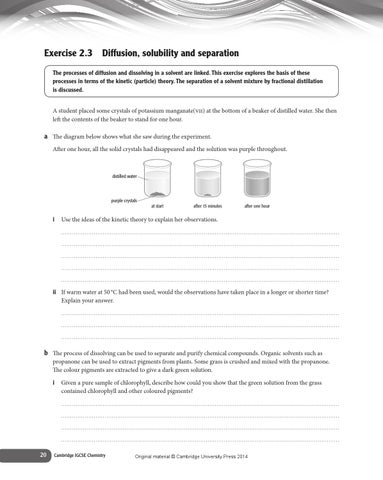
The processes of diffusion and dissolving in a solvent are linked. This exercise explores the basis of these processes in terms of the kinetic (particle) theory. The separation of a solvent mixture by fractional distillation is discussed. A student placed some crystals of potassium manganate(vii) at the bottom of a beaker of distilled water. She then left the contents of the beaker to stand for one hour.
a The diagram below shows what she saw during the experiment. After one hour, all the solid crystals had disappeared and the solution was purple throughout.
distilled water
purple crystals at start
i
after 15 minutes
after one hour
Use the ideas of the kinetic theory to explain her observations.
ii If warm water at 50 °C had been used, would the observations have taken place in a longer or shorter time? Explain your answer.
b The process of dissolving can be used to separate and purify chemical compounds. Organic solvents such as propanone can be used to extract pigments from plants. Some grass is crushed and mixed with the propanone. The colour pigments are extracted to give a dark green solution. i
20
Given a pure sample of chlorophyll, describe how could you show that the green solution from the grass contained chlorophyll and other coloured pigments?
Cambridge IGCSE Chemistry
Original material Š Cambridge University Press 2014
ii Draw a labelled diagram that describes the method of separating coloured pigments that you have discussed in part i.
Use the checklist below to give yourself a mark for your drawing. For each point, award yourself: 2 marks if you did it really well 1 mark if you made a good attempt at it, and partly succeeded 0 marks if you did not try to do it, or did not succeed. Self-assessment checklist for drawings Marks awarded
Check point
You
Your teacher
You have made a large drawing, using the space provided. There are no glaring errors – liquids missing, flasks open when they should be closed, etc. You have drawn single lines with a sharp pencil, not many tries at the same line (and erased mistakes). You have used a ruler for the lines that are straight. Your diagram is in the right proportions. You have drawn label lines with a ruler, touching the item being labelled. You have written the labels horizontally and neatly, well away from the diagram itself. Total (out of 14)
12–14 10–11 7–9 5–6 1–4
Excellent. Good. A good start, but you need to improve quite a bit. Poor. Try this same drawing again, using a new sheet of paper. Very poor. Read through all the criteria again, and then try the same drawing.
Original material © Cambridge University Press 2014
Chapter 2: The nature of matter
21
iii Explain the role of chlorophyll in the leaves of green plants.
c Propanone is a very useful solvent that mixes well with water even though it is an organic compound. A propanone:water (65%:35%) mixture used for cleaning laboratory apparatus can be separated using fractional distillation. A total volume of 80 cm3 of the mixture was distilled. Sketch below a graph of the temperature readings against the volume of distillate collected for the distillation carried out. The thermometer is placed at the connection between the fractionating column and the condenser. The boiling point of propanone is 56 °C.
Exercise 2.4
Chromatography at the races
This exercise will help you understand aspects of chromatography by considering an unfamiliar application of the technique. Chromatography is used by the ‘Horse Racing Forensic Laboratory’ to test for the presence of illegal drugs in racehorses. A concentrated sample of urine is spotted on to chromatography paper on the start line. Alongside this, known drugs are spotted. The chromatogram is run using methanol as the solvent. When finished, the paper is read by placing it under ultraviolet light. A chromatogram of urine from four racehorses is shown below. solvent front
10
Spot
Description
1
caffeine
2
paracetamol
4
3
urine sample horse A
3
4
urine sample horse B
5
urine sample horse C
6
urine sample horse D
9 8
Scale / cm
7 6 5
2 1 start line
0 1
22
Cambridge IGCSE Chemistry
2
3
4
5
6
Original material © Cambridge University Press 2014
a State two factors which determine the distance a substance travels up the paper.
b The results show that the sample from one horse contains an illegal substance. State which horse and the drug that is present.
c Give a reason for the use of this drug.
S
d The results for known drugs are given as ‘Rf values’. Rf =
distance travelled by the substance distance travelled by the solven l t
Calculate the Rf value for caffeine.
Exercise 2.5 Atomic structure This exercise helps familiarise you with aspects of atomic structure including the organisation of electrons into energy levels (or shells), and the uses of radioactivity.
a Choose from the words below to fill in the gaps in the passage. Words may be used once, more than once or not at all. proton neutrons
electrons nucleus
nucleon energy levels
Atoms are made up of three different particles: which have no charge; and
isotopes
protons
which are positively charged; which are negatively charged. (shells) around the
The negatively charged particles are arranged in different of the atom. The particles with a negligible mass are the of the same element contain the same number of same element with different numbers of
and are known as
Original material Š Cambridge University Press 2014
. All atoms . Atoms of the .
Chapter 2: The nature of matter
23
b This part of the exercise is concerned with electron arrangements and the structure of the Periodic Table. Complete these sentences by filling in the blanks with words or numbers. The electrons in an atom are arranged in a series of
around the levels. In an atom, the shell
nucleus. These shells are also called
to the nucleus fills first, then the next shell, and so on. There is room for: ●
up to
electrons in the first shell
●
up to
electrons in the second shell
●
up to
electrons in the third shell.
(There are 18 electrons in total when the three shells are completely full.) The elements in the Periodic Table are organised in the same way as the electrons fill the to
shells. Shells fill from
across
of the Periodic Table.
the ●
The first shell fills up first from
to helium.
●
The second shell fills next from lithium to
●
Eight
●
Then the fourth shell starts to fill from potassium.
.
go into the third shell from sodium to argon.
c In 1986, an explosion at Chernobyl in the Ukraine released a radioactive cloud containing various radioactive isotopes. Three such isotopes are mentioned below. Use your Periodic Table to answer the following questions about them. Element strontium
i
Nucleon (mass) number 90
iodine
131
caesium
137
How many electrons are there in one atom of strontium-90?
ii How many protons are there in one atom of iodine-131? iii How many neutrons are there in an atom of caesium-137? The prevailing winds carried fallout from Chernobyl towards Scandinavia. In Sweden, caesium-137 built up in lichen, which is the food eaten by reindeer. This gave rise to radioactive meat. iv If radioactive caesium was reacted with chlorine, would you expect the caesium chloride produced to be radioactive? Explain your answer.
24
Cambridge IGCSE Chemistry
Original material © Cambridge University Press 2014
v State a beneficial use in industry of a radioactive isotope.
vi State a medical use of a radioactive isotope.
Exercise 2.6
Influential organisation
This exercise explores aspects of the discovery of the structure of the atom and how that structure influences the major properties of the atoms of an element.
The way in which the subatomic particles are organised within an atom gives rise to the characteristic properties of that atom. Whether an atom is radioactive, the type of bond it makes, its chemical reactivity and its position in the Periodic Table are all dependent on this organisation.
a The modern view of the structure of the atom stems from experiments carried out in Rutherford’s laboratory in Manchester, UK. These experiments used α-particles fired at a sheet of gold foil. Detectors analysed the direction of the particles as they passed through the foil. The design of the experiment is summarised in the following diagram. incoming α-particles
major deflection
minor deflection
cross-section of gold foil composed of atoms with a tiny, extremely heavy, positive nucleus
1 Radioactive sample emits beam of α-particles.
2 Beam of α-particles strikes gold foil.
lead block
gold foil
5 Major deflections of α-particles are seen very rarely.
i
4 Minor deflections of α-particles are seen occasionally.
3 Flashes of light produced when α-particles strike zinc-coated screen show that most α-particles pass through with little or no deflection.
α-particles are helium nuclei. What is the composition of an α-particle and its charge? Protons: Neutrons: Charge: Original material © Cambridge University Press 2014
Chapter 2: The nature of matter
25
ii Gold foil is a solid metal. How are the atoms of gold arranged in the foil?
iii What did the fact that the majority of the α-particles passed through the foil suggest about the structure of the atoms?
iv Remarkably, some of the α-particles were repelled back in the direction from which they came. What part of the structure of the atom did this suggest the particles had hit, and why were these particles repelled backwards?
b The isotopes of certain elements, such as carbon-14, can be of use in biochemical and medical research. Because they are radioactive, they can be used by scientists to track the synthesis and use of compounds important in the chemistry of cells and tissues. i
Complete the table about the isotopes of some common elements, making deductions from the information given. For each element, the second isotope is a radioisotope used in research. Isotope
Name of element
Proton number
Nucleon number p
12 6
C
14 6
C
1 1
H
3 1
H
31 15
P
32 15
P
127 53
I
131 53
I
carbon
6
12
6
Number of n e 6
6
1 hydrogen (tritium) 15
31
iodine
53
53
53
ii Researchers are able to use these radioisotopes to study the chemistry of cells because these atoms have the same chemical properties as the non-radioactive atoms. Why are the chemical properties of all isotopes of the same element identical?
S
26
Cambridge IGCSE Chemistry
Original material © Cambridge University Press 2014