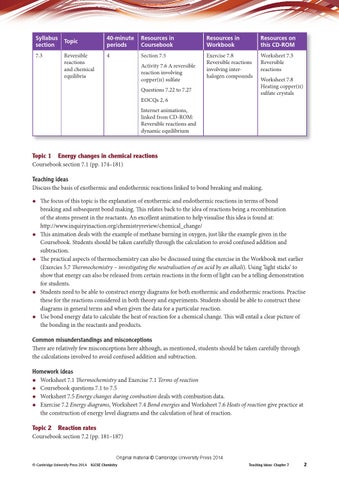
Syllabus section 7.3
Topic Reversible reactions and chemical equilibria
40-minute periods
Resources in Coursebook
Resources in Workbook
Resources on this CD-ROM
4
Section 7.5
Exercise 7.8 Reversible reactions involving interhalogen compounds
Worksheet 7.3 Reversible reactions
Activity 7.6 A reversible reaction involving copper(ii) sulfate Questions 7.22 to 7.27
Worksheet 7.8 Heating copper(ii) sulfate crystals
EOCQs 2, 6 Internet animations, linked from CD-ROM: Reversible reactions and dynamic equilibrium
Topic 1
Energy changes in chemical reactions
Coursebook section 7.1 (pp. 174–181)
Teaching ideas Discuss the basis of exothermic and endothermic reactions linked to bond breaking and making. ◆
◆
◆
◆
◆
The focus of this topic is the explanation of exothermic and endothermic reactions in terms of bond breaking and subsequent bond making. This relates back to the idea of reactions being a recombination of the atoms present in the reactants. An excellent animation to help visualise this idea is found at: http://www.inquiryinaction.org/chemistryreview/chemical_change/ This animation deals with the example of methane burning in oxygen, just like the example given in the Coursebook. Students should be taken carefully through the calculation to avoid confused addition and subtraction. The practical aspects of thermochemistry can also be discussed using the exercise in the Workbook met earlier (Exercies 5.7 Thermochemistry – investigating the neutralisation of an acid by an alkali). Using ‘light sticks’ to show that energy can also be released from certain reactions in the form of light can be a telling demonstration for students. Students need to be able to construct energy diagrams for both exothermic and endothermic reactions. Practise these for the reactions considered in both theory and experiments. Students should be able to construct these diagrams in general terms and when given the data for a particular reaction. Use bond energy data to calculate the heat of reaction for a chemical change. This will entail a clear picture of the bonding in the reactants and products.
Common misunderstandings and misconceptions There are relatively few misconceptions here although, as mentioned, students should be taken carefully through the calculations involved to avoid confused addition and subtraction.
Homework ideas ◆ ◆ ◆ ◆
Worksheet 7.1 Thermochemistry and Exercise 7.1 Terms of reaction Coursebook questions 7.1 to 7.5 Worksheet 7.5 Energy changes during combustion deals with combustion data. Exercise 7.2 Energy diagrams, Worksheet 7.4 Bond energies and Worksheet 7.6 Heats of reaction give practice at the construction of energy level diagrams and the calculation of heat of reaction.
Topic 2
Reaction rates
Coursebook section 7.2 (pp. 181–187)
Original material © Cambridge University Press 2014 © Cambridge University Press 2014 IGCSE Chemistry
Teaching ideas: Chapter 7
2