Mixture
Method of separation
solid + solid (powdered mixture)
use some difference in properties, e.g. density, solubility, sublimation, magnetism
suspension of solid in liquid
filtration or centrifugation
liquid + liquid (immiscible)
use a separating funnel or decantation
solution of solid in liquid
to obtain solid: use evaporation (crystallisation) to obtain liquid: use distillation
two (or more) liquids mixed together (miscible)
fractional distillation
solution of two (or more) solids in a liquid
chromatography
Table 2.3
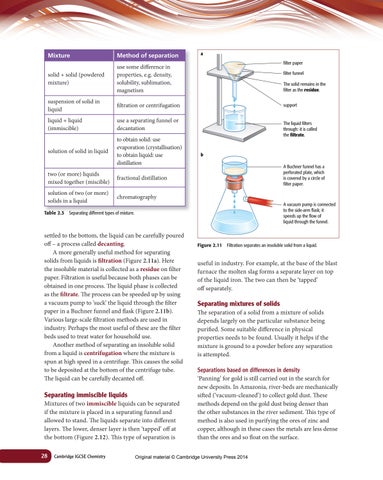
filter paper filter funnel The solid remains in the filter as the residue. support
The liquid filters through: it is called the filtrate.
b A Buchner funnel has a perforated plate, which is covered by a circle of filter paper.
A vacuum pump is connected to the side-arm flask; it speeds up the flow of liquid through the funnel.
Separating different types of mixture.
settled to the bottom, the liquid can be carefully poured off – a process called decanting. A more generally useful method for separating solids from liquids is filtration (Figure 2.11a). Here the insoluble material is collected as a residue on filter paper. Filtration is useful because both phases can be obtained in one process. The liquid phase is collected as the filtrate. The process can be speeded up by using a vacuum pump to ‘suck’ the liquid through the filter paper in a Buchner funnel and flask (Figure 2.11b). Various large-scale filtration methods are used in industry. Perhaps the most useful of these are the filter beds used to treat water for household use. Another method of separating an insoluble solid from a liquid is centrifugation where the mixture is spun at high speed in a centrifuge. This causes the solid to be deposited at the bottom of the centrifuge tube. The liquid can be carefully decanted off.
Separating immiscible liquids Mixtures of two immiscible liquids can be separated if the mixture is placed in a separating funnel and allowed to stand. The liquids separate into different layers. The lower, denser layer is then ‘tapped’ off at the bottom (Figure 2.12). This type of separation is 28
a
Cambridge IGCSE Chemistry
Figure 2.11
Filtration separates an insoluble solid from a liquid.
useful in industry. For example, at the base of the blast furnace the molten slag forms a separate layer on top of the liquid iron. The two can then be ‘tapped’ off separately.
Separating mixtures of solids The separation of a solid from a mixture of solids depends largely on the particular substance being purified. Some suitable difference in physical properties needs to be found. Usually it helps if the mixture is ground to a powder before any separation is attempted. Separations based on differences in density ‘Panning’ for gold is still carried out in the search for new deposits. In Amazonia, river-beds are mechanically sifted (‘vacuum-cleaned’) to collect gold dust. These methods depend on the gold dust being denser than the other substances in the river sediment. This type of method is also used in purifying the ores of zinc and copper, although in these cases the metals are less dense than the ores and so float on the surface.
Original material © Cambridge University Press 2014