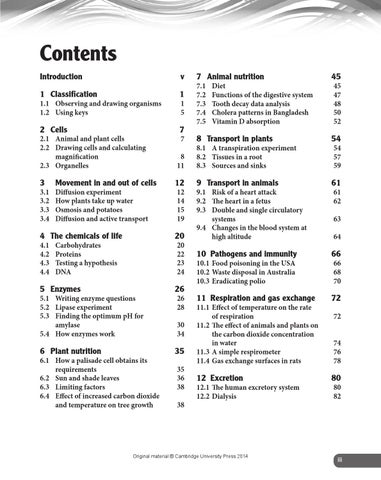
Contents Introduction v 1 Classification
1
2 Cells
7
1.1 Observing and drawing organisms 1.2 Using keys
1 5
45
8 Transport in plants
54
61
7.1 Diet 7.2 Functions of the digestive system 7.3 Tooth decay data analysis 7.4 Cholera patterns in Bangladesh 7.5 Vitamin D absorption
2.1 Animal and plant cells 2.2 Drawing cells and calculating magnification 2.3 Organelles
8 11
8.1 A transpiration experiment 8.2 Tissues in a root 8.3 Sources and sinks
3 Movement in and out of cells
12
9 Transport in animals
3.1 3.2 3.3 3.4
Diffusion experiment How plants take up water Osmosis and potatoes Diffusion and active transport
4 The chemicals of life
12 14 15 19
20
4.1 Carbohydrates 4.2 Proteins 4.3 Testing a hypothesis 4.4 DNA
20 22 23 24
5 Enzymes
5.1 Writing enzyme questions 5.2 Lipase experiment 5.3 Finding the optimum pH for amylase 5.4 How enzymes work
6 Plant nutrition
7
7 Animal nutrition
6.1 How a palisade cell obtains its requirements 6.2 Sun and shade leaves 6.3 Limiting factors 6.4 Effect of increased carbon dioxide and temperature on tree growth
26
26 28 30 34
35 35 36 38 38
45 47 48 50 52
9.1 Risk of a heart attack 9.2 The heart in a fetus 9.3 Double and single circulatory systems 9.4 Changes in the blood system at high altitude
54 57 59 61 62 63 64
10 Pathogens and immunity
66
11 Respiration and gas exchange
72
10.1 Food poisoning in the USA 10.2 Waste disposal in Australia 10.3 Eradicating polio
11.1 Effect of temperature on the rate of respiration 11.2 The effect of animals and plants on the carbon dioxide concentration in water 11.3 A simple respirometer 11.4 Gas exchange surfaces in rats
66 68 70
72
12 Excretion
74 76 78
80
12.1 The human excretory system 12.2 Dialysis
Original material © Cambridge University Press 2014
80 82
iii