The importance of magnesium ions
The importance of photosynthesis to the living universe
As with nitrates and all other ions, magnesium ions are also absorbed from the soil through the root hair. Magnesium is the central atom in a chlorophyll molecule. Plants lacking in magnesium ions are unable to make chlorophyll and thus their leaves are yellow in colour (a condition known as chlorosis).
Photosynthesis produces the carbohydrate with its stored chemical energy. Almost all other forms of life rely on carbohydrate, although plants may convert this carbohydrate into protein or fat before it is passed on.
A demonstration of the effects of a lack of nitrates and of magnesium ions in a growing plant
2
Make sure you turn the page when you see this arrow in the ➔ is refracted. Thiscorner! the amount that the light is helped by muscles at the back of the eyeball that contract
of our field of view and one eye thus covers for the other.
to increase the liquid pressure in53the eye.
Progress check 13.3 1
2
Chapter 13 Coordination and response
Apparatus: 2 small cuttings or seedlings seedling (e.g. sorghum) cotton 2 containers wool When a person is viewing a distant object: There are noCotton rods wool or cones at the point where the Black paper or black polythene dark cover retina is joined to the optic nerve. Images formed (to prevent 1 The (circular) ciliary muscles relax, increasing their Culture solutionsare not converted into on this part of the retina the growth of culture circumference. Method: single-celled solution impulses and relayed to the brain. This region green algae) Two seedlings or small cuttings, with the same 2 The suspensory ligaments are pulled tight. is therefore called the blind spot. We are not number of leaves, are selected from a quick(usually) ofheld theinblind since the blind Figure 6.10 Experiment show is effects of a lackto of become longer and growingaware plant and the topspot of two 3 Theto lens stretched nitrates ions in a growing plant containers and eyes B) using as the same spots in our(Atwo docotton not wool record partand of magnesium thinner – increasing its focal length and decreasing shown in Figure 6.10.
How to use this book
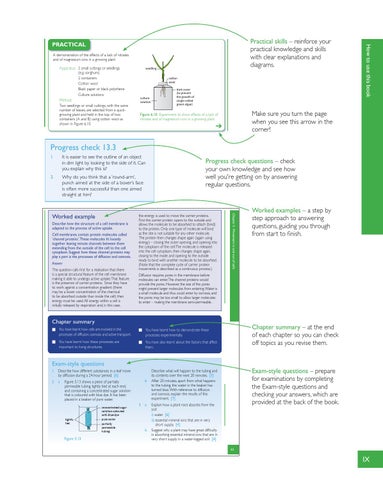
Practical skills – reinforce your practical knowledge and skills with clear explanations and diagrams.
PRACTICAL
4
Rays from the distant object are brought to focus on the retina.
It is easier to see the outline of an object in dim light by looking to the side of it. Can you explain why this is?
The pupil (or iris) your reflex own knowledge and see how
Why do you think that a ‘round-arm’, punch aimed at the side of a boxer’s face is often more successful than one aimed straight at him?
well you're onbut, by answering This reflex is usually described as thegetting pupil reflex since the pupil is a space, it is the muscles of the iris that regular questions. respond. Therefore, it is more accurate to call it the iris reflex.
Progress check questions – check
cytoplasm. Suggest how these channel proteins may
into the cell cytoplasm, then changes shape again,
The suspensory question calls filigaments, rst for a realisation thattransfer there the • the which is a special structural feature of the cell membrane the ciliary toactive the lens. making it ablemuscles to undergo uptake. That feature is the presence of carrier proteins. Since they have to work against a concentration gradient (there may be a lower concentration of the chemical to be absorbed outside than inside the cell) then energy must be used. All energy within a cell is When a person is respiration viewing aand, near object: initially released by in this case,
movements is described as a continuous process.)
closing play existence a part is the of processes diffusion and osmosis. • the ciliaryofmuscles, which are used to to the inside and opening to the outside ready to bind with another molecule to be absorbed. How the iris muscles alter the shape of the lens Answer (Note that the complete cycle of carrier protein
Near and distant objects 1 2 3
effect of
work to
Diffusion requires pores in the membrane before molecules can enter. Theiris channel would The has proteins an antagonistic arrangement provide the pores. However, the size of the pores radial muscles. might prevent larger molecules from entering. Water is a small molecule and thus could enter by osmosis, and the pores may be too small to allow larger molecules to enter – making the membrane semi-permeable.
of circular and
In bright light
The (circular) ciliary muscles contract reducing their circumference.
Chapter summary
1
Light sensitive cells in the retina detect the light intensity.
summary – at the end of each chapter so you can check brain returns along a motoroff nerve to as you revise them. Youless have force learnt how processes are With on these the lens, its elasticity allows itYou to have also3learntThe about the factors thatimpulses affect topics important to living structures. They (elastic) suspensory Youreduce have learntpull howon cellsthe are involved in the ligaments. processes of diffusion, osmosis and active transport.
2
Rays from the questions near object produce a focused image Exam-style on the retina. 1
Describe how different substances in a leaf move by diffusion during a 24-hour period. [6]
2
a
b
Figure 3.13 shows a piece of partially permeable tubing, tightly tied at each end, and containing a concentrated sugar solution that is coloured with blue dye. It has been placed in a beaker of pure water.
tightly tied
Figure 3.13
concentrated sugar solution coloured with blue dye pure water partially permeable tubing
3
Impulses are sent along the optic (a sensory) nerve Chapter
You have learnt how to demonstrate these to the brain. processes experimentally.
them. become wider (bulge) – decreasing its focal length and refracting light rays to a greater degree.
4
control pupil size
Chapter 3 Movement in and out of cells
Bright light could seriously damage the delicate light Worked sensitive cells of the retina. The intensity of light falling on examples – a step by the energy is usedthe to move theiscarrier proteins.controlled by the iris. In general retina therefore Worked example Accommodation step approach to answering First the carrier protein opens to the outside and terms, size to ofattach the pupil Describe how the structure of a cell membrane is allows the molecule to be the absorbed (bind) automatically adjusts to the questions, guiding you through adapted to the process active uptake. Accommodation is theofability to change the focalto length intensity reaching the protein. Only one typeof of light molecule will bindthe eye. In bright light, the iris as the site is not suitable for any of the so thatcontain we can seemolecules both near Celllens membranes protein calledand distant from increases in other size molecule. to make the pupil small, reducing thestart to finish. The protein then changes shape again (again using ‘channel proteins’. These molecules fit loosely objects. Accommodation depends on: light thatopening, reaches the retina. In dim light, the iris opens up energy) – closing the outer and opening into together leaving minute channels between them thecell. pupil to allowis as much light into the eye as possible. the cytoplasm of the The molecule released extending from of thethe outside • the elasticity lensof the cell to the cell
a
b
the circular muscles of the iris.
4
The circular iris muscles contract while the radial iris muscles relax.
diameter the and pupil, the hole in the centre, Describe5whatThe will happen to theof tubing its contents over the next 20allowing minutes. [3] decreases, less light to enter, decreasing the After 20 minutes, from whatto happens riskapart of damage the retina. to the tubing, the water in the beaker has turned blue. With reference to diffusion and osmosis, explain the results of this experiment. [7]
Exam-style questions – prepare for examinations by completing the Exam-style questions and checking your105answers, which are provided at the back of the book.
Explain how a plant root absorbs from the soil: i) water [6] ii) essential mineral ions that are in very short supply. [4] Suggest why a plant may have great difficulty in absorbing essential mineral ions that are in very short supply in a water-logged soil. [4] 33
IX