We are working with Cambridge Assessment International Education towards endorsement of this title. Any references or material related to answers, grades, papers or examinations are based on the opinion of the author(s). CAMBRIDGE IGCSE™ & O LEVEL COMPUTER SCIENCE: PROGRAMMING BOOK
How to use this book Throughout this book, you will notice lots of different features that will help your learning. These are explained below.
LEARNING INTENTIONS
LE
These set the scene for each chapter, help with navigation through the Visual Basic programming process and indicate the important concepts in each topic.
SKILLS FOCUS
KEY WORDS
This feature supports your computational thinking, mathematical and programming skills. They include useful explanations, step-by-step examples and questions for you to try out yourselves.
P
Pseudocode and Code snippets
This structured method for describing the logic of computer programs may be very similar to the pseudocode used in the syllabuses.
M
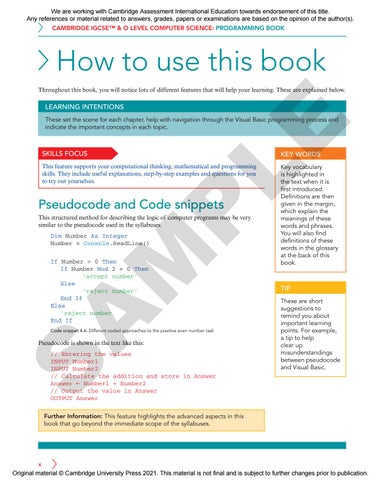
Dim Number As Integer Number = Console.ReadLine()
A
If Number > 0 Then If Number Mod 2 = 0 Then 'accept number' Else 'reject number' End If Else 'reject number End If
Code snippet 4.6: Different coded approaches to the positive even number task
Pseudocode is shown in the text like this:
S
// Entering the values INPUT Number1 INPUT Number2 // Calculate the addition and store in Answer Answer Number1 + Number2 // Output the value in Answer OUTPUT Answer
Key vocabulary is highlighted in the text when it is first introduced. Definitions are then given in the margin, which explain the meanings of these words and phrases. You will also find definitions of these words in the glossary at the back of this book.
TIP These are short suggestions to remind you about important learning points. For example, a tip to help clear up misunderstandings between pseudocode and Visual Basic.
Further Information: This feature highlights the advanced aspects in this book that go beyond the immediate scope of the syllabuses.
x Original material © Cambridge University Press 2021. This material is not final and is subject to further changes prior to publication.