We are working with Cambridge Assessment International Education towards endorsement of this title. Any references or material related to answers, grades, papers or examinations are based on the opinion of the author(s). CAMBRIDGE IGCSE™ & O LEVEL COMPUTER SCIENCE: PROGRAMMING BOOK
INTERACTIVE SESSION
LE
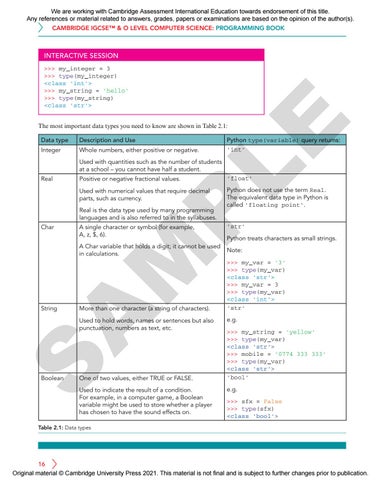
>>> my_integer = 3 >>> type(my_integer) <class 'int'> >>> my_string = 'hello' >>> type(my_string) <class 'str'> The most important data types you need to know are shown in Table 2.1: Data type
Description and Use
Integer
Whole numbers, either positive or negative.
Python type(variable) query returns:
'int'
Used with quantities such as the number of students at a school – you cannot have half a student. Positive or negative fractional values.
'float'
Used with numerical values that require decimal parts, such as currency.
Python does not use the term Real. The equivalent data type in Python is called 'floating point'.
P
Real
Real is the data type used by many programming languages and is also referred to in the syllabuses. Char
A single character or symbol (for example, A, z, $, 6).
More than one character (a string of characters).
A
String
M
A Char variable that holds a digit; it cannot be used in calculations.
S
Used to hold words, names or sentences but also punctuation, numbers as text, etc.
Boolean
One of two values, either TRUE or FALSE. Used to indicate the result of a condition. For example, in a computer game, a Boolean variable might be used to store whether a player has chosen to have the sound effects on.
'str'
Python treats characters as small strings. Note:
>>> my_var = '3' >>> type(my_var) <class 'str'> >>> my_var = 3 >>> type(my_var) <class 'int'> 'str' e.g. >>> my_string = 'yellow' >>> type(my_var) <class 'str'> >>> mobile = '0774 333 333' >>> type(my_var) <class 'str'> 'bool' e.g. >>> sfx = False >>> type(sfx) <class 'bool'>
Table 2.1: Data types
16 Original material © Cambridge University Press 2021. This material is not final and is subject to further changes prior to publication.