Gary Cambers and Steve Sibley
Cambridge IGCSE速
Geography
Coursebook
University Printing House, Cambridge cb2 8bs, United Kingdom Cambridge University Press is part of the University of Cambridge. It furthers the University’s mission by disseminating knowledge in the pursuit of education, learning and research at the highest international levels of excellence. Information on this title: education.cambridge.org © Cambridge University Press 2015 This publication is in copyright. Subject to statutory exception and to the provisions of relevant collective licensing agreements, no reproduction of any part may take place without the written permission of Cambridge University Press. First published 2010 Second edition 2015 Printed in the United Kingdom by Latimer Trend A catalogue record for this publication is available from the British Library isbn 978-1-107-45894-9 Paperback Cambridge University Press has no responsibility for the persistence or accuracy of URLs for external or third-party internet websites referred to in this publication, and does not guarantee that any content on such websites is, or will remain, accurate or appropriate. notice to teachers in the uk It is illegal to reproduce any part of this work in material form (including photocopying and electronic storage) except under the following circumstances: (i) where you are abiding by a licence granted to your school or institution by the Copyright Licensing Agency; (ii) where no such licence exists, or where you wish to exceed the terms of a licence, and you have gained the written permission of Cambridge University Press; (iii) where you are allowed to reproduce without permission under the provisions of Chapter 3 of the Copyright, Designs and Patents Act 1988, which covers, for example, the reproduction of short passages within certain types of educational anthology and reproduction for the purposes of setting examination questions. IGCSE© is the registered trademark of Cambridge International Examinations. The past paper questions on pages 267–282 are reproduced with the permission of Cambridge International Examinations. disclaimer Cambridge International Examinations bears no responsibility for the example answers to questions taken from its past papers which are contained in this publication. In examination, the way the marks are awarded may be different. The questions on pages 58–61, 128–131, 230–237, 254–264, and example answers, marks awarded and or comments that appear on pages 267–282 were written by the authors and are not the responsibility of Cambridge University Press. In examination, the way the marks are awarded may be different.
Contents
Contents Introduction vii
Part A Geographical Themes
1
Theme 1 Population and Settlement
3
World map – Location of Case Studies
Topic 1 Topic 2 Topic 3 Topic 4 Topic 5 Topic 6 Topic 7 Topic 8 Topic 9 Topic 10 Topic 11 Topic 12 Topic 13 Topic 14 Topic 15 Topic 16
World population increase Over-population and under-population Case Study: Over-population – Nigeria Case Study: Under-population – Australia Causes of a change in population size Population change Case Study: High rate of natural population growth – Niger Case Study: Population decline – Russia Population policies Population migration The impacts of migration Case Study: An international migration – Qatar Finding out about the population Case Study: A country with high dependency – Italy Factors influencing population density Case Study: High population density – Japan Case Study: Low population density – Namibia Settlement patterns Settlement sites, growth and functions Settlement hierarchies Case Study: Settlement and service provision in Sardinia Urban land use Urban problems and solutions Case Study: An urban area – Atlanta, USA Rapid urban growth Impacts of urban growth Case Study: Urbanisation in Peru – Lima
Exam-Style Questions
2
4 6 8 10 12 14 16 18 20 22 24 26 28 30 32 34 36 38 40 42 44 46 48 50 52 54 56 58
Global Theme 1 – HIV/AIDS 62
iii
Cambridge IGCSE Geography
Theme 2 The Natural Environment
iv
63
Topic 17 Types and features of earthquakes and volcanoes Topic 18 Plate tectonics Topic 19 Causes and effects of earthquakes and volcanoes Topic 20 Volcanoes present hazards and opportunities Topic 21 Reducing the impacts Case Study: An earthquake – Haiti Case Study: A volcano – Mount Sinabung, Indonesia Topic 22 Rivers and drainage basins Topic 23 The work of rivers Topic 24 River landforms – 1 Topic 25 River landforms – 2 Topic 26 Rivers – hazards and opportunities Topic 27 Managing river flooding Case Study: The Elbe river Topic 28 The work of the sea Topic 29 Coastal landforms created by erosion Topic 30 Coastal landforms created by deposition Topic 31 Coral reefs and mangrove swamps Topic 32 Hazards and opportunities Topic 33 Managing coastal erosion Case Study: An area of coastline – Mauritius Topic 34 Collecting weather data – 1 Topic 35 Collecting weather data – 2 Topic 36 Using weather data Topic 37 Using weather and climate data Topic 38 The equatorial climate Topic 39 Tropical rainforest ecosystems Rainforest deforestation Topic 40 Case Study: The tropical rainforest – Ecuador Topic 41 Hot desert climates Topic 42 Hot desert ecosystems Case Study: A hot desert – the Sahara and Mali
64 66 68 70 72 74 76 78 80 82 84 86 88 90 92 94 96 98 100 102 104 106 108 110 112 114 116 118 120 122 124 126
Exam-Style Questions
128
Global Theme 2 – Reducing Carbon Emissions
132
Theme 3 Economic Development
133
Topic 43 Indicators of development Topic 44 Identifying inequalities
134 136
Contents
Topic 45 Topic 46 Topic 47 Topic 48 Topic 49 Topic 50 Topic 51 Topic 52 Topic 53 Topic 54 Topic 55 Topic 56 Topic 57 Topic 58 Topic 59 Topic 60 Topic 61
Classifying production Employment structure varies Globalisation Case Study: A transnational corporation – Nokia, Finland Agricultural systems Case Study: An arable farm in Lincolnshire, UK Food shortages Case Study: Food shortages in Darfur, Sudan Industrial systems Industrial location Case Study: The Pakistan steel complex at Pipri, near Karachi The growth of tourism The benefits and disadvantages of tourism Managing tourism for sustainability Case Study: An area where tourism is important – Dubai, UAE Energy use varies Nuclear power or renewables Case Study: Energy supply in Iceland Using water Managing water Case Study: Water supply in Lesotho Economic activities pose threats Managing for sustainable development Conserving natural resources Case Study: Fracking in California, USA
138 140 142 144 146 148 150 152 154 156 158 160 162 164 166 168 170 172 174 176 178 180 182 184 186
Exam-Style Questions
188
Global Theme 3 – Reduce, reuse, recycle
192
Part B Geographical Skills
193
Exam-Style Questions
230
Map skills checklist
238
1. 1:50 000 Monsefu, Peru 2. 1:50 000 Harare, Zimbabwe 3. 1:25 000 North York Moors, UK 4. 1:25 000 Montego Bay, Jamaica 5. 1:25 000 Negara, Indonesia 6. 1:50 000 Leicester, UK
194 200 206 212 218 224
v
Cambridge IGCSE Geography
Part C Geographical Enquiry
239
The Alternative to Coursework
253
Exam-Style Question 1
254
Exam-Style Question 2
260
Part D Preparing for examinations
265
Resources
283
World map
284
The Coursework Assignment Topic 1 Investigating the CBD Topic 2 Investigating rivers Topic 3 Investigating tourism Topic 4 Investigating weather Fieldwork checklist
Geographical Themes: Case Studies Geographical Skills The Alternative to Coursework vi
240 242 244 246 248 250
266 270 273
Glossary 286 Index 290 Acknowledgements 295
Introduction
Introduction The IGCSE Geography textbook and CD have been extensively revised to prepare students for Cambridge IGCSE® Geography.
Part A: Geographical Themes Part A deals with the Cambridge syllabus Themes in the order in which they appear in the Cambridge syllabus. As the contents page shows, there is a close and deliberate link in Part A to the Cambridge syllabus. The following three themes are covered: Theme 1: Population and Settlement Theme 2: The Natural Environment Theme 3: Economic Development The authors have closely matched the content of this book to the Cambridge syllabus topics and to the bullet points within each topic which provide further guidance on what students should be able to do as part of their course. Teachers requested more specific guidance on case studies and in the Cambridge syllabus, specific case studies are listed at the end of each of the 19 topics. It is important for teachers to be aware that all of the listed content in each topic should be incorporated into the case studies that they use. The case studies come from 25 different countries, most of which have CIE Centres where the IGCSE Geography syllabus is studied. Centres that have been requesting resources to prepare students more effectively for this important part of the syllabus will find a wide range of examples to use. All are resource-based and involve problem-solving and free-response writing as required. At the end of each Theme there are four full examples of exam-style questions. Each question has a part (a) and (b) with resources to respond to, followed by the case study. The students can use the examples provided in the Themes in the book or others they have been taught. Three global issues are also studied at the end of each Theme and a world map showing countries is provided for reference along with time zones, which are relevant to examining in an international context.
Part B: Geographical Skills Paper 2 is mainly skills-based and tests a student’s ability to handle geographical information, without requiring knowledge as in Paper 1. As the first question will always be based on a large-scale (1:25 000 or 1:50 000) topographical map of any area in the world, Part B of the textbook provides six examples of these maps from the UK (2), Peru, Zimbabwe, Jamaica and Indonesia. The new Cambridge syllabus allows for maps to be selected from anywhere in the world. For each example an extract of a map is provided with appropriate map skills questions. Further work continues to develop map skills, as well as dealing with topics of relevance which relate to the map extract. Examples of exam-style questions, incorporating questions based on a topographical map of Ireland, are provided for practice at the end of Part B.
Part C: Geographical Enquiry For a variety of reasons, many Centres do not choose – or cannot carry out – coursework; however, some guidance is given in this book for those that may be considering it. Examples of coursework topics that may be undertaken in different countries are provided.
vii
Cambridge IGCSE Geography
These suggest the type of fieldwork or coursework that teachers might consider introducing. The ‘Route to Geographical Enquiry’ that is used in the Cambridge syllabus has been adapted for use in the classroom and a world map illustrates 16 different coursework titles that could be used in schools in different countries of the world. Guidance is also given with ideas on how to carry out coursework in four topics – the CBD, Rivers, Tourism and the Weather. A fieldwork checklist is provided for teachers and students to ensure that complete coverage prepares students for coursework. With Health and Safety such an important part of planning and carrying out coursework, a page is devoted to different topics and safety issues in each that should be considered. Paper 4 is taken by students as a written examination instead of carrying out coursework and/or fieldwork. Although the majority of Centres do choose Paper 4 as an alternative to coursework, it is important that teachers try to carry out some local fieldwork and Part C encourages this. Two examples of exam-style questions are provided; these are repeated on the Student CD with lines for writing.
Part D: Preparing for Examinations
viii
This part of the book looks at sample questions taken from previous examination papers along with possible answers and illustrations of how they might be marked. For Paper 1 the focus is on marking case studies as these count for 21 out of 75 marks on this paper. For each of the three Themes, one example question is provided. Each question is followed by three answers of different quality with a commentary on how they might be marked. For Paper 2 a few selected questions that cover a range of skills are provided with various answers of different quality. A commentary on the possible marking follows. For Paper 4 one whole question is provided and, again, a range of sample answers are followed by a commentary on their strengths and limitations.
The Student CD This is provided with the textbook and includes the following: Outline maps: These are always useful for teachers to use with several tasks. Eleven outline maps are provided covering the major regions of the world. In addition a sheet of triangular graph paper is provided as this is difficult to obtain in many countries. Student sheets: Photocopiable extension and support sheets are provided. Examples of exam-style questions: all the sample questions from Parts A, B and C are provided with lines to write on so that students can practise answering them as they would in an examination situation. Glossary: The glossary used in the textbook is repeated here for reference.
The Teacher CD This can be purchased separately from the textbook and Student CD. It contains answers to all the Tasks and exam-style questions in parts A, B and C. It also contains advice on teaching the syllabus, including sample schemes of work and lesson plans.
Part A Geographical Themes
1
Part A of this coursebook covers the three Geographical Themes set out in the Cambridge syllabus: Population and Settlement; The Natural Environment; and Economic Development. At the end of each theme there are four exam-style questions, written by the authors.
2000
4000 km
10
11
16
12 17
19
1
9
3
6
14
8
1 2 3 4 5 6 7
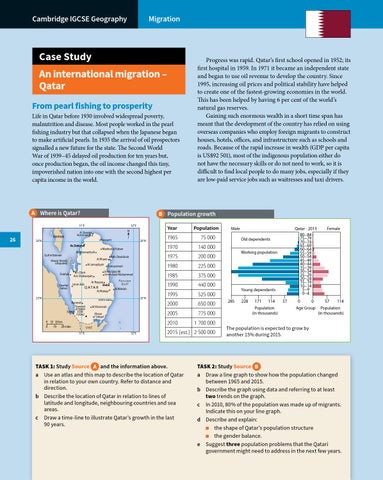
Over-population: Nigeria (p. 8) Under-population: Australia (p.10) Population growth: Niger (p.16) Population decline: Russia (p.18) International migration: Qatar (p.26) High population dependency: Italy (p.30) High population density: Japan (p.34)
8 9 10 11 12 13 14
Low population density: Namibia (p.36) Settlement and services: Sardinia (p.44) An urban area: Atlanta, USA (p.50) Urbanisation: Peru, Lima (p.56) An earthquake: Haiti (p.74) A volcano: Mt Sinabung, Indonesia (p.76) The Elbe river: Germany and Czech Republic (p.90)
The location of case studies used in PART A: GEOGRAPHICAL THEMES
0
Tropic of Capricorn
Equator
Tropic of Cancer
25
23
2 15 16 17 18 19 20 21
15
5 22
21
13
4
A coastline: Mauritius (p.104) Tropical rainforest: Ecuador (p.120) A hot desert: Sahara and Mali (p.126) Transnational corporation: Nokia, Finland (p.144) An arable farm: Lincolnshire, UK (p.148) Food shortages: Darfur, Sudan (p.152) Pakistan steel at Pipri, Karachi (p.158)
24
20
18
22 23 24 25
2
Tourism: Dubai, UAE (p.166) Energy supply in Iceland (p.172) Water supply in Lesotho (p.178) Fracking in California, USA (p.186)
7
Theme 1: Population and Settlement
3
Cambridge IGCSE Geography
1
Population Dynamics
World population increase
Population explosion The population of the world is ‘exploding’. It is growing by 78 million people every year, which means an extra 215 060 people every day. There are 150 more people now than there were one minute ago! If there are 30 people in your class, the world’s population increases by this amount every 12 seconds. Recently the United Nations (UN) released a report which said that the world’s population was likely to be more than 10 billion people by 2100, over 3 billion more than live in the world today. It took until 1804 for the world to reach its first billion people, and a century more until it hit 2 billion in 1927. However, due to reductions in the death rates
in many countries during the 20th century the population had risen to 6 billion in 1999 and by 2011 it had reached 7 billion. The UN is forecasting that the world’s population will reach 8 billion by 2025 and 10 billion by 2083, but these numbers are estimates. The size of the increase during the rest of the 21st century will depend on whether the number of deaths continues to fall and whether the number of births can be reduced in those parts of the world where they still remain much higher than death rates. All of those extra people mean more living space will be needed, and many parts of our planet are already becoming more and more crowded. There will be a lot more mouths to feed and more water will be needed. More energy will be required and there will also be a lot more waste to dispose of. More people will mean that more transport is needed and more roads, railway lines and airports will need to be built.
From 1 to 7 billion
1804 1 billion people
1927 2 billion people
1960 3 billion people
1974 4 billion people
1987 5 billion people
1999 6 billion people
2011 7 billion people
4
World population growth 2100 10.2 billion
12 2011 7 billion 1999 6 billion
11 World population billions
10 9
1987 5 billion
8 7 5
1927 2 billion
4 2
2042 9 billion
2025 8 billion
1974 4 billion
6
3
2083 10 billion
1960 3 billion
1804 1 billion
1 0 1800
1900
2000 Years
2100
Theme 1: Topic 1
The world’s 7 billionth baby
POPULATION REACHES 7 BILLION Countries around the globe marked the world’s population reaching 7 billion on Monday, with lavish ceremonies for newborn infants symbolising the milestone and warnings that there may be too many humans for the planet’s resources. Festivities are being held worldwide, with a series of symbolic seven-billionth babies being born. The celebrations began in the Philippines, where baby Danica May Camacho was greeted with cheers at Manila’s Jose Fabella Memorial Hospital. ‘She looks so lovely,’ the mother, Camille Galura, whispered as she cradled the baby, who was born about a month premature. The baby was the second for Galura and her partner, Florante Camacho, a struggling driver who supports the family on a tiny salary. Dr Eric Tayag of the Philippines’ Department of Health said later that the birth came with a warning.
TASK 1: Study Sources and a How many years did it take the world’s population to increase from: ■ 1 to 2 billion? ■ 6 to 7 billion? b By 2100 there are likely to be over 3 billion more people living in the world than today. Choose two problems which you think will be caused by this. Explain why you think each of these problems will be diff icult to solve. c The figures for 2100 are estimates. Explain why it is diff icult to predict exact population numbers for the future. TASK 2 World population growth is worked out by subtracting the number of people who die from the number who are born (births minus deaths). With a partner, use the Internet to find information to explain the following facts. ■ People lived longer on average at the end of the 20th century than at the start of it. ■ In some parts of the world there has been no reduction in the numbers of children being born. When you have found out the answers, write a paragraph in your own words to explain why world population grew so much in the 20th century. TASK 3: Study Sources and a Do you agree with the warning given by Dr Eric Tayag? Explain your view. b Suggest three things that could be done to ‘ease the population explosion’. c What message do you think the cartoon in Source D is giving about the world’s 7 billionth baby?
‘Seven billion is a number we should think about deeply,’ he said. ‘We should really focus on the question of whether there will be food, clean water, shelter, education and a decent life for every child,’ he said. ‘If the answer is no, it would be better for people to look at easing the population explosion.’ Adapted from NBC World News, 31 October 2011
Look what the stork has brought!
5
Cambridge IGCSE Geography
2
Population Dynamics
Over-population and under-population
Too many or too few? Source A shows part of Jakarta, a city on the Indonesian island of Java, which is over-populated. Source B shows part of Australia, an under-populated country. If the number of people living in an area is greater than the resources and technology available to maintain an adequate standard of living for the population, it is over-populated. A large population in a country does Over-populated or ‌
not mean that it is over-populated. For example, there are many people living in Germany but it has enough resources to support its population. However, some rural communities in parts of Africa are over-populated. Th is isn’t because they are crowded with people but because there are not enough resources to support the population living there. If the number of people living in an area is less than is needed to make full use of the resources available, then the area can be described as under-populated. For example, Australia has many resources but it is not using them fully. The country could support a higher population, which means that it is under-populated. ‌ under-populated?
6
Population and resources
Over-population
Optimum population
Under-population
Theme 1: Topic 2
TASK 1: Study Sources and Use the evidence in the photographs to help you write definitions for over-population and under-population.
New index highlights most over-populated countries Singapore is the world’s most over-populated country, followed by Israel and Kuwait, according to a new league table ranking countries by their degree of over-population. The Overpopulation Index, published by the Optimum Population Trust to mark World Population Day, is thought to be the first international ‘league table’ to rank countries according to the sustainability of their populations. It examines data for over 130 individual countries and concludes that 77 of them are over-populated – they are consuming more resources than they are producing and are dependent on other countries. These include China and India, along with many Middle Eastern and European countries.
TASK 2: Study Source a Use the diagrams to explain what is meant by optimum population. b Explain why a country with a large population may not be over-populated. c Explain why a country with a small population may be over-populated.
Adapted from Population Matters
TASK 3: Study Source a Name the three most over-populated countries according to the Optimum Population Trust. b Choose one of the countries named in Source D. Use the Internet to find out why your chosen country is over-populated.
Consequences of over-population and under-population Over-population
Under-population
■
not enough housing
■
shortage of workers
■
water and air pollution
■
low level of production
■
shortage of food and water
■
resources underused
■
high crime rates
■
high taxes
■
not enough health care and education
■
lack of government income
lack of employment
■
■
■
poverty
■
TASK 4: Study Source Describe the problems caused by over-population and under-population. For each problem you should add extra detail to the simple ideas listed in Source E. TASK 5: Study Source Explain how the two types of over-population shown have different causes.
small market for goods and services low value of exports
Different causes of over-population
x
x
x
x
=
=
7
Cambridge IGCSE Geography
Population Dynamics
Case Study Over-population – Nigeria Lagos according to Lonely Planet
Nigeria’s population – a silent killer
Lagos is the largest city in Africa, it has wall-to-wall people, bumper-to-bumper cars, noise and pollution beyond belief, an intimidating crime rate, and the public utilities cannot cope with the number of people who need to use them. Elevated motorways ringing the city are jammed with speed freaks and absurd traffic jams (‘go-slows’) on top, and tin-and-cardboard shacks underneath.
In 2013 Nigeria had a population of 175 million people with over 60% living on less than one dollar a day. It occupies only 3% of Africa but is home to over 15% of its people. Over-population means pressure on natural resources, high levels of air and water pollution, and a lack of essential services such as health care and education. Overcrowding and lack of accommodation have resulted in increased disease levels, inadequate sanitation and scarcity of resources for medical care and education. Lack of employment and poverty, and the desperation to survive have increased the crime rate and the country now experiences serious over-congestion of public transport, roads and bridges.
Named after the Portuguese word for lagoon, Lagos, the economic and cultural powerhouse of the country, has been a major port, a British political centre and, until 1991, Nigeria’s capital. Adapted from Lonely Planet
Some problems caused in Nigeria by over-population Not enough housing in Kano
High crime rates in Jos
8
NIGER
Pollution of air and water in Port Harcourt
Kano
BENIN
Jos
NIGERIA Ibadan Lagos
Shortage of food and water in Yola
Not enough health care and schools in Ibadan
Gulf of Guinea
Port Harcourt
Yola
CAMEROON Congested roads in Lagos
Case Study: Over-population – Nigeria
Problems in Lagos Lagos, Nigeria: The maze of shacks on stilts stretch out across the filthy water’s surface, canoes colliding as they hustle between them in Makoko, a slum that serves as a warning for the world’s fastest growing continent. Tens of thousands of people live in unhygienic conditions with no public services in this water-top neighbourhood in Lagos, the largest city in Africa. ‘I’m just like the other people. I don’t have shelter anywhere else,’ Friday Gezo, a 25-year-old teacher at a school started through donations, said from his woodframe classroom when asked why he lived in the slum. Adapted from Gulf News, 30 October 2011 Nnamdi Elendu, an electronics trader has just moved into an apartment in Ijesha, a Lagos suburb. The gutter that runs in front of his entrance gate is constantly filled with rubbish made up of soggy paper, bulging black nylon bags, and empty water bottles. A plastic pipe sticks out of a hole in his neighbour’s fence. ‘Four different families live in that house, and all of them wash their plates and pots and clothes and empty the water and mess through this pipe.’ ‘When I was a kid, only two families lived here, but now we have six different tenants sharing the facilities,’ said Shalewa Omoluabi, a retired teacher who lives in Surulere. Adapted from Osun Defender
TASK 1 a Using your own words, write two sentences using Nigeria’s population statistics to show that the country is over-populated. b Define the following terms: ■ pressure on natural resources ■ lack of essential services ■ inadequate sanitation. TASK 2: Study Source Look at the six problems shown on the spider diagram. a For each problem explain how it can be caused by over-population. b Choose one of the problems. Use the Internet to write a paragraph about your chosen problem in any named town or city in Nigeria. TASK 3: Study Sources , and Quality of life is a measure of the happiness, well-being and satisfaction of a person. It is affected by many factors – for example family, income and access to services. Use the evidence in the photographs and extracts to write a short newspaper article about how over-population in Lagos affects the quality of life of its people.
Life in Lagos
9
Cambridge IGCSE Geography
Population Dynamics
Case Study Under-population – Australia country could support a higher population. This means that Australia is under-populated. Indeed, successive Australian governments have tried to increase its population, to develop the country economically, by attracting migrants from other countries. From only 3.7 million in 1901, the population has increased to its current 23 million.
Under-populated Australia The United States of America and Australia are not very different in size, but the USA has over 300 million people and Australia fewer than 25 million. Many areas of Australia are empty and the resources are not being used fully, so the Australia N
Indian O cean
Factfile Australia
Arafura Sea
Timor Sea
Darwin
Gulf of Carpentaria
G
NORTHERN TERRITORY
re vid
• • • •
ng
e
NE W SOUTH WALES Murray River Basin
Brisbane
ing R a
Great Australian Bight Adelaide
Di
Perth
t
SOUTH AUSTR ALIA
a
Great Artesian Basin
Simpson Desert
Great Victoria Desert
10
QUEENSL AND
Macdonnell Ranges
WESTERN AUSTR ALIA
Sydney Canberra VICTORIA Melbourne Bass Strait
0
500
1000 km
Area: 7 686 850 km • Population: 23 344 735 (2013) • Main agricultural products: wheat, barley, • sugarcane, fruits; cattle, sheep, poultry Main industries: mining, and • transportation equipment,industrial food processing,
Pacific O cean
Kimberley Plateau
Tasmania
2
chemicals, steel Oil production: 482 500 billion barrels/day Natural gas production: 44.99 billion m3 Value of exports: US$258.8 billion Cost of imports: US$239.7 billion
USA
Factfile usa
N C AN A DA
Red Los Angeles
Pac ific O ce an 0
M E X ICO 500
1000 km
hio MO UN TAIN S
Boston New York
O
Washington DC
Houston
PA LA CH IAN
Co lor
s
Lake H uron La ke Lake M i c hi g a n O ntario Lake Chicago Detroit Erie
Miss issippi
S
DE
Arkansa
ri sou Great Plains
DA NEVA
San Francisco
AINS Y MOUNT
RR A SIE
o ad
M is
ROCK
CAS
CA
Seattle
Area: 9 826 630 km • Population: 316 668 567 (2013) • Main agricultural products: wheat, corn, other • grains, fruits, vegetables, cotton; beef, pork
La ke S u p e ri o r
•
AP
New Orleans
G ul f o f Mex i co
Atlantic O cean
Miami
• • • •
2
poultry, dairy products; fish; forest products Main industries: petroleum, steel, motor vehicles, aerospace, telecommunications, chemicals, electronics, food processing, consumer goods, timber, mining Oil production: 9.023 billion barrels/day Natural gas production: 561.3 billion m3 Value of exports: US$1.564 trillion Cost of imports: US$2.299 trillion
Case Study: Under-population – Australia Under-populated Australia? We’re in a drought, so to invite more people to share in the limited water supply on the driest continent on Earth doesn’t make much sense.
Who says Australia is under-populated? Sure, it’s a whole continent but most of it’s desert where no one wants to live. And there’s not all that much land for farming.
Give benefits to people having children and the benefits should increase depending on the number of children.
Australia is a beautiful country, and one of its great attractions is that there are so many wide open spaces, How should Australia and so few people in them. I would hate solve its under-population Australia to become like China or the USA! problem? By relaxing the visa rules so We already have heaps of people here that more immigrants can get citizenship, from other countries who can’t speak and by expanding the economy. If English, and this causes problems the economy is prosperous more in many areas. people will move here for job opportunities.
Migration to Australia The face of Australia is changing – and it starts at our borders. Whereas Australia’s migrant population once came mainly from Europe, now many come from countries in Asia to fill skills gaps in the workforce. In 2011–12, India (29 018) and China (25 509) were ahead of Australia’s traditional source country for permanent migrants, the United Kingdom, which dropped to fourth on the list with 25 274 migrants. The Conversation, 8 June 2013
The Australian Industry Group wants the government to increase the number of immigrants from 190 000 this financial year to 220 000 in 2014–15, especially skilled migrants. Chief Executive Innes Willox says ‘now is the right time to increase skilled migration given Australia’s ageing workforce and skills shortages in industries including mining, construction, engineering and health care. The Australian Workplace Productivity Agency has calculated that Australia will need an increase of about 2.8 million people with quite specific skills over the next decade to fill some of those gaps.’ ABC, 13 January 2014
TASK 1: Study Sources and Use the evidence in the maps and factfiles to explain why Australia can be considered to be under-populated compared with the USA.
and TASK 2: Study Sources a Identify three methods which could be used to solve the under-population problem in Australia. b Identify three problems which may be caused if more people are encouraged to migrate to Australia. c Explain why some people think that Australia is not underpopulated.
11
Cambridge IGCSE Geography
Population Dynamics
Causes of a change in population size
3
To calculate the overall population change, the net
migration must be considered. If more people per 1000
Calculating population change Natural population change is calculated by subtracting the death rate from the birth rate. Malta’s birth rate in 2013 was 10.3 per 1000 and its death rate was 8.8 per 1000. So its natural population change in 2013 was: 10.3 – 8.8 = 1.5 per 1000 people (i.e. 0.15%).
move into the country than move out of it, this is added. If more move out of the country than into it, this is subtracted. Malta’s net migration in 2013 was 2.4 per 1000. So its overall population change was: 10.3 – 8.8 + 2.4 = 3.9 per 1000 people (i.e. 0.39%). If the answer is positive the population is growing, if it is negative it is getting smaller.
Birth rate, death rate and migration
12
Birth rate is the average number of births per 1000 people per year.
Death rate is the average number of deaths per 1000 people per year.
Net migration is the average number of people moving into a country minus those moving out of it per 1000 people per year.
Population change Country
Birth rate (per 1000 people)
Death rate (per 1000 people)
Net migration (per 1000 people)
Belgium
10.0
10.7
+1.2
Greece
8.9
10.9
+2.3
India
20.2
7.3
–0.1
Morocco
18.7
4.8
–3.7
9.9
10.3
–0.5
Poland
Theme 1: Topic 3
The Demographic Transition Model
The Demographic Transition Model Stage 1 HIGH
Stage 3
Stage 4
Large families Birth rate falls due to changing social conditions
Birth rate and death rate
The Demographic Transition Model is a model of the way that population growth can be divided into four stages as birth and death rates change over time. It is based on what has happened in Europe and North America. The part of the graph representing population growth is the area between the lines, where birth rate is higher than death rate.
Stage 2
Death rate falls due to better health care and living conditions
Small families Birth rate Death rate
LOW TIME Stage 1
Stage 2
Stage 3
Stage 4
Birth rate Death rate Natural increase
Reasons for falling birth rates and death rates Falling birth rates are caused by: ■ ■ ■ ■ ■ ■
availability of contraception more women go out to work girls are educated and marry later reduction of infant mortality more family planning education less need for children as a labour source
Falling death rates are caused by: ■ ■ ■ ■ ■ ■
improvement in health care facilities increased availability of medicines and doctors more and better quality food available improvement in water supplies improvement in sanitation and hygiene reduction in wars and conflicts
TASK 1: Study Source a What is meant by birth rate, death rate and net migration? b What is the difference between natural population change and overall population change? c Explain how a country with a high birth rate could experience population decline. d Explain how a country with a low birth rate could have a high rate of population growth. TASK 2: Study Source a Calculate the natural population change of Morocco per 1000 people. b Calculate the overall population change of Poland per 1000 people. c Draw a bar graph to show the overall population change for all five countries listed in Source B. d Calculate the overall rate of population change of the country in which you live, as a percentage. You will need to find out the birth rate, death rate and net migration. For
any country this information can be found at: www.indexmundi.com/factbook/countries TASK 3: Study Source a Make a copy of the Demographic Transition Model in Source C. Shade in the natural increase. b Make a copy of the table under the graph. Complete the first two rows of the table using the words high, low or decreasing. Complete the third row using the phrases small increase, large increase, slower increase and fluctuating. c Explain why a large population increase occurs when a country is in Stage 2. d Explain why there is only a small population increase when a country is in Stage 4. e Today some countries have birth rates that are lower than death rates, so their population is declining. On your copy of the Demographic Transition Model, add an extra stage to show this and label it ‘Stage 5’.
13
Cambridge IGCSE Geography
4
Population Dynamics
Population change
Population growth rates vary The world population (7.2 billion in mid-2013) is expected to increase by almost 1 billion people within the next 12 years, according to the United Nations. Most of this population growth will be in LEDCs in Africa and Asia, such as India, Indonesia, Pakistan, the Philippines and Nigeria. Growth is expected to be particularly fast in the least developed countries of the world. Between 2013 and Population change from 1950 to 2050
2100, the populations of 35 countries could more than triple. Among them, the populations of Burundi, Malawi, Mali, Niger, Nigeria, Somalia, Uganda, Tanzania and Zambia are projected to increase at least fivefold by 2100. In contrast, the population of the MEDCs is not expected to change much and most of the net increase will be due to migration from LEDCs to MEDCs. The populations of 40 countries are expected to decrease between 2013 and 2100. The population of some countries is expected to decline by more than 15 per cent by 2050, including Bulgaria, Croatia, Cuba, Georgia, Latvia, Lithuania, Romania, Russia and Ukraine. Gross Domestic Product (GDP) and population growth 40 000
The world’s rising population, 1950−2050 Africa
Asia
Latin America
Population (billion)
10
Oceania
Projected beyond 2013
8 6 4
50 19 5 19 5 60 19 6 19 5 7 19 0 7 19 5 80 19 8 19 5 9 19 0 95 20 0 20 0 05 20 1 20 0 1 20 5 20 20 2 20 5 3 20 0 3 20 5 4 20 0 45 20 50
1 Denmark 2 France 3 New Zealand 4 Saudi Arabia 5 Botswana 6 Venezuela 7 China 8 Angola 9 Uganda 10 South Sudan
3 4
20 000 10 000 0
0
1 2
30 000
2
19
14
North America
GDP per capita (US$)
Europe
5 6 7
8 9
10
4 1 2 3 Population growth rate (%)
5
GDP per capita is a measure of wealth.
Population growth rates Population increase%: 4+ 3.5−4 3−3.5 2.5−3 2−2.5 1.5−2 1−1.5 0.5−1 0−0.5 <0
Tropic of Cancer Equator Tropic of Capricorn 0
2000
4000 km
TASK 1: Study Source a Copy out the sentences below, adding the correct names of the continents. had around a quarter of the world’s population in 1950 but by 2050 it will have less than a tenth. had more than half of the world’s population in 1950 and its share has continued to increase.
From 2013 ’s share of the world’s population is increasing faster than any other continent. b Estimate the figures (in billions) for the population in each continent in 1950 and 2050. Write a paragraph describing the main differences that are expected.
Theme 1: Topic 4
Population growth in four countries
“
“
Here, most couples use contraception and plan their families as most women are educated and want to continue their careers rather than staying at home and looking after children. Many couples now wait until they are at least 30 to have a family and have only one or two children. It is so expensive here to bring up children as they all attend school and many go on to university, and many live at home and need supporting for many years. Even though families are small, our country’s population is still growing because most people live until they are 80 and we have immigrants coming here from other countries. Margrethe (Denmark)
I am very proud of my family of seven children, which is not unusual in this village. The three oldest children are girls and we wanted to make sure that we had some boys too. Even if I could afford it I wouldn’t use contraception as children are a gift from God. I cannot afford to send all of the children to school; the girls work hard helping in and around the house and they help me to fetch water and firewood. The boys work in the fields and when they are older they are hoping to go to the towns and earn money for our family.
I have had four babies but only one of them is still alive. The others died before they were one year old because they became sick and I could not afford to take them to the clinic in the town. HIV/AIDS is a big problem in this country and so many people are dying that now it is unusual for anyone to live longer than 50 years. I hope I will have more babies because I need to make sure that I have someone to look after me when I get old or if I become ill.
I have only been able to have one daughter as the laws of the country make it almost impossible to have more than one child. I cannot afford to pay the fines to the government officials, who watch us so closely and give out fines and other punishments if we break the rules. I read last month that the government is going to change this policy and allow two or more children per family, as there are so few children being born that there will not be enough people to do all the jobs in the country in the future.
“
”
”
Precious (Botswana)
“
”
Nabulungi (Uganda)
”
Jiahui (China)
Afghanistan: large families encouraged by culture as well as religion Sadia from Fazelbeg in the Qarabagh district of Kabul, is 37 and has 10 children. Like most Afghan women, she has little say in the decision-making about the size of her family. Asked why she chose to have so many children, Sadia said ‘This is according to whatever Allah has given us. I would like to have more children.’ Sadia had her first child, a daughter, at the age of 13. Ever since then her life has revolved around her household, her husband and her children. She rarely goes out in public
TASK 2: Study Source a Use an atlas to put the following countries into rank order from the highest to the lowest rate of population growth. ■ Brazil ■ Germany ■ Pakistan ■ Libya ■ Madagascar b Write a paragraph to compare rates of population growth in African countries with those in Europe. Give examples of countries and growth rates to back up the points you are making. TASK 3: Study Source a Which countries are being described? ■ The GDP per capita is US$28 000 and the population growth rate is 0.85% ■ The GDP per capita is US$6000 and the population growth rate is 2.78%
15
and then only with the permission of her husband. As in many Afghan households, it is the older daughters who help their mother with the daily tasks. They are considered too old to go to school, although the secondary school is nearby. ‘No one in my husband’s family educated their daughters beyond the primary class and he did not want to get a bad name in the family.’ Adapted from Women’s News Network, 2012
b What general relationship is shown on the graph between the GDP per capita and the population growth rate? Name countries and use statistics to support your answer. c What do the statistics on the graph tell you about China’s GDP per capita and its population growth compared with the other nine countries? TASK 4: Study Sources and a Explain in detail why birth rates are high in some countries but low in others. Give examples for each. b It is not just birth rate which determines population growth rates. Explain how death rates and migration influence rates of population growth.
Population Dynamics
■ ■
■
babies are inoculated against diseases and treated when ill there are improved supplies of clean water so there are less water-borne diseases people eat more food and a more varied diet there are more clinics and hospitals with trained doctors and nurses there is better education about health and hygiene.
Arlit
MALI
Agadez
A Grand Erg de Bilma T E N E R E Erg du D E S E R T Tenere
NIGER
S
■
S A H A R
IN
■
Madama
TA
During the last 50 years death rates have been falling in many parts of Africa, especially in the poorer countries such as Niger. There are now lower death rates because health care, food supply, water supply and sanitation have improved, particularly in the capital city, Niamey, and other urban areas such as Zinder, Maradi, Agadez, Arlit, Dosso, Tessaoua and Dogondoutchi. During most years death rates continue to fall because:
ALGERIA
er
Falling death rates in Niger
250 km
Ni g
16
Tahoua S Niamey Dosso
A H
E
L
Zinder
Maradi
Diffa
Lake Chad CHAD
BURKINA FASO
N
The Republic of Niger is a land-locked country in West Africa, named after the Niger river which flows through the south-west. Its climate is mainly very hot and dry, with many desert areas. It is one of the poorest countries in the world. The largest ethnic groups in Niger are the Hausa and Djerma-Songhai, sedentary farmers who live in the southern part of the country. The rest are nomadic or semi-nomadic livestock-raising peoples – Fulani, Tuareg, Kanuri, Arabs and Toubou. The population of Niger grew from 1.7 million in 1960 to almost 17 million in 2013, with almost half of the country under 15 years old. With a high population growth rate of 3.4% it is expected to reach 56 million by 2050. With an average of just over seven births per woman, Niger has one of the highest fertility rates in the world.
0
UN AIR MO
Niger – a country in West Africa
LIBYA N
OO
High rate of natural population growth – Niger
Where is Niger?
NIGERIA
ER
Case Study
CAM
Cambridge IGCSE Geography
BENIN
Niger factfile
population 16.9 million • Total Population growth rate 3.4% • Life expectancy • Literacy 28.7% 54.3 years • GDP per capita US$800 • Population below poverty line 63% • Workforce • Agriculture 90% • Industry 6% • Services 4% • Birth and death rates in Niger Year 2000 2001 2002 2003 2004 2005 2006 2007 2008 2009 2010 2011 2012 2013
Birth rate (per 1000 people) 53.1 52.7 52.3 51.9 51.5 51.2 50.9 50.6 50.4 50.2 50.1 49.9 47.6 46.8
Death rate (per 1000 people) 16.8 16.2 15.6 15.0 14.5 13.9 13.4 13.0 12.6 12.2 11.8 11.5 13.4 13.1
Case Study: High rate of natural population growth – Niger
An action plan
Population explosion threatens development gains in Niger
NIGER: POPULATION EXPLOSION THREATENS DEVELOPMENT GAINS
GOVERNMENT ACTION PLAN Niger’s government has put in place a plan to slow down population growth.
If the people of Niger remain uninformed about family planning and keep reproducing at the current rate, the country’s population will more than quadruple by 2050, according to research by Niger’s national statistics agency. Niger’s population will make it impossible for the government to provide adequate health, education, jobs and water – tasks that it is already finding difficult, with a fraction of the population. ‘We surveyed the country and found that the average number of children per mother is 7.1. However, we also asked them how many they would like to have – women said 9 and
men said 12, but some families said they would like 40 or 50 children,’ said Adamou Soumana. For poor families children are a source of wealth. They work on the land, go into the towns to earn money and look after their parents when they are old.
The government wants the number using family planning to increase from 5 to 20% by 2015. The plan also calls for information campaigns to educate religious leaders and especially women about the availability and importance of family planning. It proposes that the number of early marriages be cut. Many girls in Niger marry before the age of 15. Raising the marriage age to 18 would take up to four years off a woman’s reproductive life.
Just 5% of the people of Niger use family planning and contraception. ‘People aren’t informed enough about the negative consequences of having so many children,’ Soumana added. Adapted from Population explosion (2007)
TASK 1: Study Source and an atlas Describe the size and location of Niger. Refer to distance and direction. TASK 2: Study Source a Make a copy of Source B. Draw an extra column and fill this in with information about the country in which you are living. For any country this information can be found at: www.indexmundi.com/factbook/countries b Use the information about Niger and your own country to write a paragraph to show that Niger is one of the poorest countries in the world. TASK 3: Study Source a Draw a graph to show the birth and death rates of Niger between 2000 and 2013. Use different coloured lines for each of the birth and death rates and shade in the area in between them that represents the natural population growth. b Choose the correct words or phrases to complete the four sentences below about Niger: ■ Birth rates and death rates generally increased/ decreased between 2000 and 2013. ■ Birth rates between 2000 and 2013 were always higher/ lower than death rates.
Natural population growth in 2013 was 20.2/28.4/33.7 per 1000 people. ■ This was higher/lower in 2013 than it was in 2000. What stage of the Demographic Transition Model do you think Niger is in? Justify your answer. Refer to page 13. ■
c
TASK 4 Working in groups, discuss the reasons why death rates have been reduced in Niger. Put the reasons in order of importance and explain your group’s order to the rest of the class. TASK 5: Study Source Draw a spider diagram to show reasons why birth rates are still high in Niger. Follow these instructions: a Draw a circle in the middle of your page. Write in it ‘Why birth rates are high in Niger’. b Draw lines radiating from the circle. c Write a reason at the end of each line. TASK 6: Study Source a The government of Niger has an action plan to slow down population growth. Design a poster that shows how it is attempting to do this. b Explain why it will be diff icult to persuade people in Niger to have smaller families.
17
Cambridge IGCSE Geography
Population Dynamics
Case Study Population decline – Russia Average birth and death rates in the former USSR
Latvia
Estonia
Russia
20 15 10 5
30
0
25 20 15 10 5 0
Ukraine
Moldova
Georgia
Armenia
Azerbaijan Turkmenistan Uzbekistan
Tajikistan
Kyrgyzstan Kazakhstan
Russia’s birth and death rates 1950 to 2014
Russia’s population 1960 to 2100
30
140
25
120
20
100
15
(Per 1,000 persons)
160
80 60
prediction Prediction
Population (millions)
18
Source A shows Russia and the other countries which, up to 1991, formed the Union of Soviet Socialist Republics (USSR). The population of Russia in 2013 was 143 million. In 1991 the population was at its highest but it has decreased mainly because of a higher death rate than birth rate. Despite some recent increases in the birth rate, the population is predicted to continue to decrease throughout the rest of the century. Alcohol-related deaths in Russia are very high, levels of HIV/AIDS, heart disease and tuberculosis are high, and male life expectancy is relatively low at 64 years. Russian women, who are highly educated, do not want large numbers of children. Immigration into Russia is low, and many emigrants are moving away from Russia, particularly to Western Europe to look for a better lifestyle.
40 20 0
1960
1980
2000
2020 2040 Years
10 5
Births
Natural Growth
Deaths
0 -5
2060
2080
2100
TASK 1: Study Source a Name the country shown on the map with the highest rate of natural population growth. b Work out the average natural population decline of Russia per 1000 people. c Name three other countries shown on the map that have experienced natural population decline. TASK 2: Study Source a Describe how the total population of Russia changed between 1960 and 2013 and is predicted to change up to 2100. Use statistics and years in your answer.
-10
1950 1952 1954 1956 1958 1960 1962 1964 1966 1968 1970 1972 1974 1976 1978 1980 1982 1984 1986 1988 1990 1992 1994 1996 1998 2000 2002 2004 2006 2008 2010 2012 2014
Lithuania
25
Death rate (per 1000 people)
Belarus
Birth rate (per 1000 people)
30
What is happening to Russia’s population?
b Match the following beginnings and endings of sentences to complete three sentences which explain why Russia’s population is now declining. Death rates are high … … because Russian women prefer to have careers rather than large numbers of children. Birth rates are low … … as more people move out of Russia than into the country. Population is lost through … because of high levels of migration alcoholism, heart disease and accidents.
Case Study: Population decline – Russia
Population graphs for the G8 countries Population since 1990
Life expectancy at birth 1990
350
1990
2004
300
85
2020 (projected)
Years
250
Millions
2013
80
200
75 70
150
65
100
60
50 0 Canada
France
Germany
Italy
Japan
Russia
UK
USA
Cash for more babies (2006)
A second baby? Russia’s mothers aren’t persuaded President Vladimir Putin last week promised to spend some of the country’s oil profits on efforts to solve the population problem. He ordered parliament to more than double monthly child support payments to 1500 roubles (about US$55) and added that women who choose to have a second baby will receive 250,000 roubles (US$9200); a very large amount in a country where average monthly incomes are close to US$330.
Canada
France
Germany
Italy
Japan
Russia
UK
USA
Russia is one of the G8 countries – one of the world’s most powerful nations .
Putin hails Russian birth rate rise (2012) Vladimir Putin paused last week, in the midst of his most important speech of the year, to outline Russia’s new strategy for population growth. In 2012, for the first time since the fall of the Soviet Union, there were slightly more births than deaths in Russia. ‘The population had grown more than 200 000 from January to September; the population policies of the last decade are working,’ he said. Throughout more than a decade of his rule, Mr Putin followed a policy, known as ‘mother capital’, of paying women up to $10 000 to have second children.
On Monday, young women at the Family Planning Youth Centre in Moscow said they liked the sound of more money, but suggested that Mr Putin has no idea about their lives. ‘A child is not an easy project, and in this world a woman is expected to get an education, find a job, and make a career,’ says Svetlana Romanicheva, a student who says she won’t consider having a baby for at least five years.
In a speech last week, he proposed additional incentives in 50 low-birth regions for women to have three children. ‘The three-child family should become the norm in Russia,’ he said.
Others say Putin is right. ‘Russian women typically have one child ... but many of my patients would like a second if they felt they had enough support,’ says Galina Dedova, a doctor at Happy Families, a private Moscow clinic. ‘Most of my patients count their roubles ... If they could get more money, some might have more children.’
The last available long-term prediction by Goskomstat, the state statistics agency, shows Russia could soon be losing population at the rate of up to a million a year. Even under the most optimistic forecasts, the ‘natural’ rate of decline will be about 400 000 a year, though it will be made up for by immigration.
The Christian Science Monitor, 19 May 2006
TASK 3: Study Source a Describe how birth rates and death rates changed in Russia between 1950 and 2014. b Identify the years when the total population: ■ increased ■ remained the same ■ decreased. TASK 4: Study Source a Identify the main differences between Russia and the other G8 countries. Use figures and examples in your answer. b Suggest reasons for these differences.
Mr Krupnov, director of the Moscow-based Institute for Demography, Migration and Regional Development, estimates that soon the downward trend will resume, as the ‘tiny generation’ of the 1990s, when birth rates fell drastically, begin to reproduce.
Financial Times, 21 December 2012
TASK 5: Study Sources and a A Russian couple are trying to decide whether to have a second child. Write a conversation between them which includes information about the advantages and problems of having another child. b Suggest reasons why Vladimir Putin considers it important to increase birth rates in Russia.
19
Cambridge IGCSE Geography
5
Population dynamics
government can try to solve these problems by influencing the natural population growth by bringing in policies that affect birth and death rates. Another way is to influence migration patterns by encouraging people to move in to add to the population or force people out to reduce it.
Population policies
The role of government Governments collect money through taxes. These taxes form government income from which essential public services are paid for. Not only are schools, hospitals, roads, public transport, pensions and care homes for the elderly needed today, but also the future must be considered. Governments need to produce policies that fit in with their plans for the country’s future. Perhaps too many babies are being born and the birth rate needs reducing; or maybe there are not going to be enough workers – so one answer may be to encourage immigration. If there are going to be many old people in ten years’ time, their care needs to be planned for. The
Singapore: population policies
Once a British colony, Singapore has been an independent city state since 1965. It has limited natural resources and space and yet, in the last 40 years, it has become one of the most advanced nations in south-east Asia. Despite this economic success, the country has struggled to manage its population numbers. Since independence it has introduced population control policies. For example, in 1970 abortion and voluntary sterilisation were made legal. The ‘Stop at Two’ campaign introduced:
Changing government policies Two is enough! No more than that.
■ ■
We are facing an ageing and shrinking poplulation. You must understand our decision to continue taking in immigrants. You didn’t make enough babies.
■
extra taxes for a third child no paid maternity leave for third child parents with more than two children could not enrol at the best schools.
These policies reduced the average number of births per woman (fertility rate) to less than two by the 1980s. Population growth had become too low to provide a young, vibrant workforce to develop the economy of the future. In a reversal of policy the government decided to encourage rapid population growth.
20
Reducing population in China Since 1949 the Communist Party has ruled China. Although there was no government control on population growth, it did encourage large families to make China strong. In 1970 the ‘Later, Longer, Fewer’ policy emerged where parents were encouraged to delay their first child, Singapore – population too low
HAVE THREE OR MORE, IF YOU CAN AFFORD IT If you have three or more babies, look what you can get. Tax rebates for the third child. Subsidies for day-care. Priority in enrolling at the best schools. Priority in gaining housing for large families. Extended sick leave. ■ Up to 4 years’ maternity leave for civil servants. ■ ■ ■ ■ ■
Contact our counselling service if you are considering abortion or sterilisation. DON’T PASSIVELY WATCH OURSELVES GO EXTINCT!
Year
Children per woman
1957
6.4
1965
4.8
1975
2.0
1985
1.6
1995
1.7
2005
1.4
2012
1.2
“
Unfortunately, despite all the incentives, the birth rate stayed at its lowest level of 1.4 children per woman in 1987 – far less than needed to maintain the population. Working people wanted more material assets and men and women were keen to pursue careers. Marriages were later too. The government tried other means such as a campaign to promote the joys of marriage and parenthood and a matchmaking agency for those with A levels. It also offered a 20 000 Singapore dollars tax rebate for the fourth child. But the birth rate remained low. However, 20 000 people enter Singapore each year to work. The problems facing the government will be a larger elderly population to be housed on limited land as well as a small working population supporting a large number of old people.
”
Demographer at the University of Singapore
Theme 1: Topic 5
allow a longer interval between births and have fewer children in total. By 1979 it was clear that there would still not be enough food, jobs or services to cope with the rapidly growing population. In 1979 the first ‘one family, one child’ policy was introduced as rapid growth was seen as a barrier to development. Since then various incentives, such as free education and health care, have been offered to those families with one child, along with punishments, such as fines, for those who had more children.
Consequences of the ‘One family, one child’ policy Various forms of the one-child policy were implemented between 1979 and 2014. The fertility rate was reduced in this time from 5.8 to 1.7, meaning that China did not have to cope with an estimated 400 million extra births. But by 2014, with an increasing amount of old people and a shrinking workforce, the government realised that the policy needed to be changed.
TASK 1: Study Source a Give two reasons why governments may want to use population policies. b Most government policies that are in place to control growth are designed to influence birth rates. Suggest why government policies, in general: ■ do not propose to increase or decrease death rates ■ do not propose mass emigration or immigration. c Give two examples of policies used by the government of Singapore in the ‘Stop at Two’ campaign. TASK 2: Study Source a How can you tell that policies to reduce the birth rate were in operation after 1965? b Explain why the government reversed its policies and encouraged population growth from the mid-1980s. c List three incentives of the ‘Have Three or More’ scheme. d Explain why the scheme did not increase birth rates.
China’s population by age group (millions) Age 50+
1950
1995
2010
2025 (estimated)
2050 (estimated)
87
209
332
526
631
20–49
228
594
665
597
529
5–19
165
320
290
278
247
0–4
76
103
93
86
78
Total
556
1226
1380
1487
1485
Increasing population in China
CHINA’S ONE-CHILD POLICY TO CHANGE IN 2014 The Chinese government has ended the country’s family planning laws to allow some families to have two children. These laws will come into effect in early 2014 and will apply to couples where one parent is an only child. The 1979 one-child policy has seen Chinese families prefer to have male children. This led to selective abortions and infanticide of females. The changes are because of a falling working population in China. People over 65 will make up a quarter of the population by 2030; currently this is 1 in 7. Meanwhile the state predicts the working population will decrease by 8 million people each year from 2023. The new laws should add an extra 2 million babies per year to the population’s young people. It will take more than a decade though for these extra births to work through into the potential working population. Adapted from the Independent, 29 December 2013
TASK 3: Study Source a Draw a graph to represent this data. b By how much is it estimated that population will grow between 1950 and 2050? Is there any evidence that stability might be achieved? c What is expected to happen to the 0–4 and 50+ age groups over this period? d Suggest problems that China’s government will face in 2050 if these estimates are correct. How could these be overcome? TASK 4: Study Source a Why has the Chinese government relaxed the one-child policy? b Explain why this revised policy will not have any great impact until around 2030. c Suggest why some companies and organisations may benefit from this change but others may not.
21
Cambridge IGCSE Geography
6
Migration
Population migration
Types of migration Migrants are people who move from one place to another in order to live or work. Unless they are forced to move, many groups of people and individuals choose to migrate to new destinations. These movements are usually voluntary and often involve looking, and hoping for, a better quality of life and standard of living at the new destination. Some groups of people and individuals are forced to migrate; their movement is involuntary. They often do not know where their destination will be or what their quality of life and standard of living will be like. It is usually worse than they experienced where they used to live. Migrants who move out of a country are called emigrants. Migrants who move into a country are called immigrants. Important definitions Type of migrant
Definition
Asylum seeker
A person who leaves their country of origin for fear of persecution. They have asked for permission to stay in another country and are waiting for a decision on this.
Refugee
A person who leaves their country of origin in fear of their lives. They run away often with no idea where they will end up and with no permission to stay in another country.
22
Illegal immigrant
A person who enters a country to live and work there without permission.
Economic migrant A person who moves to live and work in a different country for at least a year. Internal migrant
A person who moves to live or work in a different place within the same country.
Migration in the news ...
Syrian refugees left to fend for themselves in freezing cold For more than a year, a group of 200 refugees who fled from the civil war in northern Syria have survived in huts and derelict buildings at the foot of the mountains of the Bakaa Valley in neighbouring Lebanon. Now they face torrential rain, deep snow and sub-zero temperatures in huts made of scrap wood and plastic sheeting. Adapted from The Times, 13 December 2013
Rudd will send boat people to ‘harsh’ Papua New Guinea centre Asylum seekers arriving in Australia by fishing boat from Indonesia will be sent to a detention centre in Papua New Guinea, the Australian prime minister has said. The new policy was unveiled after violence broke out between 150 detainees and prison security and police on the South Pacific island of Nauru which is used to detain asylum seekers. Adapted from The Times, 20 July 2013
South Africa: a long-awaited policy on economic migrants After a decade of uncertainty and mass deportations of migrants, South Africa is to introduce a permit that will grant thousands of Zimbabweans the right to live and work in South Africa and access health care and education for an initial period of six months. Zimbabwe’s economic collapse and political crisis is a decade old now, during which immigrants travelled over the northern borders of South Africa but could only stay if granted asylum. Most were deported back or worked illegally in large cities such as Johannesburg. Now their importance to the economy will be legally recognised. Adapted from IRIN, 20 January 2014
Cubans still illegally entering USA through Mexico Since 1959, when Castro led his communist army into the capital, Havana, causing the end of cordial relations and open migration between the USA and Cuba, many people have wanted to emigrate out of the country. The two sea routes favoured by illegal migrants are hazardous and involve crossing the 250km Straits of Florida to Miami or travelling 200km west by boat across the Caribbean Sea to Mexico to illegally cross the Mexico-USA border by land. Cuba eased its migration controls in 2013 allowing more people who met certain conditions to leave; despite this, there were still 994 illegal migrants caught in 2013 compared to 2300 in 2012. The Mexico-USA border is over 3000 km long and difficult to police; it is estimated that 15000 migrants illegally enter the USA each year. Adapted from Miami Mercury, 23rd March 2014
A Mexican navy fast boat escorts a Mexican patrol boat carrying illegal Cuban immigrants to a navy base before sending them back to Cuba.
Theme 1: Topic 6
The push-pull model of migration Voluntary population movements or migrations usually take place because of inequalities in resources and opportunities. Unless forced, people do not usually move to another place unless: ■
■
there are push factors – these are features of their home area that make them want to move away. there are pull factors – these are features of their new destination that make them want to move there.
The main pull factor that makes people volunteer to move from one place to another is economic – the promise of work for better wages. This is true of internal and international migrations. This is not true, however, of most forced migrations where people have no choice but to move – job or no job.
Intervening obstacles
Push factors
– – – – – – – – – – – – – – – – – – – Origin
Pull factors Migration
Intervening obstacles
+ + + + + + + + + + + + + + + Destination
+ –
Positive factors Negative factors
Intervening obstacles may be many, e.g. cost of moving, physical obstacles, passport/visa issues.
Push-pull factors Push factors from rural areas
Pull factors to urban areas
Unemployment Low-paid jobs Farm too small Poor housing/shelter No electricity Poor water supply Few schools Natural disaster Harsh climate Few doctors/clinics Crop failure Civil war Persecution Poor transport Safety
Work Better paid jobs Higher education Join family Better housing/shelter Electricity supply Water supply More reliable transport More doctors/hospitals Better entertainment Safer More reliable food supply Chance to improve Freedom of speech Bright lights/word of mouth
TASK 1 a What is meant by migration? b What is the difference between: ■ involuntary and voluntary migration? ■ an internal and an international migrant? c How is an immigrant different from an emigrant? TASK 2: Study Sources and a Copy Source A and add a third column titled Examples. b Source B illustrates four examples of different types of international migrants. Match each example to the four types of international migration listed in Source A. c Use an atlas and an outline map of the world to locate, label and annotate these international migrations. d Describe one example of internal migration that has taken place in the country where you live. Add your example to your copy of Source A.
23
Anotherfrom boatload from north Migrants northarrives Africa arrive on theAfrica island of Lampedusa, near Malta, after a perilous sea crossing. Between January and June 2015 more than 165,000 migrants arrived by sea at Lampedusa, the south coasts of Italy, Spain and France or on the Greek island of Lesvos. But over 1800 are believed to have drowned in the Mediterranean Sea because their boats sank as they were carrying too many people desperate to find a better life in Europe.
TASK 3: Study Source Look at the push-pull factors shown in Source C. Create a two-column table headed Push and Pull factors. Sort out the factors into four groups within each column as follows: ■ physical factors ■ economic factors ■ social factors ■ political factors TASK 4: Study Source a How might ‘intervening obstacles’ be different for internal and international migration? b What was the main ‘intervening obstacle’ between north Africa and Italy? c Why do so many migrants not survive the journey from north Africa?
Cambridge IGCSE Geography
7
Migration
The impacts of migration
International migration has positive and negative impacts
■ ■ ■ ■
■
an ageing population with people living longer a diminishing workforce a reduced birth rate a workforce that does not wish to work long hours and carry out low-paid work a workforce that lacks the skills that the country needs.
To solve these problems, some countries are encouraging people to emigrate from other countries to carry out these jobs. This has had both positive and negative impacts on: ■ ■
the migrants, their families and the places they have left the indigenous people already living at the migrant’s destination.
24
International migrants work
Destination
Many countries, especially those that are relatively wealthy such as the USA and those in Western Europe, have benefited greatly from migrant labour from other countries in the last two centuries. In the 21st century, however, these and many other relatively wealthy countries have to manage a number of population issues. These include:
Origin
Migrants welcome?
Positive impacts
Negative impacts
Can send money home to family. More resources for people left behind. Learn new skills which may be used if the migrant returns home.
Loss of contact with family and friends. Away from home for long period of time.
Chance to obtain regular work. Chance to save some money. Chance of better quality of life. Chance of better standard of living.
May be low-paid work. May be exploited by long hours and poor working conditions. May be racial and cultural problems. May struggle with language. Hard to get housing.
International migrants are not always welcome
Singaporeans turn on migrants after riots
The worst riots in more than 40 years in the Racecourse Road area of Little India sparked an angry backlash against migrant workers accused of causing the trouble. Residents have asked for a crackdown on immigration. South Asian men were filmed destroying buses with rubbish bins while vehicles were set alight. Singapore’s 5.4 million citizens were asked to stay calm. About ¾ of the country is ethnically Chinese but it also has a large South Asian community with about 1.3 million foreign workers, many of whom work in the booming construction and service industries for salaries of between £225 and £340 compared with Singapore’s average monthly wage of £2165. Many endure poor working conditions and discrimination. Adapted from The Times, 11 December 2013
Migrant workers poorly treated in Canada
A migrant in Cairo can work for himself as a shoe-shiner.
OVERSEAS NURSES ARRIVE IN CITY
Following the death of 10 migrant workers in a road accident, questions are being asked about Canada’s treatment of migrants. A spokesperson for the Justice for Migrants Office said ‘Where they are reliant on one employer for their status, they are not allowed to be on the free market and have no labour mobility. They are here to do work that Canadians are too lazy or not prepared to do. They work for the minimum wage and rarely earn enough to send any money home. Remember, most have paid $15 000 to get here.’ Migrants still live in trailers or bunk houses where sanitation, overcrowding and heat can be health and safety hazards. Adapted from the Toronto Sun, 23 February 2014
Bulgaria puts up razor-wire fence to keep out migrants
A group of 49 nurses have joined staff at Leicester’s hospitals. They have been recruited from Ireland, Spain and Portugal. Fifty-five more staff will arrive in February. ‘We are looking to recruit 200 international staff in 2014,’ said a spokesman.
Bulgaria has completed the first phase of a 20-mile border fence to hold back a flood of Syrian refugees that has overwhelmed the country. More than 11 000 people have illegally crossed Bulgaria’s frontier with Turkey this year, forcing the government to turn former schools and army camps into makeshift detention centres.
Adapted from Leicester Mercury, 22 January 2014
Adapted from The Times, 30 November 2013
Theme 1: Topic 7
Internal migration has impacts The largest internal migration in the world is taking place in China. In the last 30 years over 120 million people have moved to the cities – mostly Beijing and Shanghai – and another 80 million have moved to small towns seeking work. Until 1978, less than 20 per cent of its population lived in cities. Three decades of staggering economic growth mean that, since 2000, almost 1 million villages have been abandoned or destroyed due to urban sprawl. Many villages close to towns have been taken over by construction of urban housing, motorways or rail links. Others have been left derelict and overgrown as residents migrated to cities. Many people have left villages to work on huge construction projects in cities, including the Beijing Olympics in 2008 and the Shanghai International Exposition in 2010. More and more subsistence farmers are being resettled by the government into identical housing estates close to the expanding towns and cities. Between 2010 and 2025, 300 million people are expected to move to urban areas. By 2034 the Chinese government aims to have 75% of its population living in cities. Newspaper extract
History’s greatest migration and the death of the Chinese village Five generations of the Qiao family have lived in the isolated, mountain-top village of Maijieping in Hunan province. They watched as civil war, revolution, hunger and finally massive economic change swept the nation. Now the family’s days there are over as thousands of Chinese villages are deserted as young people move away. ‘The young generation find life too hard here,’ sighs 58-year-old Qiao Jinchao, who is one of only four residents left in a village that was once home to 140. ‘The young people have left and feel no loyalty to the land. They are not coming back. Transport is bad and they don’t want to farm. It’s hard work and the money is not good. If you work in cities you can earn 2000 yuan (£202) a month. The living conditions are better there too.’ The damage began for Maijieping in the mid-1980s as China became the ‘factory of the world’. Some residents moved or married into villages that were less remote while others left to work in the nearby cities. The effects on the village are clear to see. The four residents are kept company by a few chickens, cows, dogs and cats. A local primary school has been converted into a barn. Mud-brick homes are now chicken barns, or cowsheds. There can be little social life or sense of community with just four residents. Qiao Jinchao and the other three residents have been asked to sign up for a new village being built near the city of Yanshi. ‘Enjoy the city life: build a new rural community,’ says one poster. ‘In another ten years we will have to move down the mountain too,’ he says. ‘We won’t be able to walk so we will have to go where our children are.’ Adapted from The Sunday Telegraph, 24 November 2013
TASK 1: Study Source a Suggest ways in which the two jobs are different in terms of: ■ skills required ■ working hours ■ amount of pay and taxes paid ■ job satisfaction. b Decide whether each job is formal or informal work. Explain your choice. c Suggest why each of these jobs is more likely to be carried out by migrant workers than the indigenous population. Explain your views. TASK 2: Study Source Describe two positive and two negative impacts of migration for: ■ the migrant ■ the origin of the migrant ■ the migrant’s destination. TASK 3: Study Source a Suggest why migrants in some countries are: ■ not wanted ■ not liked ■ not treated or paid well. b Suggest how governments can ensure that migrants are treated fairly once they are allowed into a country to work. TASK 4: Study Source a Identify: ■ three push factors that explain why people have left Maijieping ■ three pull factors that explain why people have left Maijieping. b Describe the impacts on the village, its environment and the remaining residents of the migration away from the village. c Which of the migrations mentioned is voluntary and which involuntary? Explain your decisions. TASK 5 Discuss with a partner your view on two policies of the Chinese government: ■ To have 75% of the population living in cities by 2034. ■ To introduce a law that makes people return home to visit their ageing parents at least twice a year.
25
Cambridge IGCSE Geography
Migration
Case Study An international migration – Qatar From pearl fishing to prosperity Life in Qatar before 1930 involved widespread poverty, malnutrition and disease. Most people worked in the pearl fishing industry but that collapsed when the Japanese began to make artificial pearls. In 1935 the arrival of oil prospectors signalled a new future for the state. The Second World War of 1939–45 delayed oil production for ten years but, once production began, the oil income changed this tiny, impoverished nation into one with the second highest per capita income in the world.
Where is Qatar?
Population growth
51°E
26
52°E
Year
N
Ar Ruways Ash Shamhi
BAHRAIN
Fuwayrit
26°N
26°N
Az Zubarah Madinat al Kaban Al Ghuwayriyah
Gulf of Bahrain
Dawhat Salwa
Adh Dhakhirah
Al Khawr
Hawar Islands (disputed)
Dukhäh
Al Jumayliyah
Sumaysimah Umm Salal Ali Umm Salal Muhammed
Bi’r Zikrit Ash Shahaniyah Umm Bab
Ar Rayyan Doha
Q ATA R
Al Wukayr
25°N Karanah Tuwayyir al Hamir Salwa 333ft. (103m)
Persian Gulf Al Wakrah 25°N
Umm Said Al Kharrarah Khwar al ’Udayd
0 10 20 km 0
10
Progress was rapid. Qatar’s first school opened in 1952; its first hospital in 1959. In 1971 it became an independent state and began to use oil revenue to develop the country. Since 1995, increasing oil prices and political stability have helped to create one of the fastest-growing economies in the world. This has been helped by having 6 per cent of the world’s natural gas reserves. Gaining such enormous wealth in a short time span has meant that the development of the country has relied on using overseas companies who employ foreign migrants to construct houses, hotels, offices, and infrastructure such as schools and roads. Because of the rapid increase in wealth (GDP per capita is US$92 501), most of the indigenous population either do not have the necessary skills or do not need to work, so it is difficult to find local people to do many jobs, especially if they are low-paid service jobs such as waitresses and taxi drivers.
20 miles
UAE 51°E
52°E
Population
1965
75 000
1970
140 000
1975
200 000
1980
225 000
1985
375 000
1990
440 000
1995
525 000
2000
650 000
2005
775 000
2010
1 700 000
2015 (est.) 2 500 000
TASK 1: Study Source and the information above. a Use an atlas and this map to describe the location of Qatar in relation to your own country. Refer to distance and direction. b Describe the location of Qatar in relation to lines of latitude and longitude, neighbouring countries and sea areas. c Draw a time-line to illustrate Qatar’s growth in the last 90 years.
Qatar - 2013 80−84 75−79 70−74 65−69 60−64 55−59 50−54 45−49 40−44 35−39 30−34 25−29 20−24 15−19 10−14 5−9 0−4
Male Old dependents Working population
Young dependents 285
228
171
114
Population (in thousands)
57
0
0
Age Group
Female
57
114
Population (in thousands)
The population is expected to grow by another 15% during 2015.
TASK 2: Study Source a Draw a line graph to show how the population changed between 1965 and 2015. b Describe the graph using data and referring to at least two trends on the graph. c In 2010, 80% of the population was made up of migrants. Indicate this on your line graph. d Describe and explain: ■ the shape of Qatar’s population structure ■ the gender balance. e Suggest three population problems that the Qatari government might need to address in the next few years.
Case Study: An international migration – Qatar
Doha: the capital of Qatar
What are they doing there?
Doha
°C 45
Temperature
mm 450
Rainfall
40
400
35
350
30
300
25
250
20
200
15
150
10
100 MAXIMUM
5 0
50
J F MA M J J A S O ND
78
77
Jan Feb
76
71
67
JFMAMJJASOND
Humidity 67 68
70
70
68
75
0 (%) 81
Mar Apr May June July Aug Sept Oct Nov Dec
Where are the migrants from? The origin of migrants: the top 14 (2013)
Country of origin India Nepal Philippines Bangladesh Sri Lanka Pakistan Sudan Indonesia Jordan Iran Lebanon Palestine UK USA
Number of migrants 545 000 341 000 185 000 137 000 100 000 90 000 42 000 38 000 34 000 30 000 25 000 20 500 20 000 15 000
TASK 3: Study Source a Describe the climate of Qatar throughout the year. Refer to: ■ minimum and maximum average temperatures ■ rainfall ■ humidity. b How does this compare with the climate where you live? c Suggest the physical problems migrants have to cope with in Qatar. How might they be solved?
Visitors arriving at Qatar Airport will have their passport stamped by a Qatari. After that they will feel they are in several other countries! There are car-hire attendants from Pakistan, taxi-drivers from Bangladesh, hotel porters from India, waitresses from the Philippines, shopkeepers from India, building labourers from Nepal, teachers from the UK and Americans turning pink on their day off from the oil and gas industries. If you commit a crime you may find yourself before a judge from Egypt. The kafala system: Foreign workers must be sponsored by companies based in Qatar. They become responsible for their visa, legal status and working conditions. The workers must hand in their passports to their employers. They cannot change jobs or leave the country at will. They need an exit permit to get out of Qatar and that has to be approved by the employer.
TASK 4: Study Source a There were 278 000 Qataris living in Qatar in 2013. Which two countries had most migrant workers in the country? b Using a world outline map, draw a flow-diagram to show the origin of the top 14 countries supplying migrants in 2013. Use a scale of 1 mm = 30 000 migrants. c Describe and explain the pattern you have drawn. TASK 5: Study Source a Divide the different jobs that migrant workers can do in Qatar into two lists: ■ jobs requiring high skills and qualifications ■ jobs requiring low skills and no qualifications. b What evidence is there in the photograph of: ■ building work taking place? ■ workers protecting themselves against the climate? c What is your view of the kafala system and how it affects migrants in Qatar? TASK 6: Many migrants are helping to build stadiums and infrastructure for the World Cup in 2022. Research the current situation in Qatar regarding this event.
27
e
Cambridge IGCSE Geography
Population structure
What a pyramid shows
Finding out about the population
8
An LEDC population pyramid A narrow shape at the top shows a low proportion of people living into old age and a high death rate
Collecting population data
Indents show higher death rates than normal (war, famine, disease) or through emigration
Nobody knows how many people there are in the world. Many governments carry out a census, or count, every few years to get an idea of the structure of their population. But some countries cannot afford a census; others choose not to have one.
A wide base shows a large number of children (high birth rate)
Features of a population pyramid Population pyramids can give you information about three different groups of people. ■
■
■
28
From youth to maturity and beyond ... Youthful
Males
Afghanistan 2010
Females
10 8 6 4 2 0 2 4 6 8 10 Per cent of total population
100+ 95–99 90–94 12 10 85–89 80–84 75–79 70–74 65–69 60–64 55–59 50–54 45–49 40–44 35–39 30–34 25–29 20–24 15–19 10–14 5–9 0–4
8
35–39 30–34 25–29 20–24 15–19 10–14 5–9 0–4
Intermediate 6 4 2 0
% male
Males
Females
0 2 4 6 8 10 tal population
Mature
Males
USA 2010
Females
10 8 6 4 2 0 2 4 6 8 10 Per cent of total population
100+ 95–99 90–94 85–89 80–84 75–79 70–74 65–69 60–64 55–59 50–54 45–49 40–44 35–39 30–34 25–29 20–24 15–19 10–14 5–9 0–4
0
Tunisia 4 6 2010
2
Females
Age
Males
Germany 2025 (projected) Females
10 8 6 4 2 0 2 4 6 8 10 Per cent of total population
6
4
2
Indents show higher death rates than normal (war, famine, disease) or through emigration or reduced birth rate A narrow base shows a small number of children (low birth rate)
0
0
2
4
6
8 10 12
% female
An MEDC population pyramid Age
A broad shape at the top shows a high proportion of people living longer
85+ 80–84 75–79 70–74 65–69 60–64 55–59 50–54 45–49 40–44 35–39 30–34 25–29 20–24 15–19 10–14 5–9 0–4
Indents show higher death rates than normal (war, famine, disease) or through emigration or reduced birth rate
Mature
8 10 12
% female
10 8 6 4 2 0 2 4 6 8 10 Per cent of total population
Post-mature
8
Women live longer than men
% male
A narrow base shows a small number of children (low birth rate)
Age Tunisia 2010
12 10
An LEDC population pyramid The youngest age group of 0–14 are dependants as they are A narrow shape at the top usually of school age and depend on others shows a low proportion of for resources. people living into old age The 15–64 age group are usually working, andAge young andWomen live 75+ and a high death rate elderly groups are dependent on them. They 70–74 provide longer 65–69 than men resources that the other groups depend Indents show higher on. 60–64 death rates than 55–59 The elderly group from 65 normal upwards are dependants as they (war, famine, 50–54 disease) or through 45–49 are not usually in work. emigration 40–44 A wide base shows a large number of children (high birth rate)
Age 75+ 70–74 65–69 60–64 55–59 50–54 45–49 40–44 35–39 30–34 25–29 20–24 15–19 10–14 5–9 0–4
An MEDC
A broad shape at the to shows a high proportio of people living longer
Males
USA 2010
Females
100+ 95–99 90–94
6 85–89 4 2
% male
80–84 75–79 70–74 65–69 60–64 55–59 50–54 45–49 40–44 35–39 30–34 25–29 20–24 15–19 10–14 5–9 0–4
0
Women live longer than men
Germany 2025 % female (projected)
Post-mature 0 2 4
Males
6
Females
TASK 1: Study Source in the shape and structure of the 10 8 6 a4 List 2 0 three 2 4 6diff 8 erences 10 10 8 6 4 2 0 2 4 6 8 10 Per cent oftwo totalpopulation population pyramids.Per cent of total population b What issues wouldAge face the government of a country with a population pyramid like that of the LEDC? c How would these issues be different for a government with a population pyramid like that of the MEDC? TASK 2: Study Source a Describe the population structure of Afghanistan in 2010. Refer to age groups, workforce and dependants in your answer. b In 2010, Tunisia’s structure was different to that of Afghanistan. Suggest reasons for any differences. c The government of the USA had different population issues to deal with in 2010 than either Afghanistan or Tunisia. Describe these differences and suggest reasons for them. d Based on sample censuses, Germany has projected its 2025 population as shown. What should the government be doing now based on the shape of this pyramid?
6
4
%m
Theme 1: Topic 8
Population pyramids Demography is the study of people or populations. Population pyramids are very useful for demographers. Where census information is available, a pyramid can be created which shows the population’s age and gender distribution. They are one of the best tools on which to base future planning decisions by the government and local authorities. Perhaps too many babies are being born and the birth rate needs reducing; or it could be the opposite. Maybe there are going to be too many dependants and not enough workers for the jobs that will be available – so one answer might be to attract immigration. If there are going to be many old people in ten years’ time, their care needs planning for.
Comparing population structures between countries Population (million) Birth rate (per 1000 pop.) Death rate (per 1000 pop.) Life expectancy: Male Female Fertility rate (per woman) Infant mortality rate (per 1000 live births) Age structure 65+ 15–64 0–14
Afghanistan 31.1 39.3 14.6 59 61 5.1 121
USA 317.6 12.6 8.1 75 81 1.88 6.2
2.4% 55.3% 42.3%
12.8% 67% 20.2%
Young and old – different concerns
AMERICA’S AGEING POPULATION
The number of old people is rapidly becoming a global issue and the pace of ageing will affect the USA in the next 30 years. By 2050, oneffth of the USA population will be over 65. This is because the ‘baby boomers’ – those born after the end of the Second World War between 1946 and 1964 – are working their way up the population pyramid and are now over 65. This will put a strain on funding their health and well-being. Taxes may need raising from a smaller workforce to provide medical centres, disability equipment, care homes and drugs.
RELIGIOUS LEADERS HELP PROMOTE BIRTH CONTROL IN AFGHANISTAN
US BIRTH RATE AT RECORD LOW AS COUPLES DECIDE TO STAY CHILD-FREE
The US birth rate is at a record low. In 2013 the birth rate was just 13.7 per 1000 people; a century ago it was 30.1. Much of this is due to the increase in educated women who want careers to last longer before committing to children. A materialistic lifestyle also encourages couples to enjoy their wealth without children or to have them later. With fewer young people coming through, there are concerns about the size of the working population in 20 years. Who will do the work?
AFGHANISTAN GIVES YOUTH THE CHANCE OF A BRIGHTER FUTURE
Recent years have seen a significant increase in birth control involving some religious leaders speaking to their communities about contraceptives and the benefits of family planning. Birth spacing is also being promoted to try and reduce one of the highest birth rates in the developing world.
Afghanistan has one of the world’s fastest growing populations but 68% of its citizens are under 25 and 40% between 15 and 24. The government has developed a National Youth Policy to involve them in education, employment, health and well-being and to develop a workforce that will also help steer the country to peace and prosperity. Developing their skills and the economy could also help increase the life expectancy of its older citizens in a country where few people live beyond 60.
TASK 3: Study Sources and a Draw comparative graphs to represent the data in Source C. b How does the data in Source C for Afghanistan help explain the shape of its pyramid in Source B? c How does the data in Source C for the USA help explain the shape of its pyramid in Source B? d Suggest whether Afghanistan or the USA is the more developed. Justify your choice using the data in Source C.
TASK 5 a Carry out research into the population structure of your country. Try and find a population pyramid for the most recent census if your country had one. b How does the population structure compare to the shapes in Source B? c Discuss with a partner the issues that face your country. Refer to: ■ those aged 65+ ■ those aged 15–64 ■ those aged 0–14 d Does the government of your country have any plans that will affect the population structure in the next few years? If so, write a brief summary of what they are.
TASK 4: Study Source a The USA and Afghanistan both have issues with birth rates. In what way are they different? b In what ways are the issues related to an ageing population different in these two countries? c How might the working populations be affected by the future population structures of these two countries?
29
Cambridge IGCSE Geography
Population structure
Case Study A country with high dependency – Italy Italy has a high dependent population Italy has more than 60 million residents, with a population density of 201/km2 (520/square mile) – one of the highest in Europe. One common fact in most Italian regions is
the high degree of dependency of the young and old on the working population, much of which is boosted by net migration into the country. Recent census data shows that Japan and most of Europe have the highest dependency ratios in the world and that Italy has one of the highest in Europe. In less economically developed countries, such as Afghanistan, the dependency is mostly from the 0–14 age group as few people live to 65 or over. As a country develops, this dependency becomes more balanced between young and old, as in the case of Italy.
Italy’s population structure Although low, the death rate remains higher than birth rate, averaging around 10 per 1000 population. Natural growth is negative but the population still increases due to immigration.
30
Working population narrow at bottom so will not replace the top as they retire. 40–49 is the widest age group for future work but they will have retired in 25 years or less. 4.5 million immigrants have helped boost these numbers over the age of 30 too but below that numbers are low.
Italy - 2013
Male
100+ 95–99 90–94 85–89 80–84 75–79 70–74 65–69 60–64 55–59 50–54 45–49 40–44 35–39 30–34 25–29 20–24 15–19 10–14 5–9 0–4
Old dependents 65+
Working population 15–64 Young dependents 0–14 3
Female
2.4 1.8 1.2 Population (in millions)
0.6
0 0 Age Group
Women slightly outnumber men as elderly dependants from 65+. This is common in most population pyramids.
0.6
1.2 1.8 2.4 3 Population (in millions)
Birth rate – average number of births per 1000 people per year
Year Number
2004
2005
2006
2007
2008
2009
2010
2011
2012
2013
9.0
8.9
8.7
8.5
8.4
8.2
8.0
9.2
9.0
8.9
Birth rate down to around 9 per 1000 population. The 0–14 age group is the narrowest on the pyramid. About 25% of women have no child and another 25% only have one child. Birth rate is higher among immigrants than Italians.
Death rate – average number of deaths per 1000 people per year
Year
2004
2005
2006
2007
2008
2009
2010
2011
2012
2013
Number
10.2
10.3
10.4
10.5
10.6
10.7
10.8
9.8
9.9
10.1
Total population (2013): 61 482 297
TASK 1: Study Source a Estimate the following: ■ the number of young dependants aged 10–14 ■ the number of working population aged 60–64. b Comment on the differences between these figures when both age groups move into the age band above them. c Why is the population still increasing even though death rate is higher than birth rate? d Italy is a developed country. Suggest why death rates are low but birth rates are lower.
TASK 2: Study Source a What is meant by: ■ a young dependant? ■ an old dependant? ■ the working population? b What is different about the dependent age groups in these countries? c Which age structure is Italy the closest to? Explain your choice.
Case Study: A country with high dependency – Italy
What is dependency Dependants are those people who are not part of the labour force of a country. In general this means young people in the age range of 0–14 and older people of 65 and over. As a rule these people are not expected to be in the working population. Those in the 15–64 age range are the people who are part of the working population even if they are unemployed on occasions. This group forms the productive part of the If you are working and aged 15–64 population. you are part of the working population.
If you are over 64 and not at work you are an old dependant.
Some international age structures and dependencies
Country
Afghanistan
Tunisia
USA
Germany
Japan
2.4%
7.3%
12.8%
20.9%
23.1%
15–64
55.3%
70.5%
67%
66.1%
63.7%
0–14
42.3%
22.2%
20.2%
13.1%
13.2%
Total population (million)
25.5
65+
1.8
317.6
Crisis in the Cabinet of Italy
“
I am concerned about the working population. More workers are reaching 65 and there are too few young people coming through to replace them. We are also losing a lot of experienced workers and may have to increase immigration to fill the jobs that our workers cannot or will not do. We may have to raise taxes to pay for the health and well-being of our ageing population; that will not be popular. My advisers suggest we raise the retirement age to 77, but who wants that?
”
Minister of Labour and Social Policy
TASK 3: Study Source a Work together in groups of five. Four group members should take on one of the roles shown in the Cabinet of Italy. A fifth member must act as the President of Italy and chair the Cabinet meeting. b Read the comments made by the person whose role you are taking. Make a list of key points made, use data from Source A too, and add some points of your own. c Discuss, with the President chairing the discussion, the issue of ‘Italy’s population structure – problems and solutions’. d The President should summarise the problems and solutions you have suggested and the decisions made about what you are going to do! Do other groups agree?
80.6
127.2
If you are at school and under 15 you are a young dependant.
“
For the next few years, while we are educating our young people to a high level, there will not be enough of them to do the jobs needed. Most schools are less than full; we may have to close some or make them join with others. This will not be popular with parents nor with teachers who may lose jobs due to the low birth rate. We could look at ways to increase the birth rate but that will only affect employment in 20 years’ time!
”
Minister of Education, Universities and Research
“
It is the ageing population that concerns me. More people are living longer and we have increased our spending on their health and well-being, but it will not be enough. We need more hospitals, medical care, doctors and nurses and care homes. Pensions and other costs will also increase. Where will the money come from?
”
Minister for Health
“
We can all see that, although death rates and birth rates are low, the death rate has been above the birth rate for over a decade. With more dying than being born, we have negative natural population growth. If it wasn’t for immigrants, we would have a real problem filling the jobs we need doing. We must relax our immigration laws and get another 2.2 million immigrants in to replace the people retiring. Not all Italians welcome migrants and there would be issues of border controls, housing and culture clashes to deal with. But we need their help now.
”
Minister of Foreign Affairs
31
Cambridge IGCSE Geography
Population density and distribution
Factors influencing population density
9
Population distribution
Population density
Population distribution means the pattern of where people live. World population distribution is uneven. Some places, especially those with hostile environments (e.g. Antarctica) have few people living there while others, which are easily habitable, contain many people.
Population density describes the average number of people living in a given area (this is usually a square kilometre, or km2). It is calculated by dividing the total population by the area of land. If all the people living in the world were evenly spread over the surface of the land there would be about six people living in every square kilometre. However, in some areas lots of people live close together in large urban areas (towns and cities). These are densely populated or have a high population density (e.g. north-east USA). There are other areas where few or no people live, such as in mountainous regions and deserts. These are sparsely populated or have a low population density (e.g. central Australia). Over 90 per cent of the world’s population lives in the northern hemisphere, where there is most land. Over half of the world’s land surface has no one living on it. In contrast, Macau has more than 18 500 people living in one square kilometre.
World population density
Where do people live?
32 0
Population/km2
Over 200
51–200
11–50
1–10
Population distribution in Australia N
N O R THER N TER R ITO RY Q U EEN SL AND WESTERN AU S T R A L IA SO U TH AU STR AL IA N E W SOUTH WALE S
VIC TO R IA
1 dot = 1000 people
Tasmania
Less than 1
Source C shows part of Shanghai, in China, where the population is 24 million. As the government has invested in the economy of urban areas such as Shanghai, the large amount of work that is available there makes it possible for many people to make a living. There is a great variety of different types of jobs, for example in offices, shops, factories, transport and hotels. Shanghai’s weather is generally mild and moist, with four distinct seasons – a pleasant warm spring, a hot rainy summer, a comfortable cool autumn and a short cold winter. Source D shows part of the Tröllaskagi peninsula, in northern Iceland, which lies between the fjords of Eyjafjörður and Skagafjörður. The peninsula is mountainous with several peaks reaching over 1000 metres above sea level, some of which are permanently covered by ice and snow. The peninsula is cut by several deep valleys that were carved by glaciers and later by the rivers that now flow down those valleys. Few people live in the area as it is hard to make a living and there is a lack of mineral resources. The slopes are difficult to build on, access is limited and winters are long and very cold.
Theme 1: Topic 9
TASK 1: Study Source a Explain the difference between population density and population distribution. b Use an atlas to name: ■ three areas with a population density of over 200 people per square kilometre ■ three areas with a population density of less than 1 person per square kilometre. c Find a map in your atlas that shows world climates. Explain how climate (temperature and rainfall) influence population density.
Shanghai, China
TASK 2: Study Source a Describe the distribution of population in Australia. In your answer you should name states and use directions to help you. b Use information from your atlas to help you to explain why Australia’s population is unevenly distributed.
Tröllaskagi, Iceland
TASK 3: Study Sources and a Describe differences between the two areas shown. Refer to: ■ relief ■ accessibility ■ employment opportunities ■ climate. b Explain how government policies can influence the population density and distribution in a country. TASK 4: Study Source a Find a picture of your own of an area where lots of people live. Add labels to it to explain why many people live there. b Find a picture of your own of an area where very few people live. Add labels to it to describe the difficulties of living there.
Factors influencing where people live Flat land
Steep relief
Arid climate
Good communications
Employment
What attracta people to live in some areas?
Infertile soils
Why do few people live in some areas?
Natural resources
Fertile soil
Reliable water supplies
Marshy land
Extremely cold climate
33
Cambridge IGCSE Geography
Population density and distribution
Population distribution in Japan
Case Study
Represents 500 000 people
High population density – Japan
HOKKAIDO
N
Where do people live in Japan?
Sea of Japan
Japan is one of the most densely populated countries in the world with a population density of over 350/km2. However, the people are not spread out evenly across the land. Some parts of Japan are densely populated but other parts have very few people living there. Source A shows the population distribution of Japan. The distribution shows the way in which people are spread out across the country.
HONSHU
SHIKOKU 0
Pacific Ocean
KYUSHU
200 km
Population density in Japan People per km2 Over 500 – industrial and urban areas
34 N
HOKKAIDO
Relief of Japan
100–500 – farming areas
Land over 500 m
Under 100 – mountain areas
Land under 500 m
Sea of Japan
HOKKAIDO
N
HONSHU
Sea of Japan
Tokyo Nagoya Osaka Pacific SHIKOKU Ocean
HONSHU
KYUSHU 0
Population
200 km
Area (km2)
5 376 000
83 500
Honshu
98 352 000
230 500
Kyushu
13 169 000
42 150
Shikoku
4 119 000
18 800
Hokkaido
SHIKOKU
Pacific Ocean
KYUSHU 0
200 km
Land reclamation in Japan Kobe, with its 1.5 million inhabitants, stretches between the Rokko Mountains and the coast, a 2–4 kilometre wide and 16 kilometre-long ribbon city. The shortage of land in Kobe, and the constantly growing demand for land for its port and industries, have led, since the mid-1950s, to the increasing reclamation of land from the sea. The Japanese call this reclaimed land umetate-chi (umetate = fill in and build; chi = land, earth). The landfill material in Kobe has consisted of rocks and soil removed from the mountains and, since 1995, also partly
from earthquake rubble. The millions of cubic metres of rocks and soil from the Rokko Mountains was transported with tipper trucks to an underground conveyor belt, and then carried to its final destination in barges. After removal of the rocks and soil, the flattened mountain regions were used in many places as valuable building land for the construction of new residential districts, where over 130 000 people have found accommodation. 10 000 new houses have been built in Myodani alone. Adapted from Diercke International Atlas
Case Study: High population density – Japan
Different population densities
Northern Japanese Alps
A village in Gifu prefecture, Japan
Tokyo cityscape
Low-density rural areas Over two-thirds of Japan is mountainous, with high land and steep slopes. These areas include the central part of Honshu Island and the southern part of Shikoku Island. Few people live here because: ■ there is not enough flat land to grow food on ■ soils are thin, acidic and infertile ■ many areas are isolated and remote as the winding roads are poor and there are few, if any, other communications ■ there is little work except forestry as there are few natural resources ■ the climate is often extreme, with long, cold winters and heavy rain or snow. High-density rural areas Outside the urban areas, on the flat valley floors and gently sloping lower slopes of Honshu and Kyushu Islands, many people live in villages or small towns, between which there are many farms. Some people are farmers but others commute daily to the large cities where they work. These areas are densely populated because: ■ crops can easily be grown on the fertile soils of the flat or gently sloping land ■ it is easy to use farm machinery on flat land ■ the warm temperate climate means a variety of crops can be grown ■ good roads and railways make it possible to live in the countryside and work in the cities. High-density urban areas Towns and cities stretch along the coasts, particularly on Honshu Island. Almost a half of Japan’s population live in the areas around Tokyo, Nagoya and Osaka. These areas are densely populated because: ■ on the flat land it is easy to build – towns and cities – factories, offices and other commercial buildings – road and rail networks – airports ■ on the coast there are many ports and harbours which have led to – the import of raw materials – the export of manufactured goods – the development of a fishing industry.
TASK 1: Study Source Choose the correct word to complete the following sentences about the distribution of Japan’s population: ■ The population is evenly/unevenly distributed. ■ Most people live on Hokkaido/Honshu/Kyushu/Shikoku Island. ■ Most people live along the borders/coast/rivers/mountains.
TASK 4: Study Source Draw a table like the one below and fill in the details. Low-density rural areas
High-density rural areas
High-density urban areas
Relief Communications Economy
TASK 2: Study Source Work out the population density of each of the four islands which are part of Japan. Rank the four islands from highest to lowest population density. TASK 3: Study Sources , , and a Describe the link between population density and relief in Japan. b Explain how land reclamation has helped reduce the problems caused by the high population density in Kobe.
TASK 5 A large part of Japan’s population lives in the Tokyo, Nagoya and Osaka areas. Working in groups, carry out research on why so many people live in these areas. You may want to use the Internet or other sources to prepare a presentation. In your presentation you should include information about: ■ relief ■ climate ■ employment.
35
Cambridge IGCSE Geography
Population density and distribution
Case Study Low population density – Namibia Climate graph of the Karas Region Regions of Namibia
25°
ANGOLA 10 11 N
1
5
12
7 13 9
2
BOTSWANA
6
3 Atlantic Ocean 4
SOUTH AFRICA 0
36
200
400 km
Population density/km2
Region
ZAMBIA
8
1
Caprivi
5.5
2
Erongo
1.7
3
Hardap
0.6
4
Karas
0.4
5
Kavango
4.2
6
Khomas
6.8
7
Kunene
0.6
8
Ohangwena
9
Omaheke
10
Omusati
8.6
11
Oshana
18.7
12
Oshikoto
4.2
13
Otjozondjupa
1.3
0.8
The Karas Region of Namibia
Namibia – a country in south-west Africa The Republic of Namibia is a country in south-west Africa on the Atlantic coast, with a low GDP (Gross Domestic Product) per person of US$7900. It gained independence from South Africa in 1990 and its capital city is Windhoek. With an overall population density of 2.6/km2 it is one of the most sparsely populated countries in the world. The Namib Desert, an immense expanse of moving gravel plains and dunes of all shapes and sizes which includes the huge dunes at Sossusvlei, stretches along the entire coastline. Much of the country has a hot, dry climate. Rainfall is sparse and erratic and there are prolonged periods of drought. The economy is dependent on the extraction and processing of minerals such as diamonds and uranium for export. The Rössing Uranium Mine, for example, located in the Namib Desert near the town of Arandisis, is one of the largest opencast mines in the world. However, mining employs only about 3 per cent of the population while about half of the population depends on subsistence agriculture.
21.3
X
Y
Z
Temperature (°C)
25°
20°
20°
15°
15°
10°
10°
5°
5°
0°
0°
80
Precipitation (mm)
80
60
60
40
40
20
20
0
J F M A M J
J A S O N D
0
Case Study: Low population density – Namibia Part of the Karas Region 15°E 26°S
16°E
17°E 24
31
C13
Z
122
B4
B4
55
Aus
Kolmanskop
13
16
12
10
29
33
15
10
16
34
14 4
Goageb
20
Kosis
16
21
12
50
12
27
C13
30
27°S
DIAM OND A RE A 1 (RES T R IC TE D AR E A)
77
kiep Kon
82
X 32
100
30
Gravel trunk and main road
33
Gravel district road
C13
Minor road route
128
Distance in km
Y
Fis
h
Tarred road
Major route
28
86 72
B4
Seebeim
50
27°S
6
18
17
15
16
16
2
18
24
35
12
24
17
Bethanie
3
Lüderitz
31
34
110
55
4
C14
60
33
57
29
12
Koichab Pan
18°E 26°S
3
16
43
47
C13 Rosh Pinah
28°S
Ai Ais
24
C10
28°S
Sendelingsdrif
Nature or game park
72
River Airport landing strip International border
Atlantic Ocean
Railway Major town
Oranjemund
60
Part of South Africa
Very small place
37
Noordoewer 0
29°S 15°E
50
100 km
16°E
TASK 1: Study Source On an outline map of Source A, produce a choropleth map to show the population density of the 13 regions of Namibia. Use three shades of the same colour for regions with: ■ over 15 people/km2 (dark shade) ■ between 5 and 15 people/km2 (medium shade) ■ fewer than 5 people/km2 (light shade). TASK 2: Study Source a What is the total annual precipitation of the Karas region? b What is the annual temperature range of the Karas region?
17°E
29°S 18°E
TASK 3: Study Sources and The map shows part of the Karas region in southern Namibia, the most sparsely populated region in the country. The locations where the photographs were taken are shown on the map by the letters X, Y , Z. a Use latitude and longitude to give references for the position of each photograph. (Note that 1° = 60'. The symbol ' is called a minute.) b Write one sentence about each photo that clearly describes its main features. TASK 4 Use all the sources to explain why the Karas region of Namibia is sparsely populated. Support your answer by referring to evidence from the sources and named places on the map, Source D.
37
Cambridge IGCSE Geography
10
Settlements and service provision
Settlement patterns
Settlement definitions Unless you live a nomadic life, you will be living in a fixed place such as a village, town or city. If you live in a town or city you live in an urban area, a large built-up area with large areas of land being used for housing. If you live in a hamlet or village, or on a farm you live in a rural area, a small settlement in the countryside. A small number of clustered houses form a hamlet, a larger number form a village, along with some basic services such as places of worship and small shops to buy everyday goods. Nucleated settlements are made up of a cluster of buildings, usually around a central point, such as a crossroads or the bridge over a river. Many have developed in lowland areas where land is fertile. These Nucleated and dispersed settlement
areas attracted people many years ago to settle here and farm. Each parish farmed a similar amount of land around it to feed a similar population. This led to a pattern of clustered villages at fairly equal intervals across the landscape. Linear settlements are long and thin (ribbon shaped). These develop along a road or a river valley or in an area where flat land is limited. Areas of dispersed settlement, such as farms and isolated buildings, are scattered across the countryside and surrounded by farmland. Dispersed patterns are often found in upland areas where settlement is difficult. Here people settled in small farms and hamlets in areas that may be sheltered, or provide a route through the hills or have some potential for growing crops or grazing livestock. Settlements are small, randomly located and isolated due to the difficulties of living there. A linear settlement
38
Contrasting settlement patterns in sub-Saharan Africa
Wellingara Bantanding Toranka
Nyang’ande
Kisumu East, Kenya Houses Houses Built-up area Built-up area 0 1 km
0
1 km Mdungu Kebbe, Gambia Mdungu Kebbe, Gambia Town or village 0
1 km
Town or village
TASK 1: Study Sources and a Write definitions of the following words: Urban Rural b Describe the shapes of the rural settlements in Sources A and B. Use the following words in your answer: Nucleated Linear Dispersed TASK 2: Study Source a Compare the population density of the two areas. b How are the settlement patterns in Kisumu East and Mdungu Kebbe different?
Theme 1: Topic 10
Rural settlement in Normandy, France 40
39
12
41
42
43 12
11
11
10
10
39
09
40
39
41
Rural settlement in Tanzania N
N
0
0
183
183
Key
Key
980metres) Contours (in metres) Contours1(in
1980
1830
ota
1830
Song
ota
1830
1830
Song
Ngresi
Ngresi
Rivers
Road
Road
Tracks and footpaths Tracks and footpaths Huts / settlementsHuts / settlements
1680
1680
Rivers
Forest
Forest
Bush and scattered trees Bush and scattered trees
Kijenge
1680
1680
Kiutu
Kijenge
Bush and scrub Bush and scrub Kiutu
Kibwesi bur 1830
1680
0
Suia
0
138
153
0
153
Suia
Nambere
138
0
Seasonal swamp Seasonal swamp
Kibwesi bur 1830 0
1680
1
0 2 km
1 3
2
3
42
Scale 1:25 000 4cm = 1 km
43
09
TASK 3: Study Source a What is the scale of this map? Calculate the area shown on the extract to the nearest square kilometre. b Describe the relief of this area of Normandy. Refer to heights given. c On an overlay using tracing paper, mark the settlements and name them. d To what extent is this pattern ‘nucleated’? Give examples of settlements in your answer. e Identify one grid square that shows examples of linear settlement. Suggest why these settlements have developed in a linear pattern.
km
Nambere
Adapted from Cambridge IGCSE Geography 0460 Paper 13 Insert Fig. 4 for Q2 November 2011
TASK 4: Study Source a Describe three features of the distribution of rural settlement on the map. b Suggest reasons for the distribution of settlement in the area. Adapted from Cambridge IGCSE Geography 0460 Paper 13 Q2 b(i) and (ii)
Cambridge IGCSE Geography
11
Settlements and service provision
Settlement sites, growth and functions
developed and other rural settlements are important for tourism. In areas close to large towns and cities, many people who live in rural settlements commute (travel daily) to work rather than working in the village where they live.
Rural settlements
Korodegaga village near Addis Ababa, Ethiopia
Most rural settlements initially grew up as isolated, self-sufficient farming communities. Their sites (the land on which they were built) were determined by: ■
■ ■ ■
■
40
0
400 km
N
water supply: water from springs, streams, rivers and wells was essential for human survival and farming, though areas likely to flood regularly were avoided relief: flat or gently sloping land was easier to build on and to farm soils: fertile, well-drained soils were important so large amounts of crops could be grown shelter: areas such as valleys which were sheltered from winds and rain were better sites than those that were exposed to the elements defence: threats from enemies resulted in settlements being built that were easy to defend.
Red Sea ETHIOPIA Addis Ababa Korodegaga
Korodegaga village consists of nine small hamlets. It has a population of about 1400 living in 300 houses. This area was first settled in the early 20th century. There were many advantages for settlement. It had access to water from two rivers, flat, fertile soil, and forests for building and firewood. Here maize, tef* and beans can be grown and cattle, sheep, goats and hens kept. There are schools, mosques and a grain mill. Although there is no market or shop here, villagers walk to Dera (25 km), Bofa (10 km) or Awash Melkase (8 km) to access these services.
In many rural areas there are still small communities that depend on farming, however they are now linked with other areas, mainly by road and sometimes by railways. The functions (main activities or purposes) of some other rural settlements have changed as they have increased in size. As many countries have developed, farming has decreased in importance. In some areas mining villages have
*tef: an important grain crop only grown in Ethiopia from which a form of bread is made Adapted from Ethiopian Village Studies – University of Bath
Functions of urban settlements Market town: (e.g. Alençon, France and Debre Zeit, Ethiopia) where goods produced in the surrounding area are bought and sold. These:
Industrial town: (e.g. Pittsburgh, USA and Nowa Huta, Poland), where many people work in factories, processing raw materials or assembling products. These:
■
■
■ ■ ■ ■
are found in farming areas have many services, e.g. shops and offices have good transport links – often they are route centres are often near bridges over rivers (mills to process farm produce were built on the river) have a marketplace in the town centre.
Port: (e.g. Olbia, Sardinia and Mar del Plata, Argentina) where goods are imported and exported by ship. These: ■
are found where there are sheltered harbours, such as on an estuary, at the mouth of a river or in a bay ■ have flat land for building or storage close to the water ■ have deep water for large ships ■ may be close to major industrial areas inland to import and export their goods.
may be found on or near coalfields ■ may have old factories near to the centre of the urban area, close to railways or canals ■ may have old housing areas and factories built close to each other ■ may have new industrial estates on the outskirts, near main roads for transport. Tourist resort: (e.g. Marbella, Spain and Pattaya, Thailand) a place which people visit to enjoy a vacation. These: ■
may be on the coast with beaches or in scenic inland areas ■ may be large historical cities ■ may be close to industrial areas with large populations, with good rail and road links ■ have hotels and entertainments of various types.
Theme 1: Topic 11
Functions of urban settlements
Accra, Ghana
The function of a settlement is its main economic activity or purpose. Most urban areas started as small settlements, growing in size and changing their function over the years. Large towns and cities developed in areas where resources were available for the growth of industry and where natural routeways and rivers met. This enabled the development of roads, railways and canals.
Accra Accra has been the capital city of Ghana since 1877. With a population of 2.3 million, Accra stretches along the coast and extends north into Ghana’s interior. It originally developed as a fishing village; however, it soon became a major port, especially when the Europeans built three forts and trading posts there in the 17th century. Accra is now the seat of government and an important financial, commercial and administrative centre. There are main banks and department stores, and many nightclubs, restaurants and hotels. Manufacturing is important, including food processing, textiles, clothing and chemicals, and fishing is still important. 41
TASK 1: Study Source a Describe the function of Korodegaga village. b Give three advantages for the villagers of its site. TASK 2: Study Source a Define the following functions: ■ Market town ■ Port ■ Industrial town ■ Tourist resort b Explain why settlements develop with different functions. Use examples of different settlements in your answer. TASK 3: Study Source a Describe the economic activities that are shown in the different photographs of Accra. b Explain how and why the functions of Accra have changed over time.
Cambridge IGCSE Geography
12
Settlements and service provision
Settlement hierarchies
What is a hierarchy? A settlement hierarchy shows how settlements in any area can be put in order based on their size or the services that they provide. Higher up the hierarchy the population size and number of services in the settlement increases, although in any area there are fewer large settlements such as cities (high order settlements) than towns (middle order settlements). There are even more small settlements such as villages (low order settlements). Settlements in an area depend on each other as people will use a variety of services found in different settlements. The area served by a settlement is known as its sphere of influence. The size of this will depend on the type and number of services offered by the settlement and the transport links to it.
Rural settlements only have a few services, which are low order services. Low order services are those that are used often, for example a small general store which sells convenience goods. Urban settlements have a greater number and variety of services, including both low order and high order services. High order services are not needed so often. They may sell comparison goods, such as furniture or clothing, and people are usually prepared to travel further to buy them. The distance that people are prepared to travel to use a service is known as its range. In order to make a profit, a shop or service needs a minimum number of potential customers, which is known as its threshold population. Services providing low order goods or services need a lower threshold population (as the service is used daily) than high order services, which need many more potential customers and thus have a higher threshold population.
Rural settlement size and number of services in part of the Republic of Ireland
A settlement hierarchy
20 18 Increase in size Capital Above 2 million of settlement, city population and number of services Regional 150 000–500 000
RURAL
centre Large town
25 000–150 000
Small town
2500–25 000
Village
100–2500
Hamlet
10–100
16 Number of services
URBAN
42
14 12 10 8 6 4 2 0
500
1000 1500 2000 Total population of settlement
2500
Percentage of rural settlements without services in part of the Republic of Ireland Population of settlement Services
Less than 1000
1000 to 2999
Above 3000
No bus service
69
41
23
No post office
48
21
9
No village shop
39
12
4
No primary school
21
5
2
3000
Theme 1: Topic 12
High order services in Warsaw, Poland Warsaw is the capital city of Poland, with a population of over 1.7 million. It is the home of the Polish Parliament, the Presidential Office and the Supreme Court. High order services in the city include: ■
■ ■
hospitals, e.g. Children’s Memorial Health Institute and Maria Skłodowska-Curie Institute of Oncology theatres, e.g. the National Theatre and the Grand Theatre the main headquarters of TV and radio stations, e.g. Canal+ Poland and MTV Poland
Different types of services
■
■
universities and schools of higher education, e.g. Warsaw School of Economics, European School of Law and Administration large malls containing shops, restaurants and multiscreen cinema complexes, e.g. Arkadia, Galeria Mokotów and Złote Tarasy.
The National Stadium (Stadion Narodowy) is located in the Praga Południe district, near Warsaw city centre. It is used mostly for international football matches but it is a multipurpose venue able to host other sporting events, concerts, cultural events, and conferences. The official stadium opening took place on 19 January 2012. National Stadium, Warsaw
43
TASK 1: Study Source and a map of the country in which you live Draw a settlement hierarchy diagram for your country. In your diagram you should name examples of the settlements of different sizes and include their populations. TASK 2: Study Sources and a What general relationship is shown between population size and the number of services available in rural settlements? b Suggest two reasons why the settlement that is circled on the scatter graph has fewer services than you would expect for its population size. c Using the information in Source C, draw a graph to show the percentage of rural settlements without services. d Write a conclusion about service provision in small rural settlements based on your graph.
TASK 3: Study Source Identify the services in the photographs that are: ■ high order services ■ services that could be found in villages, towns or cities ■ services with a large sphere of influence ■ services that need a high threshold population. TASK 4: Study Source a Make a list of five different types of high order service in Warsaw. For each one give a named example. b Suggest reasons why high order services are located in Warsaw. c Explain why venues like the National Stadium have a large sphere of influence.
Cambridge IGCSE Geography
Settlements and service provision
Sardinia’s urban population
Case Study Settlement and service provision in Sardinia
La Maddalena
N
Arzachena
Sardinia – a Mediterranean island
Porto Torres
Sardinia is an Italian island in the Mediterranean Sea with a total population of about 1.7 million people. Until recently most of the population lived in inland areas, and the economy was based on agriculture and the mining of coal, lead and zinc. However, in the last 50 years tourist development has taken place in the coastal areas. There are a number of large and small towns with different functions. Three examples are:
Olbia
Tempio Pausania
Sassari Ozieri
Alghero
Nuoro Macomer
Bosa
Cagliari, the capital city, is the main commercial and industrial centre of the island. It has one of the largest fish markets in Italy, with a vast array of fish for sale to both the public and trade. It is also one of the biggest container terminals in the Mediterranean area. ■ Carbonia was built to provide housing for the workforce of the nearby mines. The name Carbonia comes from the Italian word for coal, a resource that was abundant in this region. Since the mines closed in the 1970s, Carbonia has had to deal with high unemployment. ■ The small town of Bosa is situated on the west coast of Sardinia, about 3 km inland on the bank of the Temo River. Traditionally agriculture and fishing played an important part in the economy. Its beach has been voted the most beautiful beach in Italy and the town is growing in popularity for tourism.
Siniscola
Dorgali
■
44
Cabras Oristano
Lanusei
Tortoli
Terralba Sanluri
Guspini
Villaputzu Iglesias
Cagliari
Carbonia Pula
Population Over 250 000 50 000–250 000
Settlement hierarchy in Sardinia
15 000–49 999 0
Population
Over 250 000
The port of Olbia
Cagliari Olbia Sassari
50 000 to 250 000
Carbonia Iglesias Oristano Nuoro Porto Torres Alghero
15 000 to 49 999
Terralba Ozieri Villaputzu Siniscola La Maddelena Macomer Guspini Dorgali Bosa Tempio Pausania Pula Lanusei Cabras Arzachena Sanluri Tortoli Hundreds of small villages, hamlets and dispersed settlements
50 km
5000 to 14 999
Less than 5000
5000–14 999
Case Study: Settlement and service provision in Sardinia
An important port Olbia is a town of over 50 000 inhabitants in north-east Sardinia. It is the main connection between Sardinia and the Italian mainland, with an airport, a passenger port, and a railway to Porto Torres and Cagliari. There is an expressway to Nuoro and Cagliari and main roads to Sassari, Tempio Pausania and Palau. Where is Olbia? 0
N
5
10 km
Tyrrhenian Sea Gulf of Olbia
Olbia
Tavolara Island Porto San Paulo
Molarotto Molara Island
TASK 1: Study Sources and a Describe the hierarchy of settlements in Sardinia. b Suggest the likely differences between the services in Cagliari and Bosa. Give reasons for each of the differences that you suggest. c What are the functions of the following towns: ■ Cagliari ■ Carbonia ■ Bosa? TASK 2: Study Sources and and an atlas Suggest reasons why Olbia has become an important port. TASK 3: Study Source a Make a list of the services shown in the photographs. b Explain why services of this type are located in Olbia. You should refer to: ■ order of services ■ threshold population. ■ sphere of influence c There are many rural settlements in Sardinia. Describe the services that are likely to be found in the rural settlements. Refer to: ■ shopping ■ religion ■ transport ■ entertainment.
SARDINIA
45
Services in Olbia
Cambridge IGCSE Geography
13
Urban settlements
Urban land use models for an MEDC
Urban land use
Burgess model Burgess model
Urban zones
46
It is possible in all urban areas to identify zones where there is a particular type of land use, e.g. the Central Business District (CBD), industrial and residential zones. Land use models are theories that attempt to describe and explain the structure of urban areas. Source A shows two different land use models that apply to urban areas in MEDCs and Source B shows a model for an LEDC. The models are based on the idea that land values are highest in the centre of a town or city. This is because space is limited and competition is high in the central parts of the settlement. This leads to high-rise, high-density buildings being found near the CBD, with low-density, sparse developments on the edge of the town or city. The Hoyt model is based on the circles on the Burgess model, but adds sectors of similar land uses, e.g. the industrial zones that radiate out from the CBD. These could be following a main road or a railway line. In all urban areas new developments are constantly taking place and land use changes over time, particularly at the edge of the city – the rural-urban fringe. Here, urban sprawl is resulting in the development of roads, housing and commercial areas in areas that were previously natural environment or farmland.
2 2
B H G
H A
H
G G
C
H
A
D
H
G
C
B C
3 3
3 3
3 3
5b 5b
4 4
H
1 Central Business District (CBD) 1 Central Business District (CBD) D 2 Factories/Industry 2 Factories/Industry 3 Working-class housing E High class modern housing A Central Business District (CBD) E High class modern housing Central Business District (CBD) 3 Working-class housing 4 Middle-class housing 4 Middle-class housing New Housing (high cost apartments) F Housing improvement schemes 5 a Commuter zone New Housing (high cost apartments) F B Housing improvement schemes b Commuter High-class housing zone 5 a Old Housing (high cost) G Poor quality permanent housing b High-class housing C
D
1 1
4 4
H
D
A
3 3
2 2
E
H EB
Hoyt model Hoyt model
3 3 D
F
2 2 3 3 4 4 5a 5a
3 3
Urban land use model for an LEDC F
1 1
Old Housing (high cost)
Factories/Industry
D
Factories/Industry
H
G
Poor quality permanent housing
Squatter settlements
H
Squatter settlements
Theme 1: Topic 13
Barcelona, a city in Spain Barcelona, located on the Mediterranean coast, has many features that are typical of a city in Western Europe. Its traditional manufacturing industries have been declining, and are being replaced by service industries and high-tech industrial parks. In the centre of the present city, part of the medieval city still remains, with narrow streets, alleyways and small squares. The area to the south of the medieval city is El Raval. It was the area where factories and high-rise tenement blocks were constructed during the Industrial Revolution but now much improvement is taking place. During the 19th century, the city grew with planned housing development in a gridiron pattern. This connected Barcelona to nearby smaller towns (e.g. Gracia), which became a part of the main city.
Two residential zones
Land use in Barcelona Highest-quality residential in the foothills of Collserola Hills, upwind of the city and away from industry and low-class residential
Inc
ua lq nt ia ide gr es sin re a Inc
sity den y and l qualit age ing sidentia reas e Dec asing r e Incr
lity
rea
M low In th ain -cl dus e v ro as try all ad sr a ey an es nd ide of d r th ail nt e R ro ial ive ute rL sf o iob ll re ow ga t
To the north, on the slopes of the hills, a number of large villas were built in the late 19th and early 20th centuries. These formed a high-class residential zone. Between 1945 and 1975, large areas of high-rise apartments were built along the major routeways and on the edges of the city (e.g. La Mina) for migrants from other parts of Spain seeking work in the city. In the last 20 years, two major events – the 1992 Olympic Games and the Universal Forum of Cultures 2004 – have led to massive changes. For example, in the Poblenou district, an area of old manufacturing industry, an Olympic village was constructed on an abandoned factory site. Remaining factories and workshops in the Poblenou district are being changed into a zone for new technologies.
sin
gr es
ide
nt ia
lq
ua
lity
47
Medieval town of Gracia swallowed by Barcelona’s growth in 1897
CBD Medieval city Low-class residential
llow es fo rout Besos il a r r and he Rive road ft Main valley o and tial the stry d In u s residen s la c low
Low-class residential Middle-class transition High-class residential
Recent high-class residential developments on coastal brownfield sites at the Olympic Village and Diagonal Mar
TASK 1: Study Sources and a Describe the similarities and differences between the Burgess and Hoyt models of urban land use. b Suggest reasons why in a typical MEDC city: ■ high-cost, modern housing is on the outskirts ■ traditional industry is close to railway lines. c Describe two similarities and two differences between the models of urban land use in MEDCs and LEDCs. Suggest reasons why there are differences. TASK 2: Study Source How well does Barcelona fit with the models of urban land use in Source A?
TASK 3: Study Source a Describe the residential zones shown in each of the photographs. b In which zones do you think the photos were taken? Give reasons for your answer. TASK 4 Take photographs of different zones in a town or city you know, or find photographs on the Internet of urban zones in another town or city in your country. Annotate (fully label) each one with details of the land use.
Cambridge IGCSE Geography
14
Urban settlements
Major problems faced by the authorities include:
Urban problems and solutions
■
air, noise, water and visual pollution inequality between the rich and poor ■ poor quality housing and the growth of squatter settlements ■ traffic congestion ■ urban sprawl. ■
Stress in the cities As towns and cities increase in size they become stressful and difficult places to live in. Some parts become run-down and undesirable places to live and work, where people feel unsafe due to high levels of knife and gun crimes, drug abuse and muggings. As the land use of many cities was not planned for the current population, they are finding it more and more difficult to cope with the large numbers of people. Efforts to provide homes, services, transportation and jobs are already losing the race against rapid population growth. Urban protests
48
Urban area
Average number of people per room
% of homes with water and electricity
Murders per 100 000 people
Levels of noise (1–10) 1 = low 10 = high
Mean traffic speed (km/hr in rush hour)
Levels of air pollution (1–10) 1 = low 10 = high
Quality of life indicators for eight urban areas
Cairo (Egypt)
1.5
94
56.4
7
12.4
10
Jakarta (Indonesia)
3.4
85
5.3
6
16.3
10
London (UK)
0.6
100
2.5
8
10.4
3
Melbourne (Australia)
0.5
100
2.0
3
20.3
1
Moscow (Russia)
1.3
100
7.0
6
31.5
7
San Francisco (USA)
0.6
98
5.8
3
16.0
3
Seoul (South Korea)
2.0
100
1.2
7
13.8
7
Shanghai (China)
2.0
95
2.5
5
15.3
3
Solving problems in LEDCs
Mumbai gets country’s first monorail after 88-year wait for new mode of transport Hindustan Times Mumbai, 1 February 2014 The 8.8 km-long Mumbai monorail between Wadala and Chembur was opened on Saturday by chief minister Prithviraj Chavan, ending the city’s 88-year wait for a new mode of public transport. Mumbai, with a population of around 17 million, has around 10 million people commuting daily by trains, buses, taxis, autorickshaws and private vehicles. The stations are situated at a minimum height of around 5.5 metres — and much higher in some locations – accessed by staircases and escalators. While this stretch is the first phase of the project, the second phase involves extending the monorail up to Jacob Circle. The 11.2 km-long Wadala to Jacob Circle line is expected to be ready by next year. Once both the lines are complete, Chembur to Jacob Circle will be second-longest monorail corridor in the world after Osaka monorail corridor in Japan, which is 23.8 km long. The monorail will then connect the eastern suburbs to central Mumbai and is expected to carry up to 200 000 commuters daily. Adapted from Hindustan Times, 1 February 2014
Theme 1: Topic 14
Solving problems in MEDCs
Urban decay Urban decay occurs when parts of the city become run-down and undesirable to live in. Examples of urban decay are: ■ ■
■ ■
slum housing, with outside toilets, overcrowding, no hot water or central heating buildings in disrepair with leaking roofs, draughty windows and crumbling brickwork empty buildings boarded up or vandalised areas where buildings have been knocked down and which turn into derelict land.
There have been a number of schemes to reduce the problems of urban decay. Comprehensive redevelopment occurs when all the buildings are knocked down and the area is completely rebuilt, for example, demolishing old housing and factories and replacing them with new flats and multistorey high-rise buildings. This approach has been criticised as people have to move from their established communities
and workplaces – they no longer know their neighbours and they are moved away from their friends and relations. Urban regeneration is the renovation of existing housing and improvement of the environment and economy, including: ■ ■ ■ ■ ■
■
rewiring the houses and fitting central heating fitting double glazing cleaning the outsides of old buildings by sand-blasting improving the environment by landscaping building or improving the social facilities such as clubs and medical centres encouraging new businesses and industry to set up in the areas with grants and loans.
This has proved more popular as people have been able to stay in their own area.
49
Comprehensive redevelopment
TASK 1: Study Source In groups of four, discuss the problems of living in cities as follows. a As a group, identify the four biggest problems of living in cities. b Each group member should choose one of the four problems that your group has identified and give a presentation using actual examples, explaining why it is a major problem. c Do you think all residents of the city will agree with your choice of problems? Give reasons for your answer. TASK 2: Study Source a Name one urban area where: ■ housing is overcrowded ■ the air quality is poor ■ levels of traff ic congestion are high.
Urban regeneration
b Using only information from the table, identify the differences between the quality of life of people in Moscow and Shanghai. c Which of the cities would you prefer to live in? Explain your choice using data from the table. TASK 3: Study Source a Explain how Mumbai has attempted to solve traff ic problems. b Suggest the advantages and disadvantages to residents of Mumbai of using a public transport system such as this. c Describe three other ways in which traff ic congestion can be reduced in urban areas. TASK 4: Study Source With a partner, discuss the advantages and disadvantages of comprehensive development and urban regeneration as methods of solving problems of urban decay.
,
Cambridge IGCSE Geography
Urban settlements
Population growth of Atlanta
Case Study
City of Atlanta
7 000 000
An urban area – Atlanta, USA
Atlanta Metro Region CHEROKEE
BARTOW
6 000 000
HALL
FORSYTH
5 000 000
50
ATLANTA DEKALB DOUGLAS
WALTON
ROCKDALE CLAYTON NEWTON
2 000 000 1 000 000 2010
BUTTS
2000
0 SPALDING
1990
COWETTA
1980
HENRY
1970
FAYETTE
3 000 000
1960
FULTON
4 000 000
1950
Atlanta is the capital city of Georgia state. Its population has grown from 2 million in 1970 to over 6 million in 2013 – the fastest-growing metropolitan city in the USA. Recent population growth has been caused by newcomers from cities around the Great Lakes and the north-east, where unemployment is high and the cost of living is expensive. This growth has resulted in many problems, including traffic congestion, air pollution, lack of affordable housing and urban sprawl. The city now has a reputation for wallto-wall offices, shopping centres and vast suburbs. Planners are now trying to improve the economy and environment. Plans include investment in public transport which combines light rail with new pedestrian and bike links. Brownfield sites are being regenerated in the city
GWINNETT
COBB
PAULDING
BARROW
Number of people
A rapidly growing city
FULTON
Year
rather than further extending the city’s boundaries and building on greenfield sites. For example, a former steel mill site is being turned into office space, 5000 high-rise homes, town houses and single-family homes.
Atlanta BeltLine The Atlanta BeltLine uses old, abandoned railway tracks that were built before Atlanta was a city and uses them in a redevelopment plan which forms a loop around midtown and downtown Atlanta making up 22 miles of light rail transit, trails and green space.
75
85
Atlanta BeltLine Rail
Atlanta Memorial Park Tanyard Creek Park
Atlanta BeltLine Trail
PIEDMONT HOSPITAL Ardmore Park
MARTA
Piedmont Park Expansion ATLANTIC STATION
Interstate
ATLANTA BOTANICAL GARDENS
Path Trails
Waterworks
Parks (existing)
Westside Reservoir Park GEORGIA TECH
Maddox Park
GEORGIA AQUARIUM Washington GEORGIA DOME Park
Enota Park
Parks (planned)
Piedmont Park
ATLANTIC UNIVERSITY CENTER
Historic Fourth Ward Park
WORLD OF COLA
Oakland Cemetery
TURNER FIELD
Grand Park
ZOO ATLANTA DH Stanton Park Four Corners Park
Hillside Park
CARTER CENTER
KING CENTER
GEORGIA STATE UNIVERSITY
20
Murphey Crossing Park
Freedom Park
Boulevard Crossing Park
Glenwood West Park Maynard Jackson High School Park
Atlanta BeltLine 285
Facts and figures
hectares of new green space and parks • 527 of shared-use paths • 53$20kmbillion new economic development • 30 000 newofpermanent from new businesses • in retail, entertainment,jobseducation, health care, professional services, hospitality, light industry, and the arts
new workforce housing units • 5600 000 new housing units anticipated along the • 50corridor neighbourhoods gain new and greater • 45connectivity of the city’s land mass covered in the planning • 8% area and 25% of Atlanta’s residential population The Atlanta BeltLine: A Green Future, by Ethan Davidson. US Department of Transportation: Federal Highway Administration
Case Study: An urban area – Atlanta, USA
Growth creates problems Population growth – Atlanta is the largest metropolitan area in south-east USA. With 5.1 million people in 2006 (up from 1.4 million in 1970) urban sprawl was inevitable. Traffic congestion – plus air and noise pollution is the fourth worst in the USA. There are 50 000 km of roads in Atlanta. 90% of residents drive to work experiencing 68 hours of delays per year. Air quality – traffic congestion causes increases in respiratory illnesses such as emphysema, bronchitis and asthma. Air stagnates here so fumes from vehicles are rarely blown away. Water quality and quantity – suburbs along the Chattahoochee river increase run-off and contaminate drinking water with pollutants. Sanitation systems cannot cope. Over 1 million Atlantans use septic tanks, which often leak. Increased water demand for industry and irrigation uses up supplies, affecting fishing habitats.
Forsyth
Cherokee
N
Gwinnett
Cobb
Norcross
Marietta
Impermeable surfaces – more concrete and asphalt replacing soil and trees means surface water cannot drain away, causing flash floods and water contamination.
Dekalb
Fulton
Conyers
Douglas
Rockdale
Cultural loss – civil war battlefields surrounding Atlanta, such as the Kennesaw Mountain National Battlefield to the north, are under threat from suburban homes.
Clayton Henry Coweta
Fayette
0
16 km
Urbanised areas Agricultural land – expansion has meant that farmland has been bought and covered with shopping malls and other developments.
Loss of green space/ecosystems – between 1982 and 2002 over 38% of green space within Atlanta’s city boundary was built on. The city loses an average of 125 hectares of trees per day by deforestation. Ecosystems suffer as wildlife dies or migrates away.
Edge of Atlanta metropolitan area 1973 Edge of Atlanta metropolitan area 2012
Socio-economic division – most sprawl is to the north where white middle-class suburbs have developed. The inner city has had less investment; this is where the poorer black population has stayed. Hotlanta – the removal of trees such as maple, oak and elm and the addition of concrete encourages more heat build-up and a ‘heat island’ over the city. Temperatures can be up to 10° C higher than in the countryside.
There are no large bodies of water, mountains or other obstacles to limit the city’s outward growth. Atlanta’s urban area has more than doubled since 1973.
51
The Atlanta skyline TASK 1: Study Source a Describe how Atlanta has grown between 1950 and 2010. b Explain why Atlanta has grown rapidly. TASK 2: Study Source a Describe how Atlanta has expanded between 1973 and 2012. b Describe two problems that affect people and two problems affecting the natural environment. TASK 3: Study Source a List three ways in which the BeltLine will help to solve urban problems in Atlanta. b In which part of the city are these ideas taking place? Why? c What other plans do you think are needed? What should be the priorities for Atlanta? TASK 4: Study Source a Describe the features of Atlanta that can be seen in the photograph. b Which part of the city do you think this is? Explain your answers.