3.2 Water pollution in Bangladesh This challenge task relates to 3.4 Pollution from the Coursebook. In this challenge task, you will draw a line graph with three lines on the same pair of axes. You will then combine information from your graphs, and in another graph, to work out a possible explanation for the patterns in a set of results.
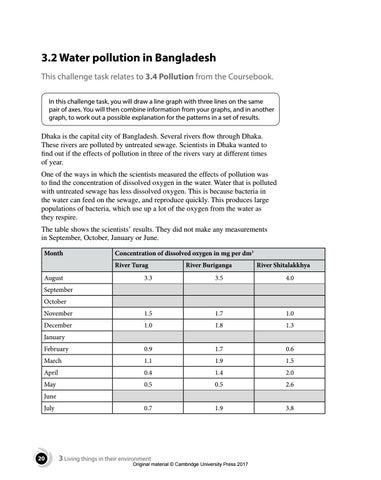
Dhaka is the capital city of Bangladesh. Several rivers flow through Dhaka. These rivers are polluted by untreated sewage. Scientists in Dhaka wanted to find out if the effects of pollution in three of the rivers vary at different times of year. One of the ways in which the scientists measured the effects of pollution was to find the concentration of dissolved oxygen in the water. Water that is polluted with untreated sewage has less dissolved oxygen. This is because bacteria in the water can feed on the sewage, and reproduce quickly. This produces large populations of bacteria, which use up a lot of the oxygen from the water as they respire. The table shows the scientists’ results. They did not make any measurements in September, October, January or June. Month
Concentration of dissolved oxygen in mg per dm3 River Turag
August
River Buriganga
River Shitalakkhya
3.3
3.5
4.0
November
1.5
1.7
1.0
December
1.0
1.8
1.3
February
0.9
1.7
0.6
March
1.1
1.9
1.5
April
0.4
1.4
2.0
May
0.5
0.5
2.6
0.7
1.9
3.8
September October
January
June July
20
3 Living things in their environment
Original material Š Cambridge University Press 2017