for the IB Diploma Coursebook with free additional online material Second edition The second edition of this well-received coursebook is fully updated for the 2014 IB Biology syllabus, comprehensively covering all requirements. Get the best coverage of the syllabus with clear assessment statements, links to Theory of Knowledge, Internationalmindedness and Nature of Science themes. Exam preparation is supported with plenty of sample exam questions, online test questions and exam tips. Clear, simple language makes the text accessible to students of all abilities. Easy navigation is ensured with Standard and Higher Level material clearly marked in all chapters. The coursebook contains: • test yourself questions throughout the chapters to test knowledge, incorporating command terms as used in IB examinations to cultivate familiarity with the terms and develop skill in answering questions appropriately • worked examples to illustrate how to tackle complex problems • exam-style questions at the end of each chapter, offering thorough practice for the examination • definitions of key terms displayed alongside the text for easy reference • links to Theory of Knowledge concepts alongside appropriate topics, to stimulate thought and discussion • a chapter on the Nature of Science • clear, well-labelled illustrations and photos to help make concepts easy to understand.
Brenda Walpole has 20 years’ experience of teaching IB Biology and has written over 30 science books. She is currently an independent consultant in science education.
Biology for the IB Diploma SECOND EDITION
Brenda Walpole
978110765460 Walpole Biology for the IB Diploma Cover C M Y K
Brenda Walpole
Biology for the IB Diploma
Biology
The free additional online student material contains: • all four Option chapters • guidance for the Internal and External Assessment and Nature of Science • additional practice questions.
See inside for details
Brenda Walpole Other titles available: Chemistry for the IB Diploma ISBN 978-1-107-62270-8 Physics for the IB Diploma ISBN 978-1-107-62819-9
with additional online material
Biology for the IB Diploma Second edition Brenda Walpole with Ashby Merson-Davies Leighton Dann
Cambridge University Press’s mission is to advance learning, knowledge and research worldwide. Our IB Diploma resources aim to: • encourage learners to explore concepts, ideas and topics that have local and global significance • help students develop a positive attitude to learning in preparation for higher education • assist students in approaching complex questions, applying critical-thinking skills and forming reasoned answers.
University Printing House, Cambridge cb2 8bs, United Kingdom Cambridge University Press is part of the University of Cambridge. It furthers the University’s mission by disseminating knowledge in the pursuit of education, learning and research at the highest international levels of excellence. www.cambridge.org Information on this title: www.cambridge.org/9781107654600 Š Cambridge University Press 2011, 2014 This publication is in copyright. Subject to statutory exception and to the provisions of relevant collective licensing agreements, no reproduction of any part may take place without the written permission of Cambridge University Press. First published 2011 Second edition 2014 Printed in the United Kingdom by Latimer Trend A catalogue record for this publication is available from the British Library isbn 978-1-107-65460-0 Paperback Additional resources for this publication at education.cambridge.org/ibsciences Cambridge University Press has no responsibility for the persistence or accuracy of URLs for external or third-party internet websites referred to in this publication, and does not guarantee that any content on such websites is, or will remain, accurate or appropriate. Information regarding prices, travel timetables, and other factual information given in this work is correct at the time of first printing but Cambridge University Press does not guarantee the accuracy of such information thereafter. The material has been developed independently by the publisher and the content is in no way connected with nor endorsed by the International Baccalaureate Organization.
notice to teachers in the uk It is illegal to reproduce any part of this book in material form (including photocopying and electronic storage) except under the following circumstances: (i) where you are abiding by a licence granted to your school or institution by the Copyright Licensing Agency; (ii) where no such licence exists, or where you wish to exceed the terms of a licence, and you have gained the written permission of Cambridge University Press; (iii) where you are allowed to reproduce without permission under the provisions of Chapter 3 of the Copyright, Designs and Patents Act 1988, which covers, for example, the reproduction of short passages within certain types of educational anthology and reproduction for the purposes of setting examination questions. The website accompanying this book contains further resources to support your IB Biology studies.Visit education.cambridge.org/ibsciences and register for access. Separate website terms and conditions apply.
Contents Introduction
v
1 Cell biology
1
Introduction 1.1 Introduction to cells 1.2 Ultrastructure of cells 1.3 Membrane structure 1.4 Membrane transport 1.5 The origin of cells 1.6 Cell division Exam-style questions
1 1 12 19 23 30 33 41
2 Molecular biology
43
Introduction 2.1 Molecules to metabolism 2.2 Water 2.3 Carbohydrates and lipids 2.4 Proteins 2.5 Enzymes 2.6 Structure of DNA and RNA 2.7 DNA replication, transcription and translation 2.8 Cell respiration 2.9 Photosynthesis Exam-style questions
3 Genetics Introduction 3.1 Genes 3.2 Chromosomes 3.3 Meiosis 3.4 Inheritance 3.5 Genetic modification and biotechnology Exam-style questions
4 Ecology Introduction 4.1 Species, communities and ecosystems 4.2 Energy flow 4.3 Carbon recycling 4.4 Climate change Exam-style questions
43 43 49 54 59 62 68 71 78 82 89
93 93 93 99 103 110 124 133
136 136 136 141 147 151 157
5 Evolution and biodiversity Introduction 5.1 Evidence for evolution 5.2 Natural selection 5.3 Classification of biodiversity 5.4 Cladistics Exam-style questions
6 Human physiology Introduction 6.1 Digestion and absorption 6.2 The blood system 6.3 Defence against infectious disease 6.4 Gas exchange 6.5 Neurons and synapses 6.6 Hormones, homeostasis and reproduction Exam-style questions
7 Nucleic acids (HL) Introduction 7.1 DNA structure and replication 7.2 Transcription and gene expression 7.3 Translation Exam-style questions
8 Metabolism, cell respiration and photosynthesis (HL)
159 159 159 164 169 178 185
187 187 187 193 202 209 215 220 232
235 235 235 245 251 259
262
Introduction 8.1 Metabolism 8.2 Cell respiration 8.3 Photosynthesis Exam-style questions
262 262 268 276 283
9 Plant biology (HL)
285
Introduction 9.1 Transport in the xylem of plants 9.2 Transport in the phloem of plants 9.3 Growth in plants 9.4 Reproduction in plants Exam-style questions
285 285 293 297 300 305
III
10 Genetics and evolution (HL) Introduction 10.1 Meiosis 10.2 Inheritance 10.3 Gene pools and speciation Exam-style questions
11 Animal physiology (HL) Introduction 11.1 Antibody production and vaccination 11.2 Movement 11.3 The kidney and osmoregulation 11.4 Sexual reproduction Exam-style questions
308 308 308 313 327 335
Answers to test yourself questions 380 Glossary
386
Index
401
Acknowledgements
407
337 337 337 346 353 365 377
Free online material The website accompanying this book contains further resources to support your IB Biology studies. Visit education.cambridge.org/ibsciences and register to access these resources:
Options
Self-test questions
Option A Neurobiology and behaviour
Assessment guidance
Option B Biotechnology and bioinformatics Model exam papers Option C Ecology and conservation
Nature of Science
Option D Human physiology
Answers to exam-style questions Answers to Options questions
IV
Introduction Biology has advanced at a rapid rate over recent decades and is truly the science of the 21st century. Advances in genetics, biochemistry, medicine and cell biology have kept the subject in the forefront of international news. To keep pace with new developments, the IB Biology course is regularly updated so that IB students can understand not only the principles of modern science but also the processes and the ethical implications that go with them. The latest revision of the IB Biology syllabus will be examined in the years 2016–2022, and this second edition of Biology for the IB Diploma is fully updated to cover the content of that syllabus. Biology may be studied at Standard Level (SL) or Higher Level (HL). Both share a common core, which is covered in Topics 1–6. At HL the core is extended to include Topics 7–11. In addition, at both levels, students then choose one Option to complete their studies. Each option consists of common core and additional Higher Level material.You can identify the HL content in this book by ‘HL’ included in the topic title (or section title in the Options), and by the red page border. The Options are included in the free online material that is accessible with the code available in this book. The structure of this book follows the structure of the IB Biology syllabus. Each topic in the book matches a syllabus topic, and the sections within each topic mirror the sections in the syllabus. Each section begins with learning objectives as starting and reference points. Test yourself questions appear throughout the text so students can check their progress and become familiar with the style and command terms used, and examination style questions appear at the end of each topic. Theory of Knowledge (TOK) provides a cross-curricular link between different subjects. It stimulates thought about critical thinking and how we can say we know what we claim to know. Throughout this book, TOK features highlight concepts in Biology that can be considered from a TOK perspective. These are indicated by the ‘TOK’ logo, shown here. Science is a truly international endeavour, being practised across all continents, frequently in international or even global partnerships. Many problems that science aims to solve are international, and will require globally implemented solutions. Throughout this book, InternationalMindedness features highlight international concerns in Biology. These are indicated by the ‘International-Mindedness’ logo, shown here. Nature of Science is an overarching theme of the Biology course. The theme examines the processes and concepts that are central to scientific endeavour, and how science serves and connects with the wider community. At the end of each section in this book, there is a ‘Nature of Science’ paragraph that discusses a particular concept or discovery from the point of view of one or more aspects of Nature of Science. A chapter giving a general introduction to the Nature of Science theme is available in the free online material. INTRODUCTION
V
Free online material Additional material to support the IB Biology Diploma course is available online.Visit education.cambridge.org/ibsciences and register to access these resources. Besides the Options and Nature of Science chapter, you will find a collection of resources to help with revision and exam preparation. This includes guidance on the assessments, interactive self-test questions and model exam papers. Additionally, answers to the exam-style questions in this book and to all the questions in the Options are available.
VI
Cell biology 1 Introduction In the middle of the seventeenth century, one of the pioneers of microscopy, Robert Hooke (1635–1703), decided to examine a piece of cork tissue with his home-built microscope. He saw numerous boxshaped structures that he thought resembled monks’ cells or rooms in a monastery, so he called them ‘cells’. As microscopes became more sophisticated, other scientists observed cells and found that they occurred in every organism. No organism has yet been discovered that does not have at least one cell. Living things may vary in shape and size but scientists agree that they are all composed of cells. The study of cells has enabled us to learn more about how whole organisms function.
1.1 Introduction to cells The cell theory Today, scientists agree that the cell is the fundamental unit of all life forms. Cell theory proposes that all organisms are composed of one or more cells and, furthermore, that cells are the smallest units of life. An individual cell can perform all the functions of life and anything that is not made of cells, such as viruses, cannot be considered living. One of the key life processes of all living organisms is reproduction. Therefore, one of the first principles of the cell theory is that cells can only come from pre-existing cells. Louis Pasteur (1822–1895) carried out experiments that provided evidence for this. Extensive examination of many organisms and millions of different types of cell supports the cell theory, although a few examples have been found that do not fit the theory perfectly. One example is fungi, whose structures consist of long threads called hyphae (Figure 1.1), which have many nuclei but are not divided into separate cells by cell walls. Another example is skeletal muscle, which is composed of muscle fibres that are much larger than a single cell and contain several hundred nuclei. Cells of some large algae are somewhat anomalous because their single cells are undifferentiated but are attached to chains of identical cells or surrounded by a matrix of extra cellular material so that they form large structures, and mammalian erythrocytes (red blood cells) do not contain nuclei once they have matured and been released into the bloodstream, which means at this stage of their life cycle they cannot carry out all the functions of life so they too depart from cell theory.
Unicellular organisms By definition, a living organism comprising just one cell has to perform all the necessary functions for survival.
Learning objectives You should understand that: r Cell theory explains that living organisms are composed of cells. r Unicellular organisms carry out all the functions of life. r Surface area to volume ratio is an important factor in limiting cell size. r Interactions between their cellular components lead to new emergent properties in multicellular organisms. r Multicellular organisms have specialised tissues, which develop as a result of cell differentiation. r Cell differentiation results from the expression of some genes but not others. r Stem cells are able to divide and differentiate along different pathways and are essential for embryonic development. This ability makes them suitable for therapeutic uses.
Figure 1.1 Fungal hyphae grow through material that nourishes the fungus. In this scanning electron micrograph the thread like structures are the hyphae and the pale pink spheres are the reproductive spores (× 2000).
1 CELL BIOLOGY
1
Key principles of the cell theory:
r living organisms are composed
of cells r cells are the smallest units of life r all cells come from pre-existing cells.
Drawing cell structures When you draw cells as they appear under a microscope, always use a sharp pencil and draw single lines to show the relative sizes and positions of the structures you can see. Do not use shading or crosshatching on your diagram. Label each structure with a straight line so that the name of each part appears at the side of your diagram. Always include a title and the magnification of your drawing.You can see an example of how to do this in Figure 1.2.
The functions of life are: r metabolism r nutrition r growth r reproduction response (or sensitivity) r r excretion r homeostasis A unicellular organism such as Paramecium (Figure 1.2) needs to metabolise organic materials in order to make the chemicals needed to sustain life. It must also be able to excrete waste produced during metabolism and dispose of it. It must be able to detect changes in its environment, so it can respond to more favourable or less favourable conditions. Some unicellular organisms photosynthesise and they have a light spot that enables them to move to a brighter environment to maximise photosynthesis. A unicellular organism must also be able to control its internal environment (homeostasis), as large changes in water or salt concentrations may have a detrimental effect on metabolism and other cellular functions. It must also obtain food, whether produced from simple inorganic substances through photosynthesis (as in Chlorella, Figure 1.3) or ingested as complex organic materials from outside as a source of nutrition. If the species is to survive, an organism must be able to reproduce. This could be either asexual or sexual reproduction.
Investigations of some life processes in Paramecium and Chlorella Paramecium can be observed under a light microscope. Paramecia have cilia, which they flick in rhythmic waves to move about in water, and they also have a row of specialised cilia that waft food particles towards the 35 Îźm
plasma membrane
Figure 1.3 Chlorella is a unicellular organism containing a chloroplast (Ă— 1200).
2
cytoplasm
food vacuoles
nucleus
oral groove
contractile vacuole
cilia
Figure 1.2 Paramecium carries out all the life functions within its single cell (Ă— 323).
visible with the naked eye visible with a light microscope
One of the few cells large enough to be visible to the unaided eye is the mature human ovum, which has a diameter of approximately 150 μm. However, most cells are much smaller than this, and can only be seen using a microscope. Light microscopes, which can magnify up to 2000 times, reveal some internal structures such as the nucleus, but greater detail requires the use of more powerful microscopes such as the electron microscope, which magnifies cell structures up to 500 000 times.Viruses can only be seen with these microscopes, so the structure of viruses was unknown until the invention of these microscopes in the 20th century. Electron microscopes use a beam of electrons, instead of light, to produce an image. The resolution of an electron microscope is much better than that of a light microscope because of the shorter wavelength of electrons. Resolving power is the ability of the microscope to separate objects that are close together so that more detail can be seen. Only nonliving material can be observed in an electron microscope and specimens must be prepared with heavy metals or coated with carbon or gold. There are two types of electron microscope: the TEM (transmission electron microscope) and SEM (scanning electron microscope). A TEM produces clear images of thin sections of material while in an SEM electrons are bounced off objects to produce detailed images of their external appearance. Both types of microscope produce black and white images but these are often artificially coloured so that certain features can be seen more clearly. Table 1.1 compares the different types of microscope. Even the electron microscope cannot distinguish individual molecules. Other techniques such as X-ray crystallography are needed to do this. Figure 1.4. indicates the relative sizes of some biological structures.
thickness of blade of a leaf
200 µm
Paramecium (unicellular organism)
100 µm
diameter of sharp end of pin and smallest object visible with eye only
40 µm
diameter of plant cell
30 µm
width of very fine human hair
20 µm
diameter of animal cell
1 µm
diameter of mitochondrion
0.5–1 µm diameter of bacterium (500–1000 nm) 0.2 µm smallest object visible with (200 nm) light microscope
visible with an electron microscope
Cell size
500 µm
20 nm
diameter of ribosome
7 nm
thickness of membrane
2 nm
diameter of DNA molecule
0.5 nm
smallest object visible with electron microscope
invisible
oral groove. If stained yeast cells are added to the culture of Paramecium it is possible to observe the path taken by food particles through the body of the organism and the food vacuoles that are formed. If Paramecium is placed in water of different salinities from distilled water – 0.1%, 0.2%, 0.4% and 0.8% sodium chloride solution, for example – the contractile vacuole, which controls the water balance of the cell, can be seen forming and emptying. Chlorella is a photosynthetic organism with a rapid growth rate. Although its cells are small and must be viewed with a microscope, it can quickly produce large numbers of individuals, which turn water green and opaque. This is most likely to happen when Chlorella grows in water that is rich in nitrates or phosphates. The organism has been used in many scientific experiments; the Nobel prize winner Otto Warburg published his pioneering work on cellular metabolism following intensive experiments on Chlorella in 1919, and in 1961 Melvin Calvin carried out his experiments on photosynthesis using Chlorella (Subtopic 8.3).
0.04 nm diameter of hydrogen atom (the smallest atom)
Figure 1.4 The sizes of some biological structures.
1 CELL BIOLOGY
3
Light microscope
TEM
SEM
uses light to produce images
uses electron beams to produce images
uses electron beams to produce images
Maximum resolution
200 nm
1 nm
1 nm
Maximum magnification
× 2000
up to × 1 000 000
× 200 000
Preparation of material
thin sections of material mounted very thin sections of material on slides supported on metal grids MJWJOH PSHBOJTNT DBO CF FYBNJOFE MJWJOH PSHBOJTNT DBOOPU CF FYBNJOFE
very thin sections of material supported on metal grids living organisms cannot be FYBNJOFE
Stain used
coloured dyes
heavy metals
carbon or gold coating
Image
viewed directly through eyepiece lens
viewed on a screen or photographic plate
viewed on a screen or photographic plate
Table 1.1 Comparison of light microscopes with transmission electron microscope (TEM) and scanning elelctron microscope (SEM).
Magnification and scale Knowing the sizes of objects viewed under the microscope can be very useful (Figure 1.5). For example, a plant scientist might want to compare the relative sizes of pollen grains from plants in the same genus to help identify different species. Magnification is defined as the ratio of the size of the image to the size of the object: magnification =
size of image size of object eyepiece lens
focusing knobs objective lenses
slide
stage mirror to direct light
Figure 1.5 Typical compound light microscope.
4
With a compound microscope, the magnification is the product of both lenses, so if a microscope has a Ă— 10 eyepiece and Ă— 40 objective, the total magnification is Ă— 400. Printed images of structures seen with a microscope usually show a scale bar or give the magnification, so that the size of an object can be calculated. For example, the magnification of the micrograph in Figure 1.6 is given as Ă— 165.
glomerulus
Figure 1.6 $PMPVSFE MJHIU NJDSPHSBQI PG B TFDUJPO UISPVHI UIF DPSUFY PG B LJEOFZ ¨
In Figure 1.6, there are three spherical glomeruli present. In the image, each one is approximately 25 mm across.You can check this using a ruler. Thus: size of image actual size of glomerulus = magnification =
25 mm 165
= 0.15 mm In electron micrographs, most measurements are expressed in micrometres. A micrometre (Οm) is 10–3 mm, so 1 mm is 1000 Οm. So the diameter of the glomerulus = 0.15 × 1000 = 150 Οm.
1 CELL BIOLOGY
5
Worked example 1.1 This image shows a red blood cell. The scale bar shows 2 μm. From this, you can calculate both the size of the cell and the magnification of the image. Size of Step 1 Step 2 Step 3
the cell Use a ruler to measure the length of the cell (its diameter in this case). This is 30 mm. Use a ruler to measure the length of the scale bar. This is 9 mm. Use the ratio of these two values to work out the actual length of the cell. 2 μm actual length of cell = 9000 μm 30 000 μm (Remember to convert all the units to μm. 1 mm = 1000 μm.) Rearranging the equation: 30 000 μm actual length of the cell = 2 μm × 9000 μm = 6.7 μm
Magnification of the image Use the formula: measured length of the cell magnification = actual length of the cell So in this case: 30 000 μm magnification = 6.7 μm = × 4500
2 µm
If you are given a value for the magnification, you can measure the length of the object in the image and then rearrange the equation to work out the actual length of the object.
SI units – International System
Becoming multicellular
1 metre (m) = 1 m
Surface area to volume ratio
1 millimetre (mm) = 10–3 m
Cells are very small, no matter what the size of the organism that they are part of. Cells do not and cannot grow to be very large and this is important in the way living organisms are built and function. The volume of a cell determines the level of metabolic activity that takes place within it. The surface area of a cell determines the rate of exchange of materials with the outside environment. As the volume of a cell increases, so does its surface area, but not in the same proportion, as Table 1.2 shows for a theoretical cube-shaped cell. So as a cell grows larger, it has proportionately less surface area to obtain the materials it needs and to dispose of waste. The rate of exchange of materials across the outer membrane becomes limiting and cannot keep up with the cell’s requirements. Some cells have specialised structures, such as folds and microvilli, to provide a larger surface area relative to their volume but nevertheless there is a limit to the size of a single cell. Beyond this limit, a cell must divide and an organism must become multicellular.
1 micrometre (μm) = 10– 6 m 1 nanometre (nm) = 10–9 m 1 centimetre cubed = 1 cm3 1 decimetre cubed = 1 dm3 1 second = 1 s 1 minute = 1 min 1 hour = 1 h concentration is measured in mol dm−3
6
Becoming multicellular has enormous advantages. An organism can grow in size and its cells can differentiate – that is, they can take on specific functions, so the organism can grow in complexity as well as size. A multicellular organism may have specialised nerve cells for communication and interaction with the outside, and muscle cells for movement. It may also have special reproductive cells and secretory cells that produce enzymes for digestion. Differentiation allows for new properties to emerge as different cell types interact with each other to allow more complex functions to take place. For example, nerve cells may interact with muscle cells to stimulate movement. Side of cube/mm
Surface area/mm2
Volume/mm3
Ratio of surface area : volume
1
1
2
24
8
3:1
3
54
27
2:1
Table 1.2 Surface area to volume ratios for a cube.
?
Test yourself 1 Many cells are roughly spherical in shape. The volume of a sphere is 43 πr 3 and its surface area is 4πr 2. Make a table similar to Table 1.2, this time for a sphere using a different radii as a starting point. Describe the relationship between surface area and volume in this case.
Take a 2Â cm cube of modelling clay. Change its shape so that it becomes a cuboid, a thin cylinder or a sphere. Calculate its surface area each time. Try creating folds in the surface. Which shape produces the greatest surface area?
Emergent properties One person playing the flute can produce a simple, recognisable tune but if several musicians with other instruments join in and play together as a group, they produce a wide variety of sounds and many different effects. New properties emerge in the cells of multicellular organisms in a similar way. Their cellular components interact so that the organism can carry out a range of more complicated functions. One cell can function on its own, but with other cells in a group, it can produce tissues and organs that carry out a range of roles in the organism. For example, lungs are made of many cells – it is only when all these cells work as a unit that the lungs are able to perform their function. Cells form tissues, tissues form organs, organs form organ systems and organ systems work in synergy so that the whole organism can carry out a complex range of tasks and is greater than the composition of its parts.
1 CELL BIOLOGY
7
The systems approach A system is defined as an assemblage of parts and the relationships between them that enable them to work together as a functioning whole. The systems approach has long been used in engineering but for many years natural systems were examined from a reductionist point of view. We can see how the two approaches differ if we consider the study of a pond. A reductionist study of the pond would describe the organisms found there in terms of their features and characteristics; for example, whether they are vertebrates or invertebrates, plant or animal. But a reductionist study would not try to consider how the pond worked as a dynamic system. A systems approach would take a holistic view of the pond and consider interrelationships such as food chains and nutrient cycling that occur between the various components of the pond. In this way a picture of the interdependence of the different parts of the pond – that is, the system’s structure – could be built up. In a study of cells and their components, the systems approach would consider a single cell in terms of the flows of energy and materials between the various structures within in it. On a larger scale, groups of cells, an organ or even a whole organism can be studied using the systems approach so that the parts and the interactions between them can be viewed as a complete functioning entity. Emergent properties in any system can only be studied by means of a systems approach.
Questions to consider
t
t
What are the advantages and disadvantages of the systems approach compared with the reductionist approach to the study of cells? In science, the reductionist and the systems approach may use similar methods of study. What is the most important difference between the philosophies of the two approaches?
Differentiation How do cells in the same organism behave in different ways when they all arose from the same parent cell and so have the same genome (genetic make-up)? In a particular organism, nerve cells and muscle cells all have the same genes but look and behave very differently. The logical answer is that in some cells particular genes are expressed that are not expressed in other cells, and vice versa. For example, a pancreatic cell will express genes for the production of digestive enzymes or insulin, but a skin cell will not. Differentiation involves the expression of some genes from the organism’s genome in the cell, but not others.
Stem cells The fertilised egg of any organism contains all the information needed for developing that single cell into a complex organism consisting of many different types of cell. This information is all within the genes, inherited from the maternal and paternal DNA as fine threads called chromosomes. (There is more information on DNA and chromosome structure in Subtopics 2.6 and 3.2.) A fertilised egg divides rapidly and produces a ball of cells called a blastocyst in which all the cells are alike. Gradually, after this stage, the cells differentiate and become destined to form specialised tissues such as muscle or liver. The process of differentiation produces 8
cells for specific purposes – muscle cells for contraction, liver cells for metabolism of toxins, and so on. Once differentiation has happened, it cannot be reversed. Cells in the blastocyst have the potential to turn into a great many different cell types: they are said to be pluripotent and are known as embryonic stem cells. Embryonic stem cells are unique in their potential versatility to differentiate into all the body’s cell types. However, some adult tissues contain a different form of stem cell – one that can only differentiate into cells associated with that tissue. For example, bone marrow contains stem cells that can form all the different types of blood cell, but not muscle cells or liver cells (Figure 1.7). Stem cells differ from most other cells in the following ways. r They are unspecialised. r They can divide repeatedly to make large numbers of new cells. r They can differentiate into several types of cell. r They have a large nucleus relative to the volume of the cytoplasm.
bone marrow stem cell
lymphocytes erythrocytes
Ethical issues in stem cell research Scientists began to investigate and culture stem cells in the 1980s and it soon became apparent that there was enormous potential in using these cells therapeutically. Some of the most recent research aims to grow stem cells to replace damaged or diseased tissue in patients suffering from degenerative conditions such as multiple sclerosis or Alzheimer’s disease. Early work concentrated on using embryonic stem cells, but these can only be obtained from discarded embryos from in vitro fertilisation (IVF) clinics. There is much debate about the ethics of doing this kind of work, and many people feel that the destruction of an embryo to obtain stem cells is morally unacceptable. Others argue that this type of research will contribute significantly to the treatment of disease and can therefore be fully justified. The use of adult stem cells is a less controversial area of research. In this case, cells are obtained from bone marrow or other tissue from a donor who has given consent. Cells can be harvested and grown, and used in medical treatments. Bone marrow transplants already help many leukaemia patients to a full recovery. Although scientists from many countries have cooperated on stem cell research, the laws governing research vary from place to place. In the European Union research using human embryos is permitted in some countries but is illegal in others, such as Germany, Ireland, Italy, Portugal and Austria. In the USA some states fund the research while others ban it; and although Australia permits research, New Zealand restricts it. Laws also differ in their application to embryonic stem cell research and in stems cells taken from adult tissues. Because laws depend on political and religious viewpoints, they may change as new information and research develops.
neutrophils
macrophages
Figure 1.7 Bone marrow cells differentiate into the different types of blood cell.
Plants also contain stem cells. These are found in the meristems just behind the tips of growing stems and roots. These cells can differentiate to become various tissues of the stem and roots.
1 CELL BIOLOGY
9
Therapeutic use of stem cells
Figure 1.8 This technician is collecting blood from an umbilical cord. This blood is a rich source of stem cells.
Another source of stem cells, which has been successfully used in medical treatments, is the blood in the umbilical cord of a newborn baby (Figure 1.8). These stem cells can divide and become any type of blood cell. Cord blood can be used to treat certain types of leukaemia, a cancer that causes overproduction of white blood cells in the bone marrow. Cells from the cord blood are collected and their tissue type is determined. After chemotherapy to destroy the patient’s own bone marrow cells, stem cells which are the correct match to the patient’s tissue are given by transfusion. They become established in the person’s bone marrow and start producing blood cells as normal. This treatment can work well in young children, but there are not enough cells in a single cord to meet the needs of an adult patient. Scientists have been looking for ways to either combine the cells from more than one baby, or to increase the number of cells in the laboratory. Allowing the stem cells to divide in the laboratory produces many blood cells, but not more stem cells. In 2010, scientists at the Fred Hutchinson Cancer Research Center in Seattle, USA, managed to alter a signalling pathway in the stem cells so they could increase in number without losing stem cell properties. As a result of this process, known as therapeutic cloning, umbical cord blood may prove to be an even more valuable source of stem cells in the future. One of the most recent areas of stem cell research has been in the treatment of Stargardt’s disease using retinal pigment epithelium (RPE). Stargardt’s disease is an inherited condition, which begins in childhood and leads to macular degeneration (a gradual destruction of cells in the centre of the retina) and eventually causes blindness. Retinal cells can be made from embryonic stem cells. In 2012, as part of a larger trial, the first patients were given transplants of retinal cells developed from human embryonic stem cells, to treat their condition. The cells were injected directly into the retina and researchers found that not only did the stem cells survive but the number of cells increased over a period of 3 months. The cells began to develop important visual pigment and the patients noticed improvement in their vision. Scientists hope that in the future, stem cells will restore some sight not only to people with Stargardt’s disease but also many millions of older people suffering from age-related macular degeneration, the most common cause of blindness. Stem cell therapy has also been successfully used in the treatment of type I diabetes, and research is continuing into therapies to treat a range of conditions involving neurological damage, such as multiple sclerosis and Alzheimer’s disease.
Nature of science Looking for trends and discrepancies – developing theories In order to explain aspects of the natural world, scientists develop theories. A theory is a well-established and widely accepted principle that arises from extensive observation of trends and discrepancies, and incorporates 10
facts, laws, predictions and tested hypotheses. A hypothesis is a speculative, specific and testable prediction about what is expected to happen in an investigation. So, a theory predicts events in general terms, while a hypothesis makes a specific prediction about a narrowly defined set of circumstances. If any evidence is collected which contradicts a hypothesis, the hypothesis must be rejected and a new hypothesis formulated. In developing a theory, it is important to consider not only the main trends of an idea – those observations that are in general agreement – but also to seek out discrepancies which might go against the trend, and perhaps suggest testable hypotheses leading to a change in the theory. So, for example, with regard to cell theory, scientists might ask if observations suggest that the structure of all parts of all organisms conform to the theory, or if there are any discrepancies. As we have seen, many millions of cells have been examined and the majority do conform to the principles of cell theory. But fungal hyphae and the fibres in muscles cells could be considered a challenge to it. Mammalian red blood cells have no nucleus (even though similar cells in reptiles and other vertebrates do), which means they cannot carry out all the functions of life and depart from cell theory in that respect. Singlecelled protoctista such as Amoeba could be thought of as a challenge to the idea that every cell has a specialised function as these organisms carry out all the functions of life. Science must consider observations like these from many different fields of study and be prepared to revise accepted theories if it is necessary.
Questions to consider
r How can evidence be obtained for the principles of the cell theory?
Can we prove that cells always arise from pre-existing cells? r Do the examples of fungal hyphae and muscle cells disprove the cell theory? r What should happen if evidence is collected that cannot be explained by a theory? r What happens if evidence is collected that disproves a hypothesis?
?
Test yourself 2 Calculate how many cells of 100 Îźm diameter will fit along a 1 mm line. 3 List examples of where the concept of emergent properties can be found in a multicellular animal, such as a bird or a flowering plant. 4 State one therapeutic use of stem cells. 5 Explain how cells in multicellular organisms are able to carry out specialised functions. 6 Use the scale bar on Figure 1.2 to calculate the length of the Paramecium in the photograph.
1 CELL BIOLOGY
11
Learning objectives You should understand that: r Prokaryotes have a simple cell structure with no compartmentalisation. r Eukaryotes have a compartmentalised cell structure with membranebound organelles present in the cytoplasm. r The resolution of electron microscopes is much higher than that of light microscopes, which allows identification of cell structures and organelles.
1.2 Ultrastructure of cells Living things are divided into two types – prokaryotes and eukaryotes – according to the structure of their cells. Prokaryotic cells are usually much smaller than eukaryotic cells and have a much simpler structure. Prokaryotes are thought to be the first cells to have evolved. Bacteria are all prokaryotic cells.
Prokaryotic cells Prokaryotic cells are so called because they have no nucleus (‘prokaryote’ comes from the Greek, meaning ‘before the nucleus’). They also have no organelles (internal structures), so cell functions do not take place in separate compartments within the cytoplasm. From the mid-20th century, when the electron microscope was developed, it became possible to study the internal detail of cells. Figures 1.9 and 1.10 show the main features of a typical prokaryotic cell. plasmid
nucleoid naked DNA 70S ribosomes cytoplasm
flagellum
capsule pili
cell wall Figure 1.9 The bacterium Escherichia coli is a typical prokaryotic cell. (Coloured TEM ¨
plasma membrane Figure 1.10 The structure of a typical prokaryotic cell.
r The cell wall surrounds the cell. It protects the cell from bursting and
is composed of peptidoglycan, which is a mixture of carbohydrate and amino acids. r The plasma membrane controls the movement of materials into and out of the cell. Some substances are pumped in and out using active transport. r Cytoplasm inside the membrane contains all the enzymes for the chemical reactions of the cell. It also contains the genetic material. r The chromosome is found in a region of the cytoplasm called the nucleoid. The DNA is not contained in a nuclear envelope and it is also ‘naked’ – that is, not associated with any proteins. Bacteria also contain additional small circles of DNA called plasmids. Plasmids replicate independently and may be passed from one cell to another. r Ribosomes are found in all prokaryotic cells, where they synthesise proteins. They can be seen in very large numbers in cells that are actively producing protein. Prokaryotes have 70S ribosomes, which are smaller than those found in eukaryotes. 12
r A flagellum is present in some prokaryotic cells. A flagellum, which
projects from the cell wall, enables a cell to move. r Some bacteria have pili (singular pilus). These structures, found on the cell wall, can connect to other bacterial cells, drawing them together so that genetic material can be exchanged between them. Prokaryotic cells are usually much smaller in volume than more complex cells because they have no nucleus. Their means of division is also simple. As they grow, their DNA replicates and separates into two different areas of the cytoplasm, which then divides into two. This is called binary fission. It differs slightly from mitosis in eukaryotic cells (Subtopic 1.6).
Eukaryotic cells
Ribosome sizes The ‘S’ unit used to ‘measure’ ribosomes is a Svedberg unit. It is a measure of the behaviour of particles during sedimentation. 70S and 80S ribosomes are different sizes and so take different times to sediment when they are centrifuged. They are said to have different sedimentation coefficients.
Eukaryotic organisms have cells that contain a nucleus. Animals, plants, fungi and protoctista all have eukaryotic cells. The complexity of a eukaryotic cell cannot be fully appreciated using a compound light microscope. But in images made using an electron microscope, which has a much higher resolution, the fine details of many different organelles are visible. Figure 1.11 shows what can be seen of animal and plant cells using a light microscope – compare these images with the electron micrographs and interpretive drawings in Figures 1.12 to 1.15.
Photograph of a stained animal cell (× 1100)
plasma membrane
cytoplasm
10 μm
mitochondrion
Photograph of a cell in a moss leaf (× 450)
vacuole
10 μm
plasma membrane cell wall
vesicle tonoplast
chloroplast nucleus
nuclear envelope
chromatin
nucleolus
glycogen granules
nuclear envelope
cytoplasm
cell wall of adjacent cell
nucleus
Figure 1.11 Photographs and interpretive drawings to show typical animal and plant cells as they appear using a light microscope.
1 CELL BIOLOGY
13
80S ribosomes
mitochondrion rough endoplasmic reticulum plasma membrane
nucleus, containing DNA associated with histones
Golgi apparatus
secretory vesicle
lumen nuclear envelope
secretory vesicle pouring its contents into lumen
Figure 1.12 &MFDUSPO NJDSPHSBQI PG BO FYPDSJOF DFMM GSPN UIF QBODSFBT ¨
80S ribosomes
mitochondrion
plasma membrane rough endoplasmic reticulum
Golgi apparatus
secretory vesicle nucleus, containing DNA associated with histones
nuclear envelope
Figure 1.13 Interpretive drawing of some of the cell structures visible in Figure 1.12.
14
lumen
nucleolus
nucleolus
vacuole nuclear envelope vacuole
80S ribosomes
80S ribosomes
nuclear envelope
nucleus
nucleus
chloroplasts
chloroplasts cell wall plasmacell membrane wall cytoplasm plasma membrane
cytoplasm endoplasmic reticulum endoplasmic reticulum mitochondrion
Figure 1.14 &MFDUSPO NJDSPHSBQI PG B QBMJTBEF NFTPQIZMM QMBOU DFMM ¨
mitochondrion 80S ribosomes
vacuole nucleolus
nuclear envelope
nucleolus
nuclear envelope
80S ribosomes
vacuole
nucleus
nucleus
chloroplasts
chloroplasts cell wall plasmacell membrane wall cytoplasm plasma membrane
cytoplasm endoplasmic reticulum endoplasmic reticulum mitochondrion mitochondrion
Figure 1.15 Drawing of a palisade mesophyll plant cell made from the electron micrograph in Figure 1.14.
1 CELL BIOLOGY
15
Eukaryotic cells contain structures called organelles, each of which forms a ‘compartment’ in which specific functions take place. This compartmentalisation enables a eukaryotic cell to carry out various chemical reactions or processes in separate parts of the cell, which all form part of the same system. Different types of cell have different organelles in different proportions, depending on the role of the cell. The largest and most obvious structure in a eukaryotic cell is the nucleus, which contains the cell’s chromosomes. Chromosomes are composed of DNA combined with histone protein, forming a material known as chromatin. The nucleus is surrounded by a double-layered membrane, the nuclear envelope. Small gaps in the envelope, called nuclear pores, are visible and it is through these that material passes between the nucleus and the rest of the cell. A distinctive feature of the nucleus is the darkly staining nucleolus. This is the site of ribosome production. Associated with the nuclear envelope is a series of membranes known as the endoplasmic reticulum (ER). Ribosomes attach to this network to form rough endoplasmic reticulum (rER), the site of protein synthesis. As proteins are produced, they collect in the spaces between the membranes, known as the cisternae. From here they can be transported in vesicles to other parts of the cell such as the Golgi apparatus. ER that has no ribosomes attached is known as smooth endoplasmic reticulum (sER). The membranes of sER have many enzymes on their surfaces. Smooth ER has different roles in different types of cell – in liver cells, it is where toxins are broken down; in the ovaries, it is the site of estrogen production. Smooth ER also produces phospholipids for the construction of membranes and lipids for use in the cell. The Golgi apparatus is similar in appearance to the sER, composed of stacks of flattened, folded membranes. It processes proteins made in the rER, collecting, packaging and modifying them, and then releasing them in vesicles for transport to various parts of the cell or for secretion from the cell. The pancreas contains many secretory cells, which have large areas of Golgi apparatus (Figures 1.12 and 1.13). Eukaryotic cells also contain mitochondria (singular mitochondrion). These are elongated structures surrounded by a double membrane that are found throughout the cytoplasm. Mitochondria are known as the cell’s ‘powerhouses’ because they are the site of aerobic respiration. The inner membrane is folded to form cristae, which greatly increase the surface area for the production of ATP in the cell. Cells that respire rapidly, such as muscle cells, have numerous mitochondria. Lysosomes are spherical organelles with little internal structure, which are made by the Golgi apparatus. They contain hydrolytic enzymes for breaking down components of cells. They are important in cell death, in breaking down old organelles and, in white blood cells, digesting bacteria that have been engulfed by phagocytosis. Plant cells do not normally contain lysosomes. Ribosomes are the site of protein synthesis in cells. They may be free in the cytoplasm or attached to the rER. They are made of RNA and 16
protein but they do not have a membrane around them. Eukaryotic cells contain 80S ribosomes, which are larger than those found in prokaryotes. As in prokaryotic cells, the plasma membrane controls the movement of materials into and out of the cell, and the gel-like cytoplasm, which fills much of the volume of the cell, provides a medium for many metabolic reactions. Plant cells have three additional structures. All plant cells have an outer cellulose cell wall and most have a large central vacuole. Some plant cells, such as palisade mesophyll cells (Figures 1.14 and 1.15), contain chloroplasts. The chloroplasts are found in cells exposed to the light, as they are the sites of photosynthesis. Chloroplasts have a double membrane and are about the same size as bacteria. Both chloroplasts and mitochondria have their own DNA and ribosomes and are able to reproduce independently of the cell. The large central vacuole contains water and salts. The membrane that surrounds it is under pressure from within and exerts a force on the cytoplasm, which in turn exerts a force on the cell wall, making the cell turgid and firm. The outer cell wall is composed of cellulose and other carbohydrates such as lignin and pectin, giving plant cells further support and a more rigid structure than animal cells. The cell walls and turgidity of plant cells give strength and support to tissues like leaves, holding them in the optimum position to catch the energy from sunlight for photosynthesis. Although they are both eukaryotic cells, there are several key differences between animal and plant cells. These are summarised in Table 1.3. Animal cells
Plant cells
cell wall absent
cell wall present
small vacuoles sometimes present
large central vacuole present in mature cells
no chloroplasts
chloroplasts often present
cholesterol in plasma membrane
no cholesterol in plasma membrane
DFOUSJPMFT QSFTFOU TFF QBHF
centrioles absent
stores glycogen
stores starch
Table 1.3 Differences between animal and plant cells.
Differences between prokaryotic and eukaryotic cells Comparisons of images of prokaryotic and eukaryotic cells show numerous differences between them. These are summarised in Table 1.4. Note, for example, the difference in size of ribosomes between prokaryotic and eukaryotic cells.
1 CELL BIOLOGY
17
Structure
Eukaryotic cell
Prokaryotic cell
nucleus
usually present, surrounded by a nuclear envelope and containing chromosomes and a nucleolus
no nucleus, and therefore no nuclear envelope or nucleolus
mitochondria
usually present
never present
chloroplasts
present in some plant cells
never present
endoplasmic reticulum
usually present
never present
ribosomes
relatively large, about 30 nm in diameter, or 80S
relatively small, about 20 nm in diameter, or 70S
chromosomes
DNA arranged in long strands, DNA present, not associated associated with histone with proteins, circular proteins plasmids may also be present
cell wall
always present in plant cells, made of cellulose, never present in animal cells
always present, made of peptidoglycan
flagella
sometimes present
some have flagella, but these have a different structure from those in eukaryotic cells
Table 1.4 Differences between prokaryotic and eukaryotic cells. The unit ‘S’ is a Svedberg unit, used to compare sizes of cell organelles.
Nature of science Scientific advance follows technical innovation – the electron microscope A typical animal cell is 10–20 μm in diameter, which is about one-fifth the size of the smallest particle visible to the naked eye. Robert Hooke was the first scientist to see and describe cells, although he didn’t know what they were. Later, Anton van Leeuwenhoek, who built one of the first microscopes in 1674, was able to see living cells of Spirogyra and bacteria.
Can we believe our eyes? Our own perception is a crucial source of knowledge. The way we see things depends on the interaction between our sense organs and our mind, and what we perceive is a selective interpretation. When studying material that has been prepared for microscopic examination, we must always bear in mind that staining and cutting cells will alter their appearance. Interpreting images requires care, and what we perceive in a particular image is likely to be influenced by these techniques as well as our own expectations.
18
Questions to consider
t
t
Consider the shapes of mitochondria in Figure 1.12. Why do some mitochondria appear cylindrical and others circular? Plant cells have a single central vacuole. Examine the plant cell in Figure 1.14. How many vacuoles can you see? How can you explain this?
It was not until good light microscopes became available in the early part of the 19th century that plant and animal tissues were seen as groups of individual cells and Schleiden and Schwann in 1838 were able to see sufficient structure to propose the cell theory, which incorporated the work of their predecessors (page 1). Animal cells are tiny and colourless so it was not until the end of the 19th century, when staining techniques were first used, that it was possible to see a little more detail of cell contents. In the early 1940s, far more powerful electron microscopes were used for the first time and organelles and greater complexity of cell structure could be studied. Developments proceeded more rapidly in the 20th century because international communication allowed for more efficient collaboration not only in the designing and building of scientific instrumentation but also in the discussion and understanding of what could be observed. A light microscope can resolve (view separately) cell details that are about 0.2 μm apart. Resolution is limited by the wavelength of light so that bacteria and mitochondria (500 nm or 0.5 μm) are the smallest objects that can be seen. An electron microscope uses a beam of electrons to probe specimens and in theory it should be able to resolve structures that are 0.002 nm apart (a resolution 10 000 times that of a light microscope). But because of practical problems in preparing specimens the best modern electron microscope resolves about 0.1 nm. For biological material this reduces to about 0.2 nm but, even so, an electron microscope allows a resolution which is 100 times better than a light microscope and its development has led to a greater understanding of cell structures and functions.
?
Test yourself 7 List three differences between prokaryotic and eukaryotic cells. 8 Distinguish between these pairs of terms: a ‘cell wall’ and ‘plasma membrane’ b ‘lysosome’ and ‘ribosome’. 9 State one advantage a cell gains from being compartmentalised – that is, from having organelles. 10 Outline the function of the endoplasmic reticulum.
1.3 Membrane structure The structure of membranes Membranes not only provide shape for a cell and enclose its contents; there is also considerable activity at membrane surfaces, especially at the plasma membrane in contact with the extracellular space. Our current model of membrane structure, the fluid mosaic model, helps to explain how membranes carry out these functions.
Learning objectives You should understand that: r Phospholipids form bilayers in water due to the amphipathic properties of the molecules. r Membranes contain a range of proteins, which differ in their structure, function and position in the phospholipid bilayer. r Cholesterol is an important component of the membranes of animal cells.
1 CELL BIOLOGY
19
All membranes, wherever they occur in cells, have the same basic structure. Membranes are usually between 7 and 10 nm thick, and are composed of two layers of phospholipid, which form a bilayer. Phospholipids are made up of a polar, hydrophilic area containing a phosphate group bonded to glycerol, and a non-polar, lipophilic area containing fatty acids. In the bilayer, the lipophilic or hydrophobic (water-hating) parts all point towards each other, and the hydrophilic (water-loving) areas point outwards, as Figure 1.16 shows. It is the different properties of each end of the molecule that cause the phospholipids to arrange themselves in this way. The hydrophilic ‘heads’ of the molecules always appear on the outside of the membrane where water is present, while the hydrophobic ‘tails’ orientate inside the double layer, away from water. The structure is called a ‘mosaic’ because, just as a mosaic picture is made up of many small, separate pieces, so the surface of the membrane is composed of the heads of many separate phospholipid molecules. The whole structure is flexible or ‘fluid’ because the phospholipids can float into a position anywhere in the membrane. Research using radioactively labelled phospholipids shows that these molecules move not only within their own layer, but also between the two layers of the membrane. Embedded in the bilayer are different molecules that contribute to the functions of membranes. Cholesterol is often present in mammal cells and is most commonly found in the plasma membrane. One end of the cholesterol molecule associates with the polar heads of phospholipid molecules while other parts of it are embedded in the membrane next to the non-polar fatty acid chains. This interaction makes the membrane less ‘fluid’, more rigid, and less permeable to water-soluble molecules. There are also different types of protein in the bilayer. Integral proteins are embedded in the bilayer, whereas peripheral proteins are attached to the surface. Many of the proteins on the outer surface are glycoproteins – that is, they have carbohydrate groups attached to them. Some of these serve as hormone binding sites and have special shapes to recognise the specific hormones to which the cell will respond. Others are important in cell-to-cell communication and adhesion. Some integral
Amphipathic compounds possess both hydrophilic (waterloving, polar) and lipophilic (fat-loving) properties. The amphipathic properties of phospholipids in a membrane explain the way a membrane structure forms. Phospholipids arrange themselves into bilayers, with their polar groups facing the surrounding aqueous (watery) medium, and their hydrophobic chains facing towards the inside of the bilayer. In this way, a nonpolar region is formed between two polar ones. Phospholipids are principal constituents of biological membranes, but cholesterol and glycolipids and glycoproteins are also amphipathic and their presence in the bilayer gives membranes different physical and biological properties.You can find out more about the importance of polar groups in Subtopic 2.2. High levels of certain types of cholesterol in the blood have been associated with heart disease.You can find out more about this on page 199.The body produces its own cholesterol in the liver, but it is also found in many foods that we eat.
hydrophilic layer
phospholipid bilayer glycerol
hydrophobic layer
water
fatty acid
In a watery environment, the phospholipids become arranged in a bilayer, because of the hydrophilic and hydrophobic properties of the ‘heads’ and ‘tails’ of the molecules.
water
Figure 1.16 A phospholipid molecule includes a phosphate, glycerol and two fatty acids but in diagrams (such as Figure 1.17) the molecule is often simplified and shown as a circle with two tails.
20
proteins are enzymes immobilised within the membrane structure and perfectly placed to carry out sequences of metabolic reactions. Finally, there are proteins that span the bilayer acting as channels for ions and molecules to pass by passive transport, or forming pumps that use active transport to move molecules into or out of the cell.
Models of membrane structure Our current understanding of the structure of the membrane has arisen from the work of a number of scientists, over many years. Each group refined previous knowledge of membranes, rejecting theories that were not supported by evidence and working to gather new data as microscopy and other techniques improved. The existence of a lipid bilayer was originally proposed and outlined by Gorter and Grendel, in 1925. Their ideas were developed and improved by Hugh Davson and James Danielli, who proposed in 1935 a model of a phospholipid bilayer between two layers of globular protein, the so-called ‘fat sandwich’ model. The Davson– Danielli model was new and it attempted to explain their observations of the surface tension of lipid bilayers. Since that time, the phenomenon of surface tension in bilayers has been better explained by studying the properties of the phospholipid heads. Nevertheless, the Davson–Danielli model predominated, and was supported by observations using the electron microscope, until 1972 when Singer and Nicolson described the ‘fluid mosaic’ model. The fluid mosaic model included descriptions of integral proteins that were sited through the membrane, and it rejected the idea of a ‘sandwich-like’ globular protein layer because it was no longer well supported by experimental evidence (see ‘Nature of science’, below). Fresh observations obtained using a new technique called freezeetching were also important. The model of membrane structure accepted today is based on the Singer and Nicolson fluid mosaic model, illustrated in Figure 1.17, and has been supported by more recent research, with only minor modifications.
Nature of science Falsification of theories – developing a model of membrane structure Scientific theories embody our current understanding of aspects of the real world, and may include models to represent those aspects. However, any scientific theory or model can only exist until it is disproved. The Davson–Danielli model of membrane structure was accepted until new evidence called the model into question. The Davson–Danielli model was very close to what is now accepted, except that it proposed that all membranes are alike. This was disproved, though, when it was found that different organisms transport very different substances across their membranes, using different proteins. For example, mammalian cells transport sodium and potassium ions across their plasma membranes via special protein channels, while methane-producing bacteria move
Freeze-etching is a method of preparing membranes to give a three-dimensional view of the surface and detail of the membrane’s structures. Cells are rapidly frozen and fractured by breaking them in liquid nitrogen. The fractured surface is shadowed with evaporated heavy metal under vacuum and stabilised. The replicated surface is floated onto fine metal grids so that it can be viewed in the electron microscope to reveal the 3D arrangement of lipids and proteins that are present.
As you read the evidence that has accumulated and helped our understanding of the structure of membranes, consider the following questions. t Why is it important for scientists to put forward their ideas in the form of theories? t How useful are models in developing ideas of biological structures? t Is it important to learn about theories that have been discredited or superseded?
1 CELL BIOLOGY
21
carbohydrate part of glycoprotein
outside Outside
glycolipid
A 3D representationprotein of protein membrane structure
glycoprotein glycoprotein cholesterol branching carbohydrate attached to a protein to form a glycoprotein
peripheral protein hydrophilic head
Inside inside phospholipid channel protein phospholipid transport protein
transport protein has hydrophilic interior for ions and hydrophilic molecules
hydrophobic tails Outer surface phospholipid bilayer Inner surface A 2D representation of membrane structure
one phospholipid molecule cholesterol in both layers
integral protein
Figure 1.17 Diagrams to show the fluid mosaic model of membrane structure.
methane out of their cells via different protein channels. Evidence such as this showed that all membranes are not alike, and falsified the Davson– Danielli model, which was superseded by our current model.
?
22
Test yourself 11 Suggest why the term ‘fluid mosaic’ is used to describe membrane structure. 12 Suggest why the fatty acid ‘tails’ of the phospholipid molecules always align themselves in the middle of the membrane. 13 Outline the difference between integral membrane proteins and peripheral membrane proteins.
1.4 Membrane transport Diffusion, facilitated diffusion and osmosis Many molecules pass across the plasma membrane. Water, oxygen, carbon dioxide, excretory products, nutrients and ions are continuously exchanged and many cells also secrete products such as hormones and enzymes through the plasma membrane. The simplest way in which molecules can move into or out of a cell is by simple diffusion through the plasma membrane. Diffusion is a passive process, which takes place as molecules move randomly. No energy input is required, and movement occurs by way of a simple concentration gradient. A concentration gradient is a difference in concentration of a substance between two regions and diffusion will always occur where such a gradient exists until particles of the substances are evenly distributed and equilibrium is reached. One important example of simple diffusion is its role in the process of cell respiration. Oxygen is needed by cells as it is continuously used up in respiration. As a cell respires, the oxygen concentration inside becomes less than the concentration outside, so oxygen molecules diffuse in. In a similar way, as carbon dioxide is continuously formed during respiration, its concentration builds up inside the cell and it diffuses out through the plasma membrane to an area where the concentration is lower. Simple diffusion occurs where the membrane is fully permeable to the substance or where channel proteins in the membrane are large enough for the substance to pass through. Large molecules, and charged particles such as chloride ions (Cl–) and potassium ions (K+), cannot pass through the membrane by simple diffusion so certain proteins form channels through which they can travel. As in simple diffusion, no energy is used by the cell and the transport relies on the kinetic energy of the particles moving down their concentration gradient. Channel proteins have an interior which is hydrophilic (Figure 1.18) so water-soluble materials can pass though them, and they are specific – that is, they only allow a particular substance to move through. Some of these channels are permanently open, whereas others are gated and only open to allow certain ions to pass when they are stimulated to do so. For example, gated channels in the axons of nerve cells open when there is a change in the voltage (potential difference) across the membrane. Gated potassium channels only allow K+ ions to pass out through the membrane after a nerve impulse has passed along the axon.You can read more about nerve impulses in Subtopic 6.5. Other channel proteins allow the movement of substances such as glucose and amino acids, which are polar and cannot diffuse though the lipid layer of the membrane. Substances like these are transported across membranes by facilitated diffusion. In this case, a carrier protein first combines with the diffusing molecules on one side of the membrane, carries them through the channel protein and then releases them on the other side (Figure 1.18). Facilitated diffusion allows a faster diffusion rate
Learning objectives You should understand that: r Particles move across membranes by osmosis, active transport, simple diffusion and facilitated diffusion. r Materials can be taken into cells by endocytosis and leave cells by exocytosis due to the fluid nature of the membrane. r Within a cell, vesicles move materials around.
Passive transport the movement of substances down a concentration gradient from an area of high concentration to an area of lower concentration without the need for energy to be used Diffusion one example of passive transport; many molecules pass into and out of cells by diffusion e.g. oxygen, carbon dioxide and glucose Osmosis another example of passive transport but the term is used only in the context of water molecules; osmosis is the movement of water molecules across a partially permeable membrane from a region of lower solute concentration, where there is a high concentration of water molecules, to a region of higher solute concentration, where the concentration of water molecules is lower Active transport the movement of substances against the concentration gradient, which always involves the expenditure of energy in the form of ATP
1 CELL BIOLOGY
23
Diffusion through a protein channel high concentration
Large or charged substances such as K+ and Cl– ions cannot pass easily through membranes. They can pass through special channel proteins if they come in contact with the channel. Only specific ions or molecules can pass and no energy input is required.
concentration gradient
channel protein open
channel protein closed
low concentration
Facilitated diffusion via a carrier protein high concentration
Carrier proteins assist some molecules through the membrane, down their concentration gradient, combining with molecules on one side of the membrane and releasing them on the other side. Again, no energy input is required.
concentration gradient
low concentration
Figure 1.18 Some large or charged ions and molecules pass through the membrane via special channel proteins.
for molecules that particular cells need – for example, the diffusion of glucose into active muscle cells. No energy input is required because the molecules move down their concentration gradient. A special case of diffusion is osmosis (Figure 1.19). This is the passive movement of water across a partially permeable membrane from an area of lower solute concentration to an area of higher solute concentration.
Before osmosis Two solutions are separated by a partially permeable membrane. B has a higher solute concentration than A. The solute molecules are too large to pass through the pores in the membrane but the water molecules are small enough.
Figure 1.19 Osmosis.
24
At equilibrium As the arrows in the left diagram indicate, more water molecules moved from A to B than from B to A, so the net movement has been from A to B, raising the level to the solution in B and lowering it in A. The water potentials (the tendency of water molecules to move in each direction) in A and B are now the same.
When the solute concentrations inside and outside a cell are the same, the same number of water molecules will pass across the membrane into the cell as those that leave. An animal cell that is placed in pure water will take in water by osmosis until eventually it may burst (Figure 1.20). Placed in a solution with a very high concentration of solutes, the cell will shrink or ‘crenate’ as water leaves the cell by osmosis. In either situation, animal cells will not function properly and their metabolism will be affected. In medical procedures, tissues and organs are bathed in a solution of ‘normal saline’, which has exactly the same osmolarity (a measure of the solute concentration in a solution) as human cell cytoplasm and is said to be isotonic with the cytoplasm. In this case osmosis does not occur and cells are not damaged. high water potential outside, lower inside
osmotic uptake of water
A cell contains many substances dissolved in its cytoplasm so when placed in pure water (which is hypotonic in relation to the cell) it will tend to take in water by osmosis. The cell will swell and eventually burst and die.
equal water potential outside and inside
no net movement of water
A cell placed in water with the same concentration of solutes as the cell (an isotonic solution) will remain in equilibrium.
low water potential outside, higher inside
osmotic loss of water
Cells placed in a solution containing a higher concentration of dissolved solutes than the cell contents (a hypertonic solution) will lose water by osmosis and shrink.
Figure 1.20 Responses of animal cells to solutions of different concentrations (see also Figure 1.21).
1 CELL BIOLOGY
25
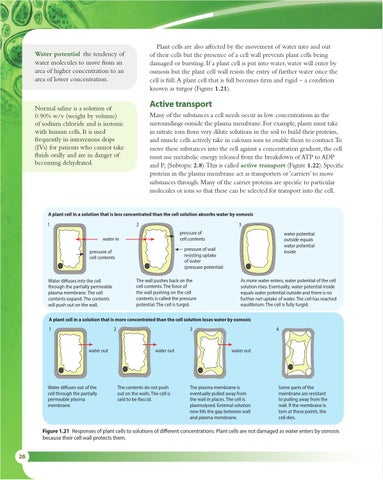
Plant cells are also affected by the movement of water into and out of their cells but the presence of a cell wall prevents plant cells being damaged or bursting. If a plant cell is put into water, water will enter by osmosis but the plant cell wall resists the entry of further water once the cell is full. A plant cell that is full becomes firm and rigid – a condition known as turgor (Figure 1.21).
Water potential the tendency of water molecules to move from an area of higher concentration to an area of lower concentration.
Active transport
Normal saline is a solution of 0.90% w/v (weight by volume) of sodium chloride and is isotonic with human cells. It is used frequently in intravenous drips (IVs) for patients who cannot take fluids orally and are in danger of becoming dehydrated.
Many of the substances a cell needs occur in low concentrations in the surroundings outside the plasma membrane. For example, plants must take in nitrate ions from very dilute solutions in the soil to build their proteins, and muscle cells actively take in calcium ions to enable them to contract. To move these substances into the cell against a concentration gradient, the cell must use metabolic energy released from the breakdown of ATP to ADP and Pi (Subtopic 2.8). This is called active transport (Figure 1.22). Specific proteins in the plasma membrane act as transporters or ‘carriers’ to move substances through. Many of the carrier proteins are specific to particular molecules or ions so that these can be selected for transport into the cell.
A plant cell in a solution that is less concentrated than the cell solution absorbs water by osmosis 1
2
3 pressure of cell contents
water in
pressure of wall resisting uptake of water (pressure potential)
pressure of cell contents
The wall pushes back on the cell contents. The force of the wall pushing on the cell contents is called the pressure potential. The cell is turgid.
Water diffuses into the cell through the partially permeable plasma membrane. The cell contents expand. The contents will push out on the wall.
water potential outside equals water potential inside
As more water enters, water potential of the cell solution rises. Eventually, water potential inside equals water potential outside and there is no further net uptake of water. The cell has reached equilibrium. The cell is fully turgid.
A plant cell in a solution that is more concentrated than the cell solution loses water by osmosis 1
2
water out
Water diffuses out of the cell through the partially permeable plasma membrane.
3
water out
The contents do not push out on the walls. The cell is said to be flaccid.
4
water out
The plasma membrane is eventually pulled away from the wall in places. The cell is plasmolysed. External solution now fills the gap between wall and plasma membrane.
Some parts of the membrane are resistant to pulling away from the wall. If the membrane is torn at these points, the cell dies.
Figure 1.21 Responses of plant cells to solutions of different concentrations. Plant cells are not damaged as water enters by osmosis because their cell wall protects them.
26
Outside the cell molecules or ions to be transported
carrier protein in lipid bilayer
carrier protein activated by reaction with ATP
change in shape and postion of carrier protein
ADP and Pi released from carrier protein, which reverts to the receptive state
ATP
Inside the cell Figure 1.22 Active transport of a single substance.
Figure 1.23 illustrates a very important example of active transport. The sodium–potassium pump maintains the concentration of sodium and potassium ions in the cells and extracellular fluid. Cells are able to exchange sodium ions for potassium ions against concentration gradients using energy provided by ATP. Sodium ions are pumped out of the cell and potassium ions are pumped into the cell. Step 1 potassium ions
outside
The breakdown of ATP provides energy for the proteins to change shape and to allow the ions to move.
ATP Step 2 sodium ions
ADP + Pi + energy
inside the cell
Step 3 sodium ions
Step 3 potassium ions
Step 1 sodium ions
Step 2 potassium ions
Figure 1.23 "O FYBNQMF PG BDUJWF USBOTQPSU o UIF TPEJVNoQPUBTTJVN QVNQ Start at step 1 for each ion in turn and work round clockwise.
1 CELL BIOLOGY
27
There are two types of endocytosis. If the substances being taken in are particles, such as bacteria, the process is called phagocytosis. If the substances are in solution, such as the end products of digestion, then it is called pinocytosis.
Exocytosis and endocytosis Cells often have to transport large chemical molecules or material in bulk across the plasma membrane. Neither diffusion nor active transport will work here. Instead, cells can release or take in such materials in vesicles, as shown in Figure 1.24. Uptake is called endocytosis and export is exocytosis. Both require energy from ATP. During endocytosis, part of the plasma membrane is pulled inward and surrounds the liquid or solid that is to be moved from the extracellular space into the cell. The material becomes enclosed in a vesicle, which pinches off from the plasma membrane and is drawn into the cell. This is how white blood cells take in bacteria (Figure 1.24).
Figure 1.24 &YBNQMFT PG FOEPDZUPTJT BOE FYPDZUPTJT
Materials for export, such as digestive enzymes, are made in the rER and then transported to the Golgi apparatus to be processed. From here they are enclosed within a membrane-bound package known as a vesicle, and moved to the plasma membrane along microtubules. The arrangement of molecules in the membrane of a vesicle is very similar to that in the plasma membrane. As a vesicle approaches the plasma membrane, it is able to fuse with it and in doing so release its contents to the outside. The flexibility and fluidity of the plasma membrane are essential to enable both endocytosis and exocytosis to happen.Vesicles also help to transfer and organise substances in the cell. They are involved in metabolism, transport and enzyme storage and some chemical reactions also occur inside them. Nerve impulses are able to pass across synapses (the tiny gaps between one nerve cell and the next) due to exocytosis and endocytosis. Neurotransmitters are secreted at the end of a nerve cell fibre by exocytosis. They stimulate the adjacent nerve and are then reabsorbed by endocytosis to be recycled and reused.You can find out more about the transmission of nerve impulses in Subtopic 6.5.
28
Nature of science Experimental design – accurate quantitative measurement Whenever experiments are designed, accuracy is important so that the experimenter can be sure that results are valid. Measurements should be obtained using the most suitable equipment with the correct degree of accuracy for the task. In the experiment described below, for example, measurements of the mass of small samples of potato and sucrose crystals are needed. A balance that provides readings accurate to 0.05 g would be most appropriate. Similarly, when measuring a small volume of liquid, a 25 cm3 measuring cylinder would be more appropriate than a 250 cm3 cylinder. This experiment can be used investigate the process of osmosis and identify the solute concentration (or water potential) of cells. Cubes or chips of potato tissue are weighed accurately and placed in test tubes each containing a sucrose solution of a different solute concentration (molarity) – for example, between 0 mol dm–3 and 0.6 mol dm–3 – for a suitable period of time. The potato samples are then removed and reweighed and the percentage change in their mass is recorded. % change = change in mass ÷ original mass × 100 A solution that causes no change in mass of the potato has the same solute concentration as the tissue and the same water potential. It is said to be isotonic. (Solutions of greater solute concentration than the tissue are hypertonic, while solutions whose solute concentration is lower than that of the tissue are known as hypotonic.) Figure 1.25 shows the results of such an experiment. From the graph it can be seen that the molarity that causes no change in mass is approximately 0.35 mol dm3. At this concentration, the water potentials inside and outside the cell are equal so there is no net movement of water by osmosis. Percentage change in mass of potato samples / %
30 20 10 0 0.2 –10
0.4
0.6
0.8 1.0 Concentration of sucrose solution / mol dm−3
–20 –30
Figure 1.25 (SBQI UP TIPX UIF SFTVMUT PG BO FYQFSJNFOU XJUI QPUBUP TBNQMFT QMBDFE in different sucrose solutions.
1 CELL BIOLOGY
29
?
Test yourself 14 Outline the difference between simple diffusion and facilitated diffusion. 15 List three ways that substances move from one side of a membrane to the other. 16 State one transport mechanism across a membrane that requires energy from ATP and one that does not. 17 State one difference and one similarity between exocytosis and endocytosis.
1.5 The origin of cells Learning objectives You should understand that: r Cells form by the division of pre-existing cells. r Non-living material must have given rise to the first cells. r Endosymbiosis is a theory that explains the origin of eukaryotic cells.
How are new cells formed? Cell theory proposes that all organisms are composed of one or more cells, which are the smallest units of life. One of the functions carried out by all living organisms is reproduction. Therefore, the first principle of the cell theory is that cells can only come from pre-existing cells. Louis Pasteur (1822–1895) carried out experiments that provided evidence for this. He showed that bacteria could not grow in a sealed, sterilised container of chicken broth. Only when living bacteria were introduced would more cells appear in the broth. Figure 1.26 summarises Pasteur’s experiment. wait
boil
no growth break stem so that air can enter
wait
microbial growth
boil Boiling the flask kills any bacteria present in the broth. The curved neck of the flask prevents the entry of any new organisms from the atmosphere.
If the neck of the flask is broken it is possible for bacteria to enter the broth where they reproduce to produce more cells.
Figure 1.26 1BTUFVS T FYQFSJNFOU EFNPOTUSBUJOH UIBU MJWJOH DFMMT DBOOPU ATQPOUBOFPVTMZ HFOFSBUF CVU NVTU PSJHJOBUF GSPN QSF FYJTUJOH MJWJOH DFMMT
30
How did the first cells originate? All prokaryotic and eukaryotic organisms alive today are made up of cells. The very first prokaryotes are thought to have appeared around 3.5 billion years ago and the structures in these first cells must have originated from chemicals present on the Earth at that time. For these structures to have formed, four essential steps must have occurred. r Living things are made of organic molecules, so simple organic molecules such as amino acids, sugars, fatty acids, glycerol and bases must have formed. r Organic molecules in living organisms (such as triglycerides, phospholipids, polypeptides and nucleic acids) are large, so single molecules must have been assembled to make these more complex molecules. r All living things reproduce, so molecules must have formed that could replicate themselves and control other chemical reactions. This is the basis of inheritance. r Finally, cells have membranes, so the mixtures of these molecules must have been enclosed within membrane-bound vesicles.
The endosymbiotic theory The endosymbiotic theory explains how eukaryotic cells could have developed from a simple cell or prokaryote. The theory suggests that some organelles found inside eukaryotes were once free-living prokaryotes. There is evidence to suggest that some prokaryotes were engulfed by larger cells, and were retained inside their membranes where they provided some advantages to the larger cell (Figure 1.27). Evidence for this theory includes the fact that two important organelles, mitochondria and chloroplasts, share many characteristics with prokaryotic cells. Both chloroplasts and mitochondria: r contain ribosomes that are smaller than those found in other parts of eukaryotic cells but are identical in size to those found in bacteria r contain small circular pieces of DNA resembling bacterial plasmids in their basic structure smaller prokaryotic cell
host cell now containing membrane-bound prokaryotic cell
larger bacterial cell
Figure 1.27 Organelles such as chloroplasts may have originated from free-living prokaryotes that were engulfed by larger cells.
1 CELL BIOLOGY
31
r have their own envelope surrounding them, on the inner membrane
Endosymbiosis Symbiosis means ‘life together’. Endo means ‘inside’ and so endosymbiosis describes a relationship taking place inside a cell.
of which are proteins synthesised inside the organelle, suggesting that they may have used this ability long ago when they were independent organisms r can replicate themselves by binary fission. This evidence supports the theory that these organelles are modified bacteria that were taken in by phagocytosis, early in the evolution of eukaryotic cells. Here they became useful inclusions. The double outer envelope of chloroplasts and mitochondria may have originated from the bacterial plasma membrane together with the membrane of an engulfing phagocytic vesicle. Perhaps some of the enclosed bacteria carried pigment molecules on their membranes and used light energy to make organic molecules and release oxygen – these may have become chloroplasts. It may be that others became efficient at using the oxygen molecules for aerobic energy production, and these became mitochondria. Critics of the endosymbiotic theory might argue that, even if prokaryotes were engulfed by larger cells, there is no certainty that they could be passed on to both daughter cells when the larger cell divided, because there is no special mechanism to ensure this. However, when a cell divides by binary fission each daughter cell contains some cytoplasm from the parent and so at least one of the daughter cells would contain the engulfed prokaryotes. Both mitochondria and chloroplasts have retained the ability to self-replicate and so their numbers can increase in the cytoplasm prior to cell division, which increases the chance of both daughter cells containing some. Critics also note that mitochondria and chloroplasts are not able to survive on their own if they are isolated from a cell, which they might be expected to do if they originated from freeliving cells. But perhaps over time they have lost the ability to synthesise one or more essential molecules and have come to depend on the ‘host’ cell to provide them.
Nature of science General principles underlying the natural world – evidence of the unbroken chain of life from the first cells gene a length of DNA at a specific location on a chromosome that controls a specific heritable characteristic
32
Further evidence for a common origin for all life on Earth comes from the genetic material, in the form of chromosomes, which is inherited by every cell. Chromosomes are made from nucleic acids, such as DNA (deoxyribonucleic acid), and built into the chromosomes is a code, which is used by the cell to assemble all the molecules it needs to live. A sequence of four key molecules, known as bases, along a DNA molecule forms this code. The bases are adenine (A), cytosine (C), guanine (G) and thymine (T). The code determines the sequence of the amino acid components that are bonded together as protein molecules are synthesised (Subtopic 2.7). The code is ‘read’ in sets of three bases known as ‘codons’ and 64 different codons can be made from combinations of the four bases A, C, G and T. A single codon represents the code for one amino acid unit in a protein.
The genetic code is said to be universal because all living organisms share the same genetic code, with only a few minor variations, which are due to mutations that have occurred over the millions of years of evolution. All life – from plants and animals to bacteria and fungi – relies on the same 64 codons to carry the biological instructions for their bodies. What varies from one organism to another is not the code’s structure or the way in which it is translated, but the individual genes which are formed from lengths of DNA (Subtopic 3.1). The Human Genome Project and similar projects have deciphered gene sequences and compared sequences and codes in different species. Scientists have found whole ‘sentences’ of identical DNA ‘text’. The study of the genetic code, together with studies of molecular processes such as respiration, photosynthesis and protein production, show that these vital processes are similar in all living cells. This provides strong evidence that all life on Earth had a common origin billions of years ago.
?
Test yourself 18 Explain how Pasteur’s experiment supports the idea that life does not arise by spontaneous generation of cells. 19 Define the term ‘endosymbiosis’.
1.6 Cell division
Learning objectives
New cells are needed to replace cells that have died or to allow an organism to grow. The nucleus and cytoplasm of a cell divide in processes known as mitosis and cytokinesis, which are phases in a series of events known as the cell cycle.
You should understand that: r Different stages of the cell cycle can be identified. One of these is interphase in which many process occur in the cytoplasm and nucleus. r Mitosis describes the division of the nucleus in a cell into two genetically identical daughter nuclei. r During mitosis chromosomes condense by supercoiling. r Cytokinesis is a phase that occurs after mitosis. It is different in plant and animal cells. r Cyclins are involved in controlling the cell cycle. r The development of primary and secondary tumours can involve mutagens, oncogenes and metastasis.
The cell cycle The cycle of a cell’s life can be divided into three stages, as shown in Figure 1.28: 1 interphase 2 mitosis (division of the nucleus) 3 cytokinesis (division of the cytoplasm). S phase – DNA replication
interphase mitosis
G1 phase
cytokinesis
G2 phase
mitosis
Figure 1.28 The cell cycle.
1 CELL BIOLOGY
33
Summary of the cell cycle G1, S and G2 are the three stages of the part of the cell cycle known as interphase. G1 phase r DFMM HSPXT r %/" JT USBOTDSJCFE r QSPUFJO JT TZOUIFTJTFE S phase r %/" JT SFQMJDBUFE G2 phase r DFMM QSFQBSFT GPS EJWJTJPO mitosis r DFMM OVDMFVT EJWJEFT cytokinesis r DZUPQMBTN EJWJEFT
Root tip squash preparations Squash preparations of onion cell root tips where cells are actively dividing can be prepared by softening the tissue in 1 mol dm–3 hydrochloric acid. One drop of toluedine blue stain is added and the cells are squashed by placing them between a cover slip and microscope slide, which is gently tapped with a pencil. The root tip will spread out as a mass on the slide and cells will separate from one another so that stages of mitosis can be seen under high power using a light microscope.
prophase
metaphase
Interphase During most of the life of a cell, it performs the task for which it has been pre-programmed during differentiation. This period is called interphase. Part of interphase is spent in preparation for cell division (the G2 phase) and part of it is the period immediately after division (the G1 phase). The two stages of cell division are the separation and division of the chromosomes (mitosis), and the division of the cell into two daughter cells (cytokinesis). If a cell is examined during interphase using a light microscope, little appears to be happening, but this is a very active phase of the cell cycle when the cell carries out its normal activities and also prepares itself for mitosis. In the nucleus, the DNA in the chromosomes is replicated (S phase) so that after cell division there will be exactly the same number of chromosomes in the two daughter cells. During interphase many proteins necessary for the division need to be synthesised at the ribosomes in the cytoplasm. The number of mitochondria increases so that the respiratory rate can be rapid enough to provide energy for cell division. In the case of plant cells with chloroplasts, the number of chloroplasts increases so there are sufficient for each daughter cell.
Mitosis The two new cells that will be formed after mitosis and cytokinesis are genetically identical. These processes allow an organism to grow more cells, or to repair injured tissue by replacing damaged cells, or to make new cells to replace old ones. Mitosis is also the way in which an embryo grows from a fertilised egg during development. Many organisms reproduce themselves using mitosis; examples include the unicellular organisms such as Amoeba, Paramecium and yeast. Reproducing in this way is known as asexual reproduction as no gametes (Subtopic 3.3) are involved and the offspring are genetically identical to the parent. There are four distinct stages in mitosis, though the process is continuous, with each stage running into the next. There are no intervals in between stages. Figures 1.29 and 1.30 show in detail the stages of mitosis. anaphase
telophase
cytokinesis
Figure 1.29 4UBHFT PG NJUPTJT JO TUBJOFE POJPO DFMMT BT TFFO JO B SPPU TRVBTI QSFQBSBUJPO Ă— 900 at 10 centimetres wide each).
34
late interphase nucleolus
‘invisible’ chromosomes each containing two identical chromatids prophase nucleolus disappears
interphase
centrioles duplicated (centrioles are normally not visible in the light microscope)
cytokinesis
chromosomes condense and are visible as threads, but individual chromatids are not often visible centrioles move apart and a spindle begins to be formed (normally not visible)
microtubules forming part of the developing spindle
telophase metaphase two chromatids of one chromosome
nuclear envelope is formed around each group of chromosomes
microtubules attached to each centromere move the chromosomes so that each centromere lies on the equator
chromosome unravels anaphase
centromeres have separated
microtubule pulls on the centromere, moving the chromatid to the pole
equator
pole
chromatid
Figure 1.30 The stages of the cell cycle, including mitosis. Note that the cells are shown with just four chromosomes here, to make it easier to understand the process.
Prophase During prophase, the chromosomes become visible using a microscope. During interphase they have been drawn out into long threads, allowing the cellular machinery access to the genes but now the chromosomes coil round themselves several times to produce a supercoil (Figure 1.31). Supercoiling not only makes the chromosomes shorter and thicker, it also 1 CELL BIOLOGY
35
reduces the space that they take up and enables them to take part in the processes that follow. We can follow these processes because supercoiled chromosomes can be seen using a microscope. Because the DNA was replicated during interphase, at this stage each chromosome consists of two identical copies. These two copies are called the sister chromatids and are attached to each other at a place called the centromere. Also visible at this time are structures known as centrioles, which move to opposite sides of the cell as microtubules form between them. This microtubule structure is called the spindle. As prophase draws to a close, the nuclear envelope breaks down. DNA double helix
histone protein nucleosomes cylindrical coil chromatin fibre
metaphase chromosome
centromere
sister chromatids
Figure 1.31 Supercoiling produces condensed, compact chromosomes in QSFQBSBUJPO GPS UIF OFYU TUBHFT PG NJUPTJT
36
Metaphase Metaphase begins when the nuclear envelope has broken down. As it disappears, more space is created so that the chromosomes can move into position during their division. The sister chromatids align themselves on the microtubules in the middle, or equator, of the spindle and are attached by their centromeres. Anaphase During anaphase, the centromeres split and the sister chromatids are pulled apart and move towards the centrioles at opposite sides, or poles, of the cell as the spindle fibres shorten. Each sister chromatid is now called a chromosome again. Telophase Once the two sets of chromosomes reach their opposite poles, the spindle fibres break down and a nuclear envelope forms around each set of chromosomes. At the same time, the chromosomes uncoil and become invisible through a light microscope. Following telophase, in animal cells, the plasma membrane pinches in and the two new nuclei become separated. Eventually, during cytokinesis, the two sides of the plasma membrane meet and two completely new cells are formed. Each has a complete set of chromosomes, cytoplasm, organelles and a centriole. In plant cells, the cytoplasm divides in a slightly different way. Firstly, a cell plate forms along the centre of the cell, separating the cytoplasm into two regions.Vesicles accumulate at the edges of the cell plate and release cellulose and pectins, which are needed to form a new cell wall. Gradually a cell wall builds up along the cell plate separating the two nuclei and dividing the cytoplasm to form two new cells.
Cyclins Cyclins are compounds that are involved in the control of the cell cycle. Cyclins interact with other proteins called CDKs (cyclin-dependent kinases) to form enzymes that direct cells through the cell cycle and control specific events such as microtubule formation and chromatid alignment. Cyclins were discovered by Timothy Hunt in 1982 when he was studying the cell cycle of sea urchins. In 2001, Hunt, together with Lee Hartwell and Paul Nurse who also contributed to the discovery, were awarded the Nobel Prize in Physiology or Medicine for their work. Understanding factors that control the cell cycle is important in the study of cancer and the way cell division can be disrupted. Cyclins are divided into four types based on their behaviour in vertebrate and yeast cells (Figure 1.32) but some cyclins have different functions in different types of cell.
Mitotic index When studying cells under the microscope, the ratio of the number of cells undergoing mitosis to the total number of cells in view is called the mitotic index. The mitotic index in an important prognostic tool used in predicting the response of cancer cells to chemotherapy – a low mitotic index indicates a longer survival time, and suggests that the treatment is working. It can be less accurate when used with elderly patients, whose cells divide more slowly. In such patients, a low mitotic index may not indicate that a treatment is working. In the laboratory, it is possible to work out the mitotic index of growing and dividing cells from an electron micrograph.
1 CELL BIOLOGY
37
G1/S cyclins start the initial processes of DNA replication, and also promote centrosome duplication in vertebrates.
S cyclins induce DNA replication. The levels of S cyclins remain high throughout S phase, G2 and the first part of mitosis to promote early events in mitosis.
S phase
G2 phase
Concentration
G1cyclin levels gradually rise and then fall throughout the cell cycle, influenced by cell growth and growthregulating signals from outside the cell. G1 cyclins coordinate cell growth and the start of a new cell cycle.
G1 phase
M cyclin influences the formation of mitotic spindles and alignment of sister chromatids along them.
mitosis
Figure 1.32 Cyclins can be divided into four types, which are important at different stages of the cell cycle: G1/S cyclins (green), S cyclins (blue), M cyclins (orange) and G1 cyclins (red).
Primary and secondary tumours
a tumour is forming
cancer cells dividing
normal cells
Figure 1.33 Formation of a primary tumour. If cells from a primary tumour become detached and form a new tumour in another part of the body, then the cells are said to be cancerous.
38
In most cases, mitosis continues until a tissue has grown sufficiently or repairs have been made to damaged areas. Most normal cells also undergo a programmed form of death known as apoptosis as tissues develop. But sometimes mitosis does not proceed normally. Cell division may continue unchecked and produce an excess of cells, which clump together. This growth is called a tumour. Tumours can be either benign, which means they are restricted to that tissue or organ, or malignant (cancerous), where some of the abnormal cells migrate to other tissues or organs and continue to grow further tumours there. If they are allowed to grow without treatment, tumours can cause obstructions in organs or tissues and interfere with their functions. Cancer occurs when cells from a primary tumour (Figure 1.33) migrate to other tissues and form new secondary tumours in a process known as metastasis. Cancer is caused by damage to genetic material, producing cells that undergo uncontrolled, abnormal mitosis, but it cannot be thought of as a single disease. Cancer can take different forms in different tissues and the DNA damage that leads to cancer can be caused by a range of factors. DNA may be modified by physical, chemical and biological agents known as mutagens. Mutagens include ionising radiation – such as X-rays, gamma rays and ultraviolet light – and also chemical compounds, such as those found in tobacco smoke and aflatoxins produced by certain fungi. The DNA changes caused by mutagens are called mutations, and not all are harmful. However, because some of them cause cancer, some mutagens are said to be carcinogens (cancer causing) (Subtopic 3.4). The development of a primary tumour can also
be caused by mistakes in copying DNA, or a genetic predisposition as a result of inheritance. Many tumours are caused by activated oncogenes, which are special genes with the potential to cause cancer. Oncogenes may either be normal genes that have become altered, or they may be genes that are expressed at abnormally high levels. Activated oncogenes can cause cells that should die during apoptosis to survive and divide instead. Most oncogenes become active as a result of some additional process such as mutation in another gene (often those which regulate cell growth or differentiation), direct exposure to a mutagen or another environmental factor such as a viral infection. Because of their importance in human cancers, oncogenes are specifically targeted in many new cancer treatments that are being developed in laboratories all over the world.
Smoking and cancer Smoking is a major cause of several types of cancer. There is strong evidence to show that it increases the risk of cancer of the bladder, cervix, kidney, larynx and stomach, and smokers are seven times more likely to die of these cancers than non-smokers. In the UK, approximately 85% of lung cancers in both men and women are related to smoking. The risk of contracting lung cancer increases with the number of cigarettes that a person smokes and the number of years that they continue to smoke. If a person gives up smoking, their risk of developing cancer decreases (Figure 1.34). Cumulative risk of lung cancer for men at age 75, according to age at which they stopped smoking
Relative risk of lung cancer, according to duration and intensity of smoking, for men 45
45 40
Relative risk
35
Cumulative risk of lung cancer / %
<10 cigarettes per day 10–19 20+
30 25 20 15 10
40 35 30 25 20 15 10 5
5 0 <20
20–29
30–39 Years of smoking
40–49
50+
0 nonsmoker
<30 years
40 years
50 years
60 years
current smoker
Age at which smoking stopped
Figure 1.34 Graphs to show the relationship between smoking and lung cancer, and the cumulative risk of lung cancer among men in the UK at age 75 according to the age at which they stopped smoking (data from Cancer Research UK).
1 CELL BIOLOGY
39
Lung cancer develops slowly and it takes years before the effects of smoking become obvious. The number of men who suffered lung cancer in the UK was at its highest levels in the early 1970s. This was as a result of a peak in smoking 20–30 years earlier. Cancer in women increased through the 1970s and 1980s and numbers are now stable. Statisticians predict that cancer in women will increase to reach the same levels as those in men over the next decade but that if people give up smoking as a result of new laws and health campaigns the number of deaths in both groups should decrease.
?
Test yourself 20 21 22 23
State three substances that can act as carcinogens. State the result of uncontrolled cell divisions. List in order the four stages of mitosis. State what is meant by ‘apoptosis’.
Nature of science Serendipity in science – the discovery of cyclins
Serendipity could also be called luck, chance or even fluke. To what extent might serendipitous discoveries be the result of intuition rather than luck?
40
Serendipity is a term derived from an old name for Sri Lanka. It is said to come from a Persian fairy tale about ‘The Three Princes of Serendip’ who made discoveries by accident. It has come to describe the role of chance in science and indicate how unexpected discoveries are sometimes made. Working scientifically, researchers often benefit from serendipity or ‘happy accidents’ as new discoveries are made by chance or from apparently unrelated findings. The discovery of cyclins is one example of a serendipitous discovery. Hunt, Hartwell and Nurse were all working on separate areas of the cell cycle and with different organisms but by chance the three strands of their work coincided. Hartwell worked with baker’s yeast in the 1970s and discovered ‘checkpoint’ genes, which seemed to start the cell cycle. In the early 1980s Nurse, working with a different species of yeast, found a gene that if mutated stopped the cell cycle or initiated early cell division, and he identified CDK. In 1982 Hunt, who worked with sea urchin eggs, discovered the other key factor that drives the cell cycle, the protein cyclin. Cyclin regulates the function of the CDK molecule and increases and decreases as cell division occurs.You can read more about their discoveries on the Nobel Prizes website by visiting www.nobelprize.org and searching for ‘cyclins’.
Exam-style questions 1 Prokaryotic cells differ from eukaryotic cells because prokaryotic cells: A B C D
have larger ribosomes have smaller ribosomes contain mitochondria have more than one nucleus
[1]
2 The correct order of the stages in the cell cycle is: A B C D
cytokinesis → mitosis → interphase interphase → cytokinesis → prophase mitosis → prophase → cytokinesis cytokinesis → interphase → mitosis
[1]
3 Explain how the properties of phospholipids help to maintain the structure of the plasma membrane.
[2]
4 Outline the evidence for the theory of endosymbiosis.
[3]
5 a Some ions can move across the membrane by passive or active transport. Distinguish between active transport and facilitated diffusion of ions.
[2]
b Digestive enzymes leave the cell by exocytosis. Describe the process of exocytosis.
[2]
6 a The mitotic index is defined as the total number of cells in mitosis in an observed sample divided by the total number of cells in the sample. Calculate the mitotic index for a sample of onion cells, using the data in the table below. Show your working. Stage
Number of cells
interphase
prophase
21
metaphase
24
anaphase
7
telophase
17
b Outline the role of cyclins in the control of cell division.
[2] [3]
1 CELL BIOLOGY
41
7 a Name the cell organelle shown in the micrograph below.
42
[1]
b Explain what is meant by ‘compartmentalisation’ in a cell’s structure.
[3]
c Electron microscopes have a higher resolution than light microscopes. Outline what is meant by the term ‘resolution’ in relation to microscope images.
[2]
Molecular biology 2 Introduction Molecular biology considers the chemical substances that are important to life and explains living processes in terms of these chemicals. Living things are built up of many chemical elements, the majority of which are bonded together in organic, carbon-containing compounds. Most organic compounds in living things are carbohydrates, proteins, nucleic acids or lipids. Other inorganic, non-carbon-containing substances are also important but are present in much smaller quantities.
2.1 Molecules to metabolism Elements in living things Carbon, hydrogen, oxygen and nitrogen are the four most common elements found in living organisms. Carbon, hydrogen and oxygen are found in all the key organic molecules – proteins, carbohydrates, nucleic acids and lipids. Proteins and nucleic acids also contain nitrogen. Any compound that does not contain carbon is said to be inorganic. A variety of inorganic substances are found in living things and are vital to both the structure and functioning of different organisms. Some important roles of inorganic elements are shown in Table 2.1. Molecular biology explains the life processes that we observe in terms of all the chemical substances that are involved and the reactions that occur between them.
Carbon atoms Carbon is found in all organic molecules and forms a wide range of diverse compounds. Figure 2.1 shows how other elements can be added to a carbon atom in one of four different directions so that complex 3D molecules can be built up.
Learning objectives You should understand that: r Molecular biology explains the roles of the chemical substances involved in life processes. r Carbon atoms are important because they form four covalent bonds and allow the formation of many different, stable compounds. r Carbon compounds including carbohydrates, lipids, proteins and nucleic acids form the basis for life. r Metabolism is defined as the series of reactions, catalysed by enzymes, which occur in an organism. r Macromolecules are built up from monomers by condensation during anabolic reactions. r Macromolecules are broken down to monomers by hydrolysis during catabolic reactions.
Element
Example of role in prokaryotes
Example of role in plants
Example of role in animals
sulfur (S)
a component of two amino acids
a component of two amino acids
a component of two amino acids, needed to make some antibodies
calcium (Ca)
co-factor in some enzyme reactions
co-factor in some enzyme reactions
important constituent of bones, needed for muscle contraction
phosphorus (P) a component of ATP and DNA
a component of ATP and DNA
a component of ATP and DNA
iron (Fe)
a component of cytochrome pigments
a component of cytochrome pigments
a component of hemoglobin and cytochrome pigments
sodium (Na)
important in membranes, changes solute concentration and affects osmosis
important in membranes, changes solute concentration and affects osmosis
important in membranes, changes solute concentration and affects osmosis; also important in transmission of nerve impulses
Table 2.1 Roles of inorganic elements in living things.
2 MOLECULAR BIOLOGY
43
Organic compounds are a vast group of compounds that includes gases, liquids and solid substances. Every organic compound contains two or more atoms of carbon. As carbon atoms can easily bond with each other, organic compounds can be formed from carbon chains that differ in shape and length. Carbon atoms can also form double and triple bonds with other atoms, so increasing the variety in the molecular structure of organic compounds. Carbohydrates, proteins, lipids and nucleic acids are the main types of carbon-containing molecules on which life is based.
the angles between all the bonds are the same – 109.5° carbon – forms four bonds with other atoms
Carbon compounds – the building blocks of life Carbon compounds form the basic molecules for life – carbohydrates, lipids, proteins and nucleic acids. Carbohydrates are compounds that contain only the elements carbon, hydrogen and oxygen and are the most abundant group of biological molecules. Lipids contain the same three elements but with much less oxygen than a carbohydrate of the same size. Lipids may also contain small amounts of other elements such as phosphorus. Proteins, unlike carbohydrates and lipids, always contain nitrogen. Sulfur, phosphorus and other elements are also often present. Many organic molecules are very large and complex but they are built up of small subunits, which can be relatively simple. Figure 2.2 shows some of these building blocks. Small subunits called monomers are built into larger complex molecules called polymers in a process known as polymerisation.
hydrogen
Figure 2.1 Carbon atoms can form four covalent bonds. Here carbon is bonded to four hydrogen atoms producing methane but many other atoms bond with carbon to produce a wide range of diverse compounds.
CH2OH C
H C HO
The fourth bond in an amino acid can be to any one of a whole range of different groups. The letter R is used to show this group.
CH2OH O
H OH
H
C
C
C
H
H
C
C OH HO
O
H OH
H
C
C
amino group
OH
H
C
N H
O
C
H
C HO
OH
H
H OH beta-D-glucose
OH H alpha-D-glucose
carboxyl group R
O
CH2
amino acid C
The alpha and beta forms of glucose are readily interconvertible, but molecules made from the different forms have different properties. Cellulose is made of beta glucose molecules while amylose is a polymer of alpha glucose molecules.
H
H
H
C
C
OH H
H
H
H
H
H
H
H
H
H
H
H
H
C
C
C
C
C
C
C
C
C
C
C
C
C
H
H
H
H
H
H
H H fatty acid
H
H
H
H
H
H
H
This fatty acid is saturated because there are no double bonds between the 14 carbon atoms in the chain.
OH
Most naturally occurring saturated fatty acids have between 4 and 28 carbon atoms.
Figure 2.2 5IF CBTJD TUSVDUVSFT PG HMVDPTF BNJOP BDJET GBUUZ BDJET BOE SJCPTF o UIF CVJMEJOH CMPDLT PG PSHBOJD NPMFDVMFT
44
OH
ribose
O C
OH C H
Carbohydrates Carbohydrates are the most abundant category of molecule in living things. In both plants and animals they have an important role as a source of energy, and in plants they also have a structural function. Carbohydrates occur in different forms. Monosaccharides, with the general formula (CH2O)n where n = the number of carbon atoms in the molecule, are monomers – single sugars made up of just one subunit. Disaccharides are sugars that have two subunits joined together by a condensation reaction (see page 46); and polysaccharides are long molecules consisting of a chains of monosaccharides linked together.
Lipids Lipids are insoluble in water but do dissolve in organic solvents. Lipids are used as energy storage molecules in plants and animals. One group known as triglyceride lipids includes fats and oils. Those that are solid are generally referred to as fats, while those that are liquid are known as oils. Animals store energy as fat whereas plants store oils – familiar examples include linseed oil and olive oil. Lipid contains about twice as much energy per gram as carbohydrate (Table 2.2) but each type of storage molecule has its own advantages (Subtopic 2.3). The second group of lipids includes steroids (Figure 2.3), which consist of four interlinked rings of carbon atoms.Vitamin D and cholesterol are the two best-known examples of steroids. CH3 CH3 CH3
CH2 CH
CH2 CH2
Molecule
Approximate energy content per gram / kJ
carbohydrate
17
lipid
39
protein
18
Table 2.2 Energy content of carbon compounds.
CH3 CH CH3
HO
Figure 2.3 Like all steroids, cholesterol has four rings of carbon atoms. Other steroids differ in the side groups attached to them.
Protein Proteins are built up of building blocks called amino acids. The atoms occurring at the fourth bond (shown as the R group in Figure 2.2) differ in different amino acids and give each one its own properties. The simplest amino acid is glycine, in which R is a hydrogen atom, while the R group in the amino acid alanine is CH3. There are more than 100 naturally occurring amino acids but only 20 are used in building the bodies of living things. Proteins are built up of amino acids in condensation reactions (see page 46).
2 MOLECULAR BIOLOGY
45
Nucleic acids
Metabolism the networks of chemical reactions that occur in an organism. Metabolic reactions are catalysed by enzymes. Respiration and photosynthesis are two metabolic reactions that are vital to life and which consist of many interrelated chemical reactions. Anabolic reactions such as condensation and catabolic reactions such as hydrolysis (digestion) are simpler metabolic processes but they too are catalysed by enzymes.
Nucleic acids are found in all living cells and in viruses. Two types of nucleic acid found in cells are deoxyribonucleic acid (DNA) and ribonucleic acid (RNA). DNA is found in the nucleus, mitochondria and chloroplasts of eukaryotes while RNA may occur in the nucleus but is usually found mainly in the cytoplasm. Nucleic acids are vital to inheritance and development, which are discussed in Topics 3 and 7. Nucleic acids are long molecules consisting of chains of units called nucleotides. Each nucleotide consists of a pentose sugar – ribose in RNA and deoxyribose in DNA – linked to phosphoric acid and an organic base. Nucleic acid chains are longer and more complex than those found in proteins.
Condensation In a condensation reaction, two molecules can be joined to form a larger molecule, held together by strong covalent bonds. Condensation is an example of an anabolic reaction, which is a type of reaction that builds up monomers to form macromolecules. Each condensation reaction requires an enzyme to catalyse the process and it produces one molecule of water. The condensation of two monosaccharide monomers produces a disaccharide. For example: → lactose + water glucose + galactose (monosaccharide) (monosaccharide) (disaccharide)
If further monosaccharides are added to a disaccharide, a polysaccharide is formed, as you can see in Figure 2.4. two glucose monomers CH2OH H C HO
C
O
H OH
H
C
C
H
OH
maltose – a disaccharide CH2OH
H
H
C
H2O one molecule of water is released
C OH
HO
C
O
H OH
H
C
C
H
OH
CH2OH H
H
C
C OH
HO
C
O
H OH
H
C
C
H
OH
CH2OH H
C
O
H OH
H
O
C
C
glycosidic bond
H
OH
H
C
C
condensation reaction
structure of part of a glycogen molecule – one polysaccharide of glucose
Glycogen consists of compact molecules made up of branching chains of glucose.
Figure 2.4 Monosaccharide subunits (glucose in this case) are joined in a condensation reaction, forming a disaccharide (maltose) and water. Glycogen is a polysaccharide, formed from long chains of glucose subunits.
46
H C OH
In a similar way, two amino acids can be linked to form a dipeptide (Figure 2.5): amino acid + amino acid → dipeptide + water When more than two amino acids are joined in this way, a polypeptide is formed. Polypeptide chains form protein molecules. amino acid
amino acid
R
H N H
O
C
R
H
C
N OH
H
one molecule of water is released
dipeptide O
C
H
H
C
N OH
H
H
R
O
C
C
R
H
condensation reaction
N
C
H
H
O C OH
peptide bond
H2O
Figure 2.5 Two amino acids combine to form a dipeptide.
In another condensation reaction, glycerol links to fatty acids to produce triglyceride lipid molecules (Figure 2.6): glycerol + 3 fatty acids → triglyceride lipid + water glycerol fatty acid H
H
H
H
H
H
H
H
H
H
H
H
H
C
C
C
C
C
C
C
C
C
C
C
C
C
H
H
H
H
H
H
H
H
H
H
H
H
H
H
O
H H
C
OH
condensation reaction
one molecule of water is released for each fatty acid that combines with glycerol
HO
C
H
HO
C
H
HO
C
H
H2O
H Each of the –OH groups in glycerol is able to combine with the –COOH group of a fatty acid. ester bond O C
H
O
C
H
O
C
H
O
C
H
O C O C
triglyceride lipid molecule
H
Figure 2.6 How a triglyceride lipid is formed from glycerol and three fatty acids in a condensation reaction.
2 MOLECULAR BIOLOGY
47
Hydrolysis Hydrolysis reactions occur every time food is digested. These reactions involve breaking down polysaccharides, polypeptides and triglycerides into the smaller units of which they are made. Hydrolysis is an example of a catabolic reaction, in which macromolecules are broken down into monomers. Water molecules are used in hydrolysis reactions which are the reverse of condensation reactions. Once again, enzymes are required to catalyse the reactions. r Hydrolysis of starch (a polysaccharide) uses water and produces many molecules of glucose. r Hydrolysis of protein (made of polypeptide chains) uses water and produces many amino acids. r Hydrolysis of a triglyceride (a lipid) uses water and produces fatty acids and glycerol molecules.
Nature of science Falsification of theories – how the synthesis of urea helped to falsify the theory of vitalism
O C H2N
NH2
Figure 2.7 Urea is produced from the breakdown of amino acids in the mammalian MJWFS *U JT FYDSFUFE JO VSJOF
48
Vitalism is a belief that living things have a distinctive ‘spirit’ contained in their bodies, which gives them life. The theory proposes that living organisms are fundamentally different from non-living things because they contain this ‘life force’, and that the organic substances upon which life is built cannot be synthesised artificially from inorganic components. Vitalism dates back to Aristotle and Galen in the 3rd century BCE and also forms part of traditional healing that views illness as an imbalance in ‘vital forces’. Hippocrates associated vital forces with four ‘temperaments’ and in Eastern philosophy the imbalance was said to block the body’s ‘qi’. Vitalism became less accepted from the 19th century as microscopy revealed the structure of cells and their components, and showed that they obeyed the laws of physics and chemistry. In addition, in 1828 Friedrich WĂ–hler successfully synthesised the organic molecule urea (Figure 2.7), thus disproving the vitalist theory, which held that organic substances could not be synthesised from inorganic components. No modern discovery has disproved the observation that parts of an organism behave in a co-ordinated way and that this is different from the way the parts behave in isolation. For example, a single cell behaves differently when it is within an organism from the way it behaves when alone. In an organism it is in direct contact with other parts of the body, which in turn interact with other parts. Furthermore, no evidence has yet contradicted the laws of physical and chemical interaction between cellular components. So far, no observations suggest that we need another ‘force’ to account for biological phenomena. In the 21st century, vitalism is no longer a generally accepted idea.
?
Test yourself 1 State the number of covalent bonds formed by a carbon atom. 2 Define anabolism. 3 State what is meant by the term ‘monomer’.
2.2 Water
Learning objectives You should understand that: r Hydrogen bonds form between water molecules, because they are polar. r The cohesive, adhesive, thermal and solvent properties of water can be explained by hydrogen bonding. r A substance may be classified as hydrophilic or hydrophobic depending on its solubility in water.
Structure and properties of water Water is the main component of living things. Most human cells are approximately 80% water. Water provides the environment in which the biochemical reactions of life can occur. It also takes part in and is produced by many reactions. Its many important properties described below are due to its molecular structure, which consists of two hydrogen atoms each bonded to an oxygen atom by a covalent bond (Figure 2.8).
Hydrogen bonds The water molecule is unusual because it has a small positive charge on the two hydrogen atoms and a small negative charge on the oxygen atom. Because of this arrangement, water is said to be a polar molecule. Polar molecules are those that have an unevenly distributed electrical charge so that there is a positive region and a negative region. Sugars and amino acids are also polar molecules. A weak bond can form between the negative charge of one water molecule and the positive charge of another, as shown in Figure 2.9. This type of bond, known as a hydrogen bond, is responsible for many of the properties of water.
In a water molecule, the two hydrogen atoms are found to one side of the oxygen atom. O H
H
small negative charge δ– δ+ δ+ small positive charges
Cohesion and adhesion Hydrogen bonds between water molecules hold them together in a network, resulting in a phenomenon known as cohesion. Cohesive forces give water many of its biologically important properties. For example, they enable water to be drawn up inside the xylem of a plant stem in a continuous column. Strong pulling forces, produced as water evaporates from the leaves at the top of tall trees, draw water and dissolved minerals up great distances to the tips of branches high above the ground. Cohesion is also responsible for surface tension, which enables some small organisms to ‘walk on water’, and contributes to the thermal properties of water too. Water also tends to be attracted and adhere to the walls of its container. There are forces of attraction, known as adhesive forces, which occur between water molecules and different molecules in vessels that contain the water. Adhesion attracts water molecules to the sides of the xylem and is important as water is drawn up the stem of a plant. Because adhesive
The oxygen atom pulls the bonding electrons towards it, which makes the oxygen slightly negatively charged. The hydrogen atoms have small positive charges.
Figure 2.8 The structure of a water molecule.
δ+
δ+
δ–
covalent bonds δ–
δ+
δ+ hydrogen bonds
δ+ δ+
δ–
δ+ δ–
δ+
Figure 2.9 Hydrogen bonding in water.
2 MOLECULAR BIOLOGY
49
Methane – a compound without hydrogen bonds Methane is the smallest and simplest hydrocarbon, consisting of one carbon atom bonded to four hydrogen atoms (Figure 2.1). Unlike water, a methane molecule does not have hydrogen bonding between its H atoms and those of nearby molecules – as a result, very little energy is needed to separate its molecules, which move freely apart. Methane therefore exists as a gas at room temperature and standard pressure – its boiling point is −161°C. Water, on the other hand, is liquid at room temperature and standard pressure, even though its molecules are a similar size to those of methane. Its boiling point is much higher, at 100 °C, because of the large input of energy needed to break the many hydrogen bonds between its molecules, and convert it from a liquid to a vapour (gas).
Thermal properties Water also has unusual thermal properties. It is unusual among small molecules because it is a liquid at a normal range of temperatures. A large amount of energy is needed to break the many weak hydrogen bonds between the water molecules. This gives water a high specific heat capacity – it can absorb or give out a great deal of heat energy without its temperature changing very much. A stable temperature is important to living things because the range of temperatures in which biological reactions can occur is quite narrow. The thermal properties of water allow it to keep an organism’s temperature fairly constant. Within the body, water can act as a temperature regulator – for example, water, which is a major component of blood, carries heat from warmer parts of the body such as the liver, to cooler parts such as the feet. In order for liquid water to evaporate and become vapour, many hydrogen bonds between the molecules must be broken, so evaporation requires a lot of energy. As a result, water is a liquid at most temperatures found on Earth, and it has a high boiling point. When it evaporates, it carries a great deal of heat with it – so, for example, when sweat evaporates from the skin surface of a mammal it acts as a coolant for the body. The properties of water are summarised in Table 2.3.
Property Reason
Consequence / Benefits to living organisms
cohesion
Hydrogen bonds hold water molecules together.
8BUFS DBO USBWFM JO DPOUJOVPVT DPMVNOT o GPS FYBNQMF JO UIF TUFNT PG QMBOUT o BOE BDU BT B USBOTQPSU NFEJVN
adhesion
Water molecules are attracted to other different molecules.
" DPMVNO PG XBUFS DBO CF IFME VQ JO UIF OBSSPX YZMFN PG a plant.
solvent
The polar molecules of water can interact with other polar molecules.
Ions dissolve easily. Large molecules with polar side groups, such as carbohydrates and proteins, can also EJTTPMWF 4P XBUFS BDUT BT BO FYDFMMFOU USBOTQPSU NFEJVN and as a medium for metabolic reactions.
thermal
Water has a high heat capacity. Large amounts of energy are needed to break hydrogen bonds and change its temperature.
The temperature of organisms tends to change slowly. Fluids such as blood can transport heat round their bodies.
Water has a high boiling point compared with other solvents because hydrogen bonds need large amounts of energy to break them.
8BUFS JT MJRVJE BU NPTU UFNQFSBUVSFT BU XIJDI MJGF FYJTUT so is a useful medium for metabolic reactions.
Water evaporates as hydrogen bonds are broken and heat from water is used.
Sweating and transpiration enable animals and plants to lose heat. Water acts as a coolant.
Table 2.3 Summary of the properties of water.
50
forces are greater in a narrow tube where relatively more water molecules are in contact with the sides, adhesive forces are able to ‘hold up’ and support a substantial mass of water in the fine xylem vessels. The water column is held together by cohesive forces.
Solvent properties Water is sometimes known as a universal solvent. Its polarity makes it an excellent solvent for other polar molecules. Most inorganic ions, such as sodium, potassium and chloride ions, dissolve well as their positive or negative charges are attracted to the charges of water molecules (Figure 2.10). Polar organic molecules, such as amino acids and sugars, are also soluble in water. Water is the medium in which most biochemical reactions take place since almost all the substances involved dissolve well in it. Protein synthesis and most of the reactions of photosynthesis and respiration take place in an aqueous (water) solution. The solvent properties of water also make it an excellent medium for transporting substances around the bodies of all organisms. In plants, the xylem carries dissolved minerals from the roots to the leaves, while the phloem transports soluble sugars up and down the plant. Many animals have blood as their transport medium. Blood is predominantly water, and the blood plasma carries many dissolved solutes including amino acids, sodium and chloride ions, sugars such as glucose, and carbon dioxide. Substances are classified into two groups according to their solubility in water. Hydrophilic substances such as sugars and salts dissolve well, as do amino acids with polar side groups. Hydrophobic or ‘water-hating’ substances do not dissolve in water. They are usually uncharged, and examples include fats and oils, and large proteins that do not carry any polar groups. Uncharged and non-polar substances are not very soluble in water because water molecules would rather remain hydrogen-bonded to each other than allow such molecules to come between them.Various gases, such as oxygen and carbon dioxide, are not very soluble in water because they are essentially non-polar. Oxygen can dissolve in water (and does so to sustain aquatic life) but its solubility is very low. Almost all oxygen carried in the blood is bound to hemoglobin, and not in solution. Most of the carbon dioxide in the blood, on the other hand, is carried in the form of bicarbonate ions (HCO3–) dissolved in the plasma (Option D). Many large molecules such as lipids and proteins are also largely non-polar but are sufficiently soluble to be carried through the aqueous environment of the blood because they have some polar groups exposed. On the outside of soluble proteins, for example, are polar groups that are able to interact with the polar water molecules and make the entire protein soluble. Cholesterol is only slightly soluble in water and dissolves in the blood in very small amounts. For this reason, cholesterol is transported in the circulatory system within lipoproteins, which have an outer surface made up of amphipathic proteins and lipids. The outward-facing surfaces of these molecules are water-soluble (hydrophilic) and their inward-facing surfaces are lipid-soluble (lipophilic). Triglycerides (fats) are carried inside such molecules, while phospholipids and cholesterol, being amphipathic themselves, are transported in the surface layer of lipoprotein particles. There are different types of lipoproteins in blood – low-density
+
positive ion
water molecules
–
negative ion
Figure 2.10 The positive and negative charges of water molecules attract ions with negative or positive charges, which means that the ions dissolve.
2 MOLECULAR BIOLOGY
51
lipoprotein (LDL) and high-density lipoprotein (HDL). The more lipid and less protein a lipoprotein has, the lower its density.
Memory of water
Question to consider
The ‘memory of water’ is a phrase that is usually associated with homeopathy. It was coined by Jacques Benveniste (1935–2004) who claimed that water retains a ‘memory’ of substances that have once been dissolved in it. Homeopathic remedies are prepared by diluting solutions to such an extent that, in some cases, no molecules of the original solute are found in them. Nevertheless, healing effects are claimed for these remedies, based on the idea that the water retains properties from the original substance. There is no scientific evidence to support the claim that water has such a ‘memory’ and the subject has drawn a lot of controversy, with many scientists rejecting it completely.
t
What criteria can be used to distinguish scientific claims from pseudoscientific claims?
Nature of science Using theories to explain natural phenomena – hydrogen bonds and the properties of water The nature of liquid water and how the molecules in it interact are questions that have been studied by scientists for many years. Techniques including infrared absorption, neutron scattering and nuclear magnetic resonance imaging (NMRI) have been used to study the structure of water, and the results – along with data from theoretical calculation – have led to the development of a number of models, which try to describe the structure of water and explain its properties. Water is a small, simple molecule in which each hydrogen atom is covalently bonded to the central oxygen atom by a pair of electrons that are shared between them (Figure 2.11). Only two of the six outer-shell electrons of each oxygen atom are used to form these covalent bonds, leaving four electrons in two non-bonding pairs. These non-bonding pairs remain closer to the oxygen atom and exert a strong repulsion against the two covalently bonded pairs so that the two hydrogen atoms are pushed closer together. Overall, water molecules are electrically neutral, but this model of the water molecule results in small positive and negative charges unevenly distributed over the molecule. When the H2O molecules are crowded together in liquid water, the forces between the atoms produce the effects that give water the properties we observe.
52
Each oxygen atom has 8 electrons in total, which we can imagine orbiting the nucleus in concentric ‘shells’. The 6 electrons in the ‘outer shell’ are the ones involved in bonding with other atoms.
electrons in the outer shell of an oxygen atom
O H Where a pair of electrons is shared between two atoms, the atoms are held together in a strong covalent bond.
H
The most stable state for an atom is to have 8 electrons in its outer shell. In oxygen, the outer shell contains 6 electrons. In a water molecule, two of these electrons pair up with the single electron of a hydrogen atom, so that there are effectively 8 electrons in the outer shell.
two hydrogen atoms, each with one electron
Figure 2.11 The two hydrogen atoms in a water molecule are pushed together on one side because of the repulsive effect of the two pairs of non-bonding electrons in UIF PVUFS TIFMM PG UIF PYZHFO BUPN
Scientists continue to test theories and refine their models, deepening our understanding of the world around us. About 50 years ago it was assumed that water consisted of hydrogen-bonded clusters aggregated together, but more recent evidence from modelling does not support this view. Present-day thinking based on computer-generated molecular modelling is that, for very short time periods of time (less than a picosecond), water has a gel-like structure that consists of a single, huge hydrogen-bonded cluster.
?
Test yourself 4 Explain why water makes a good coolant for animals. 5 Define the term ‘hydrophilic’. 6 Explain how hydrogen bonding affects the force of cohesion.
2 MOLECULAR BIOLOGY
53
2.3 Carbohydrates and lipids
Learning objectives You should understand that: r Monosaccharides are linked together by condensation reactions to form polymers such as disaccharides and polysaccharides. r A fatty acid molecule may be saturated, monounsaturated or polyunsaturated. r Unsaturated fatty acids occur in two forms, or isomers: either cis or trans. r Triglycerides are formed by the condensation of three fatty acid molecules and one glycerol molecule.
Carbohydrates Carbohydrates are the most abundant category of molecule in living things. Different types of carbohydrate are produced by linking together monosaccharide monomers to build up polymers.The condensation reactions involved in this process result in the production of either disaccharides, which consist of two monomers, or polysaccharides, formed from long chains of monosaccharide monomers (Figure 2.4).The covalent bond between two monomers in a carbohydrate is known as a glycosidic link and a water molecule is released in the condensation reaction. Glucose is the most common monosaccharide and it has the chemical formula C6H12O6. The structures of alpha-D-glucose and beta-D-glucose are shown in Figure 2.2. These two forms of the molecule (known as isomers) have slightly different arrangements of the side groups, giving them slightly different properties. When a bond is formed between two glucose monomers, a disaccharide called maltose is produced. Maltose is found in seeds such as barley. Other monosaccharides include fructose, found in fruits, and galactose, which is present in milk. Different combinations of these monomers produce a range of disaccharides, which are shown in Table 2.4.
Form of carbohydrate
Examples
Example of use in plants
Example of use in animals
monosaccharide
glucose, galactose, fructose
fructose is a component of fruits, glucose is the source of energy for cell making them taste sweet and SFTQJSBUJPO o JU JT PCUBJOFE GSPN UIF attracting animals to eat them, thereby digestion of carbohydrate foods dispersing the seeds inside
disaccharide
maltose, lactose, sucrose
sucrose is transported from leaves to storage tissues and other parts of the plant to provide an energy source
lactose is found in milk and provides energy for young mammals
polysaccharide
starch, glycogen, cellulose
cellulose is a structural component of plant cell walls starch is used as a food store
glycogen is the storage carbohydrate of animals, found in the liver and muscles
Table 2.4 &YBNQMFT BOE SPMFT PG DBSCPIZESBUFT
Polysaccharides may contain from 40 to over 1000 monomers. Starch, glycogen and cellulose are all polymers of glucose monomers. Glycogen and starch are storage carbohydrates – glycogen in animals and starch in plants. They both have a compact shape and are insoluble. Glycogen is made of branching chains of glucose monomers (Figure 2.4) while starch has long chains of glucose that coil into a helical shape (Figure 2.12). Cellulose is used to build the cell walls of plants and is made up of long, straight chains of glucose molecules. The arrangement of the molecules means that hydrogen bonds can form cross-links between adjacent, parallel chains, which gives the polysaccharide its structural properties (Figure 2.12).
54
Starch Starch is made up of alpha-glucose units, linked by 1–4 glycosidic bonds, which causes the molecule to form a helical shape. H O
CH
CH 2O
CH
H
OH
H
O H
OH
OH
O OH
H
CH
H
2O
O OH
OH
OH
OH
OH
OH
OH OH
OH
OH OH
OH OH
OH
OH OH
OH
H
OH
OH
OH
O
OH
OH
OH
OH
H
H
H
O
OH
2O
OH
OH
OH
H
H
H
H
O
OH
OH
O H
O
H
O
O
2O
OH
O
2 OH
CH
CH
H
2O
Cellulose Cellulose is made up of straight chains of beta-glucose units, with OH groups forming hydrogen bonds between chains.
amylopectin
O
OH
There are two forms of starch. Amylose contains only 1–4 glycosidic bonds and forms linear helices. Amylopectin also contains some 1–6 glycosidic bonds, which causes branching.
amylose
The hydrogen bonding between chains in cellulose causes the formation of strong, straight fibres.
Figure 2.12 Starch and cellulose are two polysaccharides found in plants.
Lipids Fats and oils are one of the two main groups of lipid and are compounds of glycerol and fatty acids (Figure 2.6). Glycerol has just one structural form but fatty acids have a wide variety of structures, which give the lipids that contain them their different physical and chemical properties. These molecules have important roles in the bodies of plants and animals and these are summarised in Table 2.5), with the properties of lipids that make them suitable for these functions. Key properties of lipids energy content
Lipids contain more energy per gramme than carbohydrates, so lipid stores are lighter than carbohydrates TUPSJOH BO FRVJWBMFOU BNPVOU PG FOFSHZ
density
-JQJET BSF MFTT EFOTF UIBO XBUFS TP GBU TUPSFT IFMQ MBSHF BRVBUJD BOJNBMT UP n PBU
solubility
Lipids are non-polar, insoluble molecules so they do not affect the movement of water in and out of cells by osmosis.
insulation
Lipids are also important in providing heat insulation. Fat stored under the skin reduces heat loss and is vital for animals such as seals, polar bears and whales, which live in cold conditions.
Table 2.5 The important properties of lipids that suit them to particular roles in living organisms.
2 MOLECULAR BIOLOGY
55
Fatty acids Fatty acids consist of a long chain of carbon atoms that are joined to hydrogen atoms (Figure 2.6). Chains like this are called hydrocarbon chains. The number of carbon atoms in a fatty acid is usually an even number most commonly between 14 and 22 although shorter and longer chain fatty acids are found. At one end of the chain is a carboxyl group (COOH) and at the other a methyl (CH3) group. If the carbon chain is linked to the maximum number of H atoms with no double bonds it is said to be saturated because no more H atoms can be added. If the chain contains a double bond between two of the carbon atoms it is said to be unsaturated (Figure 2.13). A chain with just one double bond is monounsaturated, while one with two or more double bonds is said to be polyunsaturated. Polyunsaturated fatty acids tend to be liquids at 20° C and are mainly derived from plant sources. Examples are sunflower oil, corn oil and olive oil. Unsaturated fatty acids may be either a cis or a trans configuration. If the ‘spaces’ where additional hydrogen atoms could bond are both on the same side of the hydrocarbon chain, the fatty acid is known as a cis fatty acid and the carbon chain is slightly bent. If the spaces are on opposite sides, it is a trans fatty acid, which has a straight chain (Figure 2.14). every carbon atom in the hydrocarbon chain has the maximum number of hydrogen atoms bonded
saturated fatty acid
H
H
H
H
H
H
H
H
H
H
H O
H
C
C
C
C
C
C
C
C
C
C
C
H
H
H
H
H
H
H
H
H
H
H
H
H
H
H
C
C
C OH
unsaturated fatty acid H
C
C
C
H
H
H
H H
H
C
C
C H
C
C H
H
O C
H
C OH
H
H
this hydrocarbon chain includes three double bonds, which means the carbon atoms do not have the maximum number of hydrogen atoms bonded
Figure 2.13 Saturated and polyunsaturated fatty acids.
C H
H
H
H
H
C H
C H
C
H C
H C H
H C H
H C H
bent cis fatty acid – two hydrogen atoms are absent from the same side of the hydrocarbon chain
Figure 2.14 Cis and trans fatty acids.
56
H
H
H
H
C
C
C
C
H
H
H
H
H
H
C
C
C
C
H
H
H
H
straight trans fatty acid – one hydrogen atom is absent from each side of the hydrocarbon chain
One type of cis fatty acid is the omega-3 group. These have a double bond at the third bond from the CH3 end of the molecule. Omega-3 fatty acids in our diet come from eating fish such as salmon and pilchards, and from walnuts and flax seeds. Another group, the omega-6 fatty acids, have a double bond at the sixth position and come from vegetable oils. The relative amounts of different types of fatty acid in a person’s diet can, in some cases, be correlated with health issues. Eating a diet that is high in saturated fatty acids, such as is prevalent in some western countries, has been shown to have a positive correlation with an increased risk of coronary heart disease (CHD). Saturated fatty acids can be deposited inside the arteries, and if the deposits combine with cholesterol they may lead to atherosclerosis, a condition that reduces the diameter of the arteries and leads to high blood pressure (Subtopic 6.2). Reliable evidence suggests that in countries where the diet is high in saturated fatty acids and many high-fat foods, animal products and processed foods are eaten there is likely to be a high incidence of CHD. Since all fatty acids are high in energy, an excess of these foods in the diet can also lead to obesity, which places a further strain on the heart. On the other hand, people who eat a Mediterranean-style diet, rich in unsaturated fatty acids from olive oil and fresh vegetables, tend to have a low incidence of CHD. These fats do not combine with cholesterol and so arteries tend to remain unblocked and healthy. Some polyunsaturated fats are modified or ‘hydrogenated’ so they can be used in processed foods. These hydrogenated fats become trans fatty acids. There is a positive link between a high intake of these trans fatty acids and CHD, but many other factors must also be considered. In animals, omega-3 fatty acids are used to synthesise long-chain fatty acids found in the nervous system. It has been suggested that a lack of omega-3 fatty acids could affect brain and nerve development but no conclusive evidence has yet been found.
Health issues – trans fatty acids and saturated fat Artificial trans fats are formed when vegetable oil is hydrogenated, a process that solidifies the oil. The substance produced is known as hydrogenated fat and can be used for frying or in the manufacture of processed foods. Trans fats are included in biscuits and cakes to extend their shelf life but in recent years many food manufacturers have removed trans fats from their products.
Question to consider
t
How do we decide between different views about the relative harms and benefits of foods in our diets?
Eating a diet containing high levels of trans fats has been shown to lead to high cholesterol levels, which in turn can lead to CHD and strokes. But most people do not eat large amounts of trans fats. In the UK, for example, it has been estimated that most people eat only about half the maximum recommended level of these fats. Most health professionals advise that saturated fats are a greater risk to health because of their contribution to atherosclerosis. 2 MOLECULAR BIOLOGY
57
Triglycerides Triglycerides are formed by condensation reactions between three fatty acids and one glycerol molecule (Figure 2.6). Three molecules of water are released and the bonds between the fatty acids and the glycerol are known as ester bonds. Triglycerides play a major role in the structure of membranes (Subtopic 1.3) when they combine with a phosphate group in the form of phosphoric acid to form phospholipids. The phosphoric acid combines with one of the three OH (hydroxyl) groups of glycerol and two fatty acid chains attach to the other two (Figure 1.16). Correlation and cause When studying the occurrence of medical conditions that may be related to diet, it is important to distinguish between correlation and cause. A correlation between two variables, such as a high incidence of CHD and a high intake of saturated fatty acids, does not mean that the CHD is caused by the fat intake.
? 58
Nature of science Evaluating claims – cause and correlation in health statistics Looking for correlation is one of the most common and useful statistical analysis techniques. Correlation describes the degree of relationship between two variables. For example, in the last 30 years, the number of people taking a holiday each year has increased. In the last 30 years, there has also been an increase in the number of hotels at holiday resorts. This data shows a positive correlation. We could also consider annual deaths from influenza and the number of influenza vaccines given. In this case, there is a negative correlation. With these examples, we might feel safe to say that one set of data is linked to the other and that there is a causal relationship – because there are more tourists, more hotels have been built; greater use of the influenza vaccine has resulted in fewer deaths from influenza. However, just because the data shows a trend, it does not necessarily mean that there is a causal relationship. If we consider the number of people using mobile phones in the last 10 years against the area of Amazon rainforest cut down there would be a positive correlation. But this does not mean that the use of mobile phones has caused rainforest to be cut down – nor does it mean that a reduction in rainforest area results in more mobile phone use. Observations without experiments can show a correlation but usually experiments must be used to provide evidence to show the cause of the correlation. It is not ethically possible to conduct experiments to find evidence for correlation between diet and human health. We cannot restrict different groups of subjects to diets containing different amounts of saturated fats to assess the effects on their health and so observational or epidemiological data is all we have to go on. We must think about how the data is gathered and what other variables, such as lifestyle and genetics and family history, are important. There are difficulties in collecting objective data that accounts for all possible variables – indeed, it may never be possible to say that one type of diet or fatty acid is ‘good’ and another is ‘bad’ because individual subjects vary in so many different ways.
Test yourself 7 State two examples of disaccharides. 8 Outline the difference between a saturated and an unsaturated fatty acid.
9 State the type of reaction that leads to the formation of triglycerides.
2.4 Proteins Polypeptides Polypeptides are built up from amino acid monomers during condensation reactions (Figure 2.5). Two amino acids are joined with a reaction between the amino (NH2) group of one amino acid and the carboxyl (COOH) group of the other forming a peptide bond and producing a dipeptide. If further condensation reactions occur, a series of amino acids can become joined to form a polypeptide. The covalent bonds linking the amino acids produce what is known as the primary structure of any protein that is formed from the polypeptide. In living cells, polypeptides are synthesised by ribosomes in the cytoplasm. Twenty different amino acids are used to construct polypeptides. Other amino acids do exist but these are not used in the biosynthesis of protein. Polypeptides can consist of up to 400 amino acids and, because these can be linked together in any sequence, there is a huge range of possible polypeptides. Some amino acids may also be modified once the polypeptide has been incorporated into a protein molecule so that even more different structures can be formed. The sequence of amino acids in a polypeptide is coded for by an organism’s genes. Genes consist of a series of codons, each of which carries the specific code for one amino acid (Subtopic 2.7). The sequence of codons in a gene is used as a template to direct the sequence in which the amino acids will be assembled.
Building a protein A protein may either consist of one polypeptide or several linked together. The basic chain of amino acids in a polypeptide folds and becomes a 3D shape once it is complete. The shape, known as secondary structure, results from the formation of hydrogen bonds between different parts of the chain. The most common shape is an alpha helix, held together by weak hydrogen bonds between the amino acids that form the turns in the structure. Keratin, a structural protein found in hair, is an alpha helix. In other proteins, such as silk, polypeptides in parallel chains are linked to form flat, folded shapes known as beta pleated sheets. Further folding of polypeptides can occur due to the interactions between the R groups of the amino acids present. A complex threedimensional shape known as tertiary structure results and is held together by ionic bonds and disulfide bridges. Tertiary structure is important in enzymes because the shape of the molecule determines where substrate molecules can bind to them. Some proteins are composed of two or more polypeptides linked together and are said to have quaternary structure. The pigment hemoglobin found in red blood cells has four subunits and the positioning of these subunits is very important for the role of hemoglobin in carrying oxygen (Figure 7.20, Subtopic 7.3).
Learning objectives You should understand that: r Amino acids are linked in condensation reactions to form polypeptide chains. r Twenty different amino acids found in polypeptides, which are synthesized by ribosomes. r Because amino acids can be linked in any sequence it is possible to make a huge range of different polypeptides. r The sequence of amino acids in a polypeptide is determined by the genetic code. r Proteins consist of one or more polypeptides linked together. r The sequence of amino acids in a polypeptide determines the three-dimensional shape of a protein. r Living things synthesise many different proteins with many different functions. r Every individual organism has a unique proteome.
2 MOLECULAR BIOLOGY
59
Denaturation Denaturation destroys the complex structure of a protein. A protein’s structure is determined by the different types of bonds it contains. Heat or the presence of strong acids or alkalis can all disturb the bonds between the different parts of a protein molecule and disrupt its structure. The primary structure of the protein will remain but secondary, tertiary and quaternary structures are usually lost. A denatured protein has different properties from the origin molecule. For example, enzymes are easily denatured by extremes of pH or temperature (Subtopic 2.5) and lose the ability to function as catalysts. Some proteins lose their solubility or aggregate to form clumps as they denature and this can be observed during cooking. The heat used to cook meat denatures the proteins found in it so that its texture is changed, and eggs become hardened as they cook and their proteins are denatured.
Functions of proteins The function of a protein is determined by the shape of its molecule. Proteins are divided into two main types: globular and fibrous proteins. Fibrous proteins are long, insoluble molecules made up of parallel polypeptide chains. The chains are cross-linked along their lengths. Keratin found in hair, nails and hooves and collagen found in bones, muscles and tendons are two abundant fibrous proteins. Globular proteins have polypeptide chains that are folded into compact, almost spherical shapes. The hormone insulin is a globular protein and so are enzymes. Each enzyme has its own 3D shape, which enables it to work as a catalyst for a particular reaction. Examples of some important proteins and their functions are summarised in Table 2.6. As Table 2.6 shows, a wide range of proteins is found in different organisms and each protein has its own structural or biochemical function. Every individual organism has its own unique proteins, which are determined by its unique genome. The proteins found in an organism are known as its proteome, a term derived from a combination of the words ‘protein’ and ‘genome’.
Protein
Function
Rubisco
BO FO[ZNF JOWPMWFE JO DBSCPO m YBUJPO JO QIPUPTZOUIFTJT
insulin
a hormone produced by the pancreas, which stimulates the liver to take up glucose from the blood and store it as glycogen
immunoglobulin
a large Y-shaped protein (antibody) produced by the immune system to fight infection
rhodopsin
a protein linked to a pigment found in the photoreceptor cells in the retina of the eye
collagen
a structural protein which builds muscle, tendons, ligaments and the skin of vertebrates
spider silk
a protein fibre spun by spiders, which is tough and elastic and used for constructing a spider’s web
Table 2.6 The function of some different proteins.
60
Nature of science Looking for trends and discrepancies – do all organisms use only 20 amino acids? Humans can produce 10 of the 20 amino acids we need to build proteins but we do not have the enzymes needed for the biosynthesis of the others. Plants and other autotrophs, on the other hand, must be able to make all the amino acids they require. Researchers have investigated the trends in amino acid compositions of proteins found in species of the important kingdoms of Archaea, Bacteria and Eukaryotes. The international databases ‘Proteomes’ and ‘Swiss-Prot’ (which contain information about the structure and composition of proteins) can be used to compare amino acid frequencies for 195 known proteomes and all recorded sequences of proteins. Such comparisons have shown that the amino acid compositions of proteins do differ substantially for different kingdoms. In addition to variations in amino acid sequence in proteins, some microorganisms and plants are able to make so called ‘non-standard’ amino acids by modifying standard amino acids. Some species are also able to synthesise many uncommon amino acids. For example, some microbes synthesise lanthionine, which is a modified version of the amino acid alanine. Many other proteins are modified after they have been produced. This ‘post-translational modification’ involves the addition of extra side groups to the amino acids in a protein. Considering all the evidence, it seems that, although we can observe many similar proteins in different species, we cannot always say that the same amino acids are used in their construction. The range of amino acids in proteins can vary considerably from species to species.
?
Test yourself 10 Distinguish between hydrolysis and condensation reactions. 11 State how the amino acid sequence in polypeptide is determined. 12 Define the term ‘proteome’.
2 MOLECULAR BIOLOGY
61
Learning objectives You should understand that: r Enzymes have an area on their molecule, known as the active site, to which specific substrates bind. r During enzyme-catalysed reactions, molecules move about, and substrate molecules collide with the active sites on enzyme molecules. r The rate of enzyme activity is influenced by temperature, pH and substrate concentration. r Enzyme molecules can be denatured. r Immobilised enzymes are used in many industrial processes.
Enzyme a globular protein that functions as a biological catalyst of chemical reactions Denaturation irreversible changes to the structure of an enzyme or other protein so that it can no longer function Active site region on the surface of an enzyme molecule where a substrate molecule binds and which catalyses a reaction involving the substrate
2.5 Enzymes Enzymes and active sites An enzyme is a biological catalyst. Like all catalysts, enzymes speed up biochemical reactions, such as digestion and respiration, but they remain unchanged at the end of the process. All enzymes are proteins with long polypeptide chains that are folded into 3D shapes. The arrangement of these shapes is very precise and gives each enzyme the ability to catalyse one specific reaction. If the 3D shape of an enzyme is destroyed or damaged, it can no longer carry out its job and is said to be denatured. Extremes of temperature, heavy metals and, in some cases, pH changes can cause permanent changes in an enzyme. The three-dimensional shape of an enzyme is crucial to the way it works. In the structure of every enzyme is a specially shaped region known as an active site (Figure 2.15). It is here that the substrate and enzyme bind together. The substrates are the chemicals involved in the reaction catalysed by the enzyme. The shapes of the enzyme and substrate are complementary, so that they fit together perfectly like a key fits into a lock. The ‘lock-andkey hypothesis’ is a way of explaining how each enzyme can be so specific. To unlock a door requires just one special key. To catalyse a reaction requires one special enzyme. Just as only one key fits perfectly into the lock, only one substrate fits perfectly into the active site of an enzyme. substrate
enzyme–substrate complex
products
active site
enzyme a An enzyme has a cleft in its surface called the active site. The substrate molecule has a complementary shape.
enzyme
substrate
b Random movement of enzyme and substrate brings the substrate into the active site. An enzyme–substrate complex is temporarily formed. The R groups of the amino acids in the active site interact with the substrate.
c The interaction of the substrate with the active site breaks the substrate apart. The two product molecules leave the active site, leaving the enzyme molecule unchanged and ready to bind with another substrate molecule. enzyme
enzyme–substrate complex
products
active site +
Figure 2.15 How an enzyme catalyses the breakdown of a substrate molecule into two product molecules.
62
Enzyme and substrate molecules move freely in solution and in most cases eventually collide with one another. When a substrate molecule collides with the active site of an enzyme it binds with it to form an enzyme–substrate complex. Once in place in an active site, substrates may be bonded together to form a new substance or they may be broken apart in processes such as digestion and respiration. For example, one type of enzyme bonds amino acids together to form a polypeptide, while very different enzymes are involved in digesting them.
Factors affecting enzyme action Enzymes work in many different places in living organisms and they require special conditions to work at their greatest, or optimum, efficiency. Temperature, pH and the concentration of the substrates involved all affect the rate at which enzymes operate and produce their products.
Enzymes and their substrates usually meet as a result of random collisions between their molecules, which move freely in body fluids or cytoplasm. In the human body, most reactions proceed at their greatest rate at a temperature of about 37 °C and deviations from this optimum temperature affect the reaction rate, as the graph in Figure 2.16 shows. Below 37 °C, molecules in solution move more slowly, so the likelihood of collision between them is reduced. This slows down the production of products. At very low temperatures, enzymes hardly work at all and the rate of reaction is very low. As the temperature rises, molecular collisions are more frequent and energetic, and therefore the rate of the enzymecontrolled reaction increases. As the temperature rises above the optimum, the enzyme and substrate molecules move faster – but atoms within the enzyme molecule itself also move more energetically, straining the bonds holding it together. Eventually, these bonds may be stressed or broken to such an extent that the enzyme loses its 3D shape and the active site can no longer receive substrate molecules. At these high temperatures, the structure is permanently destroyed – the enzyme is denatured and can no longer catalyse the reaction.
Rate of reaction
Temperature
0
10
20
30 40 50 Temperature / °C
60
70
Figure 2.16 The effect of temperature on the rate of an enzyme-controlled reaction. An enzyme works most efficiently at its optimum temperature.
pH pH is a measure of the relative numbers of H+ and OH– ions in a solution. A solution with a low pH value has many free H+ ions and is acidic, whereas a high pH value indicates more OH– ions and a basic solution. Pure water is neutral and has a pH value of 7 indicating that the number of OH– and H+ ions is equal. Enzyme action is influenced by pH because the amino acids that make up an enzyme molecule contain many positive and negative regions, some of which are around the active site. An excess of H+ ions in an acidic solution can lead to bonding between the H+ ions and negative charges in the active site or other parts of the enzyme.These interactions can inhibit the matching process between the enzyme and its substrate, and slow down 2 MOLECULAR BIOLOGY
63
Rate of reaction
or even prevent enzyme activity. A similar effect occurs if a solution becomes too basic – the excess of negative ions upsets the enzyme in the same way. At extremes of pH, the enzyme may even lose its shape and be denatured. Not all enzymes have the same optimum pH. Proteases (proteindigesting enzymes) in the stomach have an optimum pH of 2 and work well in the acidic conditions there, but proteases in the small intestine have an optimum of pH 8. Most enzymes that work in the cytoplasm of body cells have an optimum pH of about 7. The graph in Figure 2.17 shows how reaction rate varies with pH for this type of enzyme. 0
1
3
5
7
9
11
pH
Figure 2.17 The effect of pH on the rate of an enzyme-controlled reaction.
Rate of reaction
Maximum rate
13
Concentration of substrate If there is a set concentration of enzyme present in a reaction mixture, and the concentration of substrate increases, the rate of production of the products will increase because of the greater chance of collisions between substrate and enzyme molecules. More collisions mean that the enzyme is able to process or ‘turn over’ more substrate molecules. But there is a limit to this increase in reaction rate. If the concentration of substrate increases too much, it will exceed the maximum rate at which the enzyme can work. When this happens, at any one moment all the active sites are occupied by substrate or product molecules, and so adding further substrate has no effect. The rate reaches its limit – you can see this as the plateau in the graph in Figure 2.18.
Enzymes in industry Substrate concentration
Figure 2.18 The effect of substrate concentration on the rate of an enzymecatalysed reaction.
64
Enzymes work as catalysts in biological reactions but they are not used up so they can work over and over again. People have used enzymes from microorganisms for thousands of years in baking, cheese production and brewing. Today, many microbes are used as a source of enzymes for a wide range of industrial processes. Enzymes from fungi are used to produce biological detergents and in the textile industry to smooth fabrics. Bacterial enzymes are used in the leather industry to soften hides, in brewing and in the production of medicines. Industrial enzymes are mainly isolated from microbes that are grown on a large scale in fermenters. The enzymes are separated from the microbial culture and purified before they are used. Once enzymes have been produced they can be used in processes such as those shown in Table 2.7. Using purified enzymes improves the efficiency of reactions and makes it easier to provide optimum conditions for enzyme activity.
Industry
Enzymes
Uses
biological detergents
protease and amylase
removal of protein and starch stains
baking
amylase
allows continuous dough production, converts starch to sugar
protease
breaks down gluten to produce gluten-free products
biosensors
HMVDPTF PYJEBTF
testing for glucose in blood samples
dairy
rennin
forms curd in cheese production
lactase
production of lactose-free foods
confectionery
invertase
smoothing agent in confectionery production
medicine
streptokinase
treating bruises and blood clots
fruit juice production
cellulase and pectinase TQFFE UIF FYUSBDUJPO PG KVJDF GSPN GSVJU BOE QSFWFOU DMPVEJOFTT
Table 2.7 Some industrial applications of enzymes.
Immobilised enzymes For the greatest efficiency in producing the required products, enzymes are ‘immobilised’ by attaching them to a substance that remains stationary in a column or other container. This method allows the enzyme to be retained so that it can be re-used many times with fresh batches of substrate. Enzymes are immobilised by adsorption on to solid resins, charcoal or similar substances, or by bonding them to collagen or synthetic polymers. Another method that can be used, and one which is easy to replicate on a laboratory scale, is to enclose the enzyme in inert, insoluble calcium alginate beads. In this method, the enzyme is mixed with a suspension of sodium alginate and calcium chloride. As the mixture turns from a liquid to a gel, it can be formed into small spheres, which contain the enzyme. The alginate beads are usually enclosed in a vertical column so that substrate can be poured in at the top and products collected at the base (Figure 2.19). The size of the beads and the rate of flow of the substrate through them are crucial factors that determine the maximum enzyme efficiency and production of products. The substrate must be able to diffuse freely through the beads and in and out of the lattice that they form. The rate of flow of the substrate is very important to optimise the rate of reaction. Enzyme and substrate must remain in contact for sufficient time for reactions to occur but not too long so that the production process is too slow to be economically viable. Advantages of using immobilised enzymes include: ease of harvesting the product – after the reaction the output usually r contains only solvent and products r ease of recovering the enzyme – the immobilised enzyme can easily be collected and re-used r continuous production is possible – immobilised enzymes are more stable and less sensitive to variation in temperature than enzyme solutions r immobilisation extends production time especially when using proteases, which might digest each other in reactions in solution.
substrate
syringe containing immobilised enzyme beads
nylon gauze or muslin screw clip
product
Figure 2.19 The alginate beads are enclosed in a 20 cm3 syringe in a laboratory demonstration, such as that shown here. An industrial process uses the same principles but on a much larger scale.
2 MOLECULAR BIOLOGY
65
Production of lactose-free milk Lactose-free milk is produced using immobilised enzymes. Milk contains the sugar lactose, which is digested in the intestine by an enzyme called lactase. This produces two simple sugars (glucose and galactose) that can be absorbed into the body. Lactase can be obtained commercially from yeast that grows in milk and this enzyme is used to produce lactose-free milk. Lactose-free milk is useful because some people are lactose intolerant and cannot digest lactose properly. If they take more than a small amount of milk, they suffer symptoms such as cramps or diarrhoea. Milk that contains glucose and galactose rather than lactose also tastes sweeter and so manufacturers need to add less sweetener to milk products such as yogurt made with lactose-free milk. Glucose and galactose are also more soluble than lactose, so they produce smoother textures in dairy products such as ice cream.
Nature of science Experimental design – accuracy and reliability The accuracy of each measurement in any experiment depends on the quality of the measuring apparatus and the skill of the scientist taking the measurement. Faulty or inappropriate apparatus, or mistakes in using it, can produce inaccurate measurements. The level of accuracy of a measuring instrument determines the closeness of its measurement to the quantity’s true value. For example, a micrometer measures length to a greater level of accuracy than a ruler. For the data to be reliable, the variation within the values of the results must be small.There is always some variation in any set of measurements, whatever is being measured.These may be due to small variations in the substances used in an experiment or the way the measuring apparatus is used. When designing experiments with immobilised enzymes, such as the one shown in Figure 2.19, accurate measurement of volumes of enzyme solutions, alginate and calcium chloride are important in producing the alginate beads. For example, it would not be appropriate to use a 20 cm3 syringe to measure 2 cm3 of solution because the degree of error would be too great. The smallest possible syringe should be used so that the error is ±0.05 cm3, and not ±0.5 cm3. Also important in all experimental design is reliability. Reliable results are those that can be accepted as being trustworthy, with no readings that are erroneous. Unreliable data may be due to misreading a stopwatch or a probe or recording a value incorrectly. To minimise the risk of errors like these it is important to take a number of readings (replicates) of the results for each value of the controlled (independent) variable. Three similar results can usually be accepted as reliable and an average value calculated from them. But if the results differ widely, further replicates must be carried out. Repeating the whole experiment with a different batch of the same chemicals is a good way of testing reliability further – if the repeat experiment produces very similar results, they can be said to be reliable.
66
Development of techniques that benefit some people more than others The distribution of lactose intolerance around the globe shows considerable variation. Only 4% of the Scandinavian population is affected, while countries around the Mediterranean have incidences of the order of 50–75% and in Africa the figure reaches 80%. Asia is affected even more with about 90% of the population suffering from lactose intolerance. The control of lactase production by the human digestive system was disputed by scientists for many years. Some researchers in the 1960s argued that lactase production was stimulated in the presence of its substrate, lactose from milk. They proposed that populations that did not use milk as adults lost the ability to produce lactase, whereas groups that did consume milk continued to make the enzyme. More recent studies have cast doubt on this theory and shown that lactase production is controlled by a gene that is located on chromosome 2.
Questions to consider
t
t
t
Should scientific knowledge always be shared, even if it involved significant financial investment, and there are likely to be substantial rewards in keeping control of it? Should techniques developed in one part of the world be freely shared when they are more applicable to another? How could international cooperation benefit the efforts to combat diseases such as malaria?
Development of lactose-free products, which required significant financial investment, occurred in western, developed countries despite the fact that the benefits were more widely applicable in other parts of the world.
?
Test yourself 13 Define the ‘active site’. 14 Outline the effect of increasing temperature on an enzymecatalysed reaction. 15 State one use of immobilised enzymes in industry.
2 MOLECULAR BIOLOGY
67
Learning objectives You should understand that: r DNA and RNA are nucleic acids, which are polymers of nucleotides. r There are three essential differences between DNA and RNA: the number of strands, the composition of bases and the type of pentose sugar present in the molecule (Table 2.8). r The DNA molecule is a double helix with nucleotides arranged in two antiparallel strands that are linked by hydrogen bonds between complementary pairs of bases.
2.6 Structure of DNA and RNA DNA (deoxyribonucleic acid) molecules make up the genetic material of living organisms. DNA is an extremely long molecule but, like proteins and carbohydrates, it is built up of many monomer subunits. The subunits of DNA are called nucleotides. RNA (ribonucleic acid) is also built up of many nucleotides but these differ from DNA nucleotides in the type of pentose sugar they contain and the bases that are attached to them. Each nucleotide consists of three parts – a pentose (five-carbon) sugar (deoxyribose or ribose), a phosphate group and a nitrogenous base (Figure 2.20). DNA contains four different bases: adenine, guanine, cytosine and thymine. These are usually known by their initial letters: A, G, C and T (Figure 2.21). RNA also contains four bases but in an RNA molecule cytosine is not present and is replaced by uracil (U). To form a DNA molecule, nucleotide monomers are linked together. The phosphate group of one nucleotide links to the deoxyribose of the next molecule to form a chain of nucleotides, as shown in Figure 2.21. The sugar and phosphate groups are identical all the way along the chain and form the ‘backbone’ of the DNA molecule. The sequence of bases in the chain will vary and it is this sequence that forms the genetic code determining the characteristics of an organism. Two strands of nucleotides are linked by hydrogen bonds that form between the bases and this two-stranded structure makes up the double helix of a complete DNA molecule. Adenine always pairs with thymine and is bonded with two hydrogen bonds, while cytosine is paired with guanine by three hydrogen bonds. The arrangement is known as complementary base pairing. Notice that the two DNA chains run in opposite directions and are said to be antiparallel. You can imagine the molecule rather like a rope ladder with the sugar– phosphate backbone being the sides of the ladder and the rungs being DNA nucleotide formed by the hydrogen-bonded base pairs. To formphosphate the characteristic double helix of a DNA molecule, the ladder must be twisted to resemble a spiral staircase. To form a molecule of RNA, nucleotide monomers are linked in a similar way to those of DNA. In the case of RNA the molecule remains single stranded and the bases it contains do not bond with bases in base other RNA molecules. deoxyribose RNA nucleotide phosphate
DNA nucleotide phosphate
base
base deoxyribose
ribose
RNA nucleotide Figure 2.20 The general structure of DNA and RNA nucleotides. phosphate
68
Part of an RNA molecule, which is a single strand
An RNA single helix, with a sugar–phosphate backbone and bases projecting inwards
C
A
G How nucleotides join together in both DNA and RNA. Each nucleotide is linked to the next by covalent bonds beween phosphates and sugars.
U
Part of a DNA molecule. Two DNA strands, running in opposite directions, are held together by hydrogen bonds between the bases. one C links to G by three DNA hydrogen bonds strand
The DNA double helix. It has a ‘backbone’ of alternating sugar–phosphate units, with the bases projecting into the centre creating base pairs. sugar–phosphate ‘backbone’
C
G
T
A
C
G complementary base pair A
one DNA strand
T
A links to T by two hydrogen bonds
Figure 2.21 The structure of the bases in DNA and RNA.
DNA
RNA
DPOUBJOT UIF m WF DBSCPO TVHBS EFPYZSJCPTF
contains the five-carbon sugar ribose
contains the bases adenine, guanine, cytosine and thymine (A, G, C, T)
contains the bases adenine, guanine, cytosine and uracil (instead of thymine) (A, G, C, U)
a double-stranded molecule
a single-stranded molecule
Table 2.8 A comparison of the structure of DNA and RNA.
2 MOLECULAR BIOLOGY
69
Collaboration versus competition
Questions to consider:
The story of the discovery of DNA structure illustrates how important collaboration can be in scientific discovery. Cooperation and competition can both occur between research groups.
t t
To what extent is keeping research discoveries secret ‘anti-scientific’? How are shared and personal knowledge related in scientific research?
Nature of science Careful observation – the discovery of DNA James Watson and Frances Crick, together with Maurice Wilkins, were awarded the Nobel Prize in 1962 for their discovery of the structure of DNA (Figure 2.22). Watson and Crick put forward their theory for DNA structure in 1953, basing their ideas on the work of an American chemist, Erwin Chargaff, who calculated the proportions of the bases in DNA. Watson and Crick suggested that DNA was composed of two parallel strands held together by pairs of bases, A pairing with T, and C with G. At the same time, in different laboratories, other researchers were trying to work out DNA’s three-dimensional structure using X-ray diffraction. Rosalind Franklin (Figure 2.23) and Maurice Wilkins spent many hours trying to interpret photographs of diffraction patterns produced by DNA. (You can read more about their work in Subtopic 7.1.) From careful observation and calculation of the positions of certain markers on the X-ray photographs, Watson and Crick finally worked out that the two
Figure 2.22 Watson and Crick built a 3D model to help formulate their proposal for the structure of DNA.
70
Figure 2.23 3PTBMJOE 'SBOLMJO XBT BO FYQFSU JO UIF m FME PG 9 SBZ crystallography. Her skill and careful observations enabled her to work out that the phosphate groups of DNA are found on the outside of the molecule. She died at the age of 37 before the Nobel Prize was awarded to Watson, Crick and Wilkins. Nobel prizes cannot be awarded posthumously.
chains of DNA were wrapped into a double helix, linked at regular intervals by the bases of the nucleotides. Furthermore they were able to see from a model of DNA that there are 10 nucleotides per turn of the helix. It is important to remember that their achievement would not have been possible without the data which was provided by the other scientists working on DNA structure at the time.
?
Test yourself 16 State two differences between DNA and RNA. 17 Outline the structure of a nucleotide.
2.7 DNA replication, transcription and translation Learning objectives You should understand that: r DNA replication is semi-conservative and depends on complementary base pairing. r The first stage of the replication process involves the enzyme helicase, which unwinds the DNA molecule, separating the strands by breaking hydrogen bonds. r DNA polymerase joins nucleotides to form new strands using each original strand as a template. r The synthesis of mRNA (messenger RNA) copies of DNA sequences, by the enzyme RNA polymerase, is called transcription. r The synthesis of polypeptides by ribosomes is called translation. r The sequence of amino acids in a polypeptide is determined by the sequence of bases in the mRNA, according to the genetic code. r Three bases (a codon) on a mRNA molecule correspond to one amino acid in a polypeptide. r The process of translation depends on complementary base pairing between mRNA codons and anticodons on tRNA (transfer RNA) molecules.
DNA replication An essential feature of DNA is that it must be able to replicate itself accurately, so that when a cell divides, the genetic code it carries can be passed on to the daughter cells. DNA replication copies DNA precisely so that new molecules are produced with exactly the same sequence of bases as the original strands. DNA replication takes place in the nucleus during interphase of the cell cycle when DNA is not tightly coiled (Subtopic 1.6).
2 MOLECULAR BIOLOGY
71
As Figure 2.24 shows, this process does not occur in a haphazard manner. An enzyme called helicase unzips one region of the DNA molecule and nucleotides are added in a step-by-step process that links them to one another and to their complementary bases in an area known as the replication fork. 1 The first step in the process is the ‘unzipping’ of the two strands. DNA helicase moves along the double helix, unwinding the two strands, which separate from one another as the relatively weak hydrogen bonds between the bases are broken. 2 The unpaired nucleotides are exposed and each single strand now acts as a template for the formation of a new complementary strand. Free nucleotides move into place: C pairs with G and A pairs with T. 3 The free nucleotide bases form complementary pairs with the bases on the single DNA strands. DNA polymerase is the enzyme involved in linking the new nucleotides into place. Finally, the two new DNA molecules are rewound, each one forming a new double helix. The two new DNA strands that are produced are absolutely identical to the original strands. Complementary base pairing between the template strand and the new strand ensures that an accurate copy of the original DNA is made every time replication occurs. DNA replication is said to be semi-conservative because no DNA molecule is ever completely new. Every double helix contains one ‘original’ and one ‘new’ strand.
Taq DNA polymerase is used in the polymerase chain reaction (PCR) to produce multiple copies of DNA for forensic examination of small DNA samples (Subtopic 3.5). Taq polymerase is used because it is stable at high temperatures. It is named after the thermophilic (heat tolerant) bacterium Thermus aquaticus from which it was originally isolated.
3 base pairing between the bases on opposite strands, and condensation reactions between pentose and phosphate in the new strand make new polynucleotide strands - one strand acting as a template for the other
2 free nucleotides diffuse into position
C
1 hydrogen bonds between base pairs are broken - DNA ‘unzips’
A T
C G
A T
C C
G C
T
C
T
G
A
A
G
A
G
T
C
G two new strands
A C
G
A G
G
C
T
T
G
A
A
G C
72
T
A
T
T
Figure 2.24 DNA replication.
C
A
G
T
C
Nature of science Obtaining evidence – Meselson and Stahl’s experiment The research of Meselson and Stahl demonstrates the importance of making and testing a hypothesis in science. They investigated the two hypotheses about DNA replication that were current in the 1950s. The first hypothesis proposed that when DNA is replicated the original helix is conserved unchanged and the newly produced helix contains all new material. This conservative hypothesis was in contrast to the semi-conservative hypothesis, which proposed that one of the original DNA strands from a helix would always be found as one half of the new double helix produced after replication. Meselson and Stahl designed their experiments using Escherichia. coli. The bacteria were grown on a medium containing nitrogen 15N, which is a heavy isotope of the normal 14 N. After many generations the bacteria incorporated 15N into their cells so that their DNA became ‘labelled’ with the heavy isotope and could be identified easily. The bacteria were then transferred to a new medium containing the lighter isotope 14N, and allowed to grow for a period of time that corresponded to the length of a generation. Figure 2.25 shows how the labelled DNA would be distributed among the daughter molecules after one and two replications, according to the semiconservative theory and the conservative theory. Meselson and Stahl’s careful measurements of the amounts of 15N in the daughter molecules after one replication showed that all the helices contained one strand of labelled DNA and one strand of normal DNA. Their results therefore supported the theory of semi-conservative replication. original parent DNA molecule
first-generation daughter molecules
secondgeneration daughter
labelled DNA unlabelled DNA
distribution of labelled strands with semi-conservative replication
distribution of labelled strands with conservative replication
Figure 2.25 The distribution of labelled DNA in daughter molecules after replication, according to the semi-conservative theory and the conservative theory of replication.
2 MOLECULAR BIOLOGY
73