Cambridge International AS & A Level Physics
Skills focus See the Skills grids at the front of this book for details of the skills developed and used in this investigation.
Duration The practical work will take 30 minutes; the analysis and evaluation questions will take 30 minutes.
Preparing for the investigation
• In Part 1, learners are asked to determine the extension of a spring for a particular mass suspended from the spring.
• In Part 2, learners determine the extension of the spring when a newton-meter is attached to the spring. They change the position of the newton-meter and the force F acting on the spring and plot their results as a graph of extension against F. The spring constant of the spring can be found from the gradient of the graph.
• This practical can be conducted at the start of a course and does not have to coincide with the teaching of the theory.
Equipment
Each learner or group will need: • expendable steel spring
SA
4
• Learners may find it difficult to measure the length of the coiled section of spring because two positions of the rule must be viewed at the same time. The exact positions where the coiled section starts and ends are unclear and the spring may be moving while measurements are being taken. • Learners should be made aware that any zero error in the newton-meter could result in a systematic error in the readings unless the zero error is taken into account. Some learners may need help choosing a scale to make good use of the graph grid. Data on springs would normally be given in N m−1. Learners will probably have measured in centimetres and newtons. Encourage them to represent their results in other units, such as kN m−1 or N mm−1. Learners should discover the accepted value for k. They could look at the catalogue that the springs were purchased from.
M PL
• Learners need to be able to recall and use the equation k = eF .
Carrying out the investigation
E
Practical Investigation 1.2: Determining the spring constant of a spring
• 100 g mass hanger
Learners could repeat the experiment to see if all the springs from the same batch have the same value of k.
Learners could research which metals springs are made from. When the topic is dealt with later on in the course, learners could debate whether this is a suitable method for studying the elastic properties of a material. Would it work for a thick metal rod? Challenge more able learners to suggest why force– extension (and stress–strain) graphs are normally shown with extension as the independent variable plotted along the x-axis and force as the dependent variable along the y-axis? (Answer: In a tensile-testing machine, the sample is extended by a known amount and the resulting tension in the sample is measured.)
• 0–10 N newton-meter
Common learner misconceptions
• 30 cm ruler
• Learners may incorrectly assume that the value of a slotted mass is equal to the value marked on it.
• four 100 g slotted masses
Sample results
• two stands
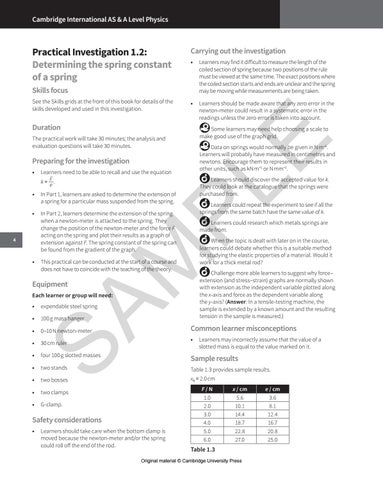
Table 1.3 provides sample results.
• two bosses
x0 = 2.0 cm
• two clamps • G-clamp.
Safety considerations • Learners should take care when the bottom clamp is moved because the newton-meter and/or the spring could roll off the end of the rod.
F/N 1.0 2.0 3.0 4.0 5.0 6.0
x / cm 5.6 10.1 14.4 18.7 22.8 27.0
Table 1.3
Original material © Cambridge University Press
e / cm 3.6 8.1 12.4 16.7 20.8 25.0