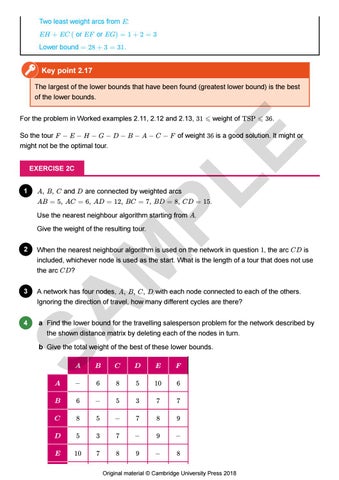
Two least weight arcs from E: or EF or EG)
EH + EC (
Lower bound =
= 1 + 2 = 3
28 + 3 = 31
.
Key point 2.17 The largest of the lower bounds that have been found (greatest lower bound) is the best of the lower bounds. For the problem in Worked examples 2.11, 2.12 and 2.13, 31
EXERCISE 2C 1
A, B, C
− F
weight of TSP
⩽ 36
.
of weight 36 is a good solution. It might or
PL E
So the tour F − E − H − G − D − B − A − C might not be the optimal tour.
⩽
and D are connected by weighted arcs
.
AB = 5, AC = 6, AD = 12, BC = 7, BD = 8, C D = 15
Use the nearest neighbour algorithm starting from A. Give the weight of the resulting tour.
When the nearest neighbour algorithm is used on the network in question 1, the arc C D is included, whichever node is used as the start. What is the length of a tour that does not use
M
2
the arc C D?
A network has four nodes, A, B, C , D with each node connected to each of the others. Ignoring the direction of travel, how many different cycles are there?
SA
3
4
a Find the lower bound for the travelling salesperson problem for the network described by the shown distance matrix by deleting each of the nodes in turn. b Give the total weight of the best of these lower bounds. A
B
C
D
E
F
A
−
6
8
5
10
6
B
6
−
5
3
7
7
C
8
5
−
7
8
9
D
5
3
7
−
9
−
E
10
7
8
9
−
8
Original material © Cambridge University Press 2018