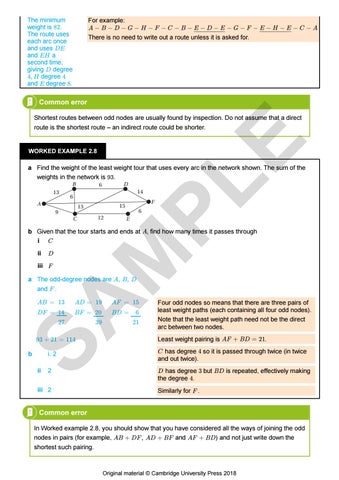
The minimum weight is 82. The route uses each arc once and uses DE and EH a second time, giving D degree 4, H degree 4 and E degree 8.
For example: A − B − D − G − H − F − C − B − E − D − E − G − F − E − H − E − C − A − −−−−− −−− − −−−−−−−−
There is no need to write out a route unless it is asked for.
Common error Shortest routes between odd nodes are usually found by inspection. Do not assume that a direct
PL E
route is the shortest route – an indirect route could be shorter.
WORKED EXAMPLE 2.8
a Find the weight of the least weight tour that uses every arc in the network shown. The sum of the weights in the network is 93.
i
C
ii
D
iii
F
M
b Given that the tour starts and ends at A, find how many times it passes through
SA
a The odd-degree nodes are A, B, D and F . AB =
13
DF =
AD =
=
15
14 BF =
20 BD =
6
27
39
93 + 21 = 114
b
i. 2
ii
2
iii 2
19
AF
21
Four odd nodes so means that there are three pairs of least weight paths (each containing all four odd nodes). Note that the least weight path need not be the direct arc between two nodes. Least weight pairing is AF
.
+ BD = 21
has degree 4 so it is passed through twice (in twice and out twice).
C
has degree 3 but BD is repeated, effectively making the degree 4.
D
Similarly for F .
Common error In Worked example 2.8, you should show that you have considered all the ways of joining the odd nodes in pairs (for example, AB + DF , AD + BF and AF + BD) and not just write down the shortest such pairing.
Original material © Cambridge University Press 2018